AUTOMOBILE ENGINEERING
ME6602
UNIT-I
VEHICLE STRUCTURE AND ENGINES
• UNIT I VEHICLE STRUCTURE AND ENGINES
Types of automobiles, vehicle construction
and different layouts, chassis, frame and body,
Vehicle aerodynamics(various resistances and
moments involved), IC engines –components
functions and materials, variable valve timing
(VVT).
TYPES OF AUTOMOBILES
• (i) with respect to the purpose
• (a) Passenger vehicles. Ex. Car, bus, jeep, scooter, mopeds and motor
cycles
• (b) Goods carriers: ex. Trucks and lorries
• (ii) weight of the vehicles:
• - Heavy weight vehicle- buses, trucks and trailers
• - Light weight vehicles - cars, jeeps
• - Medium weigh vehicles – minibus and station wagon
• (iii) With respect to the fuel:
• - Petrol vehicles – scooters, cars motors cycles
• - Diesel vehicles - Buses , trucks
• Gas vehicles – Coal gas, LPG, CNG vehicles
• Electric vehicle – Heavy cranes, battery truck, cars and fork lifts
• Solar vehicles.
• (iv) with respect to capacity:
• Heavy transport vehicles – Bus lorries, trucks, tractors
• Light transport vehicles _ Car, scooter, mopeds, motor
cycles, jeeps
• (v) with respect to number of wheels:
• Two wheelers – Scooters, mopeds
• Four wheelers – car, jeep, buses, truckes
• Three wheelers – Auto, tempos
• Six wheelers - heavy trucks
• (vi) With respect to side of driver seat
• - Left hand drive- American, European and UAE
• -Right hand drive – Indian vehicles
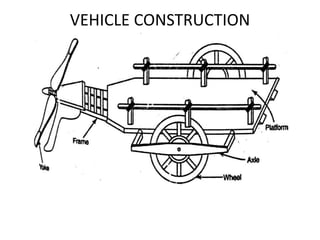
• Bullock cart consists of
• (i) Frame (ii) wheels & axle
• (iii) Yoke (iv) Body or superstructure and
platform
• These pars can be divided into two main
portions
• (i) Machine portion (ii)carriage portion
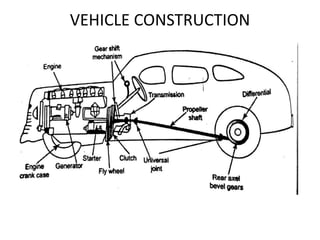
VEHICLE CONSTRUCTION
Classification of chassis
• According to the fitting of engine
1.Full-forward – Cars, mahindra jeeps
2.Semi-forward – Tata series of vehicle
3. Bus chassis
4. Engine at back -volkswagen cars, layland bus of
england.
5. Engine at centre.-royal tiger world master buses of
Delhi transport.
• According to the number of wheels fitted in the wheels
1.4x2 drive chassis 2. 4x4 drive chassis
3. 6x2 drive chassis 4. 6x4 drive chassis
LAYOUT OF CHASSIS
CLASSIFICATION OF CHASSIS
According to the fitting of engine
Characteristics of Good Chassis
• Fast pickup
• Strength
• Safety
• Durability
• Ease of control
• Speed
• Power accessibility
• Economy of operation
• Low centre of gravity
• Stability
• Load clearance
• Braking ability
• Simplicity of lubrication
FRAME
• Main part of the chassis
• Backbone of the vehicle.
Functions of the frame
• To form the base for mounting engine & transmission
systems
• To withstand the engine & transmission thrust & torque
stresses as well as accelerating and braking torque
• To accommodate suspension system
• To carry the other parts of the vehicle & its passengers
• To resist the effect of centrifugal forces when cornering
a curve
• To with stand bending and twisting stresses
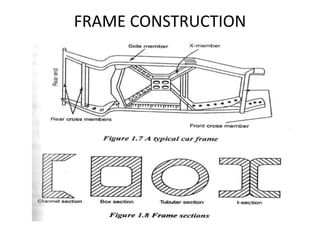
FRAME CONSTRUCTION
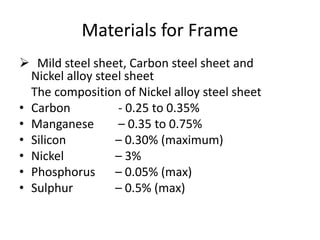
Materials for Frame
 Mild steel sheet, Carbon steel sheet and
Nickel alloy steel sheet
The composition of Nickel alloy steel sheet
• Carbon - 0.25 to 0.35%
• Manganese – 0.35 to 0.75%
• Silicon – 0.30% (maximum)
• Nickel – 3%
• Phosphorus – 0.05% (max)
• Sulphur – 0.5% (max)
FRAMELESS CONSTRUCTION
TYPES OF VEHICLE BODY
COMPONENTS OF CAR BODY
RESISTANCES TO VEHICLE MOTION
1. Air resistance:
a. Size of vehicle b. Shape
c. Speed d. Wind velocity
2.Gradient resistances:
The component of the vehicle’s weight which is
parallel to the plane of the road. This component
remains constant but independent of the vehicle
speed.
3. Miscellaneous resistance:
a. Road characteristics b. Tyre characteristics
c. Vehicle weight d. Vehicle speed
AERODYNAMICS OF AUTOMOBILE
BODY
i) Drag force(Fx)
ii) Lift force(Fz)
iii) Cross wind force(Fy)
ENGINE CONSTRUCTION
CYLINDER BLOCK
 Cylinder block materials – Grey cast iron, aluminium with steel sleeves
 Cylinder head materials – cast iron, aluminium alloy etc.
CYLINDER LINERS
 chromium plated mild steel tubes
PISTON
 Cast iron, aluminium alloy, chrome – nickel alloy, nickel –
iron alloy and cast steel
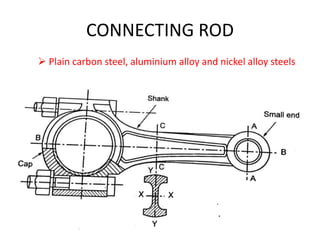
CONNECTING ROD
 Plain carbon steel, aluminium alloy and nickel alloy steels
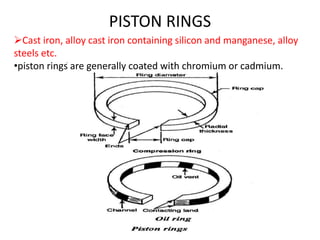
PISTON RINGS
Cast iron, alloy cast iron containing silicon and manganese, alloy
steels etc.
•piston rings are generally coated with chromium or cadmium.
CRANK SHAFT
 carbon steel, nickel-chromium and other heat treated alloy
steels.
CAM SHAFT
VALVES
It should be made of high heat resistance material such as
silicon-chrome steel, high speed steel, cobalt-chrome steel and
tungsten steel.
SIDE VALVE MECHANISM
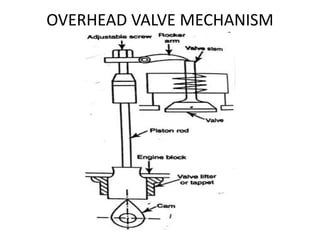
OVERHEAD VALVE MECHANISM
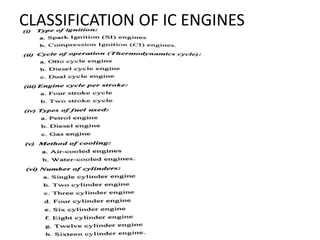
CLASSIFICATION OF IC ENGINES
Theoretical Valve Timing Diagram for
Four Stroke SI Engines
Actual Valve Timing Diagram for Four
Stroke SI Engines
Variable Valve Timing (VVT) for Four
Cylinder Engine

Unit i-ME6602&AUTOMOBILE ENGINEERING

  • 1.
  • 2.
  • 3.
    • UNIT IVEHICLE STRUCTURE AND ENGINES Types of automobiles, vehicle construction and different layouts, chassis, frame and body, Vehicle aerodynamics(various resistances and moments involved), IC engines –components functions and materials, variable valve timing (VVT).
  • 4.
  • 5.
    TYPES OF AUTOMOBILES •(i) with respect to the purpose • (a) Passenger vehicles. Ex. Car, bus, jeep, scooter, mopeds and motor cycles • (b) Goods carriers: ex. Trucks and lorries • (ii) weight of the vehicles: • - Heavy weight vehicle- buses, trucks and trailers • - Light weight vehicles - cars, jeeps • - Medium weigh vehicles – minibus and station wagon • (iii) With respect to the fuel: • - Petrol vehicles – scooters, cars motors cycles • - Diesel vehicles - Buses , trucks • Gas vehicles – Coal gas, LPG, CNG vehicles • Electric vehicle – Heavy cranes, battery truck, cars and fork lifts • Solar vehicles.
  • 6.
    • (iv) withrespect to capacity: • Heavy transport vehicles – Bus lorries, trucks, tractors • Light transport vehicles _ Car, scooter, mopeds, motor cycles, jeeps • (v) with respect to number of wheels: • Two wheelers – Scooters, mopeds • Four wheelers – car, jeep, buses, truckes • Three wheelers – Auto, tempos • Six wheelers - heavy trucks • (vi) With respect to side of driver seat • - Left hand drive- American, European and UAE • -Right hand drive – Indian vehicles
  • 7.
    • Bullock cartconsists of • (i) Frame (ii) wheels & axle • (iii) Yoke (iv) Body or superstructure and platform • These pars can be divided into two main portions • (i) Machine portion (ii)carriage portion
  • 9.
  • 10.
  • 11.
    Classification of chassis •According to the fitting of engine 1.Full-forward – Cars, mahindra jeeps 2.Semi-forward – Tata series of vehicle 3. Bus chassis 4. Engine at back -volkswagen cars, layland bus of england. 5. Engine at centre.-royal tiger world master buses of Delhi transport. • According to the number of wheels fitted in the wheels 1.4x2 drive chassis 2. 4x4 drive chassis 3. 6x2 drive chassis 4. 6x4 drive chassis
  • 12.
  • 13.
    CLASSIFICATION OF CHASSIS Accordingto the fitting of engine
  • 14.
    Characteristics of GoodChassis • Fast pickup • Strength • Safety • Durability • Ease of control • Speed • Power accessibility • Economy of operation • Low centre of gravity • Stability • Load clearance • Braking ability • Simplicity of lubrication
  • 15.
    FRAME • Main partof the chassis • Backbone of the vehicle. Functions of the frame • To form the base for mounting engine & transmission systems • To withstand the engine & transmission thrust & torque stresses as well as accelerating and braking torque • To accommodate suspension system • To carry the other parts of the vehicle & its passengers • To resist the effect of centrifugal forces when cornering a curve • To with stand bending and twisting stresses
  • 16.
  • 17.
    Materials for Frame Mild steel sheet, Carbon steel sheet and Nickel alloy steel sheet The composition of Nickel alloy steel sheet • Carbon - 0.25 to 0.35% • Manganese – 0.35 to 0.75% • Silicon – 0.30% (maximum) • Nickel – 3% • Phosphorus – 0.05% (max) • Sulphur – 0.5% (max)
  • 18.
  • 19.
  • 20.
  • 21.
    RESISTANCES TO VEHICLEMOTION 1. Air resistance: a. Size of vehicle b. Shape c. Speed d. Wind velocity 2.Gradient resistances: The component of the vehicle’s weight which is parallel to the plane of the road. This component remains constant but independent of the vehicle speed. 3. Miscellaneous resistance: a. Road characteristics b. Tyre characteristics c. Vehicle weight d. Vehicle speed
  • 22.
    AERODYNAMICS OF AUTOMOBILE BODY i)Drag force(Fx) ii) Lift force(Fz) iii) Cross wind force(Fy)
  • 23.
  • 24.
    CYLINDER BLOCK  Cylinderblock materials – Grey cast iron, aluminium with steel sleeves  Cylinder head materials – cast iron, aluminium alloy etc.
  • 25.
    CYLINDER LINERS  chromiumplated mild steel tubes
  • 26.
    PISTON  Cast iron,aluminium alloy, chrome – nickel alloy, nickel – iron alloy and cast steel
  • 27.
    CONNECTING ROD  Plaincarbon steel, aluminium alloy and nickel alloy steels
  • 28.
    PISTON RINGS Cast iron,alloy cast iron containing silicon and manganese, alloy steels etc. •piston rings are generally coated with chromium or cadmium.
  • 29.
    CRANK SHAFT  carbonsteel, nickel-chromium and other heat treated alloy steels.
  • 30.
  • 31.
    VALVES It should bemade of high heat resistance material such as silicon-chrome steel, high speed steel, cobalt-chrome steel and tungsten steel.
  • 32.
  • 33.
  • 34.
  • 35.
  • 36.
    Theoretical Valve TimingDiagram for Four Stroke SI Engines
  • 37.
    Actual Valve TimingDiagram for Four Stroke SI Engines
  • 38.
    Variable Valve Timing(VVT) for Four Cylinder Engine