191ME63 - AUTOMOBILE
ENGINEERING
I C ENGINE
K.Karthik,
Assistant Professor,
Department of Mechanical Engineering,
P.S.R. Engineering college.
1
UNIT 1 VEHICLE STRUCTURE AND ENGINE COMPONENTS 9
Types of automobiles, Vehicle construction and different layouts, Chassis, Frame and Body, Resistances to vehicle motion, Components of Engine – their
forms, functions and materials, Flywheel –needs, Carburetor – Simple carburetor &Solex carburetor, Super chargers & Turbo chargers
UNIT 1I ENERGY SOURCES 9
Important qualities of fuel, Rating of fuels, Properties – conventional fuels, Alternative fuels – Compressed Natural Gas, Liquefied Petroleum Gas,
Alcohols, Bio-diesel and Hydrogen, Engine emission control by three way catalytic converter system, Electric and Hybrid Vehicles, Fuel Cell
UNIT 1II TRANSMISSION SYSTEM, WHEELS AND TYRES 9
Clutch – types and construction, Need for a gearbox, Types of gear boxes – manual and automatic (epicyclic gear box), Over drive, Transfer box, Fluid
flywheel – Torque converter, Propeller shaft, Universal joints, Final drive and Differential, Rear axle drive – Hotchkiss Drive and Torque Tube Drive –
Wheels – Disc wheel, Wire wheel & Cast wheel, Tyres – Designations – Types – Tubed tyres& Tubeless tyres
UNIT 1V FRONT AXLE, STEERING, BRAKES AND SUSPENSION SYSTEMS 9
Front Axle – Types of Front Axle, Steering geometry, Steering mechanism – Ackermann, Types of steering gear box & Steering ratio, Power Steering,
Braking Systems – Drum brakes & Disc brakes, Antilock Braking System, Regenerative brake system, Suspension Systems – Types of Suspension Spring –
Coil springs, Leaf springs & Torsion bars – Shock absorbers
UNIT V AUTOMOTIVE ELECTRICAL & ELECTRONIC SYSTEMS 9
Lead acid battery – Construction, working & maintenance, Electronically controlled gasoline injection system for SI engines (Multi point fuel
injection system), Electronically controlled diesel injection system for CI engines (Unit injector system, Rotary distributor type and common rail
direct injection system), Electronic ignition system, Starter motor, Lighting system, Windscreen wiper, Automobile air conditioning, Vehicle tracking
system
Total Periods: 45
2
TYPES OF AUTOMOBILES
Automobiles or vehicles can be classified
On the Basis of Load
(a) Heavy transport vehicle (HTV) or heavy motor vehicle (HMV), e.g.
trucks, buses, etc.
(b) Light transport vehicle (LTV), e.g. pickup, station wagon, etc.
(c) Light motor vehicle (LMV), e.g. cars, jeeps, etc.
On the Basis Wheels
(a) Two wheeler vehicle, for example : Scooter, motorcycle, etc.
(b) Three wheeler vehicle, for example : Autorickshaw, three wheeler
scooter for handicaps and tempo, etc.
(c) Four wheeler vehicle, for example : Car, jeep, trucks, buses, etc.
(d) Six wheeler vehicle, for example : Big trucks with two gear axles
each having four wheels.
On the Basis of Fuel Used
(a) Petrol vehicle, e.g. motorcycle, scooter, cars, etc.
(b) Diesel vehicle, e.g. trucks, buses, etc.
(c) Electric vehicle which use battery to drive.
(d) Steam vehicle, e.g. an engine which uses steam engine. These
engines are now obsolete.
(e) Gas vehicle, e.g. LPG and CNG vehicles, where LPG is liquefied
petroleum gas and CNG is compressed natural gas.
On the Basis of Body
(a) Sedan with two doors
(b) Sedan with four doors
(c) Station wagon
(d) Convertible, e.g. jeep, etc.
(e) Van
(f) Special purpose vehicle, e.g. ambulance, milk van, etc.
On the Basis of Transmission
(a) Conventional vehicles with manual transmission,
e.g. car with 5 gears.
(b) Semi-automatic
(c) Automatic : In automatic transmission, gears are
not required to be changed manually. It is
automatically changes as per speed of the automobile.
On the Basis of Position of Engine
Engine in Front
Most of the vehicles have engine in the front.
Example : most of the cars, buses, trucks in India.
Engine in the Rear Side
Very few vehicles have engine located in the rear.
Example : Nano car.
VEHICLE CONSTRUCTION AND
DIFFERENT LAYOUTS
Chassis and frame
Body
6
chassis
7
Chassis
8
Components
Frame
Front Suspension
Steering Mechanism
Radiator
Engine,clutch,gear
box
Propeller shaft
Rear spring
Road wheels
Differential,Half shaft,
Universal joint
Brakes and Braking
System
Storage battery
Silencer
Shock absorbers,fueltank
ect..
9
Frame
The word frame is used to denote the main
skeleton of the vehicle.
The front end of the frame carries the
engine and rear end carries rear axle
housing, the wheel and tyres and other
components on the frame are steering
system, fuel tank ect.
The frame is provided with cross rods to
increase the rigidity, withstand shocks and
vibration.
10
FUNCTIONOFFRAME
To support chassis components & the body.
To with stand the static & dynamic load of
different components of chassis.
To withstand load of the body.
To carry load of passengers/goods carried in
body.
To withstand stresses caused due to uneven
road conditions.
To withstand force caused due to turning of
vehicle & sudden braking or acceleration. 11
TYPESOFFRAME
Conventional frame
Integral or Unit construction or Frameless chassis
12
CONVENTIONALFRAME
It is used in most of the heavy vehicles.
Construction of frame varies according to the type of
vehicle.
Generally made from the steel sections.
This type of frame has “ 2 long side members” & “5
to 6 cross members” joined together with the help of
rivets or bolts.
Cross members are used to increase the strength of
the frame.
They are inswept(Narrow) at the front & are
upswept (Broad) at the rear.
13
Body brackets are provided to support the body of the
vehicle.
Spring brackets are provided for mounting the body of
the vehicle.
Extension of chassis frame ahead of the front axle
known as front overhung.
Extension of chassis beyond the rear axle known as
rear overhung.
Different sections are used for long & cross members.
Generally channel section & box section are used for
long side members & other sections like I section, hat
section, tubular section are used for cross members.
14
INTEGRATED FRAME CHASSIS
or FRAMELESS CHASSIS
This frame construction, now-a-days used in most of the motor
cars called as a frame lessor chassis lessor mono or unit
construction in which the floor assembly & frame form one
integral unit.
Need of the heavy side members are eliminated ,which is used
in conventional frame & the floor is strengthened by cross
members & body , all welded together.
In some cases sub-frames are also used on which various
chassis components are mounted. This sub-frames are
supported by main frame.
The main purpose of sub-frame are to provide isolation ,
flexibility & simplified production.
So, in this type of construction all components like cross
member , floor , body are welder or bolted together as one
assembly.
15
Backbone chassis
16
Monocoque chassis
17
BODY
It is a super structure of the vehicle.
Chassis & body makes the complete vehicle.
For small & light car body & chassis are
made as a single unit but in large vehicles
both are made as a single unit.
Generally it is made from metal or fibre.
Main purpose of car body is to provide
comfort & protection to the passenger & also
the good look.
18
body
19
Vehicle aerodynamics
20
21
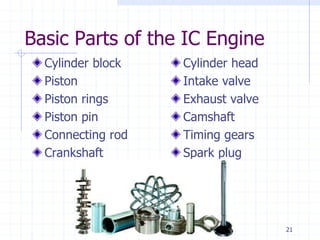
Basic Parts of the IC Engine
Cylinder block
Piston
Piston rings
Piston pin
Connecting rod
Crankshaft
Cylinder head
Intake valve
Exhaust valve
Camshaft
Timing gears
Spark plug
22
Cylinder Block
Basic frame of
gasoline engine.
Contains the
cylinder.
23
Piston
A sliding plug that
harnesses the force
of the burning gases
in the cylinder.
24
Piston Rings
The rings seal the
compression gases
above the piston
keep the oil below
the piston rings.
25
Piston Pins
Also known as the
wrist pin, it connects
the piston to the
small end of the
connecting rod.
It transfers the force
and allows the rod
to swing back and
forth.
26
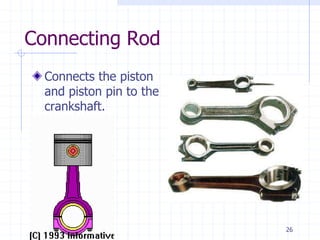
Connecting Rod
Connects the piston
and piston pin to the
crankshaft.
27
Crankshaft
Along the the piston
pin and connecting
rod it converts the
up and down motion
(reciprocating) of
the engine to
spinning (rotary)
motion.
28
Flywheel
Carries the inertia
when there is no
power stroke.
29
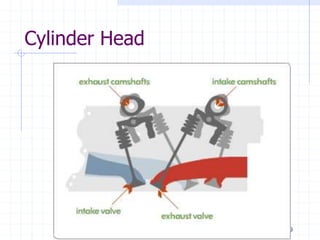
Cylinder Head
30
Intake and Exhaust Valves
Doorway that lets
the gases in and out
of the engine.
31
Camshaft
Through the use of
an eccentric the cam
lobes push the
valves open.
The valve springs
close them.
32
Spark Plug
Electric match used
to begin the
combustion process
of burning air and
gasoline to create
heat.
33
Engine Related Terms
TDC (top dead center)
BDC (bottom dead center)
Stroke
Bore
Revolution
Compression Ratio
Displacement
Cycle
34
Four Stroke Cycle
Intake
Compression
Power
Exhaust
35
Intake Stroke
Piston moves TDC TO
BDC
Intake valve opens.
Exhaust valve closed.
A vacuum is created
inside the cylinder.
Atmospheric pressure
pushes the air/fuel
mixture into the
cylinder.
½ turn of crankshaft
completed.
36
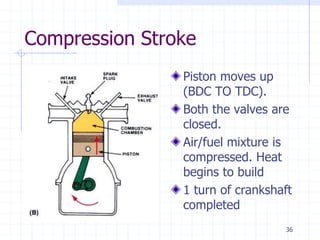
Compression Stroke
Piston moves up
(BDC TO TDC).
Both the valves are
closed.
Air/fuel mixture is
compressed. Heat
begins to build
1 turn of crankshaft
completed
37
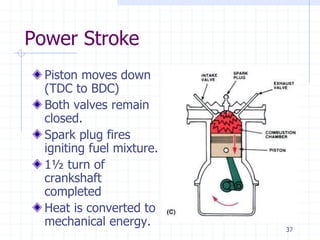
Power Stroke
Piston moves down
(TDC to BDC)
Both valves remain
closed.
Spark plug fires
igniting fuel mixture.
1½ turn of
crankshaft
completed
Heat is converted to
mechanical energy.
22
Exhaust Stroke
Piston move up
(BDC to TDC)
Exhaust valve
opens. Inlet valve
remain closed.
Exhaust gases are
pushed out.
crankshaft makes 2
turn.
39
Four Stroke Cycle Animation
40
Two Stroke Animation
VALVE TIMING DIAGRAM
42
PORT TIMING DIAGRAM
43
TYPES OF COOLING SYSTEM
DIRECT COOLING / AIR
COOLING
INDIRECT COOLING / LIQUID
COOLING
44
DIRECT COOLING / AIR
COOLING
45
INDIRECT COOLING / LIQUID
COOLING
46
COMPONENTS IN LIQUID
COOLING
RADIATOR
WATER PUMP
THERMOSTAT
BELLOW TYPE
WAX TYPE
47
RADIATOR
48
WATER PUMP
49
THERMOSTAT
50
LUBRICATION SYSTEM
SPLASH LUBRICATION
PRESSURE LUBRICATION
51
LUBRICATION SYSTEM
52

unit - 1.ppt

  • 1.
    191ME63 - AUTOMOBILE ENGINEERING IC ENGINE K.Karthik, Assistant Professor, Department of Mechanical Engineering, P.S.R. Engineering college. 1
  • 2.
    UNIT 1 VEHICLESTRUCTURE AND ENGINE COMPONENTS 9 Types of automobiles, Vehicle construction and different layouts, Chassis, Frame and Body, Resistances to vehicle motion, Components of Engine – their forms, functions and materials, Flywheel –needs, Carburetor – Simple carburetor &Solex carburetor, Super chargers & Turbo chargers UNIT 1I ENERGY SOURCES 9 Important qualities of fuel, Rating of fuels, Properties – conventional fuels, Alternative fuels – Compressed Natural Gas, Liquefied Petroleum Gas, Alcohols, Bio-diesel and Hydrogen, Engine emission control by three way catalytic converter system, Electric and Hybrid Vehicles, Fuel Cell UNIT 1II TRANSMISSION SYSTEM, WHEELS AND TYRES 9 Clutch – types and construction, Need for a gearbox, Types of gear boxes – manual and automatic (epicyclic gear box), Over drive, Transfer box, Fluid flywheel – Torque converter, Propeller shaft, Universal joints, Final drive and Differential, Rear axle drive – Hotchkiss Drive and Torque Tube Drive – Wheels – Disc wheel, Wire wheel & Cast wheel, Tyres – Designations – Types – Tubed tyres& Tubeless tyres UNIT 1V FRONT AXLE, STEERING, BRAKES AND SUSPENSION SYSTEMS 9 Front Axle – Types of Front Axle, Steering geometry, Steering mechanism – Ackermann, Types of steering gear box & Steering ratio, Power Steering, Braking Systems – Drum brakes & Disc brakes, Antilock Braking System, Regenerative brake system, Suspension Systems – Types of Suspension Spring – Coil springs, Leaf springs & Torsion bars – Shock absorbers UNIT V AUTOMOTIVE ELECTRICAL & ELECTRONIC SYSTEMS 9 Lead acid battery – Construction, working & maintenance, Electronically controlled gasoline injection system for SI engines (Multi point fuel injection system), Electronically controlled diesel injection system for CI engines (Unit injector system, Rotary distributor type and common rail direct injection system), Electronic ignition system, Starter motor, Lighting system, Windscreen wiper, Automobile air conditioning, Vehicle tracking system Total Periods: 45 2
  • 3.
    TYPES OF AUTOMOBILES Automobilesor vehicles can be classified On the Basis of Load (a) Heavy transport vehicle (HTV) or heavy motor vehicle (HMV), e.g. trucks, buses, etc. (b) Light transport vehicle (LTV), e.g. pickup, station wagon, etc. (c) Light motor vehicle (LMV), e.g. cars, jeeps, etc. On the Basis Wheels (a) Two wheeler vehicle, for example : Scooter, motorcycle, etc. (b) Three wheeler vehicle, for example : Autorickshaw, three wheeler scooter for handicaps and tempo, etc. (c) Four wheeler vehicle, for example : Car, jeep, trucks, buses, etc. (d) Six wheeler vehicle, for example : Big trucks with two gear axles each having four wheels.
  • 4.
    On the Basisof Fuel Used (a) Petrol vehicle, e.g. motorcycle, scooter, cars, etc. (b) Diesel vehicle, e.g. trucks, buses, etc. (c) Electric vehicle which use battery to drive. (d) Steam vehicle, e.g. an engine which uses steam engine. These engines are now obsolete. (e) Gas vehicle, e.g. LPG and CNG vehicles, where LPG is liquefied petroleum gas and CNG is compressed natural gas. On the Basis of Body (a) Sedan with two doors (b) Sedan with four doors (c) Station wagon (d) Convertible, e.g. jeep, etc. (e) Van (f) Special purpose vehicle, e.g. ambulance, milk van, etc.
  • 5.
    On the Basisof Transmission (a) Conventional vehicles with manual transmission, e.g. car with 5 gears. (b) Semi-automatic (c) Automatic : In automatic transmission, gears are not required to be changed manually. It is automatically changes as per speed of the automobile. On the Basis of Position of Engine Engine in Front Most of the vehicles have engine in the front. Example : most of the cars, buses, trucks in India. Engine in the Rear Side Very few vehicles have engine located in the rear. Example : Nano car.
  • 6.
    VEHICLE CONSTRUCTION AND DIFFERENTLAYOUTS Chassis and frame Body 6
  • 7.
  • 8.
  • 9.
    Components Frame Front Suspension Steering Mechanism Radiator Engine,clutch,gear box Propellershaft Rear spring Road wheels Differential,Half shaft, Universal joint Brakes and Braking System Storage battery Silencer Shock absorbers,fueltank ect.. 9
  • 10.
    Frame The word frameis used to denote the main skeleton of the vehicle. The front end of the frame carries the engine and rear end carries rear axle housing, the wheel and tyres and other components on the frame are steering system, fuel tank ect. The frame is provided with cross rods to increase the rigidity, withstand shocks and vibration. 10
  • 11.
    FUNCTIONOFFRAME To support chassiscomponents & the body. To with stand the static & dynamic load of different components of chassis. To withstand load of the body. To carry load of passengers/goods carried in body. To withstand stresses caused due to uneven road conditions. To withstand force caused due to turning of vehicle & sudden braking or acceleration. 11
  • 12.
    TYPESOFFRAME Conventional frame Integral orUnit construction or Frameless chassis 12
  • 13.
    CONVENTIONALFRAME It is usedin most of the heavy vehicles. Construction of frame varies according to the type of vehicle. Generally made from the steel sections. This type of frame has “ 2 long side members” & “5 to 6 cross members” joined together with the help of rivets or bolts. Cross members are used to increase the strength of the frame. They are inswept(Narrow) at the front & are upswept (Broad) at the rear. 13
  • 14.
    Body brackets areprovided to support the body of the vehicle. Spring brackets are provided for mounting the body of the vehicle. Extension of chassis frame ahead of the front axle known as front overhung. Extension of chassis beyond the rear axle known as rear overhung. Different sections are used for long & cross members. Generally channel section & box section are used for long side members & other sections like I section, hat section, tubular section are used for cross members. 14
  • 15.
    INTEGRATED FRAME CHASSIS orFRAMELESS CHASSIS This frame construction, now-a-days used in most of the motor cars called as a frame lessor chassis lessor mono or unit construction in which the floor assembly & frame form one integral unit. Need of the heavy side members are eliminated ,which is used in conventional frame & the floor is strengthened by cross members & body , all welded together. In some cases sub-frames are also used on which various chassis components are mounted. This sub-frames are supported by main frame. The main purpose of sub-frame are to provide isolation , flexibility & simplified production. So, in this type of construction all components like cross member , floor , body are welder or bolted together as one assembly. 15
  • 16.
  • 17.
  • 18.
    BODY It is asuper structure of the vehicle. Chassis & body makes the complete vehicle. For small & light car body & chassis are made as a single unit but in large vehicles both are made as a single unit. Generally it is made from metal or fibre. Main purpose of car body is to provide comfort & protection to the passenger & also the good look. 18
  • 19.
  • 20.
  • 21.
    21 Basic Parts ofthe IC Engine Cylinder block Piston Piston rings Piston pin Connecting rod Crankshaft Cylinder head Intake valve Exhaust valve Camshaft Timing gears Spark plug
  • 22.
    22 Cylinder Block Basic frameof gasoline engine. Contains the cylinder.
  • 23.
    23 Piston A sliding plugthat harnesses the force of the burning gases in the cylinder.
  • 24.
    24 Piston Rings The ringsseal the compression gases above the piston keep the oil below the piston rings.
  • 25.
    25 Piston Pins Also knownas the wrist pin, it connects the piston to the small end of the connecting rod. It transfers the force and allows the rod to swing back and forth.
  • 26.
    26 Connecting Rod Connects thepiston and piston pin to the crankshaft.
  • 27.
    27 Crankshaft Along the thepiston pin and connecting rod it converts the up and down motion (reciprocating) of the engine to spinning (rotary) motion.
  • 28.
    28 Flywheel Carries the inertia whenthere is no power stroke.
  • 29.
  • 30.
    30 Intake and ExhaustValves Doorway that lets the gases in and out of the engine.
  • 31.
    31 Camshaft Through the useof an eccentric the cam lobes push the valves open. The valve springs close them.
  • 32.
    32 Spark Plug Electric matchused to begin the combustion process of burning air and gasoline to create heat.
  • 33.
    33 Engine Related Terms TDC(top dead center) BDC (bottom dead center) Stroke Bore Revolution Compression Ratio Displacement Cycle
  • 34.
  • 35.
    35 Intake Stroke Piston movesTDC TO BDC Intake valve opens. Exhaust valve closed. A vacuum is created inside the cylinder. Atmospheric pressure pushes the air/fuel mixture into the cylinder. ½ turn of crankshaft completed.
  • 36.
    36 Compression Stroke Piston movesup (BDC TO TDC). Both the valves are closed. Air/fuel mixture is compressed. Heat begins to build 1 turn of crankshaft completed
  • 37.
    37 Power Stroke Piston movesdown (TDC to BDC) Both valves remain closed. Spark plug fires igniting fuel mixture. 1½ turn of crankshaft completed Heat is converted to mechanical energy.
  • 38.
    22 Exhaust Stroke Piston moveup (BDC to TDC) Exhaust valve opens. Inlet valve remain closed. Exhaust gases are pushed out. crankshaft makes 2 turn.
  • 39.
  • 40.
  • 42.
  • 43.
  • 44.
    TYPES OF COOLINGSYSTEM DIRECT COOLING / AIR COOLING INDIRECT COOLING / LIQUID COOLING 44
  • 45.
    DIRECT COOLING /AIR COOLING 45
  • 46.
    INDIRECT COOLING /LIQUID COOLING 46
  • 47.
    COMPONENTS IN LIQUID COOLING RADIATOR WATERPUMP THERMOSTAT BELLOW TYPE WAX TYPE 47
  • 48.
  • 49.
  • 50.
  • 51.
  • 52.