Introduction to Automobile
1
Introduction to Automobile
“Automobile is a self-propelled vehicle which produces its
own propelling power and controlled by an operator”.
Purpose or need of automobile
1. To transport the Commodity, man, materials from one
place to another.
2. Save the time and cost, fuel economy
3. Reduce efforts and fatigue
4. Dynamic Characteristics ( Tractive effort and braking
ability)
5. Capable to operate adverse conditions
2
Classification of Automobile
Automobiles are classifies as
1. Requirements: Passenger Vehicle (Bus, car, jeep….), Load Carrying
(Truck, matador..) , racing cars and tractors.
2. Load carrying Capacity: Light ( Cars, bike..), Heavy (Bus, truck,
Trailers..), Light Commercial ( Matador, Van, SVU..)
3. Type of Body : passenger car, truck half and full
4. Type of Drive : Left or right hand steering
5. Fuel used : Petrol, diesel, LPG, CNG
6. Number of Wheels : Two, three, Four, Six, Eight….
7. Numbers of seats : Two, four, six, ten, fourty….
8. Model and Make : manufacturer ( maruti 800, i10,120, vista)
9. Piston Displacement volume : 50cc, 100cc,125cc,150cc….
10.Type of control: Normal, Forward, semi-forward
3
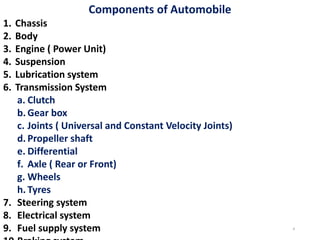
Components of Automobile
1. Chassis
2. Body
3. Engine ( Power Unit)
4. Suspension
5. Lubrication system
6. Transmission System
a. Clutch
b. Gear box
c. Joints ( Universal and Constant Velocity Joints)
d. Propeller shaft
e. Differential
f. Axle ( Rear or Front)
g. Wheels
h. Tyres
7. Steering system
8. Electrical system
9. Fuel supply system 4
Chassis
Chassis is the back bone of the vehicle.
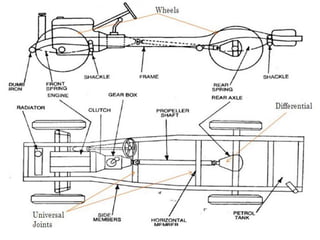
A vehicle without a body is called Chassis. The
components of the vehicle like Power plant, Transmission
System, Axles, Wheels and Tyres, Suspension, Controlling
Systems like Braking, Steering etc., and also electrical
system parts are mounted on the Chassis frame. It is the
main mounting for all the components including the body.
5
4/5/2022 Sh. S. A. Borikar, Asst. Prof., MED, KITS, Ramtek 6
Types of Chassis
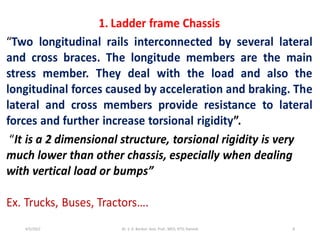
1.Ladder Frame chassis
2.Tubular Space Frame
3.Monocoque
4.Backbone Chassis
7
4/5/2022 Sh. S. A. Borikar, Asst. Prof., MED, KITS, Ramtek 8
Tubular Space Frame
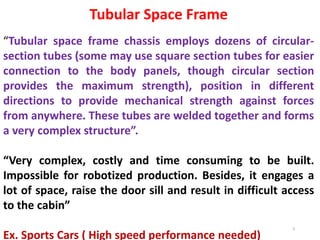
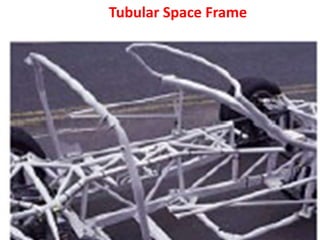
“Tubular space frame chassis employs dozens of circular-
section tubes (some may use square section tubes for easier
connection to the body panels, though circular section
provides the maximum strength), position in different
directions to provide mechanical strength against forces
from anywhere. These tubes are welded together and forms
a very complex structure”.
“Very complex, costly and time consuming to be built.
Impossible for robotized production. Besides, it engages a
lot of space, raise the door sill and result in difficult access
to the cabin”
Ex. Sports Cars ( High speed performance needed)
9
4/5/2022 Sh. S. A. Borikar, Asst. Prof., MED, KITS, Ramtek 10
Tubular Space Frame
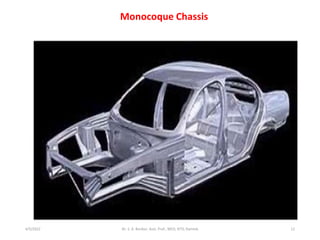
Monocoque Chassis
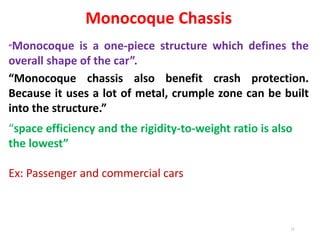
“Monocoque is a one-piece structure which defines the
overall shape of the car”.
“Monocoque chassis also benefit crash protection.
Because it uses a lot of metal, crumple zone can be built
into the structure.”
“space efficiency and the rigidity-to-weight ratio is also
the lowest”
Ex: Passenger and commercial cars
11
4/5/2022 Sh. S. A. Borikar, Asst. Prof., MED, KITS, Ramtek 12
Monocoque Chassis
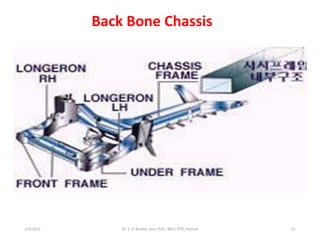
Back Bone Chassis
“Backbone chassis is very simple: a strong tubular
backbone (usually in rectangular section) connects the
front and rear axle and provides nearly all the mechanical
strength. Inside which there is space for the drive shaft in
case of front-engine, rear-wheel drive layout like the Elan.
The whole drive train, engine and suspensions are
connected to both ends of the backbone. The body is built
on the backbone, usually made of glass-fibre”.
Ex: F1 cars..
Elan : feeling of strong eagerness
13
4/5/2022 Sh. S. A. Borikar, Asst. Prof., MED, KITS, Ramtek 14
Back Bone Chassis
FUNCTIONS OF THE CHASSIS FRAME
1. To carry the load of the passengers or goods carried in the body.
2. To support the load of the body, engine, gearbox etc.,
3. To withstand the forces caused due to the sudden braking or
acceleration
4. To withstand the stresses caused due to the bad road condition.
5. To withstand centrifugal force while the cornering frame is used in
FIAT cars and some of the European and American cars.
TYPES OF CHASSIS FRAMES
1. Conventional frame
2. Integral frame
3. Semi-integral frame
15
1. Conventional frame: It has two long side members and 5 to 6 cross
members joined together with the help of rivets and bolts. The
frame sections are used generally.
Channel Section - Good resistance to bending
Tabular Section - Good resistance to Torsion
Box Section - Good resistance to both bending and Torsion
2. Integral Frame: This frame is used now a days in most of the cars.
There is no frame and all the assembly units are attached to the
body. All the functions of the frame carried out by the body itself.
Due to elimination of long frame it is cheaper and due to less
weight most economical also. Only disadvantage is repairing is
difficult.
3. Semi - Integral Frame: In some vehicles half frame is fixed in the
front end on which engine gear box and front suspension is
mounted. It has the advantage when the vehicle is met with
accident the front frame can be taken easily to replace the damaged
16
Chassis Layouts
1. Forward
2. Semi-forward
3. Fully Forward
in Forward chassis layout engine is mounted inside the drivers
cabinet. Drivers seat is exactly above the front wheel. This layout
provides full view of road.
Advantages: clear view of road, easy control, avoids accidents….
Ex.: buses, trucks….
In Semi-forward Chassis layout engine is mounted partially inside the
cabinet and partially outside the cabinet. Allow to view the road
better.
Ex: matador, pick-up vans…
In Fully Forward chassis layout engine is mounted completely outside
the drivers cabinet. It improves the aesthetic look of the vehicle.
Ex: cars…..
17
Chassis Layouts….
1. Front Engine Front Wheel drive and front engine rare
wheel drive
2. Transverse engine front wheel and transverse engine
rare wheel drive
3. Rare engine rare wheel drive
4. Four wheel drive
Longitudinal or Transverse Mounted engine
18
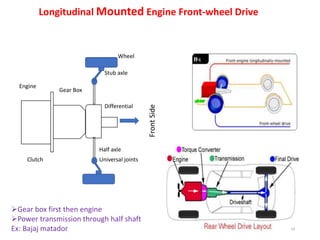
Engine
Clutch
Gear Box
Differential
Half axle
Stub axle
Wheel
Universal joints
Front
Side
Gear box first then engine
Power transmission through half shaft
Ex: Bajaj matador
Longitudinal Mounted Engine Front-wheel Drive
19
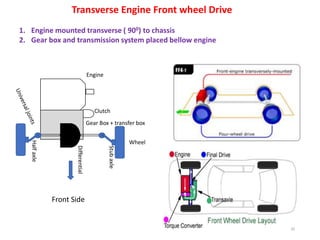
Transverse Engine Front wheel Drive
1. Engine mounted transverse ( 900) to chassis
2. Gear box and transmission system placed bellow engine
Engine
Clutch
Gear Box + transfer box
Differential
Half
axle
Stub
axle
Wheel
Front Side
20
Body
Passenger Body and Commercial body
Requirements of bodies for various types of vehicle
1. The body should be light.
2. It should have minimum number of components.
3. It should provide sufficient space for passengers and luggage.
4. It should withstand vibrations while in motion.
5. It should offer minimum resistance to air.
6. It should be cheap and easy in manufacturing.
7. It should be attractive in shape and colour.
8. It should have uniformly distributed load.
9. It should have long fatigue life 21
References
1. Charles Ofria, “Short Course on Automatic Transmissions”
2. H. S. Sethi,1998 “Automotive Engineering”, Tata Mc-graw Hill
Publishing house, second edition,
3. R. K. Rajput, 2010“ Automobile Engineering”, Laxmi publication Pvt.
Ltd. first edition, reprint
22

Lect 01 chassis_ intro_1

  • 1.
  • 2.
    Introduction to Automobile “Automobileis a self-propelled vehicle which produces its own propelling power and controlled by an operator”. Purpose or need of automobile 1. To transport the Commodity, man, materials from one place to another. 2. Save the time and cost, fuel economy 3. Reduce efforts and fatigue 4. Dynamic Characteristics ( Tractive effort and braking ability) 5. Capable to operate adverse conditions 2
  • 3.
    Classification of Automobile Automobilesare classifies as 1. Requirements: Passenger Vehicle (Bus, car, jeep….), Load Carrying (Truck, matador..) , racing cars and tractors. 2. Load carrying Capacity: Light ( Cars, bike..), Heavy (Bus, truck, Trailers..), Light Commercial ( Matador, Van, SVU..) 3. Type of Body : passenger car, truck half and full 4. Type of Drive : Left or right hand steering 5. Fuel used : Petrol, diesel, LPG, CNG 6. Number of Wheels : Two, three, Four, Six, Eight…. 7. Numbers of seats : Two, four, six, ten, fourty…. 8. Model and Make : manufacturer ( maruti 800, i10,120, vista) 9. Piston Displacement volume : 50cc, 100cc,125cc,150cc…. 10.Type of control: Normal, Forward, semi-forward 3
  • 4.
    Components of Automobile 1.Chassis 2. Body 3. Engine ( Power Unit) 4. Suspension 5. Lubrication system 6. Transmission System a. Clutch b. Gear box c. Joints ( Universal and Constant Velocity Joints) d. Propeller shaft e. Differential f. Axle ( Rear or Front) g. Wheels h. Tyres 7. Steering system 8. Electrical system 9. Fuel supply system 4
  • 5.
    Chassis Chassis is theback bone of the vehicle. A vehicle without a body is called Chassis. The components of the vehicle like Power plant, Transmission System, Axles, Wheels and Tyres, Suspension, Controlling Systems like Braking, Steering etc., and also electrical system parts are mounted on the Chassis frame. It is the main mounting for all the components including the body. 5
  • 6.
    4/5/2022 Sh. S.A. Borikar, Asst. Prof., MED, KITS, Ramtek 6
  • 7.
    Types of Chassis 1.LadderFrame chassis 2.Tubular Space Frame 3.Monocoque 4.Backbone Chassis 7
  • 8.
    4/5/2022 Sh. S.A. Borikar, Asst. Prof., MED, KITS, Ramtek 8
  • 9.
    Tubular Space Frame “Tubularspace frame chassis employs dozens of circular- section tubes (some may use square section tubes for easier connection to the body panels, though circular section provides the maximum strength), position in different directions to provide mechanical strength against forces from anywhere. These tubes are welded together and forms a very complex structure”. “Very complex, costly and time consuming to be built. Impossible for robotized production. Besides, it engages a lot of space, raise the door sill and result in difficult access to the cabin” Ex. Sports Cars ( High speed performance needed) 9
  • 10.
    4/5/2022 Sh. S.A. Borikar, Asst. Prof., MED, KITS, Ramtek 10 Tubular Space Frame
  • 11.
    Monocoque Chassis “Monocoque isa one-piece structure which defines the overall shape of the car”. “Monocoque chassis also benefit crash protection. Because it uses a lot of metal, crumple zone can be built into the structure.” “space efficiency and the rigidity-to-weight ratio is also the lowest” Ex: Passenger and commercial cars 11
  • 12.
    4/5/2022 Sh. S.A. Borikar, Asst. Prof., MED, KITS, Ramtek 12 Monocoque Chassis
  • 13.
    Back Bone Chassis “Backbonechassis is very simple: a strong tubular backbone (usually in rectangular section) connects the front and rear axle and provides nearly all the mechanical strength. Inside which there is space for the drive shaft in case of front-engine, rear-wheel drive layout like the Elan. The whole drive train, engine and suspensions are connected to both ends of the backbone. The body is built on the backbone, usually made of glass-fibre”. Ex: F1 cars.. Elan : feeling of strong eagerness 13
  • 14.
    4/5/2022 Sh. S.A. Borikar, Asst. Prof., MED, KITS, Ramtek 14 Back Bone Chassis
  • 15.
    FUNCTIONS OF THECHASSIS FRAME 1. To carry the load of the passengers or goods carried in the body. 2. To support the load of the body, engine, gearbox etc., 3. To withstand the forces caused due to the sudden braking or acceleration 4. To withstand the stresses caused due to the bad road condition. 5. To withstand centrifugal force while the cornering frame is used in FIAT cars and some of the European and American cars. TYPES OF CHASSIS FRAMES 1. Conventional frame 2. Integral frame 3. Semi-integral frame 15
  • 16.
    1. Conventional frame:It has two long side members and 5 to 6 cross members joined together with the help of rivets and bolts. The frame sections are used generally. Channel Section - Good resistance to bending Tabular Section - Good resistance to Torsion Box Section - Good resistance to both bending and Torsion 2. Integral Frame: This frame is used now a days in most of the cars. There is no frame and all the assembly units are attached to the body. All the functions of the frame carried out by the body itself. Due to elimination of long frame it is cheaper and due to less weight most economical also. Only disadvantage is repairing is difficult. 3. Semi - Integral Frame: In some vehicles half frame is fixed in the front end on which engine gear box and front suspension is mounted. It has the advantage when the vehicle is met with accident the front frame can be taken easily to replace the damaged 16
  • 17.
    Chassis Layouts 1. Forward 2.Semi-forward 3. Fully Forward in Forward chassis layout engine is mounted inside the drivers cabinet. Drivers seat is exactly above the front wheel. This layout provides full view of road. Advantages: clear view of road, easy control, avoids accidents…. Ex.: buses, trucks…. In Semi-forward Chassis layout engine is mounted partially inside the cabinet and partially outside the cabinet. Allow to view the road better. Ex: matador, pick-up vans… In Fully Forward chassis layout engine is mounted completely outside the drivers cabinet. It improves the aesthetic look of the vehicle. Ex: cars….. 17
  • 18.
    Chassis Layouts…. 1. FrontEngine Front Wheel drive and front engine rare wheel drive 2. Transverse engine front wheel and transverse engine rare wheel drive 3. Rare engine rare wheel drive 4. Four wheel drive Longitudinal or Transverse Mounted engine 18
  • 19.
    Engine Clutch Gear Box Differential Half axle Stubaxle Wheel Universal joints Front Side Gear box first then engine Power transmission through half shaft Ex: Bajaj matador Longitudinal Mounted Engine Front-wheel Drive 19
  • 20.
    Transverse Engine Frontwheel Drive 1. Engine mounted transverse ( 900) to chassis 2. Gear box and transmission system placed bellow engine Engine Clutch Gear Box + transfer box Differential Half axle Stub axle Wheel Front Side 20
  • 21.
    Body Passenger Body andCommercial body Requirements of bodies for various types of vehicle 1. The body should be light. 2. It should have minimum number of components. 3. It should provide sufficient space for passengers and luggage. 4. It should withstand vibrations while in motion. 5. It should offer minimum resistance to air. 6. It should be cheap and easy in manufacturing. 7. It should be attractive in shape and colour. 8. It should have uniformly distributed load. 9. It should have long fatigue life 21
  • 22.
    References 1. Charles Ofria,“Short Course on Automatic Transmissions” 2. H. S. Sethi,1998 “Automotive Engineering”, Tata Mc-graw Hill Publishing house, second edition, 3. R. K. Rajput, 2010“ Automobile Engineering”, Laxmi publication Pvt. Ltd. first edition, reprint 22