Classification of Automobiles
ME3103: Automotive Engineering I
Department of Mechanical Engineering,
Faculty of Engineering,
General Sir John Kotelawala Defense University
• General Classification of Vehicles
• Types of Automobiles
General Classification of Vehicles
1. Single - unit Vehicles or Load carriers
2. Articulated Vehicles
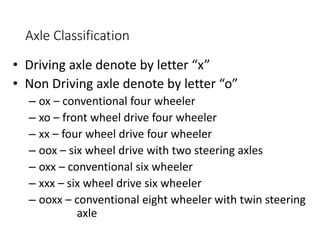
Axle Classification
• Driving axle denote by letter “x”
• Non Driving axle denote by letter “o”
– ox – conventional four wheeler
– xo – front wheel drive four wheeler
– xx – four wheel drive four wheeler
– oox – six wheel drive with two steering axles
– oxx – conventional six wheeler
– xxx – six wheel drive six wheeler
– ooxx – conventional eight wheeler with twin steering
axle
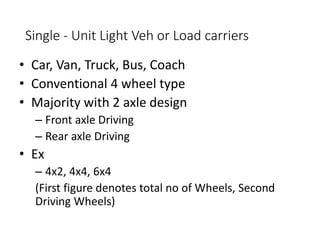
Single - Unit Light Veh or Load carriers
• Car, Van, Truck, Bus, Coach
• Conventional 4 wheel type
• Majority with 2 axle design
– Front axle Driving
– Rear axle Driving
• Ex
– 4x2, 4x4, 6x4
(First figure denotes total no of Wheels, Second
Driving Wheels)
• Heavy Tractors
• Motor coaches
• Lorries
• ox, oxx, xxx, xxxx
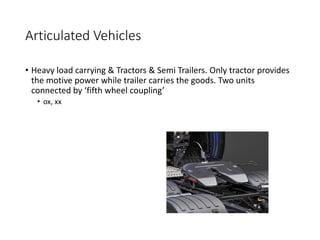
Articulated Vehicles
• Heavy load carrying & Tractors & Semi Trailers. Only tractor provides
the motive power while trailer carries the goods. Two units
connected by ‘fifth wheel coupling’
• ox, xx
Types of Automobiles
1. With respect to the Use
2. With respect to the Capacity
3. With respect to the Fuel used
4. With respect to the Make & Model
5. With respect to Wheels & Axles
6. With respect to the Drive
7. With respect to the Engine
8. With respect to the Suspension
9. With respect to the Transmission
10. With respect to the Body style & no of Doors
Types of Automobiles
1. With respect to the Use
• Scooters & Motor cycles
• Cars Station wagons, pick-ups & Vans
• Lorries, Buses & Trucks
• Tractors
2. With respect to the Capacity
• H.T.V. – Heavy Transport Veh
• L.T.V. – Light Transport Veh
• ¼ Ton, 1 Ton, 3 Ton
• 2 seater, 5 Seater, 52 Seater
Types of Automobiles
3. With respect to the Fuel used
• Steam
• Petrol, Diesel, Gas
• Electric, Hybrid
• Hydrogen
Types of Automobiles
4. With respect to the
• Make - Name given by manufacturer. After the name, name
of the power unit indicating, no of cylinder, shape of the
engine.
• Toyota, Nissan, Dihatsu
• Land Rover, Jaguar, Ford, Ferrari, Renault….
• Bajaj, Honda, Yamaha, Kawasaki
• Layland, Tata, Mahindra
Model - The Year of manufacture or Specific code no
• Toyota – Corolla AE100, 110, 121, CE100, CE110
• Nissan – Sunny FB13, 14, 15, SB 13, 14, 15
• Yamaha – FZ, DT, TW, TTR, R1, FZR
Types of Automobiles
5. With respect to Wheels & Axles
• Two wheelers
• Three wheelers
• Four wheelers…. With Axle Classifications
6. With respect to the Drive
• Left hand drive
• Right hand drive
• 2 wheel drive, 4 wheel drive, 8X8
Types of Automobiles
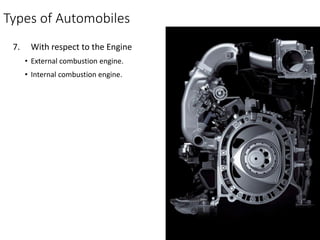
7. With respect to the Engine
• External combustion engine.
• Internal combustion engine.
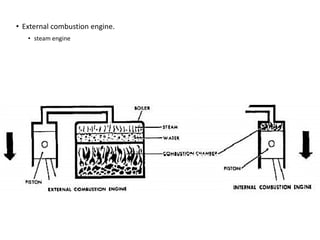
• External combustion engine.
• steam engine
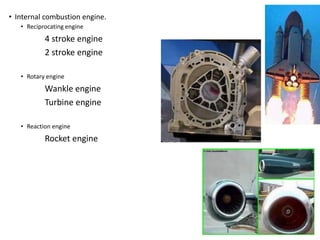
• Internal combustion engine.
• Reciprocating engine
4 stroke engine
2 stroke engine
• Rotary engine
Wankle engine
Turbine engine
• Reaction engine
Rocket engine
8. With respect to the Suspension
• Conventional
• Spring, Shock-absorber
• Independent
• Pneumatic, Self leveling
9. With respect to the Transmission
• Conventional (Manual)
• Automatic
• Semi Automatic
Types of Automobiles
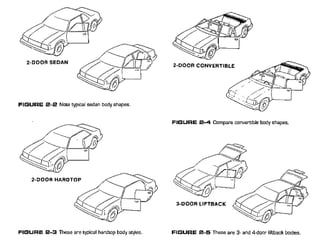
10. With respect to the Body & no of Doors
• Microcars
• Saloons/ Sedan
• Convertible
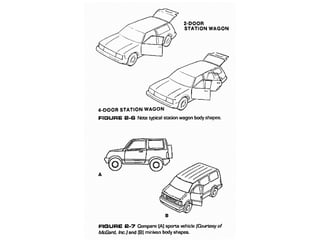
• Station Wagon
• Coupe
• Hatchback
• Sports
• Off-roaders
• Multipurpose Veh/ Mini van
Main components & Assemblies
(Constructional Features)
1. The Basic structure or the Framework
2. The Engine or Power plant
3. The Power train or the Transmission sys
4. The Body or the Super structure
5. The Auxiliaries
• Fuel, Lubricant, Cooling, Brake, Exhaust
6. The Controls
• Clutch, Brake, Accelerator pedals
• Lighting Switches
• Viper, AC switches
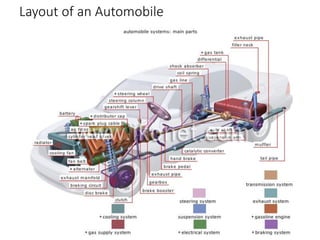
Layout of an Automobile
• Different veh to veh
• Frame, Chassis
• Superstructure, Body
• Front axle
• Rear axle
• Wheel
• Suspension system
• Power unit
• Transmission system
• Brakes
• Electrical system
• Safety systems
• Auxiliaries
• ECU & controlling modules
CHASSIS
BASIC FUNCTION OF CHASSIS ARE
1. Provide basic structure to assemble body or super structure and all
other components.
2. It absorbs the reaction from the movement of an engine and axle.
3. Balances the reaction forces (Twisting & Bending forces) of the wheel
in acceleration and braking.
4. Absorb aerodynamics wind forces and road shocks through the
suspension.
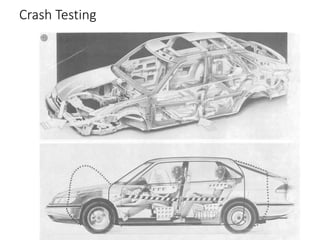
5. Absorb the major “Energy of Impact“ in the event of an accident.
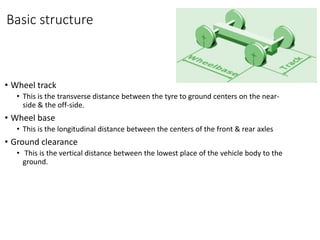
Basic structure
• Wheel track
• This is the transverse distance between the tyre to ground centers on the near-
side & the off-side.
• Wheel base
• This is the longitudinal distance between the centers of the front & rear axles
• Ground clearance
• This is the vertical distance between the lowest place of the vehicle body to the
ground.
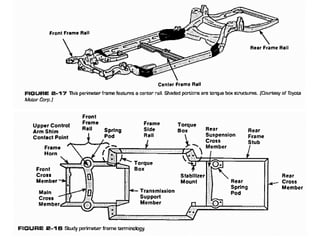
• Side rails – runs from front to rear on each side of the veh & support the
body
• Control beam stiffness
• Control the tortion
• Control the vibrations
• Cross members – separate the side rails & support other sub-systems
• Welded, bolted or reverted
• Transfer inertia force from components to side rails
• Fuel tank, rear suspension, radiator, spare tyre
• Brackets – provide a means for attaching the various sub-systems
• Welded to side rails or cross members
• Components mounted with bolts with rubber mounts or bushings
Different Type of Chassis
1. Ladder Chassis
2. Backbone Frame Chassis
3. Tubular Frame Chassis
4. Monocoque Chassis
5. ULSAB Monocoque
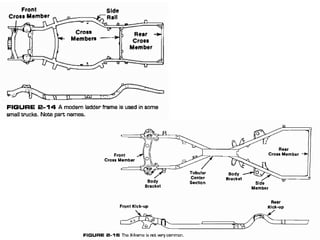
Ladder Chassis
• This is oldest kind of chassis.in early 60s,nearly all cars in world used it
as a standard chassis. Even today most of the SUVs & MUVs use this type
• COSTRUCTION
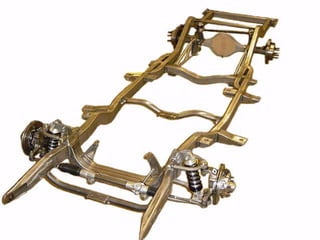
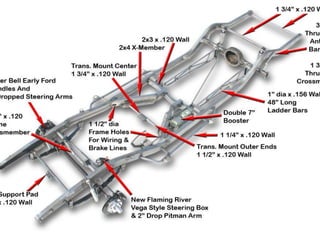
• As name is LADDER : it has two longitudinal rails interconnected by several
lateral and cross braces. The longitude members are main stress member. They
deals with the load and also the longitudinal forces caused by the acceleration
and braking. The lateral and cross members provide the resistance to the lateral
forces and further increase torsional rigidity.
• ADVANTAGES
1.Easy to construct
2.Good for SUVs & truck
DISADVANTAGES
Torsional rigidity is lower especially in case of vertical loads and
bumps.
USED BY
Truck making company like TATA, ASHOK LEYLAND.
2. BACKBONE FRAME CHASSIS
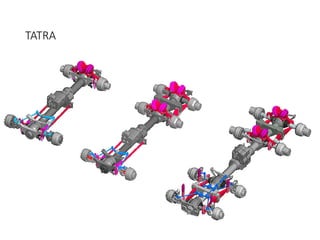
• This is also one of the oldest type
of chassis.
TATRA
• CONSTRUCTION
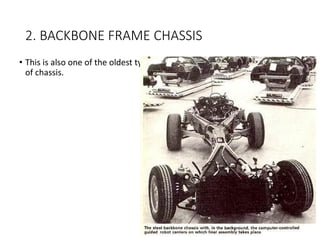
It is usually in rectangular section connects the front and rear axle and
provides nearly all the mechanical strength. Inside which there is space
for the drive shaft in case of front engine, rear-wheel drive. The whole
drive train, engine and suspension are connected to both ends of the
backbone. The body is built on the backbone, usually made of glass-fibre.
• ADVANTAGES
1.Strong for smaller sports car & used by special Heavy veh
2.Easy to construct by hands
3.Cheap for low volume production
• DISADVANTAGES
1.Not strong enough for high-end sports car
2.It does not provides protection against side impact
3.Cost ineffective for mass production
3.High Cost for Heavy veh & complex transmission design
• USED BY
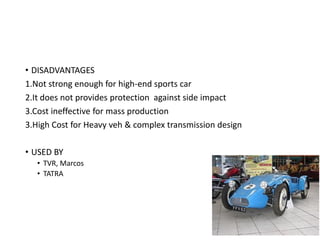
• TVR, Marcos
• TATRA
3.TUBULAR FRAME CHASSIS
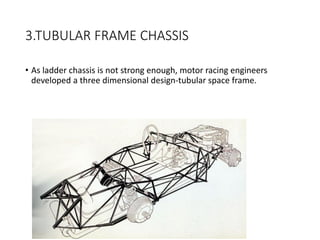
• As ladder chassis is not strong enough, motor racing engineers
developed a three dimensional design-tubular space frame.
CONSTRUCTION
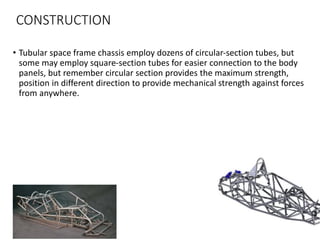
• Tubular space frame chassis employ dozens of circular-section tubes, but
some may employ square-section tubes for easier connection to the body
panels, but remember circular section provides the maximum strength,
position in different direction to provide mechanical strength against forces
from anywhere.
• ADVANTAGES
1.It can counter-balance stress from any direction( compared to ladder and
monocoque chassis of same weight)
• DISADVANTAGES
1.Very complex structure
2.Cost and time consuming to built.
3.Impossible for robotized production
4.It also covers lot of space
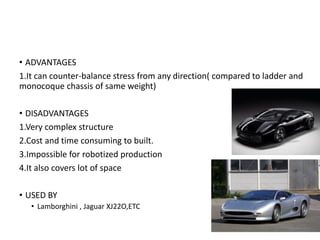
• USED BY
• Lamborghini , Jaguar XJ22O,ETC
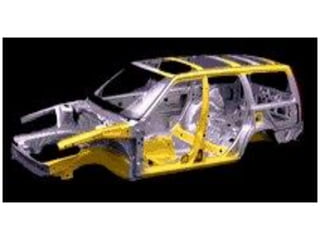
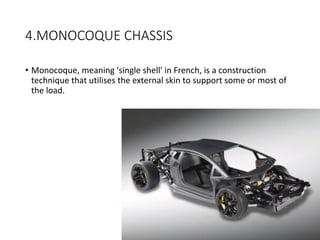
4.MONOCOQUE CHASSIS
• Monocoque, meaning 'single shell' in French, is a construction
technique that utilises the external skin to support some or most of
the load.
4.MONOCOQUE CHASSIS
• This is as opposed to using an internal frame or chassis that is then
covered with cosmetic body panels.
• Today, 99% cars produced in this world are made of steel monocoque
chassis, due to its low production cost and suitability to robotized
production
CONSTRUCTION
• It is one-piece structure which defines the overall shape of car. While
ladder, tubular space frame and backbone chassis provides only the
members and need to build the body around them where-as the
monocoque chassis is already incorporated with the body in a single
piece. In fact the "one-piece" chassis is actually made by welding several
pieces together. The floor pan, which is the largest piece, and other
pieces are press-made by big stamping machines. They are spot welded
together by robot arms in a stream production line.
• ADVANTAGES
1. Cheap for mass production
2. Proves good in times of crash in case of protection
3. Space efficient
• DISADVANTAGES
1. Impossible for small-volume production
2. Heavy
• USED BY
• All cars, all current Porsche, Audi
ULSAB MONOCOQUE
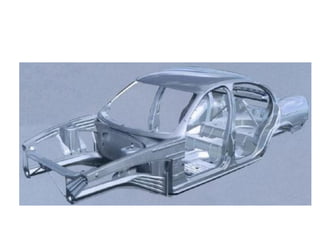
(Ultra Light Steel Auto Body)
• Basically it has the same structure as a conventional monocoque. The
difference is the use of “Hydroform" parts, sandwich steel and laser
beam welding.
CONSTRUCTION
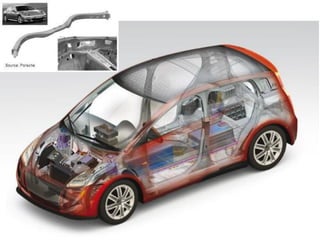
• Hydroform is a new technique for shaping metal to desired shape,
alternative to pressing use a heavy-weight machine to press a sheet metal
into a die, this inevitably creates inhomogeneous thickness result the edges
and the corner are always thinner than surfaces. To maintain a minimum
thickness there for the benefit of stiffness, car designer have to chose thicker
steel metal than originally needed.
Conventional sheet metal forming
https://youtu.be/ivEovm9rJcg
Hydroforming
• Video- https://www.fluidforming.de/fluid-forming/prinzip
CONSTRUCTION
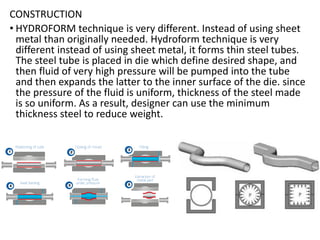
• HYDROFORM technique is very different. Instead of using sheet
metal than originally needed. Hydroform technique is very
different instead of using sheet metal, it forms thin steel tubes.
The steel tube is placed in die which define desired shape, and
then fluid of very high pressure will be pumped into the tube
and then expands the latter to the inner surface of the die. since
the pressure of the fluid is uniform, thickness of the steel made
is so uniform. As a result, designer can use the minimum
thickness steel to reduce weight.
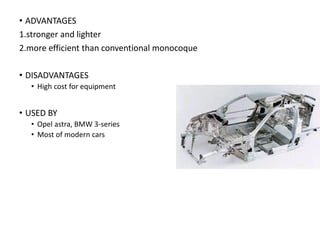
• ADVANTAGES
1.stronger and lighter
2.more efficient than conventional monocoque
• DISADVANTAGES
• High cost for equipment
• USED BY
• Opel astra, BMW 3-series
• Most of modern cars
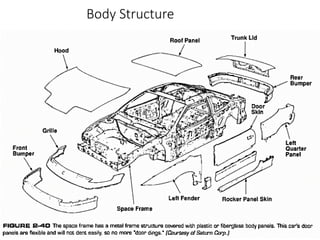
Body
• Made of steel, aluminum, fiberglass, plastic, or composite materials
• It forms the outside of the vehicle & Serves as an attractive covering for
the chassis
• For passengers protection & keeping them dry and shaded, the primary
purpose is to shield from the wind, which can be substantial when
travelling at high speeds.
• The body has design with aerodynamic shape
• Has design aesthetically pleasing ways to capture bigger market.
• The body can be based on a chassis but there are also cars of monocoque
construction where the structural loads are distributed throughout the
body, which acts as a load-bearing shell.
Body Structure
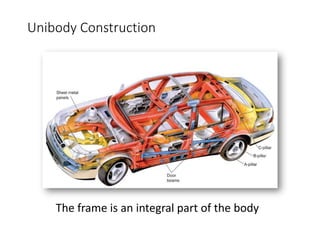
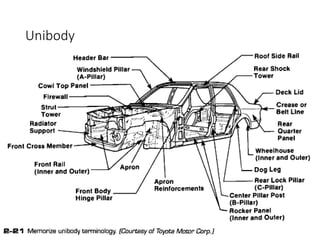
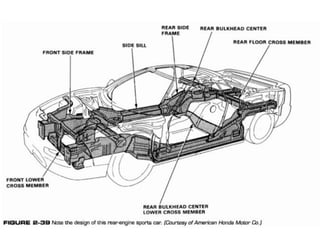
Unibody Construction
The frame is an integral part of the body
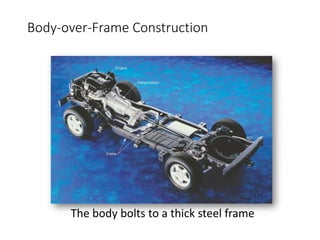
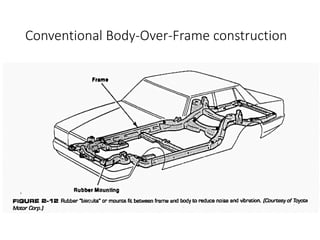
Body-over-Frame Construction
The body bolts to a thick steel frame
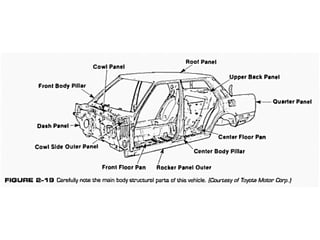
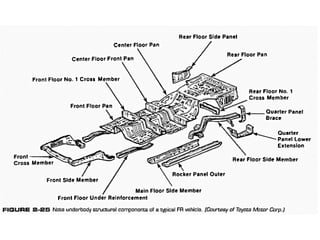
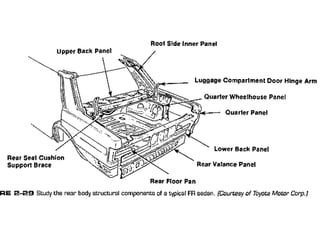
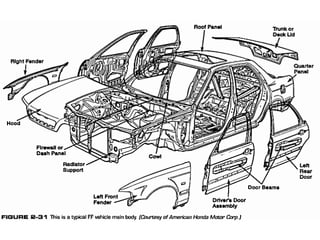
Major Body Sections
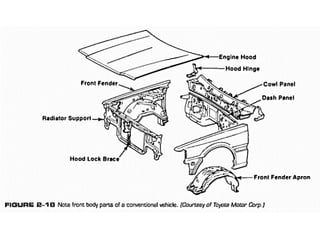
• Front section (Nose section)
• Between Front bumper & Firewall ( Front uspension parts, Frame rails,
radiater core support)
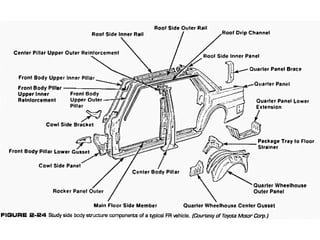
• Center section
• Mid section (passenger compartment, floor pan, roof pannel, cowl, doors,
door pillars, glass )
• Rear section
• Tail section ( Trunk & lid, quarter panels, rear frame rails rear bumper)
Different Type of Body Construction
Classification according to the mounting on the chassis,
1. Conventional Body-Over-Frame construction
2. Unibody construction
Conventional Body-Over-Frame construction
Unibody
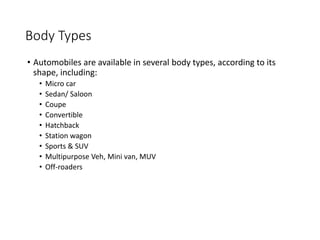
Body Types
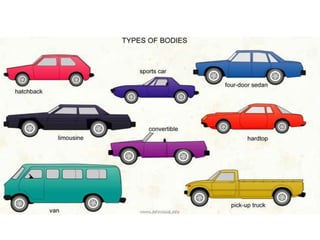
• Automobiles are available in several body types, according to its
shape, including:
• Micro car
• Sedan/ Saloon
• Coupe
• Convertible
• Hatchback
• Station wagon
• Sports & SUV
• Multipurpose Veh, Mini van, MUV
• Off-roaders
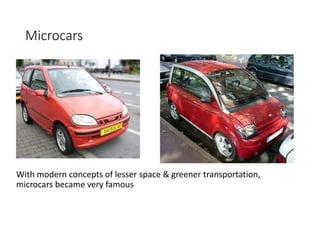
Microcars
With modern concepts of lesser space & greener transportation,
microcars became very famous
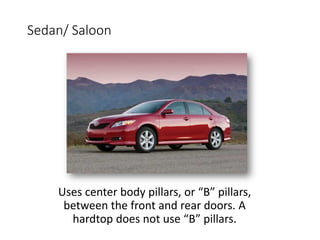
Sedan/ Saloon
Uses center body pillars, or “B” pillars,
between the front and rear doors. A
hardtop does not use “B” pillars.
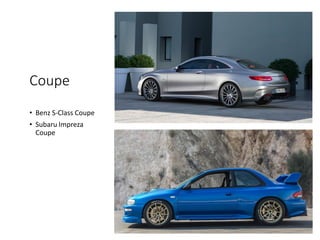
Coupe
• Benz S-Class Coupe
• Subaru Impreza
Coupe
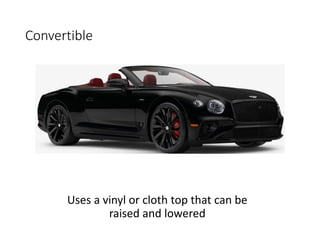
Convertible
Uses a vinyl or cloth top that can be
raised and lowered
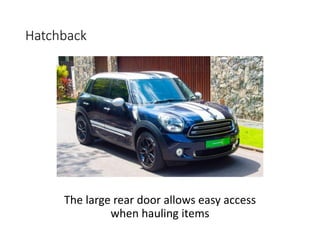
Hatchback
The large rear door allows easy access
when hauling items
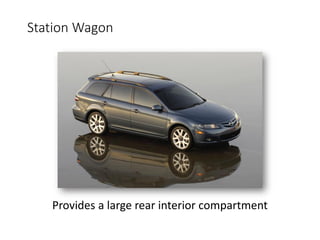
Station Wagon
Provides a large rear interior compartment
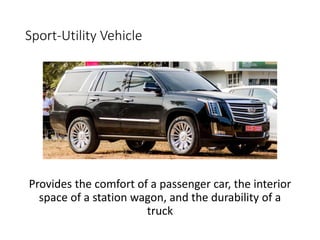
Sport-Utility Vehicle
Provides the comfort of a passenger car, the interior
space of a station wagon, and the durability of a
truck
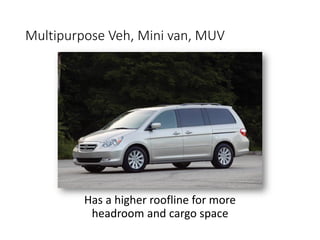
Multipurpose Veh, Mini van, MUV
Has a higher roofline for more
headroom and cargo space
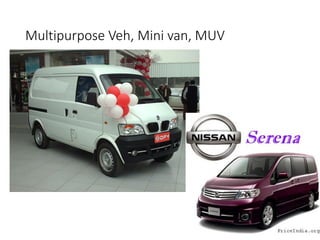
Multipurpose Veh, Mini van, MUV
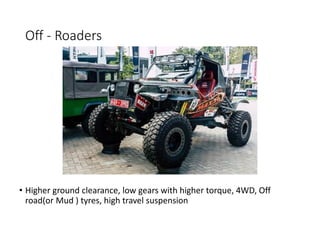
Off - Roaders
• Higher ground clearance, low gears with higher torque, 4WD, Off
road(or Mud ) tyres, high travel suspension
Crash Testing
• Old Car vs Modern Car during Crash Test / Evolution of Car
Safety
• https://youtu.be/TikJC0x65X0

Lec02-Classification of Auto,.pdf

  • 1.
    Classification of Automobiles ME3103:Automotive Engineering I Department of Mechanical Engineering, Faculty of Engineering, General Sir John Kotelawala Defense University
  • 2.
    • General Classificationof Vehicles • Types of Automobiles
  • 3.
    General Classification ofVehicles 1. Single - unit Vehicles or Load carriers 2. Articulated Vehicles
  • 4.
    Axle Classification • Drivingaxle denote by letter “x” • Non Driving axle denote by letter “o” – ox – conventional four wheeler – xo – front wheel drive four wheeler – xx – four wheel drive four wheeler – oox – six wheel drive with two steering axles – oxx – conventional six wheeler – xxx – six wheel drive six wheeler – ooxx – conventional eight wheeler with twin steering axle
  • 5.
    Single - UnitLight Veh or Load carriers • Car, Van, Truck, Bus, Coach • Conventional 4 wheel type • Majority with 2 axle design – Front axle Driving – Rear axle Driving • Ex – 4x2, 4x4, 6x4 (First figure denotes total no of Wheels, Second Driving Wheels)
  • 6.
    • Heavy Tractors •Motor coaches • Lorries • ox, oxx, xxx, xxxx
  • 7.
    Articulated Vehicles • Heavyload carrying & Tractors & Semi Trailers. Only tractor provides the motive power while trailer carries the goods. Two units connected by ‘fifth wheel coupling’ • ox, xx
  • 8.
    Types of Automobiles 1.With respect to the Use 2. With respect to the Capacity 3. With respect to the Fuel used 4. With respect to the Make & Model 5. With respect to Wheels & Axles 6. With respect to the Drive 7. With respect to the Engine 8. With respect to the Suspension 9. With respect to the Transmission 10. With respect to the Body style & no of Doors
  • 9.
    Types of Automobiles 1.With respect to the Use • Scooters & Motor cycles • Cars Station wagons, pick-ups & Vans • Lorries, Buses & Trucks • Tractors 2. With respect to the Capacity • H.T.V. – Heavy Transport Veh • L.T.V. – Light Transport Veh • ¼ Ton, 1 Ton, 3 Ton • 2 seater, 5 Seater, 52 Seater
  • 10.
    Types of Automobiles 3.With respect to the Fuel used • Steam • Petrol, Diesel, Gas • Electric, Hybrid • Hydrogen
  • 11.
    Types of Automobiles 4.With respect to the • Make - Name given by manufacturer. After the name, name of the power unit indicating, no of cylinder, shape of the engine. • Toyota, Nissan, Dihatsu • Land Rover, Jaguar, Ford, Ferrari, Renault…. • Bajaj, Honda, Yamaha, Kawasaki • Layland, Tata, Mahindra Model - The Year of manufacture or Specific code no • Toyota – Corolla AE100, 110, 121, CE100, CE110 • Nissan – Sunny FB13, 14, 15, SB 13, 14, 15 • Yamaha – FZ, DT, TW, TTR, R1, FZR
  • 12.
    Types of Automobiles 5.With respect to Wheels & Axles • Two wheelers • Three wheelers • Four wheelers…. With Axle Classifications 6. With respect to the Drive • Left hand drive • Right hand drive • 2 wheel drive, 4 wheel drive, 8X8
  • 13.
    Types of Automobiles 7.With respect to the Engine • External combustion engine. • Internal combustion engine.
  • 14.
    • External combustionengine. • steam engine
  • 15.
    • Internal combustionengine. • Reciprocating engine 4 stroke engine 2 stroke engine • Rotary engine Wankle engine Turbine engine • Reaction engine Rocket engine
  • 16.
    8. With respectto the Suspension • Conventional • Spring, Shock-absorber • Independent • Pneumatic, Self leveling 9. With respect to the Transmission • Conventional (Manual) • Automatic • Semi Automatic Types of Automobiles
  • 17.
    Types of Automobiles 10.With respect to the Body & no of Doors • Microcars • Saloons/ Sedan • Convertible • Station Wagon • Coupe • Hatchback • Sports • Off-roaders • Multipurpose Veh/ Mini van
  • 18.
    Main components &Assemblies (Constructional Features) 1. The Basic structure or the Framework 2. The Engine or Power plant 3. The Power train or the Transmission sys 4. The Body or the Super structure 5. The Auxiliaries • Fuel, Lubricant, Cooling, Brake, Exhaust 6. The Controls • Clutch, Brake, Accelerator pedals • Lighting Switches • Viper, AC switches
  • 19.
    Layout of anAutomobile • Different veh to veh
  • 20.
    • Frame, Chassis •Superstructure, Body • Front axle • Rear axle • Wheel • Suspension system • Power unit • Transmission system • Brakes • Electrical system • Safety systems • Auxiliaries • ECU & controlling modules
  • 21.
    CHASSIS BASIC FUNCTION OFCHASSIS ARE 1. Provide basic structure to assemble body or super structure and all other components. 2. It absorbs the reaction from the movement of an engine and axle. 3. Balances the reaction forces (Twisting & Bending forces) of the wheel in acceleration and braking. 4. Absorb aerodynamics wind forces and road shocks through the suspension. 5. Absorb the major “Energy of Impact“ in the event of an accident.
  • 22.
    Basic structure • Wheeltrack • This is the transverse distance between the tyre to ground centers on the near- side & the off-side. • Wheel base • This is the longitudinal distance between the centers of the front & rear axles • Ground clearance • This is the vertical distance between the lowest place of the vehicle body to the ground.
  • 23.
    • Side rails– runs from front to rear on each side of the veh & support the body • Control beam stiffness • Control the tortion • Control the vibrations • Cross members – separate the side rails & support other sub-systems • Welded, bolted or reverted • Transfer inertia force from components to side rails • Fuel tank, rear suspension, radiator, spare tyre • Brackets – provide a means for attaching the various sub-systems • Welded to side rails or cross members • Components mounted with bolts with rubber mounts or bushings
  • 24.
    Different Type ofChassis 1. Ladder Chassis 2. Backbone Frame Chassis 3. Tubular Frame Chassis 4. Monocoque Chassis 5. ULSAB Monocoque
  • 27.
    Ladder Chassis • Thisis oldest kind of chassis.in early 60s,nearly all cars in world used it as a standard chassis. Even today most of the SUVs & MUVs use this type • COSTRUCTION • As name is LADDER : it has two longitudinal rails interconnected by several lateral and cross braces. The longitude members are main stress member. They deals with the load and also the longitudinal forces caused by the acceleration and braking. The lateral and cross members provide the resistance to the lateral forces and further increase torsional rigidity.
  • 30.
    • ADVANTAGES 1.Easy toconstruct 2.Good for SUVs & truck DISADVANTAGES Torsional rigidity is lower especially in case of vertical loads and bumps. USED BY Truck making company like TATA, ASHOK LEYLAND.
  • 31.
    2. BACKBONE FRAMECHASSIS • This is also one of the oldest type of chassis.
  • 32.
  • 33.
    • CONSTRUCTION It isusually in rectangular section connects the front and rear axle and provides nearly all the mechanical strength. Inside which there is space for the drive shaft in case of front engine, rear-wheel drive. The whole drive train, engine and suspension are connected to both ends of the backbone. The body is built on the backbone, usually made of glass-fibre. • ADVANTAGES 1.Strong for smaller sports car & used by special Heavy veh 2.Easy to construct by hands 3.Cheap for low volume production
  • 34.
    • DISADVANTAGES 1.Not strongenough for high-end sports car 2.It does not provides protection against side impact 3.Cost ineffective for mass production 3.High Cost for Heavy veh & complex transmission design • USED BY • TVR, Marcos • TATRA
  • 35.
    3.TUBULAR FRAME CHASSIS •As ladder chassis is not strong enough, motor racing engineers developed a three dimensional design-tubular space frame.
  • 36.
    CONSTRUCTION • Tubular spaceframe chassis employ dozens of circular-section tubes, but some may employ square-section tubes for easier connection to the body panels, but remember circular section provides the maximum strength, position in different direction to provide mechanical strength against forces from anywhere.
  • 37.
    • ADVANTAGES 1.It cancounter-balance stress from any direction( compared to ladder and monocoque chassis of same weight) • DISADVANTAGES 1.Very complex structure 2.Cost and time consuming to built. 3.Impossible for robotized production 4.It also covers lot of space • USED BY • Lamborghini , Jaguar XJ22O,ETC
  • 38.
    4.MONOCOQUE CHASSIS • Monocoque,meaning 'single shell' in French, is a construction technique that utilises the external skin to support some or most of the load.
  • 39.
    4.MONOCOQUE CHASSIS • Thisis as opposed to using an internal frame or chassis that is then covered with cosmetic body panels. • Today, 99% cars produced in this world are made of steel monocoque chassis, due to its low production cost and suitability to robotized production
  • 40.
    CONSTRUCTION • It isone-piece structure which defines the overall shape of car. While ladder, tubular space frame and backbone chassis provides only the members and need to build the body around them where-as the monocoque chassis is already incorporated with the body in a single piece. In fact the "one-piece" chassis is actually made by welding several pieces together. The floor pan, which is the largest piece, and other pieces are press-made by big stamping machines. They are spot welded together by robot arms in a stream production line.
  • 41.
    • ADVANTAGES 1. Cheapfor mass production 2. Proves good in times of crash in case of protection 3. Space efficient • DISADVANTAGES 1. Impossible for small-volume production 2. Heavy • USED BY • All cars, all current Porsche, Audi
  • 43.
    ULSAB MONOCOQUE (Ultra LightSteel Auto Body) • Basically it has the same structure as a conventional monocoque. The difference is the use of “Hydroform" parts, sandwich steel and laser beam welding.
  • 45.
    CONSTRUCTION • Hydroform isa new technique for shaping metal to desired shape, alternative to pressing use a heavy-weight machine to press a sheet metal into a die, this inevitably creates inhomogeneous thickness result the edges and the corner are always thinner than surfaces. To maintain a minimum thickness there for the benefit of stiffness, car designer have to chose thicker steel metal than originally needed. Conventional sheet metal forming https://youtu.be/ivEovm9rJcg
  • 46.
  • 47.
    CONSTRUCTION • HYDROFORM techniqueis very different. Instead of using sheet metal than originally needed. Hydroform technique is very different instead of using sheet metal, it forms thin steel tubes. The steel tube is placed in die which define desired shape, and then fluid of very high pressure will be pumped into the tube and then expands the latter to the inner surface of the die. since the pressure of the fluid is uniform, thickness of the steel made is so uniform. As a result, designer can use the minimum thickness steel to reduce weight.
  • 49.
    • ADVANTAGES 1.stronger andlighter 2.more efficient than conventional monocoque • DISADVANTAGES • High cost for equipment • USED BY • Opel astra, BMW 3-series • Most of modern cars
  • 50.
    Body • Made ofsteel, aluminum, fiberglass, plastic, or composite materials • It forms the outside of the vehicle & Serves as an attractive covering for the chassis • For passengers protection & keeping them dry and shaded, the primary purpose is to shield from the wind, which can be substantial when travelling at high speeds. • The body has design with aerodynamic shape • Has design aesthetically pleasing ways to capture bigger market. • The body can be based on a chassis but there are also cars of monocoque construction where the structural loads are distributed throughout the body, which acts as a load-bearing shell.
  • 51.
  • 52.
    Unibody Construction The frameis an integral part of the body
  • 53.
    Body-over-Frame Construction The bodybolts to a thick steel frame
  • 54.
    Major Body Sections •Front section (Nose section) • Between Front bumper & Firewall ( Front uspension parts, Frame rails, radiater core support) • Center section • Mid section (passenger compartment, floor pan, roof pannel, cowl, doors, door pillars, glass ) • Rear section • Tail section ( Trunk & lid, quarter panels, rear frame rails rear bumper)
  • 55.
    Different Type ofBody Construction Classification according to the mounting on the chassis, 1. Conventional Body-Over-Frame construction 2. Unibody construction
  • 56.
  • 63.
  • 65.
    Body Types • Automobilesare available in several body types, according to its shape, including: • Micro car • Sedan/ Saloon • Coupe • Convertible • Hatchback • Station wagon • Sports & SUV • Multipurpose Veh, Mini van, MUV • Off-roaders
  • 69.
    Microcars With modern conceptsof lesser space & greener transportation, microcars became very famous
  • 70.
    Sedan/ Saloon Uses centerbody pillars, or “B” pillars, between the front and rear doors. A hardtop does not use “B” pillars.
  • 71.
    Coupe • Benz S-ClassCoupe • Subaru Impreza Coupe
  • 72.
    Convertible Uses a vinylor cloth top that can be raised and lowered
  • 73.
    Hatchback The large reardoor allows easy access when hauling items
  • 74.
    Station Wagon Provides alarge rear interior compartment
  • 75.
    Sport-Utility Vehicle Provides thecomfort of a passenger car, the interior space of a station wagon, and the durability of a truck
  • 76.
    Multipurpose Veh, Minivan, MUV Has a higher roofline for more headroom and cargo space
  • 77.
  • 78.
    Off - Roaders •Higher ground clearance, low gears with higher torque, 4WD, Off road(or Mud ) tyres, high travel suspension
  • 79.
  • 80.
    • Old Carvs Modern Car during Crash Test / Evolution of Car Safety • https://youtu.be/TikJC0x65X0