UNIT-II VECTOR CALCULUS
                                             IMPORTANT QUESTIONS:
                                                         PART-A
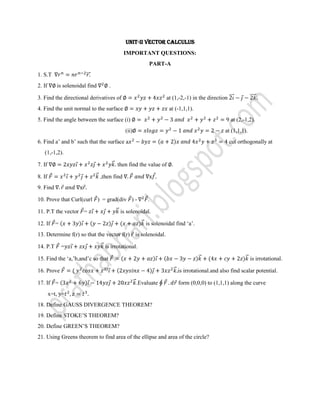
1. S.T
2. If      is solenoidal find       .

3. Find the directional derivatives of                          at (1,-2,-1) in the direction
4. Find the unit normal to the surface                           at (-1,1,1).
5. Find the angle between the surface (i)                                                       at (2,-1,2).
                                             (ii)                                           at (1,1,1).
6. Find a’ and b’ such that the surface a                                                       cut orthogonally at
   (1,-1,2).

7. If                                   then find the value of .

8. If                           ,then find
9. Find

10. Prove that Curl(curl ) = grad(div ) -               .

11. P.T the vector =                     is solenoidal.

12. If =                                               is solenoidal find ‘a’.
13. Determine f(r) so that the vector f(r) is solenoidal.

14. P.T      =                    is irrotational.

15. Find the ‘a,’b,and’c so that                                                                          is irrotational.

16. Prove                                                             is irrotational.and also find scalar potential.

17. If =                                            .Evaluate         form (0,0,0) to (1,1,1) along the curve
        x=t, y=
18. Define GAUSS DIVERGENCE THEOREM?
19. Define STOKE’S THEOREM?
20. Define GREEN’S THEOREM?
21. Using Greens theorem to find area of the ellipse and area of the circle?
UNIT-II VECTOR CALCULUS
                                                      PRAT-B

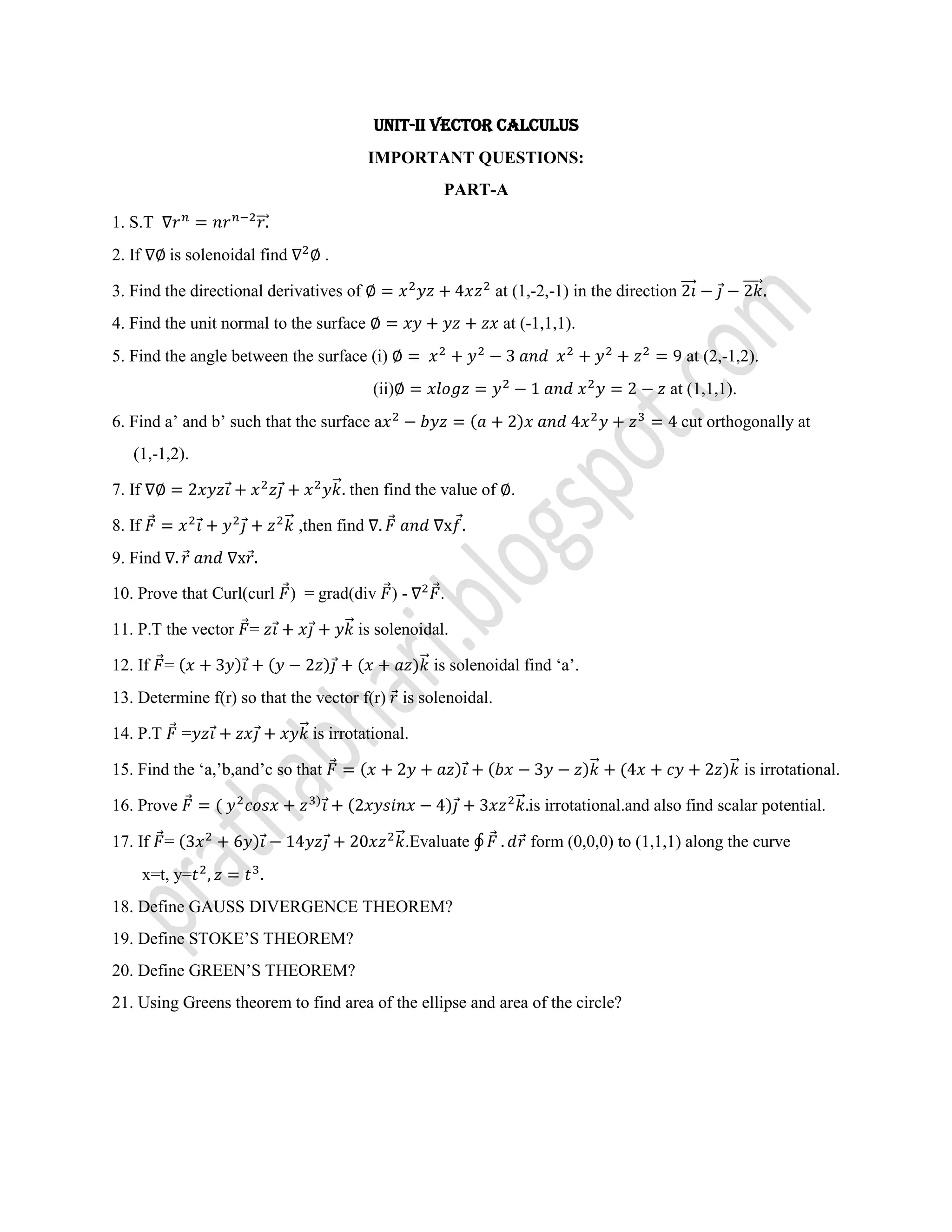
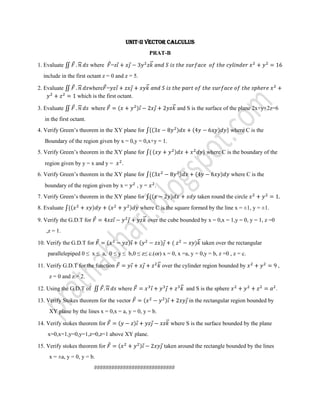
1. Evaluate               where   =z
  include in the first octant z = 0 and z = 5.

2. Evaluate            where =
                   which is the first octant.

3. Evaluate               where                                    and S is the surface of the plane 2x+y+2z=6
   in the first octant.
4. Verify Green’s theorem in the XY plane for                                                where C is the
   Boundary of the region given by x = 0,y = 0,x+y = 1.
5. Verify Green’s theorem in the XY plane for                                  where C is the boundary of the
   region given by y = x and y =        .
6. Verify Green’s theorem in the XY plane for                                                where C is the
   boundary of the region given by x =          ,y=      .
7. Verify Green’s theorem in the XY plane for                              taken round the circle
8. Evaluate                                      where C is the square formed by the line x = ±1, y = ±1.

9. Verify the G.D.T for                               over the cube bounded by x = 0,x = 1,y = 0, y = 1, z =0
   ,z = 1.

10. Verify the G.D.T for                                                     taken over the rectangular
    parallelepiped 0 ≤ x ≤ a, 0 ≤ y ≤ b,0 ≤ z≤ c.(or) x = 0, x =a, y = 0,y = b, z =0 , z = c.

11. Verify G.D.T for the function                            over the cylinder region bounded by                    ,
     z = 0 and z = 2.

12. Using the G.D.T of                 where                           and S is the sphere                      .

13. Verify Stokes theorem for the vector                                in the rectangular region bounded by
     XY plane by the lines x = 0,x = a, y = 0, y = b.

14. Verify stokes theorem for                                   where S is the surface bounded by the plane
    x=0,x=1,y=0,y=1,z=0,z=1 above XY plane.

15. Verify stokes theorem for                                taken around the rectangle bounded by the lines
     x = ±a, y = 0, y = b.
                           ############################

Unit ii vector calculus

  • 1.
    UNIT-II VECTOR CALCULUS IMPORTANT QUESTIONS: PART-A 1. S.T 2. If is solenoidal find . 3. Find the directional derivatives of at (1,-2,-1) in the direction 4. Find the unit normal to the surface at (-1,1,1). 5. Find the angle between the surface (i) at (2,-1,2). (ii) at (1,1,1). 6. Find a’ and b’ such that the surface a cut orthogonally at (1,-1,2). 7. If then find the value of . 8. If ,then find 9. Find 10. Prove that Curl(curl ) = grad(div ) - . 11. P.T the vector = is solenoidal. 12. If = is solenoidal find ‘a’. 13. Determine f(r) so that the vector f(r) is solenoidal. 14. P.T = is irrotational. 15. Find the ‘a,’b,and’c so that is irrotational. 16. Prove is irrotational.and also find scalar potential. 17. If = .Evaluate form (0,0,0) to (1,1,1) along the curve x=t, y= 18. Define GAUSS DIVERGENCE THEOREM? 19. Define STOKE’S THEOREM? 20. Define GREEN’S THEOREM? 21. Using Greens theorem to find area of the ellipse and area of the circle?
  • 2.
    UNIT-II VECTOR CALCULUS PRAT-B 1. Evaluate where =z include in the first octant z = 0 and z = 5. 2. Evaluate where = which is the first octant. 3. Evaluate where and S is the surface of the plane 2x+y+2z=6 in the first octant. 4. Verify Green’s theorem in the XY plane for where C is the Boundary of the region given by x = 0,y = 0,x+y = 1. 5. Verify Green’s theorem in the XY plane for where C is the boundary of the region given by y = x and y = . 6. Verify Green’s theorem in the XY plane for where C is the boundary of the region given by x = ,y= . 7. Verify Green’s theorem in the XY plane for taken round the circle 8. Evaluate where C is the square formed by the line x = ±1, y = ±1. 9. Verify the G.D.T for over the cube bounded by x = 0,x = 1,y = 0, y = 1, z =0 ,z = 1. 10. Verify the G.D.T for taken over the rectangular parallelepiped 0 ≤ x ≤ a, 0 ≤ y ≤ b,0 ≤ z≤ c.(or) x = 0, x =a, y = 0,y = b, z =0 , z = c. 11. Verify G.D.T for the function over the cylinder region bounded by , z = 0 and z = 2. 12. Using the G.D.T of where and S is the sphere . 13. Verify Stokes theorem for the vector in the rectangular region bounded by XY plane by the lines x = 0,x = a, y = 0, y = b. 14. Verify stokes theorem for where S is the surface bounded by the plane x=0,x=1,y=0,y=1,z=0,z=1 above XY plane. 15. Verify stokes theorem for taken around the rectangle bounded by the lines x = ±a, y = 0, y = b. ############################