Dr. Shah-Noor Hassan FCPS,FRCS
Consultant, Vitreo-Retina
Bangladesh Eye Hospital & Institute
INTRODUCTION
 First described by LEBER in 1877.
 KOYANAGI first described more
incidence in UT branch.
 2nd most common cause of vision d/t
retinal vascular disease (after diabetic
retinopathy)
 BRVO accounts for 69.5% of total RVO.
Demography
• Age: 5th – 6th decade
• Sex: males = females
• Incidence : 0.7% between 50 – 60
4.6% after 80 yrs
Risk factors
 Systemic hypertension
 Diabetes
 Hyperlipidemia
 Glaucoma
 Smoking
 Age related atherosclerosis
Others risk factors–
• Eyes with shorter axial lengths
• Anti-phospholipid antibody syndrome
• Elevated plasma homocysteine levels
• Low serum folate levels
• Inflammatory disease( Sarcoidosis, Bechet’s
disease)
• Acquired & inherited thrombophilic conditions
• Hyper viscosity state ( polycythemia, myeloma,
etc.)
Protective factors
 Higher serum HDL
 Moderate alcohol consumption
Pathogenesis
• Almost always occurs at AV crossings
• Retinal artery and vein share a common
adventitial sheath & in some cases a
common medium
• Artery located anterior to the vein at the
obstructed site; lumen of the vein
compressed upto 33 % at the obstruction
site
• Role of vitreous – eyes with decreased
axial length and and higher likelihood of
vitreomacular attachment at AV crossings
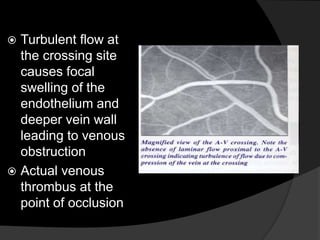
 Turbulent flow at
the crossing site
causes focal
swelling of the
endothelium and
deeper vein wall
leading to venous
obstruction
 Actual venous
thrombus at the
point of occlusion
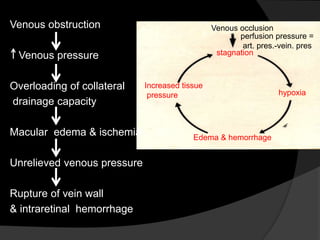
Venous occlusion
stagnation
hypoxia
Edema & hemorrhage
Increased tissue
pressure
perfusion pressure =
art. pres.-vein. pres.
Venous obstruction
Venous pressure
Overloading of collateral
drainage capacity
Macular edema & ischemia
Unrelieved venous pressure
Rupture of vein wall
& intraretinal hemorrhage
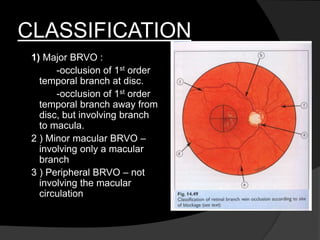
CLASSIFICATION
1) Major BRVO :
-occlusion of 1st order
temporal branch at disc.
-occlusion of 1st order
temporal branch away from
disc, but involving branch
to macula.
2 ) Minor macular BRVO –
involving only a macular
branch
3 ) Peripheral BRVO – not
involving the macular
circulation
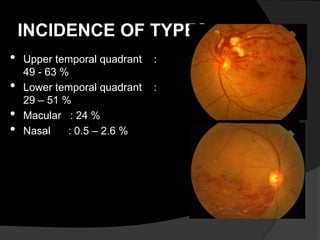
INCIDENCE OF TYPES
• Upper temporal quadrant :
49 - 63 %
• Lower temporal quadrant :
29 – 51 %
• Macular : 24 %
• Nasal : 0.5 – 2.6 %
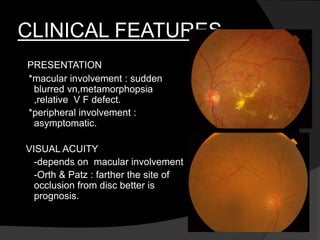
CLINICAL FEATURES
PRESENTATION
*macular involvement : sudden
blurred vn,metamorphopsia
,relative V F defect.
*peripheral involvement :
asymptomatic.
VISUAL ACUITY
-depends on macular involvement
-Orth & Patz : farther the site of
occlusion from disc better is
prognosis.
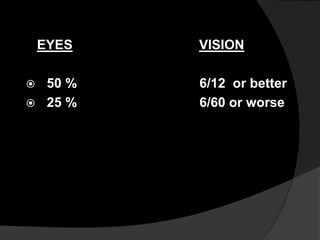
EYES VISION
 50 % 6/12 or better
 25 % 6/60 or worse
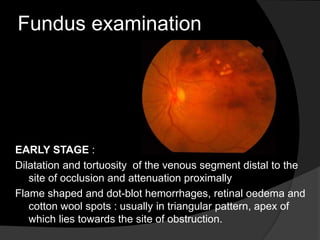
Fundus examination
EARLY STAGE :
Dilatation and tortuosity of the venous segment distal to the
site of occlusion and attenuation proximally
Flame shaped and dot-blot hemorrhages, retinal oedema and
cotton wool spots : usually in triangular pattern, apex of
which lies towards the site of obstruction.
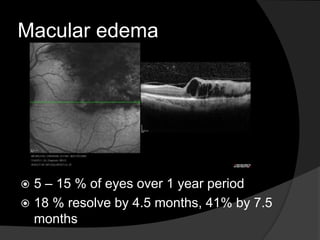
Macular edema
 5 – 15 % of eyes over 1 year period
 18 % resolve by 4.5 months, 41% by 7.5
months
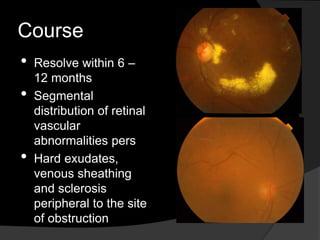
Course
• Resolve within 6 –
12 months
• Segmental
distribution of retinal
vascular
abnormalities pers
• Hard exudates,
venous sheathing
and sclerosis
peripheral to the site
of obstruction
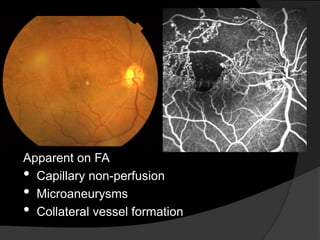
Apparent on FA
• Capillary non-perfusion
• Microaneurysms
• Collateral vessel formation
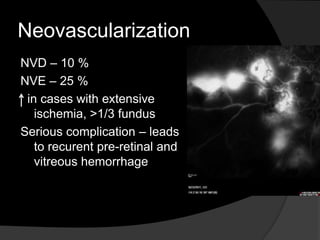
Neovascularization
NVD – 10 %
NVE – 25 %
in cases with extensive
ischemia, >1/3 fundus
Serious complication – leads
to recurent pre-retinal and
vitreous hemorrhage
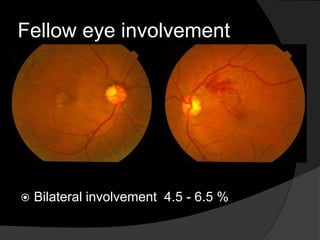
Fellow eye involvement
 Bilateral involvement 4.5 - 6.5 %
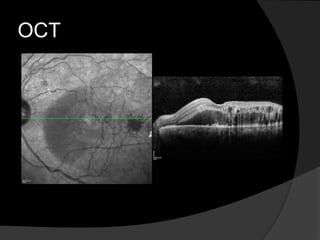
OCT
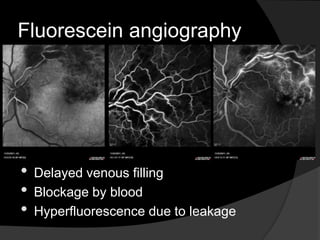
Fluorescein angiography
• Delayed venous filling
• Blockage by blood
• Hyperfluorescence due to leakage
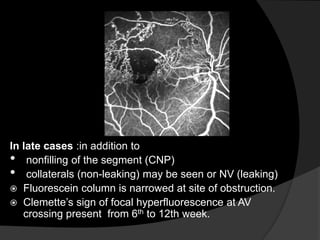
In late cases :in addition to
• nonfilling of the segment (CNP)
• collaterals (non-leaking) may be seen or NV (leaking)
 Fluorescein column is narrowed at site of obstruction.
 Clemette’s sign of focal hyperfluorescence at AV
crossing present from 6th to 12th week.
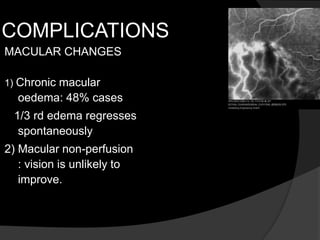
COMPLICATIONS
MACULAR CHANGES
1) Chronic macular
oedema: 48% cases
1/3 rd edema regresses
spontaneously
2) Macular non-perfusion
: vision is unlikely to
improve.
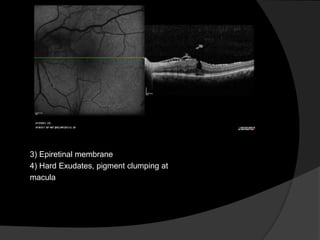
3) Epiretinal membrane
4) Hard Exudates, pigment clumping at
macula
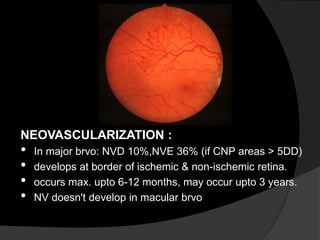
NEOVASCULARIZATION :
• In major brvo: NVD 10%,NVE 36% (if CNP areas > 5DD)
• develops at border of ischemic & non-ischemic retina.
• occurs max. upto 6-12 months, may occur upto 3 years.
• NV doesn't develop in macular brvo
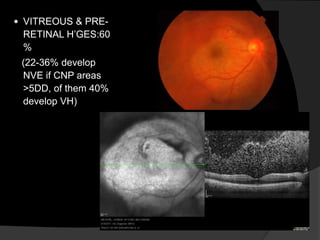
 VITREOUS & PRE-
RETINAL H’GES:60
%
(22-36% develop
NVE if CNP areas
>5DD, of them 40%
develop VH)
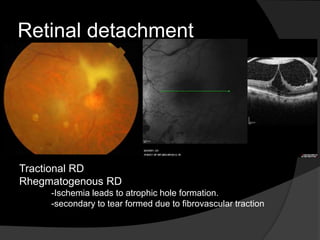
Tractional RD
Rhegmatogenous RD
-Ischemia leads to atrophic hole formation.
-secondary to tear formed due to fibrovascular traction
Retinal detachment
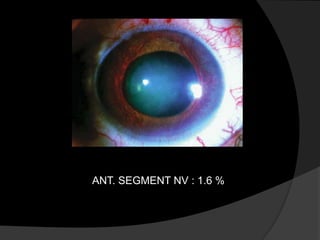
ANT. SEGMENT NV : 1.6 %
INVESTIGATIONS
BP, ECG
CBC, ESR
Fasting blood glucose & lipids
In young patients
• Autoantibodies
• ACE
• Homocysteine
• Thrombophilia screen
• Plasma protein electrophoresis
Management
2 main objectives
1. Identification of modifiable risk factors
(example HT, DM, CVS) and their
management – for other eye
2. Recognition and management of sight-
threatening complications
Anticoagulant therapy
 Not beneficial in either prevention or
management
 Associated with systemic complications
 Theoretically, severity of intraretinal
hemorrhage in acute phase
BRVO with perfused periphery
& normal VA
 Favourable prognosis
 No therapy
 Monitored monthly for 1st 3 months, then
every 2 months for the 1st year
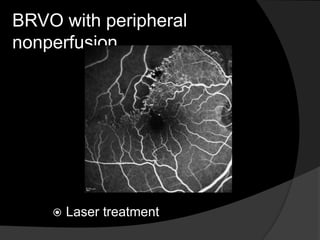
BRVO with peripheral
nonperfusion
 Laser treatment
Macular BRVO
 Involves a small vein draining a sector of
the macular region
 Favourable natural course
Laser photocoagulation
BVOS eligibility criteria
Grid laser recommended in eyes with
1. VA of 20/40 or less
2. Persistent macular edema > 4 mths
3. Resorption of macular hemorrhages
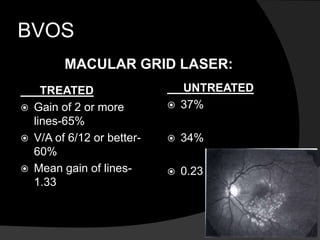
BVOS
TREATED
 Gain of 2 or more
lines-65%
 V/A of 6/12 or better-
60%
 Mean gain of lines-
1.33
UNTREATED
 37%
 34%
 0.23
MACULAR GRID LASER:
SCORE study
 Recommended grid photocoagulation
for vision loss with macular edema
secondary to BRVO
 However, leads to paracentral visual
field defects
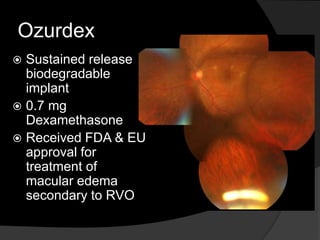
Ozurdex
 Sustained release
biodegradable
implant
 0.7 mg
Dexamethasone
 Received FDA & EU
approval for
treatment of
macular edema
secondary to RVO
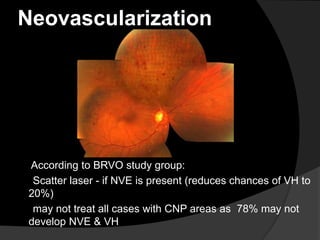
Neovascularization
According to BRVO study group:
Scatter laser - if NVE is present (reduces chances of VH to
20%)
may not treat all cases with CNP areas as 78% may not
develop NVE & VH
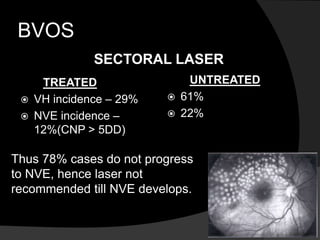
BVOS
TREATED
 VH incidence – 29%
 NVE incidence –
12%(CNP > 5DD)
UNTREATED
 61%
 22%
Thus 78% cases do not progress
to NVE, hence laser not
recommended till NVE develops.
SECTORAL LASER
SURGICAL
INTERVENTIONS
 Isovolaemic haemodilution
 tPA( tissue plasminogen activator)
 Chorio-retinal anastomosis
 Sheathotomy
 PVD Induction
 Steroids
 Anti-VEGF
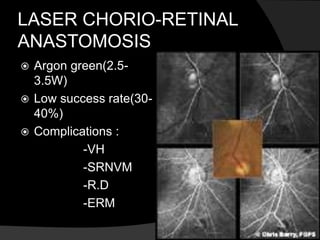
LASER CHORIO-RETINAL
ANASTOMOSIS
 Argon green(2.5-
3.5W)
 Low success rate(30-
40%)
 Complications :
-VH
-SRNVM
-R.D
-ERM
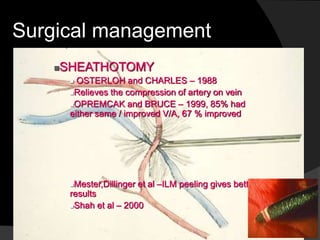
Surgical management
SHEATHOTOMY
 OSTERLOH and CHARLES – 1988
Relieves the compression of artery on vein
OPREMCAK and BRUCE – 1999, 85% had
either same / improved V/A, 67 % improved
Mester,Dillinger et al –ILM peeling gives better
results
Shah et al – 2000
BMV with PVD induction
(+/- Sheathotomy)
 Proposed mechanisms :
-removal of vitreo-macular traction
-removal of cytokines that increase
vascular permeability
-improvement of oxygen tension in
posterior retina
-faster development of collaterals- 6
months (normally 6-24 months)
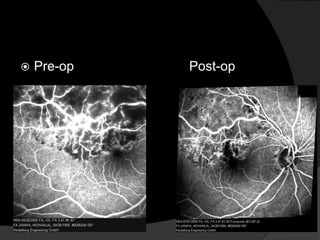
 Pre-op Post-op
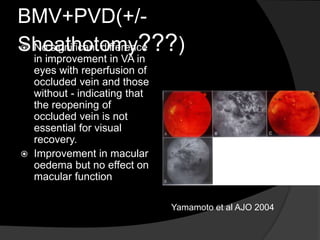
BMV+PVD(+/-
Sheathotomy???) No significant difference
in improvement in VA in
eyes with reperfusion of
occluded vein and those
without - indicating that
the reopening of
occluded vein is not
essential for visual
recovery.
 Improvement in macular
oedema but no effect on
macular function
Yamamoto et al AJO 2004
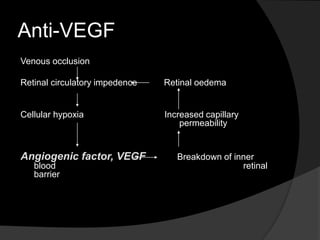
Venous occlusion
Retinal circulatory impedence Retinal oedema
Cellular hypoxia Increased capillary
permeability
Angiogenic factor, VEGF Breakdown of inner
blood retinal
barrier
Anti-VEGF
anti-VEGF
 Safe and efficacious.
 Unsustainad effect in some cases.
 Does not alter the perfusion status
which determines the end result.
 The benefit of any treatment has to be
compared with the natural course of the
disease.
 50-60% maintain maintain initial V/A of
6/12 at 1-3 yrs followup. Thereafter natural
course remains relatively stable.
 Conversely natural course of V/A<6/12 is
unfavourable without treatment.
( at 3 yrs 23% had V/A of 6/60 or worse &
only 37% gained 2 or more lines)
Treatment
 Focused on management of vision-
limiting complications
 Macular edema
 Macular non-perfusion
 Vitreous hemorrhage from
neovascularization
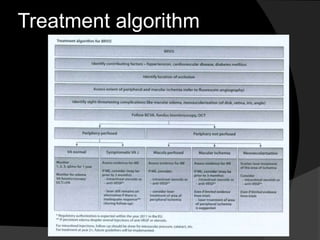
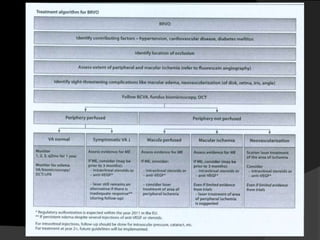
Treatment algorithm
Prognosis
 33 – 50% regain 6/12 or better VA
spontaneously.
• More similarities than dis-similarities in the risk
factor profiles for BRVO, CRVO and HRVO
• Testing for patients with HT, DM and open-angle
glaucoma should be part of the evaluation of
patients with retinal vein occlusion
 Favorable safety and tolerability profile over 12
months of follow-up.
 can be repeated with no new safety concerns after
the second treatment with regard to IOP
increases, although cataract progression does
seem to increase
Edaravone (MCI-186) is effective as a free
radical scavenger following arteriovenous
sheathotomy for treatment of macular
oedema associated with branch retinal vein
occlusion
T Maeno1,2, R Tano1, H Takenaka1, T Mano1
+Author Affiliations
1Tane Memorial Eye Hospital, Osaka, Japan
2Department of Ophthalmology, Osaka Medical
College, Takatsuki, Japan
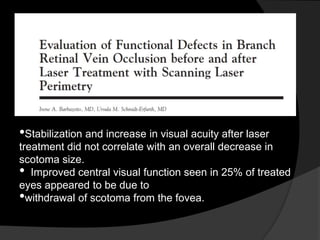
•Stabilization and increase in visual acuity after laser
treatment did not correlate with an overall decrease in
scotoma size.
• Improved central visual function seen in 25% of treated
eyes appeared to be due to
•withdrawal of scotoma from the fovea.
Sheathotomy
Principle steps
• Pars plana vitrectomy
• Overlying artery is separated from the
vein by creating an incision in the
adventitial sheath adjacent to the
arteriovenous crossing and then
separating the adhesions.
Although the study by Mason et al reported a benefi
cial effect on VA in those patients undergoing
surgery compared with those receiving laser or no
treatment, the
study was not randomized and was partly
retrospective, introducing sources of potential
bias. There is currently no evidence from RCTs
supporting the routine use of adventitial
sheathotomy to improve VA in eyes with BRVO
Plasminogen
Activator to Treat Macular
Edema
Associated With Branch
Retinal
Vein Occlusion
(Am J Ophthalmol 2006;142: 318–320
• After topical anesthesia was applied and a
paracentesis created
• tPA (40 k international units [IU]) injected into the
vitreous
• bedrest in the supine position for four hours
following treatment
 Mechanisms - PVD induction & development of
collateral vessels
Multifocal ERG
Responses from multifocal
electroretinography demonstrate retinal
dysfunction in branch retinal vein
occlusion
Moreover, if repeat injections are required,
the use of a sustained release steroid
implant would obviate the need for
multiple injections, but also magnify the
risk of steroid related complications.
Although steroids have antiangiogenic, antifibrotic, and
antipermeability properties, the principal effects of
steroids
are stabilization of the blood-retinal barrier, resorption of
exudation, and down regulation of inflammatory stimuli.
Whereas it is clear that there is a break-down in the
blood
retinal barrier in BVO, studies have shown that there
may
also be an inflammatory component that would respond
to
steroids.
Endophthalmitis, sterile endophthalmitis,
pseudo-hypopyon, cataract, retinal
tears, retinal detachment, and vitreous
hemorrhage have all been described
after intravitreal steroid injections.
Additionally, steroid related complications
including cataract and increased
intraocular pressure (IOP) can occur.
Increased IOP was seen in 33% of
patients in the intravitreal injection group

Branch Retinal Vein Occlusion

  • 1.
    Dr. Shah-Noor HassanFCPS,FRCS Consultant, Vitreo-Retina Bangladesh Eye Hospital & Institute
  • 2.
    INTRODUCTION  First describedby LEBER in 1877.  KOYANAGI first described more incidence in UT branch.  2nd most common cause of vision d/t retinal vascular disease (after diabetic retinopathy)  BRVO accounts for 69.5% of total RVO.
  • 3.
    Demography • Age: 5th– 6th decade • Sex: males = females • Incidence : 0.7% between 50 – 60 4.6% after 80 yrs
  • 4.
    Risk factors  Systemichypertension  Diabetes  Hyperlipidemia  Glaucoma  Smoking  Age related atherosclerosis
  • 5.
    Others risk factors– •Eyes with shorter axial lengths • Anti-phospholipid antibody syndrome • Elevated plasma homocysteine levels • Low serum folate levels • Inflammatory disease( Sarcoidosis, Bechet’s disease) • Acquired & inherited thrombophilic conditions • Hyper viscosity state ( polycythemia, myeloma, etc.)
  • 6.
    Protective factors  Higherserum HDL  Moderate alcohol consumption
  • 7.
    Pathogenesis • Almost alwaysoccurs at AV crossings • Retinal artery and vein share a common adventitial sheath & in some cases a common medium • Artery located anterior to the vein at the obstructed site; lumen of the vein compressed upto 33 % at the obstruction site • Role of vitreous – eyes with decreased axial length and and higher likelihood of vitreomacular attachment at AV crossings
  • 8.
     Turbulent flowat the crossing site causes focal swelling of the endothelium and deeper vein wall leading to venous obstruction  Actual venous thrombus at the point of occlusion
  • 9.
    Venous occlusion stagnation hypoxia Edema &hemorrhage Increased tissue pressure perfusion pressure = art. pres.-vein. pres. Venous obstruction Venous pressure Overloading of collateral drainage capacity Macular edema & ischemia Unrelieved venous pressure Rupture of vein wall & intraretinal hemorrhage
  • 10.
    CLASSIFICATION 1) Major BRVO: -occlusion of 1st order temporal branch at disc. -occlusion of 1st order temporal branch away from disc, but involving branch to macula. 2 ) Minor macular BRVO – involving only a macular branch 3 ) Peripheral BRVO – not involving the macular circulation
  • 11.
    INCIDENCE OF TYPES •Upper temporal quadrant : 49 - 63 % • Lower temporal quadrant : 29 – 51 % • Macular : 24 % • Nasal : 0.5 – 2.6 %
  • 12.
    CLINICAL FEATURES PRESENTATION *macular involvement: sudden blurred vn,metamorphopsia ,relative V F defect. *peripheral involvement : asymptomatic. VISUAL ACUITY -depends on macular involvement -Orth & Patz : farther the site of occlusion from disc better is prognosis.
  • 13.
    EYES VISION  50% 6/12 or better  25 % 6/60 or worse
  • 14.
    Fundus examination EARLY STAGE: Dilatation and tortuosity of the venous segment distal to the site of occlusion and attenuation proximally Flame shaped and dot-blot hemorrhages, retinal oedema and cotton wool spots : usually in triangular pattern, apex of which lies towards the site of obstruction.
  • 15.
    Macular edema  5– 15 % of eyes over 1 year period  18 % resolve by 4.5 months, 41% by 7.5 months
  • 16.
    Course • Resolve within6 – 12 months • Segmental distribution of retinal vascular abnormalities pers • Hard exudates, venous sheathing and sclerosis peripheral to the site of obstruction
  • 17.
    Apparent on FA •Capillary non-perfusion • Microaneurysms • Collateral vessel formation
  • 18.
    Neovascularization NVD – 10% NVE – 25 % in cases with extensive ischemia, >1/3 fundus Serious complication – leads to recurent pre-retinal and vitreous hemorrhage
  • 19.
    Fellow eye involvement Bilateral involvement 4.5 - 6.5 %
  • 20.
  • 21.
    Fluorescein angiography • Delayedvenous filling • Blockage by blood • Hyperfluorescence due to leakage
  • 22.
    In late cases:in addition to • nonfilling of the segment (CNP) • collaterals (non-leaking) may be seen or NV (leaking)  Fluorescein column is narrowed at site of obstruction.  Clemette’s sign of focal hyperfluorescence at AV crossing present from 6th to 12th week.
  • 23.
    COMPLICATIONS MACULAR CHANGES 1) Chronicmacular oedema: 48% cases 1/3 rd edema regresses spontaneously 2) Macular non-perfusion : vision is unlikely to improve.
  • 24.
    3) Epiretinal membrane 4)Hard Exudates, pigment clumping at macula
  • 25.
    NEOVASCULARIZATION : • Inmajor brvo: NVD 10%,NVE 36% (if CNP areas > 5DD) • develops at border of ischemic & non-ischemic retina. • occurs max. upto 6-12 months, may occur upto 3 years. • NV doesn't develop in macular brvo
  • 26.
     VITREOUS &PRE- RETINAL H’GES:60 % (22-36% develop NVE if CNP areas >5DD, of them 40% develop VH)
  • 27.
    Tractional RD Rhegmatogenous RD -Ischemialeads to atrophic hole formation. -secondary to tear formed due to fibrovascular traction Retinal detachment
  • 28.
  • 29.
    INVESTIGATIONS BP, ECG CBC, ESR Fastingblood glucose & lipids In young patients • Autoantibodies • ACE • Homocysteine • Thrombophilia screen • Plasma protein electrophoresis
  • 30.
    Management 2 main objectives 1.Identification of modifiable risk factors (example HT, DM, CVS) and their management – for other eye 2. Recognition and management of sight- threatening complications
  • 31.
    Anticoagulant therapy  Notbeneficial in either prevention or management  Associated with systemic complications  Theoretically, severity of intraretinal hemorrhage in acute phase
  • 32.
    BRVO with perfusedperiphery & normal VA  Favourable prognosis  No therapy  Monitored monthly for 1st 3 months, then every 2 months for the 1st year
  • 33.
  • 34.
    Macular BRVO  Involvesa small vein draining a sector of the macular region  Favourable natural course
  • 35.
    Laser photocoagulation BVOS eligibilitycriteria Grid laser recommended in eyes with 1. VA of 20/40 or less 2. Persistent macular edema > 4 mths 3. Resorption of macular hemorrhages
  • 36.
    BVOS TREATED  Gain of2 or more lines-65%  V/A of 6/12 or better- 60%  Mean gain of lines- 1.33 UNTREATED  37%  34%  0.23 MACULAR GRID LASER:
  • 37.
    SCORE study  Recommendedgrid photocoagulation for vision loss with macular edema secondary to BRVO  However, leads to paracentral visual field defects
  • 38.
    Ozurdex  Sustained release biodegradable implant 0.7 mg Dexamethasone  Received FDA & EU approval for treatment of macular edema secondary to RVO
  • 39.
    Neovascularization According to BRVOstudy group: Scatter laser - if NVE is present (reduces chances of VH to 20%) may not treat all cases with CNP areas as 78% may not develop NVE & VH
  • 40.
    BVOS TREATED  VH incidence– 29%  NVE incidence – 12%(CNP > 5DD) UNTREATED  61%  22% Thus 78% cases do not progress to NVE, hence laser not recommended till NVE develops. SECTORAL LASER
  • 41.
    SURGICAL INTERVENTIONS  Isovolaemic haemodilution tPA( tissue plasminogen activator)  Chorio-retinal anastomosis  Sheathotomy  PVD Induction  Steroids  Anti-VEGF
  • 42.
    LASER CHORIO-RETINAL ANASTOMOSIS  Argongreen(2.5- 3.5W)  Low success rate(30- 40%)  Complications : -VH -SRNVM -R.D -ERM
  • 43.
    Surgical management SHEATHOTOMY  OSTERLOHand CHARLES – 1988 Relieves the compression of artery on vein OPREMCAK and BRUCE – 1999, 85% had either same / improved V/A, 67 % improved Mester,Dillinger et al –ILM peeling gives better results Shah et al – 2000
  • 44.
    BMV with PVDinduction (+/- Sheathotomy)  Proposed mechanisms : -removal of vitreo-macular traction -removal of cytokines that increase vascular permeability -improvement of oxygen tension in posterior retina -faster development of collaterals- 6 months (normally 6-24 months)
  • 45.
  • 46.
    BMV+PVD(+/- Sheathotomy???) No significantdifference in improvement in VA in eyes with reperfusion of occluded vein and those without - indicating that the reopening of occluded vein is not essential for visual recovery.  Improvement in macular oedema but no effect on macular function Yamamoto et al AJO 2004
  • 47.
    Venous occlusion Retinal circulatoryimpedence Retinal oedema Cellular hypoxia Increased capillary permeability Angiogenic factor, VEGF Breakdown of inner blood retinal barrier Anti-VEGF
  • 48.
    anti-VEGF  Safe andefficacious.  Unsustainad effect in some cases.  Does not alter the perfusion status which determines the end result.
  • 49.
     The benefitof any treatment has to be compared with the natural course of the disease.  50-60% maintain maintain initial V/A of 6/12 at 1-3 yrs followup. Thereafter natural course remains relatively stable.  Conversely natural course of V/A<6/12 is unfavourable without treatment. ( at 3 yrs 23% had V/A of 6/60 or worse & only 37% gained 2 or more lines)
  • 50.
    Treatment  Focused onmanagement of vision- limiting complications  Macular edema  Macular non-perfusion  Vitreous hemorrhage from neovascularization
  • 51.
  • 52.
    Prognosis  33 –50% regain 6/12 or better VA spontaneously.
  • 54.
    • More similaritiesthan dis-similarities in the risk factor profiles for BRVO, CRVO and HRVO • Testing for patients with HT, DM and open-angle glaucoma should be part of the evaluation of patients with retinal vein occlusion
  • 56.
     Favorable safetyand tolerability profile over 12 months of follow-up.  can be repeated with no new safety concerns after the second treatment with regard to IOP increases, although cataract progression does seem to increase
  • 57.
    Edaravone (MCI-186) iseffective as a free radical scavenger following arteriovenous sheathotomy for treatment of macular oedema associated with branch retinal vein occlusion T Maeno1,2, R Tano1, H Takenaka1, T Mano1 +Author Affiliations 1Tane Memorial Eye Hospital, Osaka, Japan 2Department of Ophthalmology, Osaka Medical College, Takatsuki, Japan
  • 58.
    •Stabilization and increasein visual acuity after laser treatment did not correlate with an overall decrease in scotoma size. • Improved central visual function seen in 25% of treated eyes appeared to be due to •withdrawal of scotoma from the fovea.
  • 60.
    Sheathotomy Principle steps • Parsplana vitrectomy • Overlying artery is separated from the vein by creating an incision in the adventitial sheath adjacent to the arteriovenous crossing and then separating the adhesions.
  • 61.
    Although the studyby Mason et al reported a benefi cial effect on VA in those patients undergoing surgery compared with those receiving laser or no treatment, the study was not randomized and was partly retrospective, introducing sources of potential bias. There is currently no evidence from RCTs supporting the routine use of adventitial sheathotomy to improve VA in eyes with BRVO
  • 62.
    Plasminogen Activator to TreatMacular Edema Associated With Branch Retinal Vein Occlusion (Am J Ophthalmol 2006;142: 318–320 • After topical anesthesia was applied and a paracentesis created • tPA (40 k international units [IU]) injected into the vitreous • bedrest in the supine position for four hours following treatment  Mechanisms - PVD induction & development of collateral vessels
  • 63.
    Multifocal ERG Responses frommultifocal electroretinography demonstrate retinal dysfunction in branch retinal vein occlusion
  • 64.
    Moreover, if repeatinjections are required, the use of a sustained release steroid implant would obviate the need for multiple injections, but also magnify the risk of steroid related complications.
  • 65.
    Although steroids haveantiangiogenic, antifibrotic, and antipermeability properties, the principal effects of steroids are stabilization of the blood-retinal barrier, resorption of exudation, and down regulation of inflammatory stimuli. Whereas it is clear that there is a break-down in the blood retinal barrier in BVO, studies have shown that there may also be an inflammatory component that would respond to steroids.
  • 66.
    Endophthalmitis, sterile endophthalmitis, pseudo-hypopyon,cataract, retinal tears, retinal detachment, and vitreous hemorrhage have all been described after intravitreal steroid injections. Additionally, steroid related complications including cataract and increased intraocular pressure (IOP) can occur. Increased IOP was seen in 33% of patients in the intravitreal injection group