Vascular AccessMary Corcoran RN, BSN, MICN
Peripheral Access
Tips and TricksPeripheral Access is obtained using Aseptic technique
Initial insertion attempts should begin distally and progress up the extremity
If the situation and pt vasculature allow
During resuscitation peripheral access is preferred to eliminate interruption in chest compression for central line insertion
Proximal veins may be used when giving medication with extremely short half life, or for rapid fluid or CT contrast infusion
Adenosine
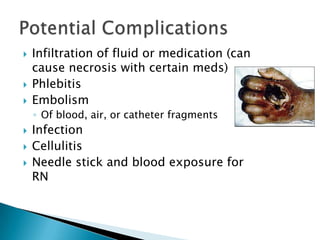
Scalp Veins have no valves and are easily visible on infants- allowing infusion in both directionsInfiltration of fluid or medication (can cause necrosis with certain meds)PhlebitisEmbolismOf blood, air, or catheter fragmentsInfectionCellulitisNeedle stick and blood exposure for RNPotential Complications
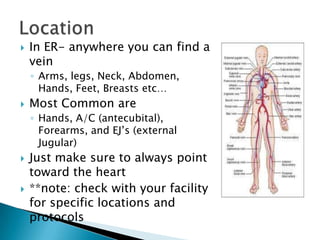
In ER- anywhere you can find a veinArms, legs, Neck, Abdomen, Hands, Feet, Breasts etc…Most Common areHands, A/C (antecubital), Forearms, and EJ’s (external Jugular)Just make sure to always point toward the heart **note: check with your facility for specific locations and protocolsLocation
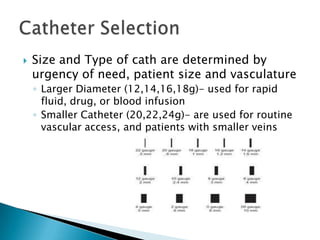
Size and Type of cath are determined by urgency of need, patient size and vasculatureLarger Diameter (12,14,16,18g)- used for rapid fluid, drug, or blood infusionSmaller Catheter (20,22,24g)- are used for routine vascular access, and patients with smaller veinsCatheter Selection
IV Insertion
Central Venus Access
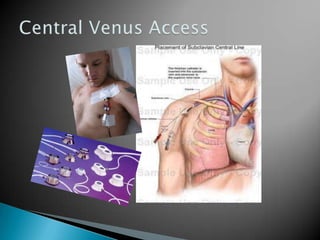
Subclavian Vein- under the clavicleInternal Jugular- also under the clavicle Femoral Vein- In the groinWhere are they placed?
Why do we place them?Short TermWhen all other peripheral access is unavailableWhen condition is unstable and requires hemodynamic monitoring (eg CVP)Prolonged IV TherapyTPN, extended Abx therapy, or caustic medication administration VancomycinDebilitating diseases 	AIDS, CancerLong Term
Central Line Insertion
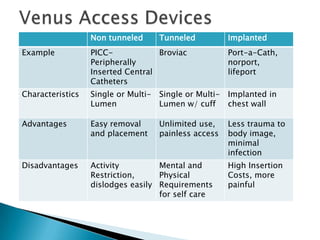
Venus Access Devices
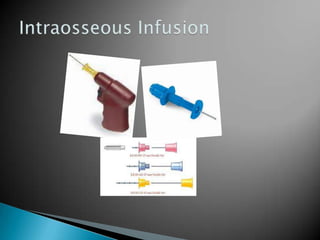
Intraosseous Infusion
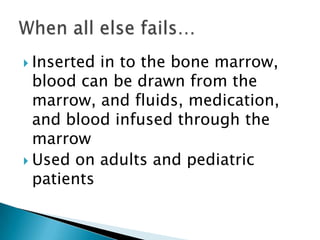
Inserted in to the bone marrow, blood can be drawn from the marrow, and fluids, medication, and blood infused through the marrowUsed on adults and pediatric patientsWhen all else fails…
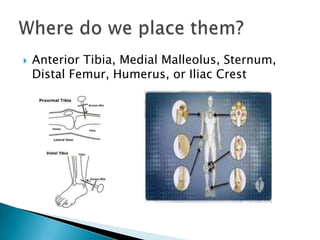
Anterior Tibia, Medial Malleolus, Sternum, Distal Femur, Humerus, or Iliac CrestWhere do we place them?
You Tube Video for Humeral IO, staring someone familiar…..
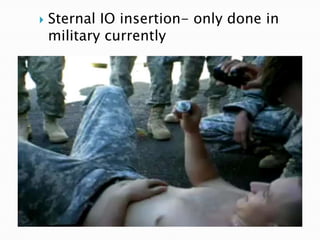
Sternal IO insertion- only done in military currently
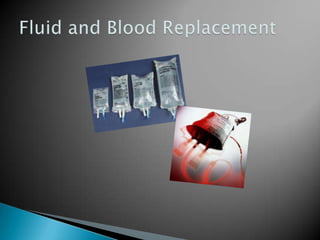
Fluid and Blood Replacement
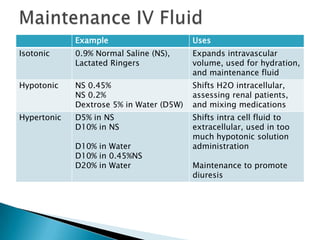
Maintenance IV Fluid
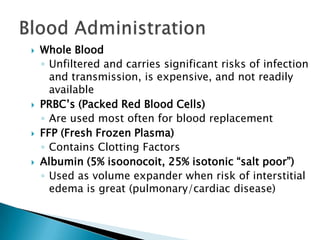
Whole BloodUnfiltered and carries significant risks of infection and transmission, is expensive, and not readily availablePRBC’s (Packed Red Blood Cells)Are used most often for blood replacementFFP (Fresh Frozen Plasma)Contains Clotting FactorsAlbumin (5% isoonocoit, 25% isotonic “salt poor”)Used as volume expander when risk of interstitial edema is great (pulmonary/cardiac disease)Blood Administration

Vascular access

  • 1.
  • 2.
  • 3.
    Tips and TricksPeripheralAccess is obtained using Aseptic technique
  • 4.
    Initial insertion attemptsshould begin distally and progress up the extremity
  • 5.
    If the situationand pt vasculature allow
  • 6.
    During resuscitation peripheralaccess is preferred to eliminate interruption in chest compression for central line insertion
  • 7.
    Proximal veins maybe used when giving medication with extremely short half life, or for rapid fluid or CT contrast infusion
  • 8.
  • 9.
    Scalp Veins haveno valves and are easily visible on infants- allowing infusion in both directionsInfiltration of fluid or medication (can cause necrosis with certain meds)PhlebitisEmbolismOf blood, air, or catheter fragmentsInfectionCellulitisNeedle stick and blood exposure for RNPotential Complications
  • 10.
    In ER- anywhereyou can find a veinArms, legs, Neck, Abdomen, Hands, Feet, Breasts etc…Most Common areHands, A/C (antecubital), Forearms, and EJ’s (external Jugular)Just make sure to always point toward the heart **note: check with your facility for specific locations and protocolsLocation
  • 11.
    Size and Typeof cath are determined by urgency of need, patient size and vasculatureLarger Diameter (12,14,16,18g)- used for rapid fluid, drug, or blood infusionSmaller Catheter (20,22,24g)- are used for routine vascular access, and patients with smaller veinsCatheter Selection
  • 12.
  • 13.
  • 14.
    Subclavian Vein- underthe clavicleInternal Jugular- also under the clavicle Femoral Vein- In the groinWhere are they placed?
  • 15.
    Why do weplace them?Short TermWhen all other peripheral access is unavailableWhen condition is unstable and requires hemodynamic monitoring (eg CVP)Prolonged IV TherapyTPN, extended Abx therapy, or caustic medication administration VancomycinDebilitating diseases AIDS, CancerLong Term
  • 16.
  • 17.
  • 18.
  • 19.
    Inserted in tothe bone marrow, blood can be drawn from the marrow, and fluids, medication, and blood infused through the marrowUsed on adults and pediatric patientsWhen all else fails…
  • 20.
    Anterior Tibia, MedialMalleolus, Sternum, Distal Femur, Humerus, or Iliac CrestWhere do we place them?
  • 21.
    You Tube Videofor Humeral IO, staring someone familiar…..
  • 22.
    Sternal IO insertion-only done in military currently
  • 23.
    Fluid and BloodReplacement
  • 24.
  • 25.
    Whole BloodUnfiltered andcarries significant risks of infection and transmission, is expensive, and not readily availablePRBC’s (Packed Red Blood Cells)Are used most often for blood replacementFFP (Fresh Frozen Plasma)Contains Clotting FactorsAlbumin (5% isoonocoit, 25% isotonic “salt poor”)Used as volume expander when risk of interstitial edema is great (pulmonary/cardiac disease)Blood Administration