...‫اﻟﻠﻪ‬ ‫ﺑﺎﺳﻢ‬ (( ً
‫ﺳﻬﻼ‬ ‫ﺷﺌﺖ‬ ‫إذا‬ ‫اﻟﺤﺰن‬ ‫ﺗﺠﻌﻞ‬ ‫وأﻧﺖ‬ ً
‫ﺳﻬﻼ‬ ‫ﺟﻌﻠﺘﻪ‬ ‫ﻣﺎ‬ ‫إﻻ‬ ‫ﺳﻬﻞ‬ ‫ﻻ‬ ‫ﻢ‬ ّ
‫اﻟﻠﻬ‬ ))
Vascular Access
{Color index: ​Important​| ​Notes​ ​| ​Book​ ​|​ ​Extra ​|​ ​Editing File​ | ​comments or errors​}
Resources: lecture slides, 435teamwork, Book
Objectives
● Examine the construction of the commonly used venous catheters.
● Anatomical considerations regarding peripheral and ​central venous access​.
● Choice of catheter size.
● Prepare and set-up an IV infusion set.
● The choice of sites for placement of IV catheters.
● What are the different sites suitable for ​central venous catheter ​and ​arterial catheter
placement?
● Universal precautions.
● Indications and complications of central venous access
● Indications and complications of arterial access
Done by:​ Najd AlTheeb, Sama alharbi, Lina Alwakeel
Revised by: ​Amal Alshaibi, Rawan alwadee, Shrooq alsomali
★ Medical Asepsis:
● Removal or destruction of disease causing organisms or infected material
● Sterile technique (surgical asepsis)
● Clean technique
★ Antiseptics and Disinfectants:
● Chemical agents used to kill ​or reduce the count of ​specific microorganisms ​mostly
bacterial.
● Some chemical agents have antiseptic and disinfectant properties
Disinfectants:
● Used on non-living objects ​(e.g. Bleach)
● Toxic to living tissue
Antiseptics:
● Applied to living tissue​ ​like skin.
● More dilute to prevent cell damage ​ ​(e.g. alcohol, iodine)
What is the difference between alcohol and iodine?
iodine is bacteriostatic (it decreases the bacterial count) after applying it wait 3-5 minutes it will
decrease the bacterial count but there are still some remaining bacteria while alcohol is a
bactericidal (it destroys the bacteria).
Sometimes they are using both alcohol and iodine at the same time in the OR, initially iodine then
alcohol to destroy the remaining bacteria.
★ Universal Precautions:
Universal standard precautions on every patient:
● Observe ​hand washing​ and gloving procedures ​to remove the bacteria physically​.
● Face shields​ indicated during clean procedures
● Sterile gowns​ plus above all for sterile procedures.
In clean procedure in which it does not require all sterile precautions you may not need sterile
gloves. like peripheral IV access you need only hand washing and non-sterile gloves but for
central venous catheter, Epidural catheter, spinal anesthesia or any surgical procedure you need
(hand washing, sterile gloves, sterile gowns)
★ Types of IV catheters:
● Hollow needles
○ butterfly type ​Nowadays it's not commonly used, you may see it in pediatric
● Indwelling plastic catheter over hollow needle ​commonly used
● Indwelling plastic catheter inserted through a hollow needle
○ Intracath
★ Needles:
● Vary in length and gauge
● Larger gauge means smaller needle
★ Peripheral IV insertion:
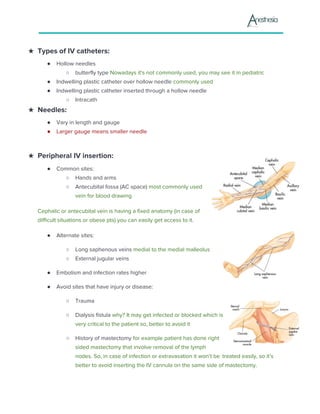
● Common sites:
○ Hands and arms
○ Antecubital fossa (AC space)​ most commonly used
vein for blood drawing
Cephalic or antecubital vein is having a fixed anatomy (in case of
difficult situations or obese pts) you can easily get access to it.
● Alternate sites:
○ Long saphenous veins ​medial to the medial malleolus
○ External jugular veins
● Embolism and infection rates higher
● Avoid sites that have injury or disease:
○ Trauma
○ Dialysis fistula ​why? It may get infected or blocked which is
very critical to the patient so, better to avoid it
○ History of mastectomy ​for example patient has done right
sided mastectomy that involve removal of the lymph
nodes. So, in case of infection or extravasation it won’t be ​ ​treated easily, so it’s
better to avoid inserting the IV cannula on the same side of mastectomy.
★ Peripheral IV Procedure:
1. Explain procedure
2. Assemble equipment
3. Inspect fluid for contamination appearance, and expiration date
4. Prepare infusion set
○ Attach infusion set to bag of solution
5. Clamp tubing and squeeze reservoir on infusion set until it fills half way
6. Open clamp and flush air from tubing
7. Close clamp
8. Maintain aseptic technique
★ Indwelling vascular device:
● Heparin or saline lock
★ Peripheral IV procedures:​ it’s a clean not a sterile procedure
● Select catheter:
○ Large-bore​ catheter used for fluid replacement ​> 14 to 16 gauge
○ Smaller bore​ catheter used for “keep open” lines ​> 18 to 20 gauge
● Prepare other equipment
● Put on gloves
● Select site
● Apply tourniquet above antecubital space ​to make the veins prominent.
● Prepare site,​ it means clean with alcohol or iodine...ext.
● Cleanse area with alcohol or iodine wipes (per protocol)
○ Check for iodine allergy
● Stabilize vein ​because sometimes skin is loose or veins become tortuous so we have to make it
straight.
● Apply pressure and tension to point of entry
There are two parts of the IV catheter: 1- plastic part, it remains inside and is called
cannula. 2- needle, which is used to pierce the skin.
● Bevel​ (bevel is cut at 45 degrees) ​of the needle up in adults
○ May be down in infants and children
● Pass needle through skin into vein from side or directly on top
● Advance needle​ and catheter about ​2 mm​ past point where blood return is seen in hub of
needle. ​When you see blood it means your needle is inside the vein, but the catheter is still
outside. So advance 2mm more.
● Slide catheter over needle and into vein
● Withdraw needle while stabilizing catheter
● Lock in protective sheath if present
● Apply pressure on proximal end of catheter to stop escaping blood
● Obtain blood samples if needed
● Release tourniquet
● Attach IV tubing
● Open tubing clamp and allow fluid infusion to begin at prescribed flow rate
● Cover puncture site dressing
○ Antibiotic ointment if indicated by protocol
● Anchor tubing
● Secure catheter ​and proper fixation is very important.
● Document procedure ​very important (document about which side did you insert the catheter
and in which arm, vital signs, any complications like redness itching...etc.)
● Monitor flow
★ Local Complications:
● Pain and irritation
● Infiltration and extravasation ​immediate complication
● Phlebitis
● Thrombosis and thrombophlebitis
● Hematoma formation ​immediate complication
● Venous spasm
● Vessel collapse
● Cellulitis
● Nerve, tendon,ligament, and limb damage
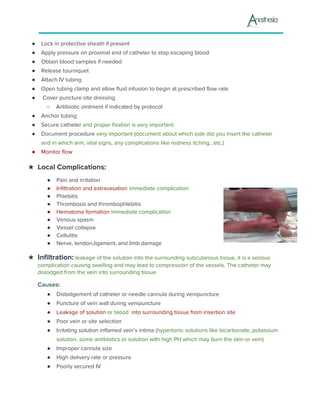
★ Infiltration:​ leakage of the solution into the surrounding subcutanous tissue, it is a serious
complication causing swelling and may lead to compression of the vessels. The catheter may
dislodged from the vein into surrounding tissue
Causes:
● Dislodgement of catheter or needle cannula during venipuncture
● Puncture of vein wall during venipuncture
● Leakage of solution ​or blood ​ into surrounding tissue from insertion site
● Poor vein or site selection
● Irritating solution inflamed vein’s intima ​(hypertonic solutions like bicarbonate, potassium
solution, some antibiotics or solution with high PH which may burn the skin or vein)
● Improper cannula size
● High delivery rate or pressure
● Poorly secured IV
Signs and Symptoms:
● Cool skin around IV site ​compare it with other area
● Swelling at IV site
○ With or without pain
● Sluggish or absent flow
● Infusion flows when fluid is pushed forcefully
● No backflow of blood into IV tubing when clamp is fully opened and solution container is
lowered below IV site
Management:
● Lower fluid reservoir to check for presence of backflow of blood into the tubing
○ Absence of backflow suggests infiltration
● Discontinue IV infusion
● Remove needle or catheter
● Apply a pressure dressing to the site
● Choose new site
● Initiate IV therapy with new equipment
● Document
Sometimes when it compromises the vascularity it may need surgical intervention or
incision to relieve it
★ Central Venous Access:​ (access to bigger veins usually deep veins like IJV or subclavian
that is directly go to SVC or IVC)
● Requires special training
● Authorization from medical direction
● Not for rapid fluid replacement in pre-hospital setting ​not for trauma cases
● Within scope of paramedic practice in some EMS systems
Common sites include:
● Femoral vein ​to get access to IVC
● Internal jugular vein ​ ​to get access to SVC
● Subclavian vein
● sometimes Axillary vein
Prepare as for peripheral veins (Sterile procedure)
Success depends on:
● Patient's body position
● Knowledge of anatomy
● Familiarity with the procedure and equipment
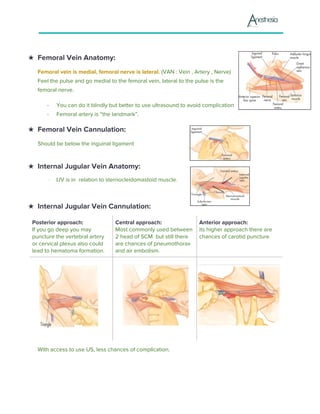
★ Femoral Vein Anatomy:
Femoral vein is medial, femoral nerve is lateral. ​(VAN : Vein , Artery , Nerve)
Feel the pulse and go medial to the femoral vein, lateral to the pulse is the
femoral nerve.
- You can do it blindly but better to use ultrasound to avoid complication
- Femoral artery is “the landmark”.
★ Femoral Vein Cannulation:
Should be below the inguinal ligament
★ Internal Jugular Vein Anatomy:
·​ ​IJV is in​ ​relation to sternocleidomastoid muscle.
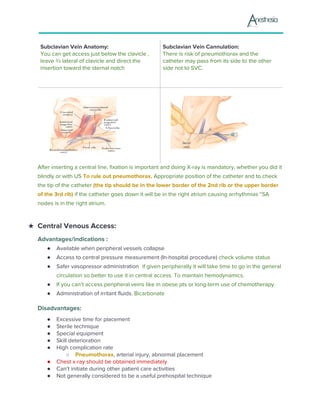
★ Internal Jugular Vein Cannulation:
Posterior approach:
If you go deep you may
puncture the vertebral artery
or cervical plexus also could
lead to hematoma formation.
Central approach:
Most commonly used between
2 head of SCM but still there
are chances of pneumothorax
and air embolism.
Anterior approach:
its higher approach there are
chances of carotid puncture
With access to use US, less chances of complication.
Subclavian Vein Anatomy:
You can get access just below the clavicle ,
leave ⅔ lateral of clavicle and direct the
insertion toward the sternal notch
Subclavian Vein Cannulation:
There is risk of pneumothorax and the
catheter may pass from its side to the other
side not to SVC.
After inserting a central line, fixation is important and doing X-ray is mandatory, whether you did it
blindly or with US ​To rule out pneumothorax, ​Appropriate position of the catheter and to check
the tip of the catheter ​(the tip should be in the lower border of the 2nd rib or the upper border
of the 3rd rib)​ ​if the catheter goes down it will be in the right atrium causing arrhythmias “SA
nodes is in the right atrium.
★ Central Venous Access:
Advantages/indications :
● Available when peripheral vessels collapse
● Access to central pressure measurement (In-hospital procedure) ​check volume status
● Safer vasopressor administration ​ ​if given peripherally it will take time to go in the general
circulation so better to use it in central access. To maintain hemodynamics.
● If you can’t access peripheral veins like in obese pts or long-term use of chemotherapy.
● Administration of irritant fluids. ​Bicarbonate
Disadvantages:
● Excessive time for placement
● Sterile technique
● Special equipment
● Skill deterioration
● High complication rate
○ Pneumothorax​, arterial injury, abnormal placement
● Chest x-ray should be obtained immediately
● Can’t initiate during other patient care activities
● Not generally considered to be a useful prehospital technique
● Lower flow rates than peripheral IV
Complications:
● ​Femoral vein: (Local complications, Systemic complications)
● ​Internal jugular and subclavian veins: (Local complications, Systemic complications)
Systemic Complications:
● ​Contamination and infection
● ​Hypersensitivity reactions
● ​​Sepsis
● ​​Speed shock ​Administering drug through central circulation may cause rapid response of
the drug because the release of histamine will be immediate unlike the peripheral vein
which the drug takes more time to do its action.
● ​Emboli (blood clot, air, and catheter)
★ Air Embolism:
● Uncommon but can be fatal ​(most fetal complication)
● Air enters the blood stream through catheter tubing
● Risk greatest with catheter in central circulation ​like in SVC air can go very easily & drain
into general circulation and may obstruct the blood flow into the heart​.
● Negative pressure may pull air in ​but in positive pressure ventilation the chance of getting
air embolism is low.
○ If the catheter above the heart level → air can enter into the catheter
○ If it is below the heart level → blood will come into the catheter
● ​Air can enter circulation
○ During catheter insertion
○ If tubing is disconnected
● ​If enough air enters the heart chamber:​ ( it depends on how much air and the speed of air)
○ Blood flow is impeded. ​If it is a big bubble > invade the pulmonary artery which will
cause decreased cardiac output or no cardiac output, then the patient will show
signs of shock. causing either partial or complete occlusion > the heart is unable
to pump blood
○ Shock develops
Signs and symptoms:
● Hypotension
● Cyanosis
● Weak and rapid pulse
● Loss of consciousness
● Sudden arrhythmias
● Sudden drop in saturation
● S​udden drop in EtCO2
Management:
● Close the tubing
● Turn patient on left side with head down ​It will shift the bubbles from pulmonary artery to
the apex of the heart so the blood will start flowing.
● Check tubing for leaks
● Administer100% Oxygen
● Notify medical direction
Indwelling Vascular Devices​:
● Single, dual, and triple lumen catheters
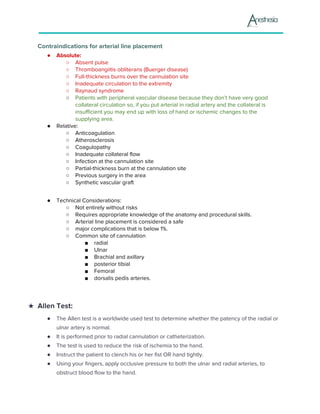
US guided IV insertion US guided CVC insertion
Arterial line placement:
● Provide Continuous BP monitoring
● Arterial blood sampling
★ Arterial line placement indications :
● Continuous arterial BP monitoring - more accurate than NIBP. ​Beat to beat change
● ​Inability to use indirect BP monitoring (eg, in patients with severe burns or morbid obesity)
● ​Frequent blood sampling
● ​Frequent arterial blood gas sampling
● In major vascular surgeries, cardiac surgeries and neurosurgeries. And in critical patient
like ischemic heart disease.
● ICU patient, for monitoring and repeated blood sampling.
Contraindications for arterial line placement
● Absolute:
○ ​Absent pulse
○ ​Thromboangiitis obliterans (Buerger disease)
○ ​Full-thickness burns over the cannulation site
○ ​Inadequate circulation to the extremity
○ ​Raynaud syndrome
○ Patients with peripheral vascular disease because they don’t have very good
collateral circulation so, if you put arterial in radial artery and the collateral is
insufficient you may end up with loss of hand or ischemic changes to the
supplying area.
● Relative:
○ ​Anticoagulation
○ ​Atherosclerosis
○ ​Coagulopathy
○ ​Inadequate collateral flow
○ ​Infection at the cannulation site
○ ​Partial-thickness burn at the cannulation site
○ ​Previous surgery in the area
○ ​Synthetic vascular graft
● Technical Considerations:
○ ​Not entirely without risks
○ ​Requires appropriate knowledge of the anatomy and procedural skills.
○ ​Arterial line placement is considered a safe
○ major complications that is below 1%.
○ ​Common site of cannulation
■ radial
■ Ulnar
■ Brachial and axillary
■ posterior tibial
■ Femoral
■ dorsalis pedis arteries.
★ Allen Test:
● The Allen test is a worldwide used test to determine whether the patency of the radial or
ulnar artery is normal.
● It is performed prior to radial cannulation or catheterization.
● The test is used to reduce the risk of ischemia to the hand.
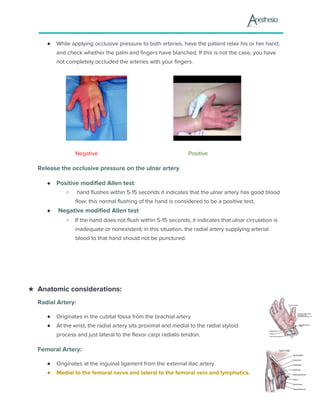
● Instruct the patient to clench his or her fist OR hand tightly.
● Using your fingers, apply occlusive pressure to both the ulnar and radial arteries, to
obstruct blood flow to the hand.
● While applying occlusive pressure to both arteries, have the patient relax his or her hand,
and check whether the palm and fingers have blanched. If this is not the case, you have
not completely occluded the arteries with your fingers.
Negative Positive
Release the occlusive pressure on the ulnar artery
● Positive modified Allen test​:
○ hand flushes within 5-15 seconds it indicates that the ulnar artery has good blood
flow; this normal flushing of the hand is considered to be a positive test.
● Negative modified Allen test
○ If the hand does not flush within 5-15 seconds, it indicates that ulnar circulation is
inadequate or nonexistent; in this situation, the radial artery supplying arterial
blood to that hand should not be punctured.
★ Anatomic considerations:
Radial Artery:
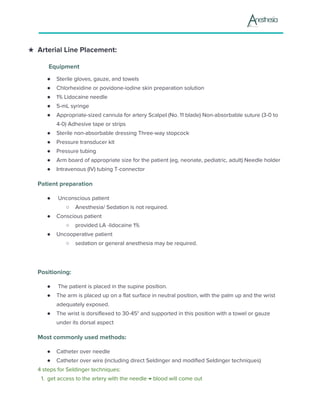
● Originates in the cubital fossa from the brachial artery
● At the wrist, the radial artery sits proximal and medial to the radial styloid
process and just lateral to the flexor carpi radialis tendon.
Femoral Artery:
● Originates at the inguinal ligament from the external iliac artery
● Medial to the femoral nerve and lateral to the femoral vein and lymphatics.
★ Arterial Line Placement:
Equipment
● Sterile gloves, gauze, and towels
● Chlorhexidine or povidone-iodine skin preparation solution
● 1% Lidocaine needle
● 5-mL syringe
● Appropriate-sized cannula for artery Scalpel (No. 11 blade) Non-absorbable suture (3-0 to
4-0) Adhesive tape or strips
● Sterile non-absorbable dressing Three-way stopcock
● Pressure transducer kit
● Pressure tubing
● Arm board of appropriate size for the patient (eg, neonate, pediatric, adult) Needle holder
● Intravenous (IV) tubing T-connector
Patient preparation
● Unconscious patient
○ Anesthesia/ Sedation is not required.
● Conscious patient
○ provided LA -lidocaine 1%
● Uncooperative patient
○ sedation or general anesthesia may be required.
Positioning:
● The patient is placed in the supine position.
● The arm is placed up on a flat surface in neutral position, with the palm up and the wrist
adequately exposed.
● The wrist is dorsiflexed to 30-45° and supported in this position with a towel or gauze
under its dorsal aspect
Most commonly used methods:
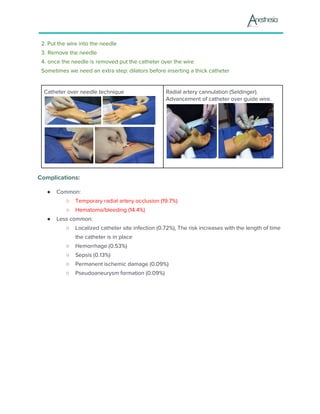
● Catheter over needle
● Catheter over wire (including direct Seldinger and modified Seldinger techniques)
4 steps for Seldinger techniques:
1.​ ​get access to the artery with the needle → blood will come out
2. Put the wire into the needle
3.​ ​Remove the needle
4.​ ​once the needle is removed put the catheter over the wire
Sometimes we need an extra step: dilators before inserting a thick catheter
Catheter over needle technique Radial artery cannulation (Seldinger).
Advancement of catheter over guide wire.
Complications:
● Common:
○ Temporary radial artery occlusion (19.7%)
○ Hematoma/bleeding (14.4%)
● Less common:
○ Localized catheter site infection (0.72%), The risk increases with the length of time
the catheter is in place
○ Hemorrhage (0.53%)
○ Sepsis (0.13%)
○ Permanent ischemic damage (0.09%)
○ Pseudoaneurysm formation (0.09%)
Practice Questions:
Q45: What is the anatomical position of femoral vein?
A. Medial to femoral nerve
B. Lateral to femoral artery
C. Medial to femoral artery
D. Lateral to femoral nerve
Q46: While inserting central venous catheter. What will be the correct position of the tip of the
catheter on X-ray chest?
A. Right atrium
B. Lower border of 1st rib
C. Upper border of 3rd rib
D. Below the clavicle
Q58: Which one of the following is the expected complication while inserting left internal
jugular vein catheter?
A. A) Pneumothorax
B. B) Vagus nerve injury
C. C) Chylothorax
D. D) Phrenic nerve injury
Answers:
Q1: C | Q2: C | Q3: A |

9-Vascular-Access-updated.pdf

  • 1.
    ...‫اﻟﻠﻪ‬ ‫ﺑﺎﺳﻢ‬ ((ً ‫ﺳﻬﻼ‬ ‫ﺷﺌﺖ‬ ‫إذا‬ ‫اﻟﺤﺰن‬ ‫ﺗﺠﻌﻞ‬ ‫وأﻧﺖ‬ ً ‫ﺳﻬﻼ‬ ‫ﺟﻌﻠﺘﻪ‬ ‫ﻣﺎ‬ ‫إﻻ‬ ‫ﺳﻬﻞ‬ ‫ﻻ‬ ‫ﻢ‬ ّ ‫اﻟﻠﻬ‬ )) Vascular Access {Color index: ​Important​| ​Notes​ ​| ​Book​ ​|​ ​Extra ​|​ ​Editing File​ | ​comments or errors​} Resources: lecture slides, 435teamwork, Book Objectives ● Examine the construction of the commonly used venous catheters. ● Anatomical considerations regarding peripheral and ​central venous access​. ● Choice of catheter size. ● Prepare and set-up an IV infusion set. ● The choice of sites for placement of IV catheters. ● What are the different sites suitable for ​central venous catheter ​and ​arterial catheter placement? ● Universal precautions. ● Indications and complications of central venous access ● Indications and complications of arterial access Done by:​ Najd AlTheeb, Sama alharbi, Lina Alwakeel Revised by: ​Amal Alshaibi, Rawan alwadee, Shrooq alsomali
  • 2.
    ★ Medical Asepsis: ●Removal or destruction of disease causing organisms or infected material ● Sterile technique (surgical asepsis) ● Clean technique ★ Antiseptics and Disinfectants: ● Chemical agents used to kill ​or reduce the count of ​specific microorganisms ​mostly bacterial. ● Some chemical agents have antiseptic and disinfectant properties Disinfectants: ● Used on non-living objects ​(e.g. Bleach) ● Toxic to living tissue Antiseptics: ● Applied to living tissue​ ​like skin. ● More dilute to prevent cell damage ​ ​(e.g. alcohol, iodine) What is the difference between alcohol and iodine? iodine is bacteriostatic (it decreases the bacterial count) after applying it wait 3-5 minutes it will decrease the bacterial count but there are still some remaining bacteria while alcohol is a bactericidal (it destroys the bacteria). Sometimes they are using both alcohol and iodine at the same time in the OR, initially iodine then alcohol to destroy the remaining bacteria. ★ Universal Precautions: Universal standard precautions on every patient: ● Observe ​hand washing​ and gloving procedures ​to remove the bacteria physically​. ● Face shields​ indicated during clean procedures ● Sterile gowns​ plus above all for sterile procedures. In clean procedure in which it does not require all sterile precautions you may not need sterile gloves. like peripheral IV access you need only hand washing and non-sterile gloves but for central venous catheter, Epidural catheter, spinal anesthesia or any surgical procedure you need (hand washing, sterile gloves, sterile gowns)
  • 3.
    ★ Types ofIV catheters: ● Hollow needles ○ butterfly type ​Nowadays it's not commonly used, you may see it in pediatric ● Indwelling plastic catheter over hollow needle ​commonly used ● Indwelling plastic catheter inserted through a hollow needle ○ Intracath ★ Needles: ● Vary in length and gauge ● Larger gauge means smaller needle ★ Peripheral IV insertion: ● Common sites: ○ Hands and arms ○ Antecubital fossa (AC space)​ most commonly used vein for blood drawing Cephalic or antecubital vein is having a fixed anatomy (in case of difficult situations or obese pts) you can easily get access to it. ● Alternate sites: ○ Long saphenous veins ​medial to the medial malleolus ○ External jugular veins ● Embolism and infection rates higher ● Avoid sites that have injury or disease: ○ Trauma ○ Dialysis fistula ​why? It may get infected or blocked which is very critical to the patient so, better to avoid it ○ History of mastectomy ​for example patient has done right sided mastectomy that involve removal of the lymph nodes. So, in case of infection or extravasation it won’t be ​ ​treated easily, so it’s better to avoid inserting the IV cannula on the same side of mastectomy.
  • 4.
    ★ Peripheral IVProcedure: 1. Explain procedure 2. Assemble equipment 3. Inspect fluid for contamination appearance, and expiration date 4. Prepare infusion set ○ Attach infusion set to bag of solution 5. Clamp tubing and squeeze reservoir on infusion set until it fills half way 6. Open clamp and flush air from tubing 7. Close clamp 8. Maintain aseptic technique ★ Indwelling vascular device: ● Heparin or saline lock ★ Peripheral IV procedures:​ it’s a clean not a sterile procedure ● Select catheter: ○ Large-bore​ catheter used for fluid replacement ​> 14 to 16 gauge ○ Smaller bore​ catheter used for “keep open” lines ​> 18 to 20 gauge ● Prepare other equipment ● Put on gloves ● Select site ● Apply tourniquet above antecubital space ​to make the veins prominent. ● Prepare site,​ it means clean with alcohol or iodine...ext. ● Cleanse area with alcohol or iodine wipes (per protocol) ○ Check for iodine allergy ● Stabilize vein ​because sometimes skin is loose or veins become tortuous so we have to make it straight. ● Apply pressure and tension to point of entry There are two parts of the IV catheter: 1- plastic part, it remains inside and is called cannula. 2- needle, which is used to pierce the skin. ● Bevel​ (bevel is cut at 45 degrees) ​of the needle up in adults ○ May be down in infants and children ● Pass needle through skin into vein from side or directly on top ● Advance needle​ and catheter about ​2 mm​ past point where blood return is seen in hub of needle. ​When you see blood it means your needle is inside the vein, but the catheter is still outside. So advance 2mm more. ● Slide catheter over needle and into vein ● Withdraw needle while stabilizing catheter
  • 5.
    ● Lock inprotective sheath if present ● Apply pressure on proximal end of catheter to stop escaping blood ● Obtain blood samples if needed ● Release tourniquet ● Attach IV tubing ● Open tubing clamp and allow fluid infusion to begin at prescribed flow rate ● Cover puncture site dressing ○ Antibiotic ointment if indicated by protocol ● Anchor tubing ● Secure catheter ​and proper fixation is very important. ● Document procedure ​very important (document about which side did you insert the catheter and in which arm, vital signs, any complications like redness itching...etc.) ● Monitor flow ★ Local Complications: ● Pain and irritation ● Infiltration and extravasation ​immediate complication ● Phlebitis ● Thrombosis and thrombophlebitis ● Hematoma formation ​immediate complication ● Venous spasm ● Vessel collapse ● Cellulitis ● Nerve, tendon,ligament, and limb damage ★ Infiltration:​ leakage of the solution into the surrounding subcutanous tissue, it is a serious complication causing swelling and may lead to compression of the vessels. The catheter may dislodged from the vein into surrounding tissue Causes: ● Dislodgement of catheter or needle cannula during venipuncture ● Puncture of vein wall during venipuncture ● Leakage of solution ​or blood ​ into surrounding tissue from insertion site ● Poor vein or site selection ● Irritating solution inflamed vein’s intima ​(hypertonic solutions like bicarbonate, potassium solution, some antibiotics or solution with high PH which may burn the skin or vein) ● Improper cannula size ● High delivery rate or pressure ● Poorly secured IV
  • 6.
    Signs and Symptoms: ●Cool skin around IV site ​compare it with other area ● Swelling at IV site ○ With or without pain ● Sluggish or absent flow ● Infusion flows when fluid is pushed forcefully ● No backflow of blood into IV tubing when clamp is fully opened and solution container is lowered below IV site Management: ● Lower fluid reservoir to check for presence of backflow of blood into the tubing ○ Absence of backflow suggests infiltration ● Discontinue IV infusion ● Remove needle or catheter ● Apply a pressure dressing to the site ● Choose new site ● Initiate IV therapy with new equipment ● Document Sometimes when it compromises the vascularity it may need surgical intervention or incision to relieve it ★ Central Venous Access:​ (access to bigger veins usually deep veins like IJV or subclavian that is directly go to SVC or IVC) ● Requires special training ● Authorization from medical direction ● Not for rapid fluid replacement in pre-hospital setting ​not for trauma cases ● Within scope of paramedic practice in some EMS systems Common sites include: ● Femoral vein ​to get access to IVC ● Internal jugular vein ​ ​to get access to SVC ● Subclavian vein ● sometimes Axillary vein Prepare as for peripheral veins (Sterile procedure) Success depends on: ● Patient's body position ● Knowledge of anatomy ● Familiarity with the procedure and equipment
  • 7.
    ★ Femoral VeinAnatomy: Femoral vein is medial, femoral nerve is lateral. ​(VAN : Vein , Artery , Nerve) Feel the pulse and go medial to the femoral vein, lateral to the pulse is the femoral nerve. - You can do it blindly but better to use ultrasound to avoid complication - Femoral artery is “the landmark”. ★ Femoral Vein Cannulation: Should be below the inguinal ligament ★ Internal Jugular Vein Anatomy: ·​ ​IJV is in​ ​relation to sternocleidomastoid muscle. ★ Internal Jugular Vein Cannulation: Posterior approach: If you go deep you may puncture the vertebral artery or cervical plexus also could lead to hematoma formation. Central approach: Most commonly used between 2 head of SCM but still there are chances of pneumothorax and air embolism. Anterior approach: its higher approach there are chances of carotid puncture With access to use US, less chances of complication.
  • 8.
    Subclavian Vein Anatomy: Youcan get access just below the clavicle , leave ⅔ lateral of clavicle and direct the insertion toward the sternal notch Subclavian Vein Cannulation: There is risk of pneumothorax and the catheter may pass from its side to the other side not to SVC. After inserting a central line, fixation is important and doing X-ray is mandatory, whether you did it blindly or with US ​To rule out pneumothorax, ​Appropriate position of the catheter and to check the tip of the catheter ​(the tip should be in the lower border of the 2nd rib or the upper border of the 3rd rib)​ ​if the catheter goes down it will be in the right atrium causing arrhythmias “SA nodes is in the right atrium. ★ Central Venous Access: Advantages/indications : ● Available when peripheral vessels collapse ● Access to central pressure measurement (In-hospital procedure) ​check volume status ● Safer vasopressor administration ​ ​if given peripherally it will take time to go in the general circulation so better to use it in central access. To maintain hemodynamics. ● If you can’t access peripheral veins like in obese pts or long-term use of chemotherapy. ● Administration of irritant fluids. ​Bicarbonate Disadvantages: ● Excessive time for placement ● Sterile technique ● Special equipment ● Skill deterioration ● High complication rate ○ Pneumothorax​, arterial injury, abnormal placement ● Chest x-ray should be obtained immediately ● Can’t initiate during other patient care activities ● Not generally considered to be a useful prehospital technique
  • 9.
    ● Lower flowrates than peripheral IV Complications: ● ​Femoral vein: (Local complications, Systemic complications) ● ​Internal jugular and subclavian veins: (Local complications, Systemic complications) Systemic Complications: ● ​Contamination and infection ● ​Hypersensitivity reactions ● ​​Sepsis ● ​​Speed shock ​Administering drug through central circulation may cause rapid response of the drug because the release of histamine will be immediate unlike the peripheral vein which the drug takes more time to do its action. ● ​Emboli (blood clot, air, and catheter) ★ Air Embolism: ● Uncommon but can be fatal ​(most fetal complication) ● Air enters the blood stream through catheter tubing ● Risk greatest with catheter in central circulation ​like in SVC air can go very easily & drain into general circulation and may obstruct the blood flow into the heart​. ● Negative pressure may pull air in ​but in positive pressure ventilation the chance of getting air embolism is low. ○ If the catheter above the heart level → air can enter into the catheter ○ If it is below the heart level → blood will come into the catheter ● ​Air can enter circulation ○ During catheter insertion ○ If tubing is disconnected ● ​If enough air enters the heart chamber:​ ( it depends on how much air and the speed of air) ○ Blood flow is impeded. ​If it is a big bubble > invade the pulmonary artery which will cause decreased cardiac output or no cardiac output, then the patient will show signs of shock. causing either partial or complete occlusion > the heart is unable to pump blood ○ Shock develops Signs and symptoms: ● Hypotension ● Cyanosis ● Weak and rapid pulse
  • 10.
    ● Loss ofconsciousness ● Sudden arrhythmias ● Sudden drop in saturation ● S​udden drop in EtCO2 Management: ● Close the tubing ● Turn patient on left side with head down ​It will shift the bubbles from pulmonary artery to the apex of the heart so the blood will start flowing. ● Check tubing for leaks ● Administer100% Oxygen ● Notify medical direction Indwelling Vascular Devices​: ● Single, dual, and triple lumen catheters US guided IV insertion US guided CVC insertion Arterial line placement: ● Provide Continuous BP monitoring ● Arterial blood sampling ★ Arterial line placement indications : ● Continuous arterial BP monitoring - more accurate than NIBP. ​Beat to beat change ● ​Inability to use indirect BP monitoring (eg, in patients with severe burns or morbid obesity) ● ​Frequent blood sampling ● ​Frequent arterial blood gas sampling ● In major vascular surgeries, cardiac surgeries and neurosurgeries. And in critical patient like ischemic heart disease. ● ICU patient, for monitoring and repeated blood sampling.
  • 11.
    Contraindications for arterialline placement ● Absolute: ○ ​Absent pulse ○ ​Thromboangiitis obliterans (Buerger disease) ○ ​Full-thickness burns over the cannulation site ○ ​Inadequate circulation to the extremity ○ ​Raynaud syndrome ○ Patients with peripheral vascular disease because they don’t have very good collateral circulation so, if you put arterial in radial artery and the collateral is insufficient you may end up with loss of hand or ischemic changes to the supplying area. ● Relative: ○ ​Anticoagulation ○ ​Atherosclerosis ○ ​Coagulopathy ○ ​Inadequate collateral flow ○ ​Infection at the cannulation site ○ ​Partial-thickness burn at the cannulation site ○ ​Previous surgery in the area ○ ​Synthetic vascular graft ● Technical Considerations: ○ ​Not entirely without risks ○ ​Requires appropriate knowledge of the anatomy and procedural skills. ○ ​Arterial line placement is considered a safe ○ major complications that is below 1%. ○ ​Common site of cannulation ■ radial ■ Ulnar ■ Brachial and axillary ■ posterior tibial ■ Femoral ■ dorsalis pedis arteries. ★ Allen Test: ● The Allen test is a worldwide used test to determine whether the patency of the radial or ulnar artery is normal. ● It is performed prior to radial cannulation or catheterization. ● The test is used to reduce the risk of ischemia to the hand. ● Instruct the patient to clench his or her fist OR hand tightly. ● Using your fingers, apply occlusive pressure to both the ulnar and radial arteries, to obstruct blood flow to the hand.
  • 12.
    ● While applyingocclusive pressure to both arteries, have the patient relax his or her hand, and check whether the palm and fingers have blanched. If this is not the case, you have not completely occluded the arteries with your fingers. Negative Positive Release the occlusive pressure on the ulnar artery ● Positive modified Allen test​: ○ hand flushes within 5-15 seconds it indicates that the ulnar artery has good blood flow; this normal flushing of the hand is considered to be a positive test. ● Negative modified Allen test ○ If the hand does not flush within 5-15 seconds, it indicates that ulnar circulation is inadequate or nonexistent; in this situation, the radial artery supplying arterial blood to that hand should not be punctured. ★ Anatomic considerations: Radial Artery: ● Originates in the cubital fossa from the brachial artery ● At the wrist, the radial artery sits proximal and medial to the radial styloid process and just lateral to the flexor carpi radialis tendon. Femoral Artery: ● Originates at the inguinal ligament from the external iliac artery ● Medial to the femoral nerve and lateral to the femoral vein and lymphatics.
  • 13.
    ★ Arterial LinePlacement: Equipment ● Sterile gloves, gauze, and towels ● Chlorhexidine or povidone-iodine skin preparation solution ● 1% Lidocaine needle ● 5-mL syringe ● Appropriate-sized cannula for artery Scalpel (No. 11 blade) Non-absorbable suture (3-0 to 4-0) Adhesive tape or strips ● Sterile non-absorbable dressing Three-way stopcock ● Pressure transducer kit ● Pressure tubing ● Arm board of appropriate size for the patient (eg, neonate, pediatric, adult) Needle holder ● Intravenous (IV) tubing T-connector Patient preparation ● Unconscious patient ○ Anesthesia/ Sedation is not required. ● Conscious patient ○ provided LA -lidocaine 1% ● Uncooperative patient ○ sedation or general anesthesia may be required. Positioning: ● The patient is placed in the supine position. ● The arm is placed up on a flat surface in neutral position, with the palm up and the wrist adequately exposed. ● The wrist is dorsiflexed to 30-45° and supported in this position with a towel or gauze under its dorsal aspect Most commonly used methods: ● Catheter over needle ● Catheter over wire (including direct Seldinger and modified Seldinger techniques) 4 steps for Seldinger techniques: 1.​ ​get access to the artery with the needle → blood will come out
  • 14.
    2. Put thewire into the needle 3.​ ​Remove the needle 4.​ ​once the needle is removed put the catheter over the wire Sometimes we need an extra step: dilators before inserting a thick catheter Catheter over needle technique Radial artery cannulation (Seldinger). Advancement of catheter over guide wire. Complications: ● Common: ○ Temporary radial artery occlusion (19.7%) ○ Hematoma/bleeding (14.4%) ● Less common: ○ Localized catheter site infection (0.72%), The risk increases with the length of time the catheter is in place ○ Hemorrhage (0.53%) ○ Sepsis (0.13%) ○ Permanent ischemic damage (0.09%) ○ Pseudoaneurysm formation (0.09%)
  • 15.
    Practice Questions: Q45: Whatis the anatomical position of femoral vein? A. Medial to femoral nerve B. Lateral to femoral artery C. Medial to femoral artery D. Lateral to femoral nerve Q46: While inserting central venous catheter. What will be the correct position of the tip of the catheter on X-ray chest? A. Right atrium B. Lower border of 1st rib C. Upper border of 3rd rib D. Below the clavicle Q58: Which one of the following is the expected complication while inserting left internal jugular vein catheter? A. A) Pneumothorax B. B) Vagus nerve injury C. C) Chylothorax D. D) Phrenic nerve injury Answers: Q1: C | Q2: C | Q3: A |