Intro to ER Nursing	An OverviewMary Corcoran RN, BSN, MICN
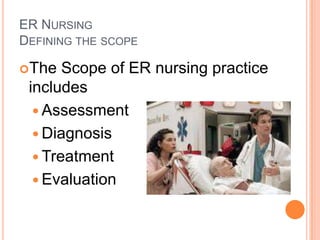
ER NursingDefining the scope	The Scope of ER nursing practice includes AssessmentDiagnosisTreatmentEvaluation
ER Scope	Resolution of “Emergent” problems may require minimal care, advanced life support, patient and family education, appropriate referral, and knowledge of legal implications
ER ScopeEmergency nursing is multi dimensional, requiring knowledge of various body systems, disease processes, and age groups.It also requires unique knowledge such as triage, and emergency operations preparedness, WMD training, Trauma care, EMS training and the anticipation of unforeseen scenarios.
Standards of emergency nursing practice	As set by the ENA (Emergency Nurses Agency) the ER nurse will:Initiate accurate and ongoing assessment of physical, psychological, and social problemsAnalyze assessment data to identify patient problemsIdentifies expected outcomes, based on assessment, id problems, and cultural diversityFormulates the plan of care, based on assessment, pt problems, and expected outcomesEvaluates and modifies the plan of care based on observable pt responses, and attainment of expected outcomes
Standards of practicethe er nurse will:Evaluate the quality and effectiveness of emergency nursing practiceAdhere to established standards of ER nursing practice including behaviors that characterize professional statusRecognize self-learning needs and is accountable for maximizing professional developmentEngages in behaviors and activities that characterize a professionalProvides care based on philosophical and ethical concepts: including reverence for life; respect for the inherent dignity, worth, autonomy, and individuality of each human being; and acknowledging the beliefs of other people
Standards of er nursingthe er nurse will:Ensures open and timely communication with emergency patients, significant others, and other health care providers through professional collaborationRecognize, value, and use research and quality improvement findings to enhance the practice of emergency nursingCollaborates with other health care providers to deliver patient-centered care in a manner consistent with safe, efficient, and cost effective use of resources
Community educationEmergency nurses are actively involved in community education problems, because they serve to reduce the risk and consequence of disease, illness and injury. The ultimate outcome is achieved through primary, secondary, and tertiary prevention
Community educationprimary preventionPrimary prevention attempts to avert disease or injury by reducing risk factor levelseg: child safety seat distribution and education
Community educationsecondary preventionSecondary prevention aims to detect disease early to control or limit its effects eg: HIV/STD screening for those with risky behavior
Community educationtertiary preventionTertiary prevention focuses on treating disease and injury in an effort to reduce disability and preserve functioneg: Referral to  treatment programs for substance abuse
Core measuresWhat are they?Core measures are items determined by the accreditation body of the hospital to be vital to improving patient care or outcomes
Core measuresWhat do I have to do as a nurse?At your designated facility check with management or your PI department about what your specific core measures are and what is expected of you.Examples of core measures are:Acute Myocardial Infarction (AMI)Heart FailurePneumoniaPregnancy and related conditionsSurgical infection prevention
Patient Safety National Patient Safety Goals (NPSG) are a standard set by the accreditation body, following a systematic review of literature and databases by safety experts and clinicians. ER nurses are responsible for integrating these safety goals into the care they provide.
National Patient Safety GoalsImprove accuracy of patient identificationImprove the effectiveness of communication among care giversImprove the safety of using medicationsReduce the risk of health care-associated infectionsEncourage patients active involvement in their own care as a pt safety strategyThe organization identifies safety risks inherent in its populationImprove recognition and response to changes in patients conditionAccurately and completely reconcile medications across the continuum of careReduce the risk of patient harm resulting from fallsReduce the risk of influenza and PNA in institutionalized older adultsReduce risk of surgical firesPrevent health care associated pressure ulcers (decubitus ulcers)The organization meets the expectations of the universal protocol
Certification overviewECRN- Emergency Communications NurseMICN- Mobile Intensive Care NurseTNS- Trauma Nurse SpecialistCEN- Certified Emergency NurseCFRN-Certified Flight Registered NurseCTRN- Certified Transport Registered Nurse*all require examination and oversight by issuing body- either state, county, or institution

Intro to er nursing

  • 1.
    Intro to ERNursing An OverviewMary Corcoran RN, BSN, MICN
  • 2.
    ER NursingDefining thescope The Scope of ER nursing practice includes AssessmentDiagnosisTreatmentEvaluation
  • 3.
    ER Scope Resolution of“Emergent” problems may require minimal care, advanced life support, patient and family education, appropriate referral, and knowledge of legal implications
  • 4.
    ER ScopeEmergency nursingis multi dimensional, requiring knowledge of various body systems, disease processes, and age groups.It also requires unique knowledge such as triage, and emergency operations preparedness, WMD training, Trauma care, EMS training and the anticipation of unforeseen scenarios.
  • 5.
    Standards of emergencynursing practice As set by the ENA (Emergency Nurses Agency) the ER nurse will:Initiate accurate and ongoing assessment of physical, psychological, and social problemsAnalyze assessment data to identify patient problemsIdentifies expected outcomes, based on assessment, id problems, and cultural diversityFormulates the plan of care, based on assessment, pt problems, and expected outcomesEvaluates and modifies the plan of care based on observable pt responses, and attainment of expected outcomes
  • 6.
    Standards of practicetheer nurse will:Evaluate the quality and effectiveness of emergency nursing practiceAdhere to established standards of ER nursing practice including behaviors that characterize professional statusRecognize self-learning needs and is accountable for maximizing professional developmentEngages in behaviors and activities that characterize a professionalProvides care based on philosophical and ethical concepts: including reverence for life; respect for the inherent dignity, worth, autonomy, and individuality of each human being; and acknowledging the beliefs of other people
  • 7.
    Standards of ernursingthe er nurse will:Ensures open and timely communication with emergency patients, significant others, and other health care providers through professional collaborationRecognize, value, and use research and quality improvement findings to enhance the practice of emergency nursingCollaborates with other health care providers to deliver patient-centered care in a manner consistent with safe, efficient, and cost effective use of resources
  • 8.
    Community educationEmergency nursesare actively involved in community education problems, because they serve to reduce the risk and consequence of disease, illness and injury. The ultimate outcome is achieved through primary, secondary, and tertiary prevention
  • 9.
    Community educationprimary preventionPrimaryprevention attempts to avert disease or injury by reducing risk factor levelseg: child safety seat distribution and education
  • 10.
    Community educationsecondary preventionSecondaryprevention aims to detect disease early to control or limit its effects eg: HIV/STD screening for those with risky behavior
  • 11.
    Community educationtertiary preventionTertiaryprevention focuses on treating disease and injury in an effort to reduce disability and preserve functioneg: Referral to treatment programs for substance abuse
  • 12.
    Core measuresWhat arethey?Core measures are items determined by the accreditation body of the hospital to be vital to improving patient care or outcomes
  • 13.
    Core measuresWhat doI have to do as a nurse?At your designated facility check with management or your PI department about what your specific core measures are and what is expected of you.Examples of core measures are:Acute Myocardial Infarction (AMI)Heart FailurePneumoniaPregnancy and related conditionsSurgical infection prevention
  • 14.
    Patient Safety NationalPatient Safety Goals (NPSG) are a standard set by the accreditation body, following a systematic review of literature and databases by safety experts and clinicians. ER nurses are responsible for integrating these safety goals into the care they provide.
  • 15.
    National Patient SafetyGoalsImprove accuracy of patient identificationImprove the effectiveness of communication among care giversImprove the safety of using medicationsReduce the risk of health care-associated infectionsEncourage patients active involvement in their own care as a pt safety strategyThe organization identifies safety risks inherent in its populationImprove recognition and response to changes in patients conditionAccurately and completely reconcile medications across the continuum of careReduce the risk of patient harm resulting from fallsReduce the risk of influenza and PNA in institutionalized older adultsReduce risk of surgical firesPrevent health care associated pressure ulcers (decubitus ulcers)The organization meets the expectations of the universal protocol
  • 16.
    Certification overviewECRN- EmergencyCommunications NurseMICN- Mobile Intensive Care NurseTNS- Trauma Nurse SpecialistCEN- Certified Emergency NurseCFRN-Certified Flight Registered NurseCTRN- Certified Transport Registered Nurse*all require examination and oversight by issuing body- either state, county, or institution

Editor's Notes

  • #10 Or bike safety training
  • #11 Pap smears at Planned parenthood,
  • #12 Dialysis, chemo etc.