Clinical
Perspective
IV Cannulation
By Ms.Ṇikethana R Nair,M.Sc, MBA, M.Sc, M.Phil,
NABH Assessor, Nursing Superintendent,
Meenakshi Mision Hospital & Research Center -
Madurai.
Definition
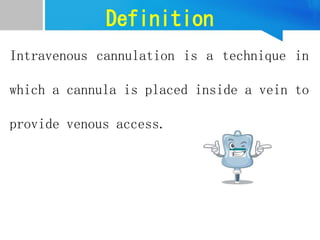
Intravenous cannulation is a technique in
which a cannula is placed inside a vein to
provide venous access.
Types of Cannula
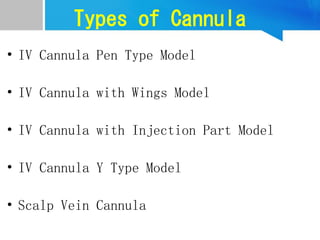
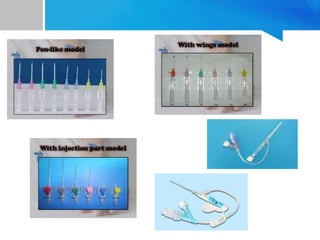
• IV Cannula Pen Type Model
• IV Cannula with Wings Model
• IV Cannula with Injection Part Model
• IV Cannula Y Type Model
• Scalp Vein Cannula
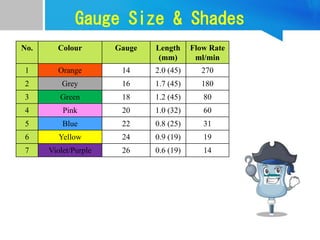
Gauge Size & Shades
No. Colour Gauge Length
(mm)
Flow Rate
ml/min
1 Orange 14 2.0 (45) 270
2 Grey 16 1.7 (45) 180
3 Green 18 1.2 (45) 80
4 Pink 20 1.0 (32) 60
5 Blue 22 0.8 (25) 31
6 Yellow 24 0.9 (19) 19
7 Violet/Purple 26 0.6 (19) 14
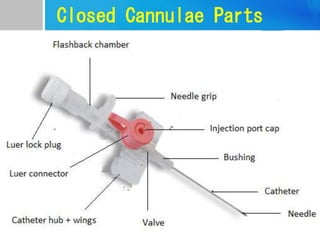
Closed Cannulae Parts
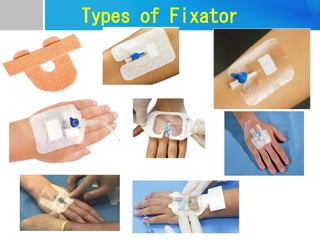
Types of Fixator
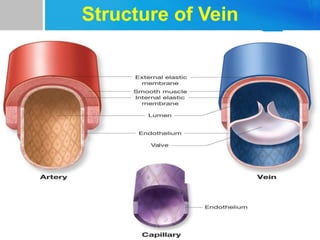
Structure of Vein
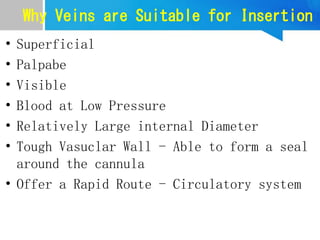
Why Veins are Suitable for Insertion
• Superficial
• Palpabe
• Visible
• Blood at Low Pressure
• Relatively Large internal Diameter
• Tough Vasuclar Wall - Able to form a seal
around the cannula
• Offer a Rapid Route - Circulatory system
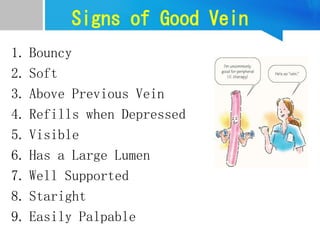
Signs of Good Vein
1. Bouncy
2. Soft
3. Above Previous Vein
4. Refills when Depressed
5. Visible
6. Has a Large Lumen
7. Well Supported
8. Staright
9. Easily Palpable
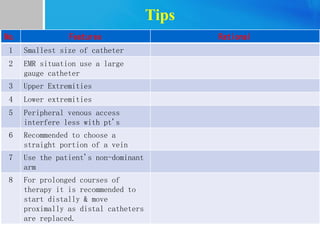
Tips
No. Features Rational
1 Smallest size of catheter
2 EMR situation use a large
gauge catheter
3 Upper Extremities
4 Lower extremities
5 Peripheral venous access
interfere less with pt's
6 Recommended to choose a
straight portion of a vein
7 Use the patient's non-dominant
arm
8 For prolonged courses of
therapy it is recommended to
start distally & move
proximally as distal catheters
are replaced.
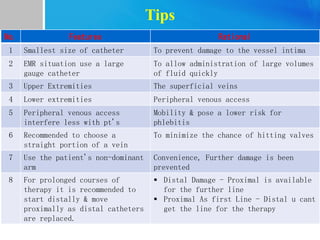
Tips
No. Features Rational
1 Smallest size of catheter To prevent damage to the vessel intima
2 EMR situation use a large
gauge catheter
To allow administration of large volumes
of fluid quickly
3 Upper Extremities The superficial veins
4 Lower extremities Peripheral venous access
5 Peripheral venous access
interfere less with pt's
Mobility & pose a lower risk for
phlebitis
6 Recommended to choose a
straight portion of a vein
To minimize the chance of hitting valves
7 Use the patient's non-dominant
arm
Convenience, Further damage is been
prevented
8 For prolonged courses of
therapy it is recommended to
start distally & move
proximally as distal catheters
are replaced.
 Distal Damage - Proximal is available
for the further line
 Proximal As first Line - Distal u cant
get the line for the therapy
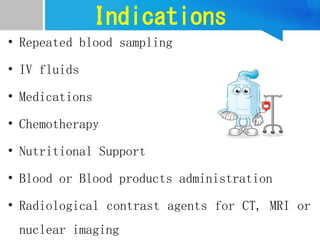
Indications
• Repeated blood sampling
• IV fluids
• Medications
• Chemotherapy
• Nutritional Support
• Blood or Blood products administration
• Radiological contrast agents for CT, MRI or
nuclear imaging
Contraindications
Avoid Peripheral Venous Access in
1.An injured,
2.Infected,
3.Burned extremity - if possible
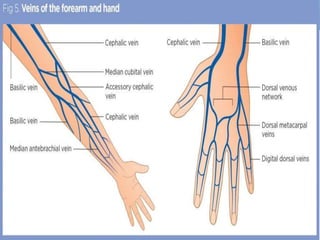
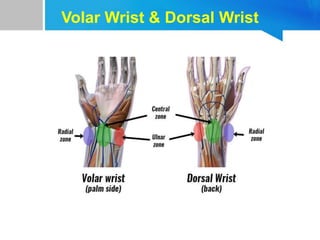
Volar Wrist & Dorsal Wrist
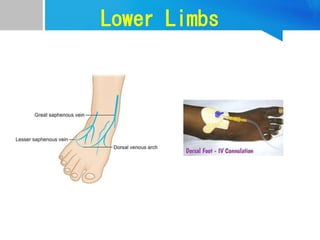
Lower Limbs
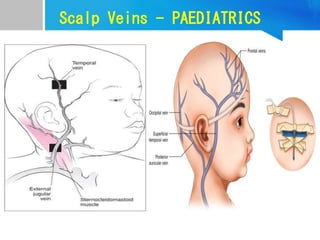
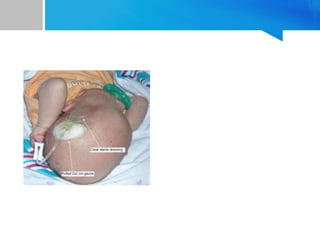
Scalp Veins - PAEDIATRICS
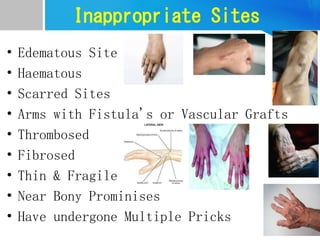
Inappropriate Sites
• Edematous Site
• Haematous
• Scarred Sites
• Arms with Fistula's or Vascular Grafts
• Thrombosed
• Fibrosed
• Thin & Fragile
• Near Bony Prominises
• Have undergone Multiple Pricks
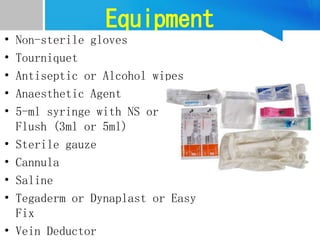
Equipment
• Non-sterile gloves
• Tourniquet
• Antiseptic or Alcohol wipes
• Anaesthetic Agent
• 5-ml syringe with NS or Poshi
Flush (3ml or 5ml)
• Sterile gauze
• Cannula
• Saline
• Tegaderm or Dynaplast or Easy
Fix
• Vein Deductor
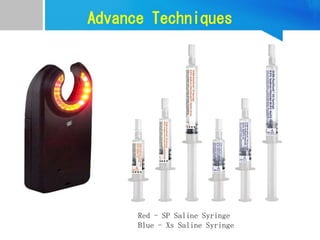
Advance Techniques
Red - SP Saline Syringe
Blue - Xs Saline Syringe
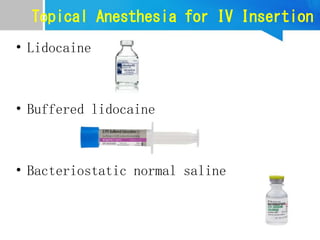
Topical Anesthesia for IV Insertion
• Lidocaine
• Buffered lidocaine
• Bacteriostatic normal saline
Before The Procedure
• Introduce yourself to the patient.
• Explain the procedure to the patient & gain informed
consent to continue
• Make sure there is adequate light & that the room is
warm enough to encourage vasodilation
• Make sure the patient is in a comfortable position
• The patients skin should be kept clean for the procedure
Standard Precautions
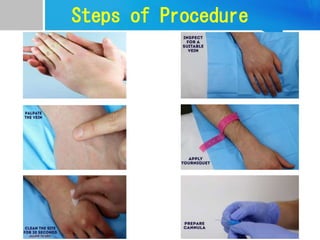
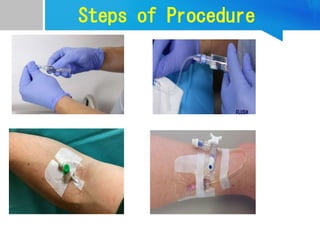
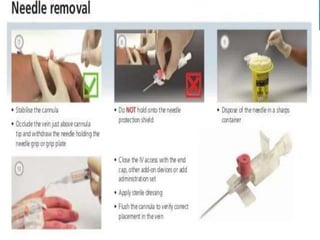
Steps of Procedure
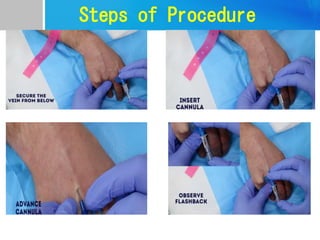
Steps of Procedure
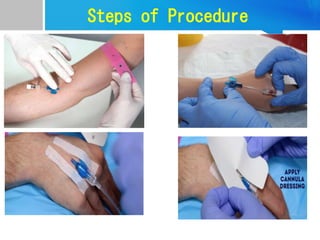
Steps of Procedure
Steps of Procedure
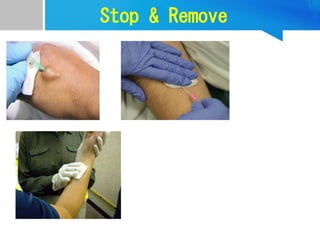
Stop & Remove
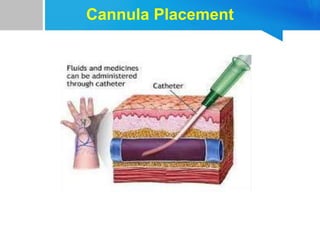
Cannula Placement
IV Cannulation in Fragile Veins
• Say no to tourniquet as much as possible
• Use the smallest catheter as much as
possible - 20 to 22g
• Use Bevel Up, Low Angle & Slowly but
surey approach
• Secure the catherter with Micropore or
Transparent dressing
• Provide Health Education
IV Cannulation for the Geriatrics
• Extremely Challenging
• Avoid applying too much friction when
preparing the skin
• use the smallest catheter
• Know the veins depth
• If possible do not use tourniquet,
Incase use a soft material ones
• stabilise the vein & insert the
catheter on top of the vein
• Hypoallergic Tape tape to be used
Documentation
• Date & Time
• Site & Size of the Cannula
• Any Problems Encountered
• Notes Eaxmple:
• 22/8/19 @ 3pm: Inserted 16G Needle under
Clean Techique in a single prick in Rt
Metacarpel region by S/N XX,Pt cooperated,
Back Flow Present, Flushed with 5ml Poshi
flush or NS,Line Intact & Patent,Line
Secured with dynaplast & labelled with
date & time. Score: I 0/4 & P 0/5
• 22/8/19 @ 3pm:Inserted 20G Needle under Clean
Techique in Lt anaesthetist vein. First prick
failed since there was no back flow or
infiltration present in Lft Cephalic Vein by
S/N xyz.
• By 2nd prick line was secured by Anaesthetist
XXXX. Pt was irritable.
• Back Flow Present, Flushed with 5ml Poshi flush
or NS,Line Intact & Patent
• Line Secured with Tegaderm & labelled with date
& time.
• Score: I 0/4 & P 0/5
Complications
• Pain
• Cannula Clott
• Blood stops flowing into the flashback chamber
• Arterial puncture
• Hypersensitivity reaction
• Peripheral nerve palsy
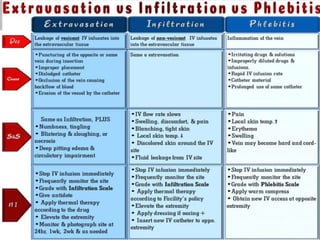
• Thrombophlebitis
• Phebilitis
• Infiltration
• Extravasation
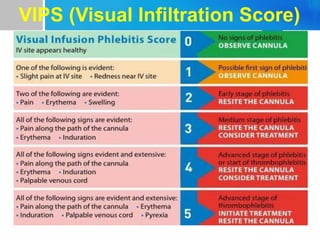
VIPS (Visual Infiltration Score)
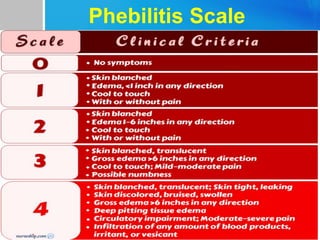
Phebilitis Scale
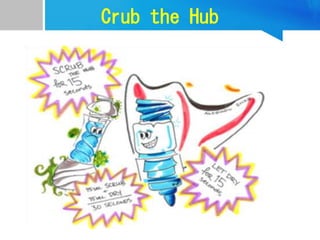
Crub the Hub
Purpose
To administer the appropriate amount of
fluid to the patient
To prevent fluid overload & fluid
deficiency
To prevent, treat & support the
patient’s condition with the help of
correct administration of fluid.
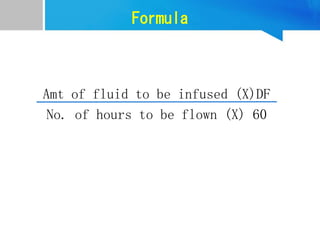
Formula
Amt of fluid to be infused (X)DF
No. of hours to be flown (X) 60
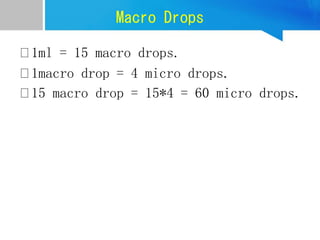
Macro Drops
1ml = 15 macro drops.
1macro drop = 4 micro drops.
15 macro drop = 15*4 = 60 micro drops.
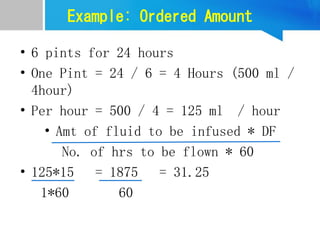
Example: Ordered Amount
• 6 pints for 24 hours
• One Pint = 24 / 6 = 4 Hours (500 ml /
4hour)
• Per hour = 500 / 4 = 125 ml / hour
• Amt of fluid to be infused * DF
No. of hrs to be flown * 60
• 125*15 = 1875 = 31.25
1*60 60
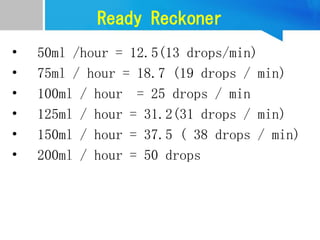
Ready Reckoner
• 50ml /hour = 12.5(13 drops/min)
• 75ml / hour = 18.7 (19 drops / min)
• 100ml / hour = 25 drops / min
• 125ml / hour = 31.2(31 drops / min)
• 150ml / hour = 37.5 ( 38 drops / min)
• 200ml / hour = 50 drops
IV Cannulation.ppt

IV Cannulation.ppt

  • 1.
    Clinical Perspective IV Cannulation By Ms.ṆikethanaR Nair,M.Sc, MBA, M.Sc, M.Phil, NABH Assessor, Nursing Superintendent, Meenakshi Mision Hospital & Research Center - Madurai.
  • 2.
    Definition Intravenous cannulation isa technique in which a cannula is placed inside a vein to provide venous access.
  • 3.
    Types of Cannula •IV Cannula Pen Type Model • IV Cannula with Wings Model • IV Cannula with Injection Part Model • IV Cannula Y Type Model • Scalp Vein Cannula
  • 5.
    Gauge Size &Shades No. Colour Gauge Length (mm) Flow Rate ml/min 1 Orange 14 2.0 (45) 270 2 Grey 16 1.7 (45) 180 3 Green 18 1.2 (45) 80 4 Pink 20 1.0 (32) 60 5 Blue 22 0.8 (25) 31 6 Yellow 24 0.9 (19) 19 7 Violet/Purple 26 0.6 (19) 14
  • 6.
  • 7.
  • 8.
  • 9.
    Why Veins areSuitable for Insertion • Superficial • Palpabe • Visible • Blood at Low Pressure • Relatively Large internal Diameter • Tough Vasuclar Wall - Able to form a seal around the cannula • Offer a Rapid Route - Circulatory system
  • 10.
    Signs of GoodVein 1. Bouncy 2. Soft 3. Above Previous Vein 4. Refills when Depressed 5. Visible 6. Has a Large Lumen 7. Well Supported 8. Staright 9. Easily Palpable
  • 11.
    Tips No. Features Rational 1Smallest size of catheter 2 EMR situation use a large gauge catheter 3 Upper Extremities 4 Lower extremities 5 Peripheral venous access interfere less with pt's 6 Recommended to choose a straight portion of a vein 7 Use the patient's non-dominant arm 8 For prolonged courses of therapy it is recommended to start distally & move proximally as distal catheters are replaced.
  • 12.
    Tips No. Features Rational 1Smallest size of catheter To prevent damage to the vessel intima 2 EMR situation use a large gauge catheter To allow administration of large volumes of fluid quickly 3 Upper Extremities The superficial veins 4 Lower extremities Peripheral venous access 5 Peripheral venous access interfere less with pt's Mobility & pose a lower risk for phlebitis 6 Recommended to choose a straight portion of a vein To minimize the chance of hitting valves 7 Use the patient's non-dominant arm Convenience, Further damage is been prevented 8 For prolonged courses of therapy it is recommended to start distally & move proximally as distal catheters are replaced.  Distal Damage - Proximal is available for the further line  Proximal As first Line - Distal u cant get the line for the therapy
  • 13.
    Indications • Repeated bloodsampling • IV fluids • Medications • Chemotherapy • Nutritional Support • Blood or Blood products administration • Radiological contrast agents for CT, MRI or nuclear imaging
  • 14.
    Contraindications Avoid Peripheral VenousAccess in 1.An injured, 2.Infected, 3.Burned extremity - if possible
  • 16.
    Volar Wrist &Dorsal Wrist
  • 17.
  • 18.
    Scalp Veins -PAEDIATRICS
  • 20.
    Inappropriate Sites • EdematousSite • Haematous • Scarred Sites • Arms with Fistula's or Vascular Grafts • Thrombosed • Fibrosed • Thin & Fragile • Near Bony Prominises • Have undergone Multiple Pricks
  • 21.
    Equipment • Non-sterile gloves •Tourniquet • Antiseptic or Alcohol wipes • Anaesthetic Agent • 5-ml syringe with NS or Poshi Flush (3ml or 5ml) • Sterile gauze • Cannula • Saline • Tegaderm or Dynaplast or Easy Fix • Vein Deductor
  • 22.
    Advance Techniques Red -SP Saline Syringe Blue - Xs Saline Syringe
  • 23.
    Topical Anesthesia forIV Insertion • Lidocaine • Buffered lidocaine • Bacteriostatic normal saline
  • 24.
    Before The Procedure •Introduce yourself to the patient. • Explain the procedure to the patient & gain informed consent to continue • Make sure there is adequate light & that the room is warm enough to encourage vasodilation • Make sure the patient is in a comfortable position • The patients skin should be kept clean for the procedure
  • 25.
  • 26.
  • 27.
  • 28.
  • 29.
  • 31.
  • 32.
  • 33.
    IV Cannulation inFragile Veins • Say no to tourniquet as much as possible • Use the smallest catheter as much as possible - 20 to 22g • Use Bevel Up, Low Angle & Slowly but surey approach • Secure the catherter with Micropore or Transparent dressing • Provide Health Education
  • 34.
    IV Cannulation forthe Geriatrics • Extremely Challenging • Avoid applying too much friction when preparing the skin • use the smallest catheter • Know the veins depth • If possible do not use tourniquet, Incase use a soft material ones • stabilise the vein & insert the catheter on top of the vein • Hypoallergic Tape tape to be used
  • 35.
    Documentation • Date &Time • Site & Size of the Cannula • Any Problems Encountered • Notes Eaxmple: • 22/8/19 @ 3pm: Inserted 16G Needle under Clean Techique in a single prick in Rt Metacarpel region by S/N XX,Pt cooperated, Back Flow Present, Flushed with 5ml Poshi flush or NS,Line Intact & Patent,Line Secured with dynaplast & labelled with date & time. Score: I 0/4 & P 0/5
  • 36.
    • 22/8/19 @3pm:Inserted 20G Needle under Clean Techique in Lt anaesthetist vein. First prick failed since there was no back flow or infiltration present in Lft Cephalic Vein by S/N xyz. • By 2nd prick line was secured by Anaesthetist XXXX. Pt was irritable. • Back Flow Present, Flushed with 5ml Poshi flush or NS,Line Intact & Patent • Line Secured with Tegaderm & labelled with date & time. • Score: I 0/4 & P 0/5
  • 37.
    Complications • Pain • CannulaClott • Blood stops flowing into the flashback chamber • Arterial puncture • Hypersensitivity reaction • Peripheral nerve palsy • Thrombophlebitis • Phebilitis • Infiltration • Extravasation
  • 39.
  • 40.
  • 41.
  • 42.
    Purpose To administer theappropriate amount of fluid to the patient To prevent fluid overload & fluid deficiency To prevent, treat & support the patient’s condition with the help of correct administration of fluid.
  • 43.
    Formula Amt of fluidto be infused (X)DF No. of hours to be flown (X) 60
  • 44.
    Macro Drops 1ml =15 macro drops. 1macro drop = 4 micro drops. 15 macro drop = 15*4 = 60 micro drops.
  • 45.
    Example: Ordered Amount •6 pints for 24 hours • One Pint = 24 / 6 = 4 Hours (500 ml / 4hour) • Per hour = 500 / 4 = 125 ml / hour • Amt of fluid to be infused * DF No. of hrs to be flown * 60 • 125*15 = 1875 = 31.25 1*60 60
  • 46.
    Ready Reckoner • 50ml/hour = 12.5(13 drops/min) • 75ml / hour = 18.7 (19 drops / min) • 100ml / hour = 25 drops / min • 125ml / hour = 31.2(31 drops / min) • 150ml / hour = 37.5 ( 38 drops / min) • 200ml / hour = 50 drops