Various Forms of Education
Dr.M.Deivam
Assistant Professor
Department of Education
The Gandhigram Rural Institute (Deemed to be University)
Gandhigram, Dindigul District, Tamil Nadu – 624 302
Formal Education: Meaning
• “Formal education is that which is
continuously and deliberately planned for
modification of behaviour with a particular
end in view.”
Characteristics
• It is pre-planned direct, organized and given in
specific educational institutions such as
schools and colleges.
• It is limited to a specific period and it has well-
defined curriculum.
• It is given by qualified and trained teachers.
• Formal education observe strict discipline.
Cont.,
• Formal education can be primary, middle,
secondary, higher secondary levels in the
school, undergraduate and post graduate level
in the colleges and universities which can be
in Art, Science, Technical and Professional
areas.
Merits
• Imbibes self- discipline
• Continuous learning
• Generates habit of reading & writing
• Education from qualified teachers
Informal Education: Meaning
• Informal Education is that education which an
individual acquires without attending any
educational organisation, system or
institution.
• Example: Market place, A hotel, One’s sitting
room talking with others constitute informal
education, Television, radio and Films.
Characteristics
• It is not pre-planned
• It is indirect, incidental and spontaneous
• no specific agencies or institutions are there like
schools to impart this type of education
• No formal ends or goals or objectives are there
• takes place from the day to day activities,
experiences and living in the family or community
or even in the school and colleges incidentally
either through informal interaction or by
observation of various things.
Cont.,
• No prescribed time table or curriculum is
there
• No qualified or trained teachers are there
• No examinations or awarding of certificates
take place
• It is provided by informal agencies such as
home or family or community
Merits
• Anywhere & Anytime
• Takes place every location.
• Uses a variety of methods.
• Lifelong education.
• Focuses on Early stage development of
learner.
Non-Formal Education
• Non-formal education refers to education that
occurs outside the formal school system.
• Non-formal education is often used
interchangeably with terms such as
community education, adult education,
lifelong education and second-
chance education.
Characteristics
• It is intentional, incidental and given outside
the formal system, i.e., school.
• It is consciously and deliberately planned,
organized and systematically implemented.
• It is an open system of education without
rigid rules, regulations and fixed stages or
time schedule.
• It is a life-long process, integrated with life and
work.
Cont.,
• It is life oriented and environment based.
• It is intended for all ages.
• It is programmed to serve the needs of
identified groups of different categories if and
when they need.
• It necessitates flexibility in designing the
curriculum and the scheme of evaluation.
• social or adult education, distance education
are the examples of non-formal education.
Merits
• According to UNESCO (2010), non-formal
education helps to ensures equal access
to education,
• Eradicate illiteracy among women
• Improve women's access to vocational
training, science, technology and
continuing education.
• It also encourages the development of non-
discriminatory education and training.
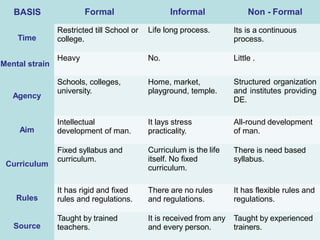
BASIS Formal Informal Non - Formal
Time
Restricted till School or
college.
Life long process. Its is a continuous
process.
Mental strain
Heavy No. Little .
Agency
Schools, colleges,
university.
Home, market,
playground, temple.
Structured organization
and institutes providing
DE.
Aim
Intellectual
development of man.
It lays stress
practicality.
All-round development
of man.
Curriculum
Fixed syllabus and
curriculum.
Curriculum is the life
itself. No fixed
curriculum.
There is need based
syllabus.
Rules
It has rigid and fixed
rules and regulations.
There are no rules
and regulations.
It has flexible rules and
regulations.
Source
Taught by trained
teachers.
It is received from any
and every person.
Taught by experienced
trainers.
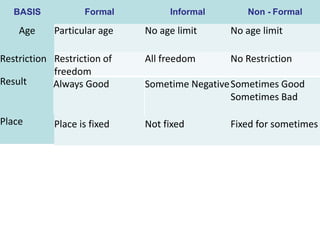
BASIS Formal Informal Non - Formal
Age Particular age No age limit No age limit
Restriction Restriction of
freedom
All freedom No Restriction
Result Always Good Sometime NegativeSometimes Good
Sometimes Bad
Place Place is fixed Not fixed Fixed for sometimes
Conclusion
• All these three types of education - formal,
informal and non-formal, have their due place
in the modern system of education. Each has
its own merits and demerits. There is need to
integrate the three forms and make education
holistic and comprehensive.
Thank You

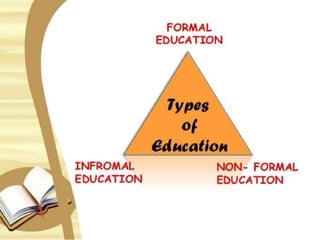
Various forms of education

  • 1.
    Various Forms ofEducation Dr.M.Deivam Assistant Professor Department of Education The Gandhigram Rural Institute (Deemed to be University) Gandhigram, Dindigul District, Tamil Nadu – 624 302
  • 3.
    Formal Education: Meaning •“Formal education is that which is continuously and deliberately planned for modification of behaviour with a particular end in view.”
  • 4.
    Characteristics • It ispre-planned direct, organized and given in specific educational institutions such as schools and colleges. • It is limited to a specific period and it has well- defined curriculum. • It is given by qualified and trained teachers. • Formal education observe strict discipline.
  • 5.
    Cont., • Formal educationcan be primary, middle, secondary, higher secondary levels in the school, undergraduate and post graduate level in the colleges and universities which can be in Art, Science, Technical and Professional areas.
  • 6.
    Merits • Imbibes self-discipline • Continuous learning • Generates habit of reading & writing • Education from qualified teachers
  • 7.
    Informal Education: Meaning •Informal Education is that education which an individual acquires without attending any educational organisation, system or institution. • Example: Market place, A hotel, One’s sitting room talking with others constitute informal education, Television, radio and Films.
  • 8.
    Characteristics • It isnot pre-planned • It is indirect, incidental and spontaneous • no specific agencies or institutions are there like schools to impart this type of education • No formal ends or goals or objectives are there • takes place from the day to day activities, experiences and living in the family or community or even in the school and colleges incidentally either through informal interaction or by observation of various things.
  • 9.
    Cont., • No prescribedtime table or curriculum is there • No qualified or trained teachers are there • No examinations or awarding of certificates take place • It is provided by informal agencies such as home or family or community
  • 10.
    Merits • Anywhere &Anytime • Takes place every location. • Uses a variety of methods. • Lifelong education. • Focuses on Early stage development of learner.
  • 11.
    Non-Formal Education • Non-formaleducation refers to education that occurs outside the formal school system. • Non-formal education is often used interchangeably with terms such as community education, adult education, lifelong education and second- chance education.
  • 12.
    Characteristics • It isintentional, incidental and given outside the formal system, i.e., school. • It is consciously and deliberately planned, organized and systematically implemented. • It is an open system of education without rigid rules, regulations and fixed stages or time schedule. • It is a life-long process, integrated with life and work.
  • 13.
    Cont., • It islife oriented and environment based. • It is intended for all ages. • It is programmed to serve the needs of identified groups of different categories if and when they need. • It necessitates flexibility in designing the curriculum and the scheme of evaluation. • social or adult education, distance education are the examples of non-formal education.
  • 14.
    Merits • According toUNESCO (2010), non-formal education helps to ensures equal access to education, • Eradicate illiteracy among women • Improve women's access to vocational training, science, technology and continuing education. • It also encourages the development of non- discriminatory education and training.
  • 15.
    BASIS Formal InformalNon - Formal Time Restricted till School or college. Life long process. Its is a continuous process. Mental strain Heavy No. Little . Agency Schools, colleges, university. Home, market, playground, temple. Structured organization and institutes providing DE. Aim Intellectual development of man. It lays stress practicality. All-round development of man. Curriculum Fixed syllabus and curriculum. Curriculum is the life itself. No fixed curriculum. There is need based syllabus. Rules It has rigid and fixed rules and regulations. There are no rules and regulations. It has flexible rules and regulations. Source Taught by trained teachers. It is received from any and every person. Taught by experienced trainers.
  • 16.
    BASIS Formal InformalNon - Formal Age Particular age No age limit No age limit Restriction Restriction of freedom All freedom No Restriction Result Always Good Sometime NegativeSometimes Good Sometimes Bad Place Place is fixed Not fixed Fixed for sometimes
  • 17.
    Conclusion • All thesethree types of education - formal, informal and non-formal, have their due place in the modern system of education. Each has its own merits and demerits. There is need to integrate the three forms and make education holistic and comprehensive.
  • 18.