Basics of Valves
Tahseen Qamhieh
Sr. Mechanical Engineer
 What are Valves?
 Functions of Valves
 Common Parts of Valves
 Valves Material
 Types of Valves
 Valves End Connections Methods
 Valves Selection
 Valves Standards
 Valves Maintenance
Page 2
Presentation Outline
BASICS OF VALVES
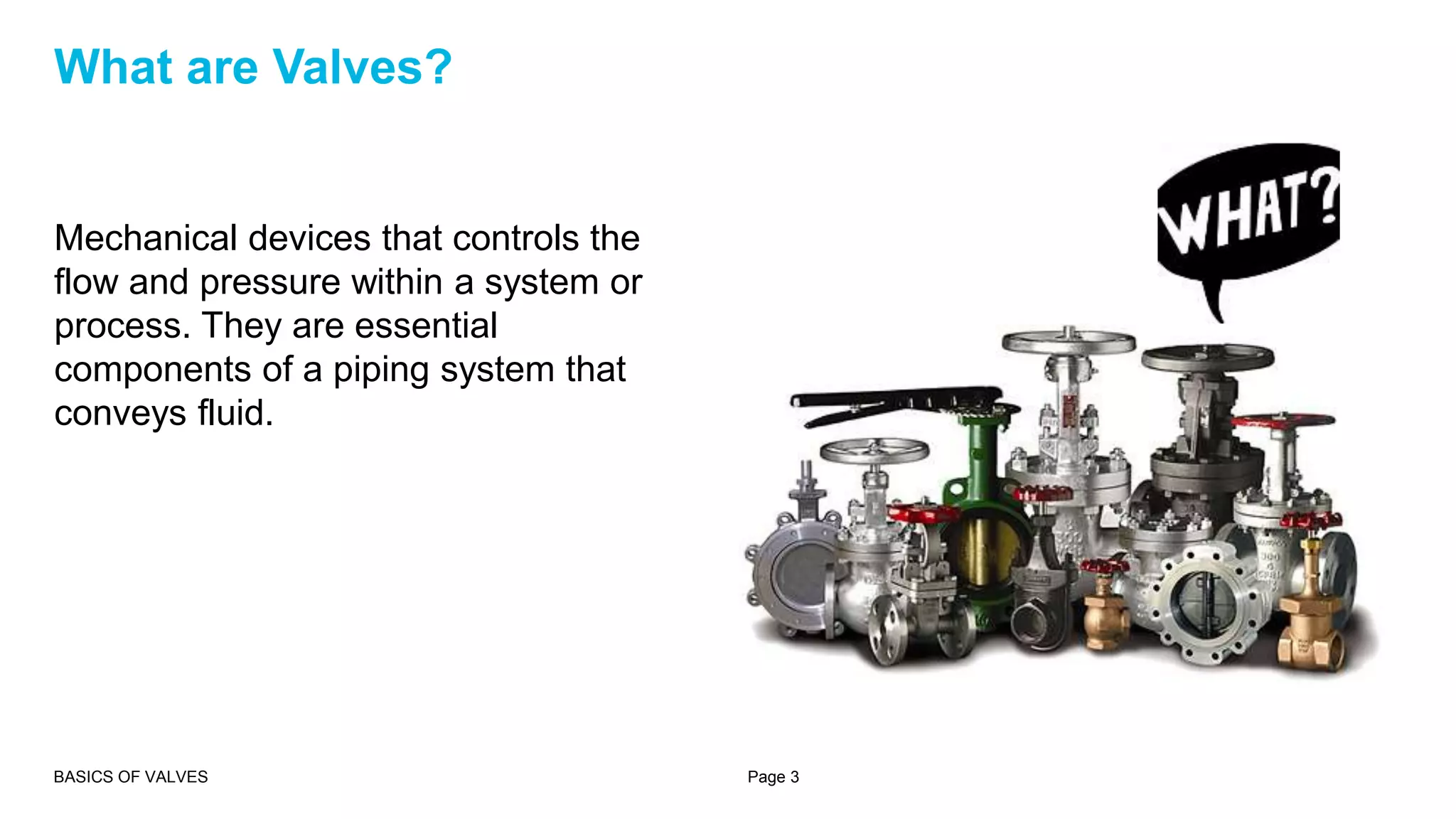
Mechanical devices that controls the
flow and pressure within a system or
process. They are essential
components of a piping system that
conveys fluid.
BASICS OF VALVES Page 3
What are Valves?
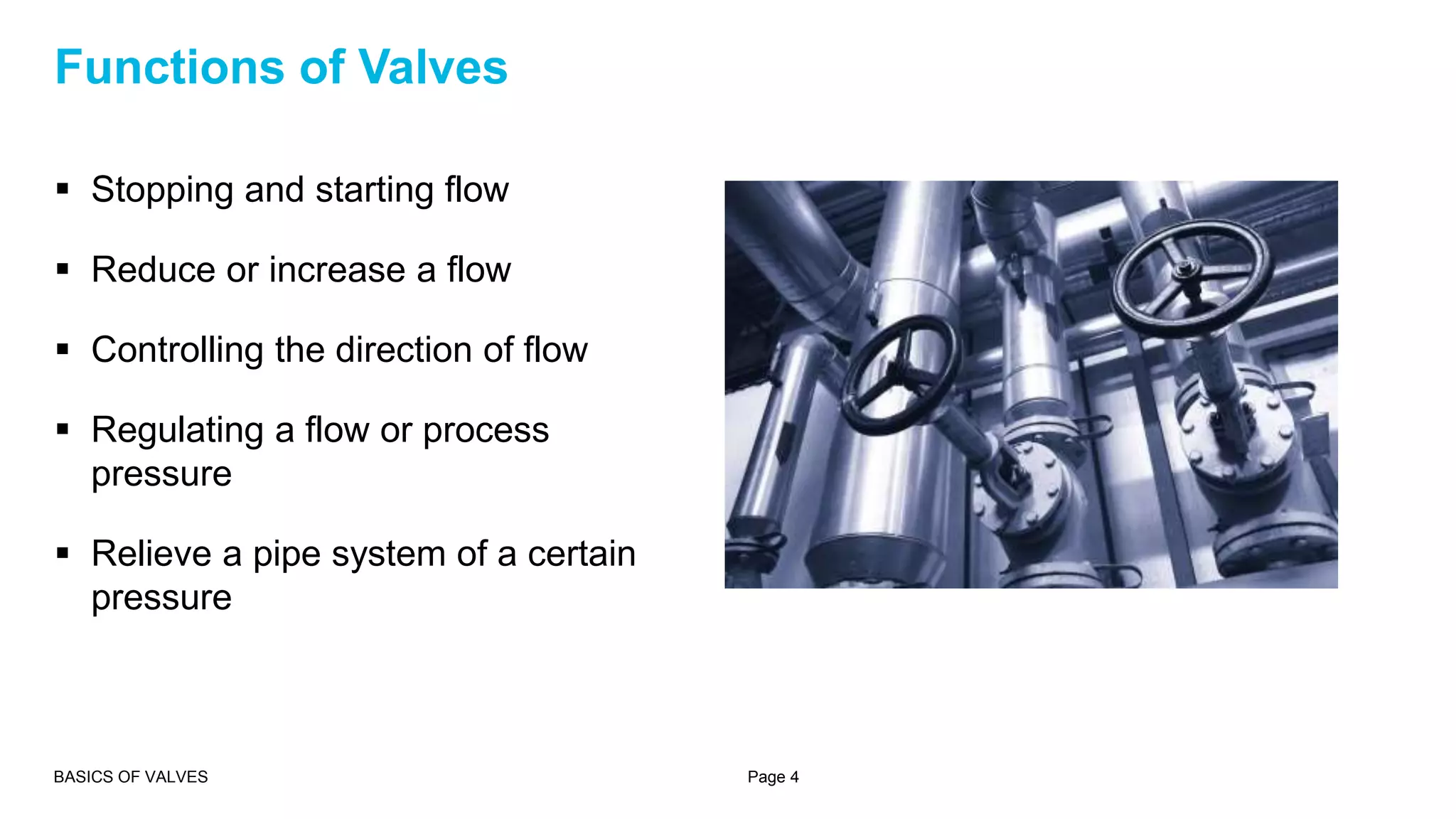
 Stopping and starting flow
 Reduce or increase a flow
 Controlling the direction of flow
 Regulating a flow or process
pressure
 Relieve a pipe system of a certain
pressure
BASICS OF VALVES Page 4
Functions of Valves
Common Parts of
Valve
BASICS OF VALVES Page 6
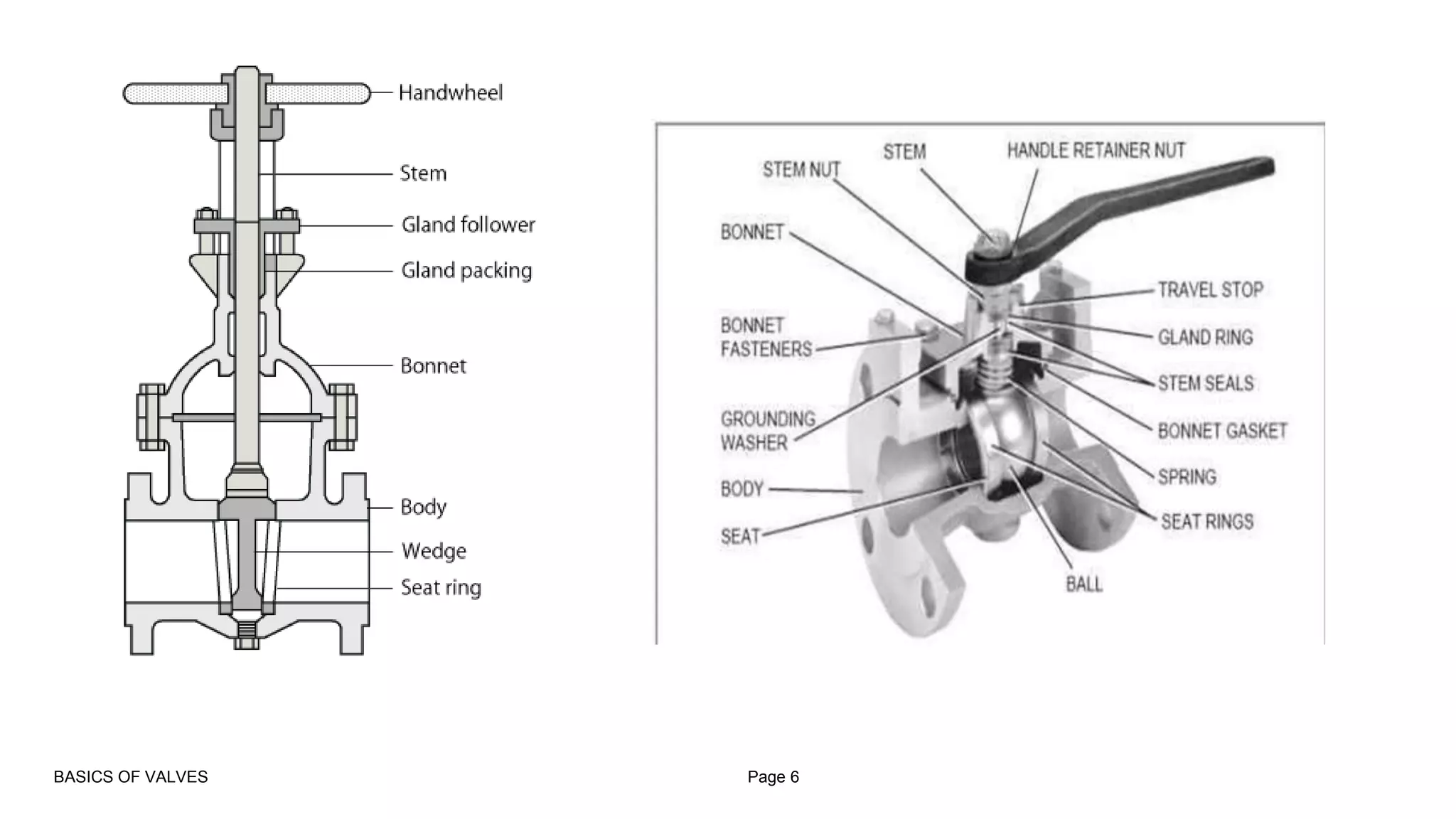
• Serves as the main element of a valve
assembly because it is the framework
that holds all the parts together.
• The first pressure boundary of a valve,
resists fluid pressure loads from
connecting piping.
• It receives inlet and outlet piping through
threaded, bolted, or welded joints.
BASICS OF VALVES Page 7
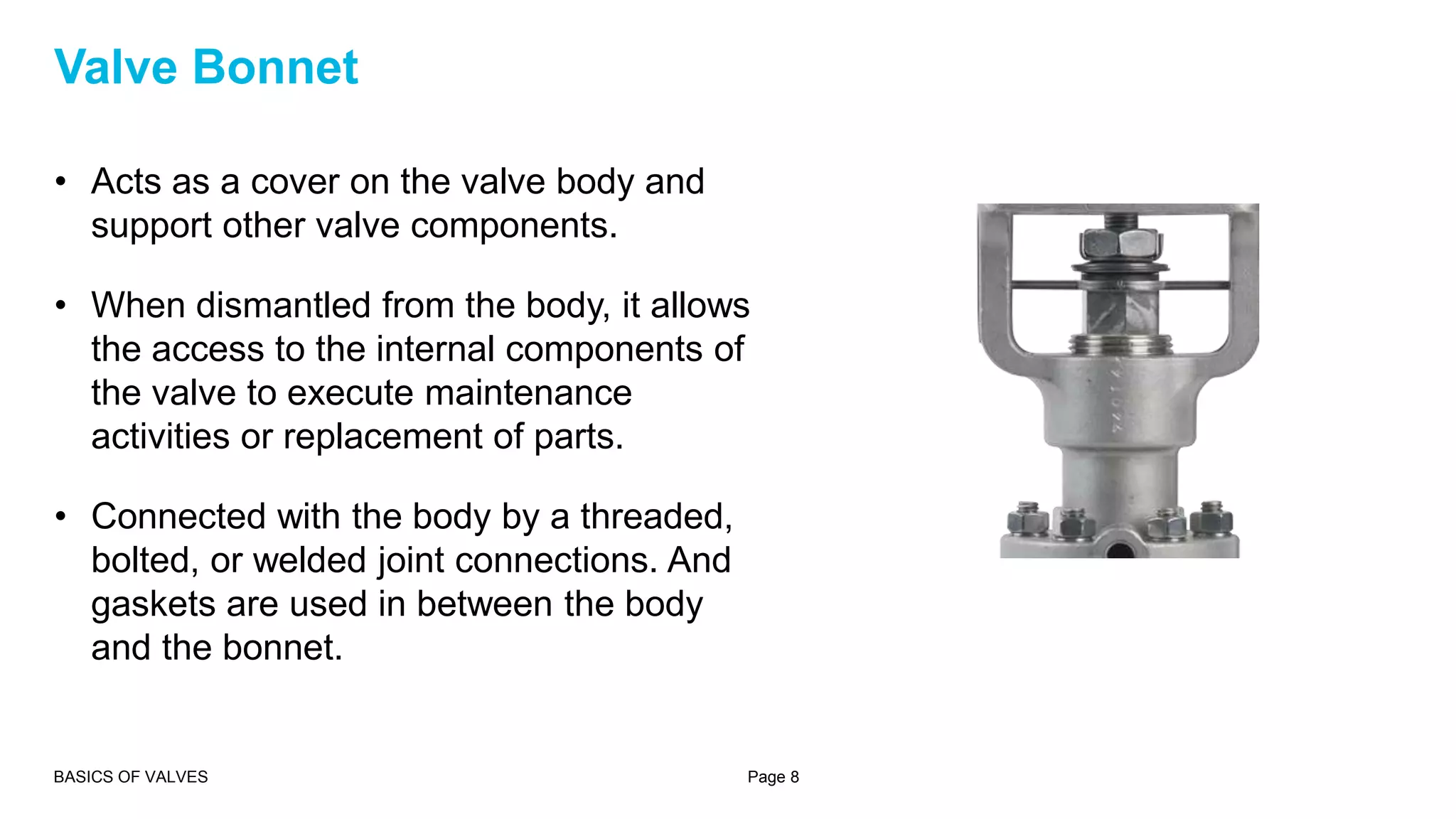
Valve Body
• Acts as a cover on the valve body and
support other valve components.
• When dismantled from the body, it allows
the access to the internal components of
the valve to execute maintenance
activities or replacement of parts.
• Connected with the body by a threaded,
bolted, or welded joint connections. And
gaskets are used in between the body
and the bonnet.
BASICS OF VALVES Page 8
Valve Bonnet
• A collective name for the removal and
replaceable valve internal parts that
come in contact with the flow medium.
• Typically these parts include valve seats,
disc, glands, spacers, guides, bushings,
and internal springs.
BASICS OF VALVES Page 9
Valve Trim
• The part which allows, throttles, or stops
flow depending on its position.
• In the case of a gate valve, the “gate” is
the disc. Whereas the disc is called “ball”
for ball valves.
BASICS OF VALVES Page 10
Valve Disc
• Provide the seating surface for the disc.
• Can be threaded, press fit, or welded into
body of the valve.
• In some cases the seat is cast as a
component of the valve body.
• A valve may have one or more seats.
BASICS OF VALVES Page 11
Valve Seats
• Provides the necessary movement to the disc, and is responsible for the
proper positioning of the disc.
• It is connected to the valve hand wheel, actuator, or the lever at one end
and on the other side to the valve disc.
BASICS OF VALVES Page 12
Valve Stem
• Valve stem types:
 Rising stem with outside screw and yoke
 Rising stem with inside screw
 Sliding stem
 Non rising stem with inside screw
 Rotary stem
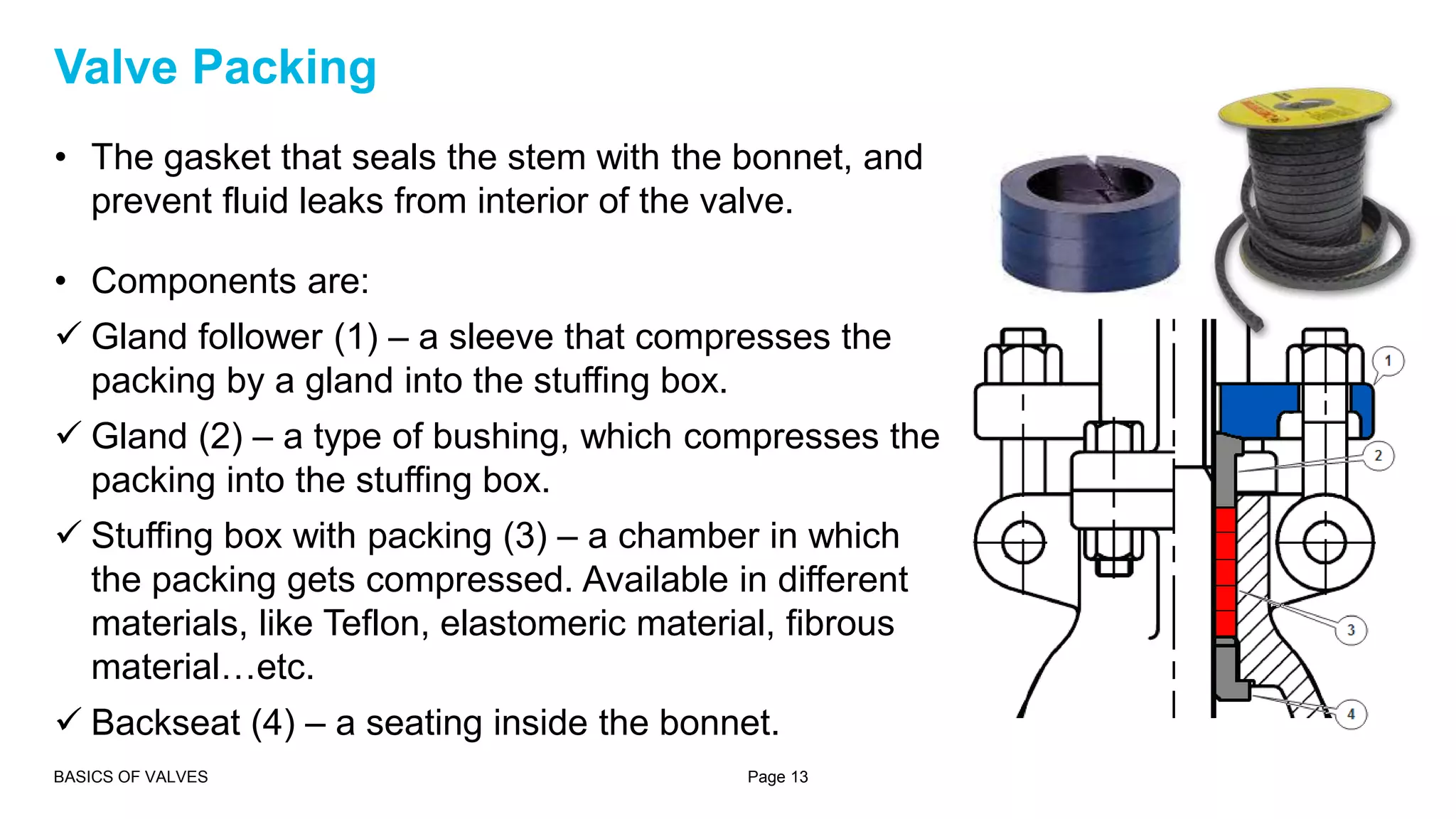
• The gasket that seals the stem with the bonnet, and
prevent fluid leaks from interior of the valve.
• Components are:
 Gland follower (1) – a sleeve that compresses the
packing by a gland into the stuffing box.
 Gland (2) – a type of bushing, which compresses the
packing into the stuffing box.
 Stuffing box with packing (3) – a chamber in which
the packing gets compressed. Available in different
materials, like Teflon, elastomeric material, fibrous
material…etc.
 Backseat (4) – a seating inside the bonnet.
BASICS OF VALVES Page 13
Valve Packing
• A device that produces linear and rotary motion
able to open or close the valve of a source of
power under the action of a source of control.
• Main types of valves actuators:
 Gear actuators
 Electric Motor actuators
 Pneumatic actuators
 Hydraulic actuators
 Solenoid actuators
BASICS OF VALVES Page 14
Valve Actuator
• Hand operated valves are generally equipped with a hand wheel that can be
rotated clockwise or counter-clockwise to open and close the valve (typical
for gate and globe valves). Ball, plug or butterfly are actuated using a lever
(manual quarter turn valves).
• There are applications where it is not possible or desirable to actuate the
valve manually by hand wheel or lever:
 Large valves that operate at high pressure.
 Valves that need to be controlled from a remote location.
 Valves that require (for the nature of the process) a very fast open or close
operation.
BASICS OF VALVES Page 15
Valve Actuator
Valves Material
 A valve may be constructed of several materials, while material
specifications depend on the application and operating conditions.
 Typical available materials; Ductile iron, Carbon steel, Cast iron,
Stainless steel, Brass, Bronze, and Plastic.
 Body material for small valves are usually brass, bronze, or forged
steel.
 Body material for larger valves, cast iron, ductile iron, or carbon
steel as required for the pressure and service.
BASICS OF VALVES Page 17
Valves Material
Types of Valves
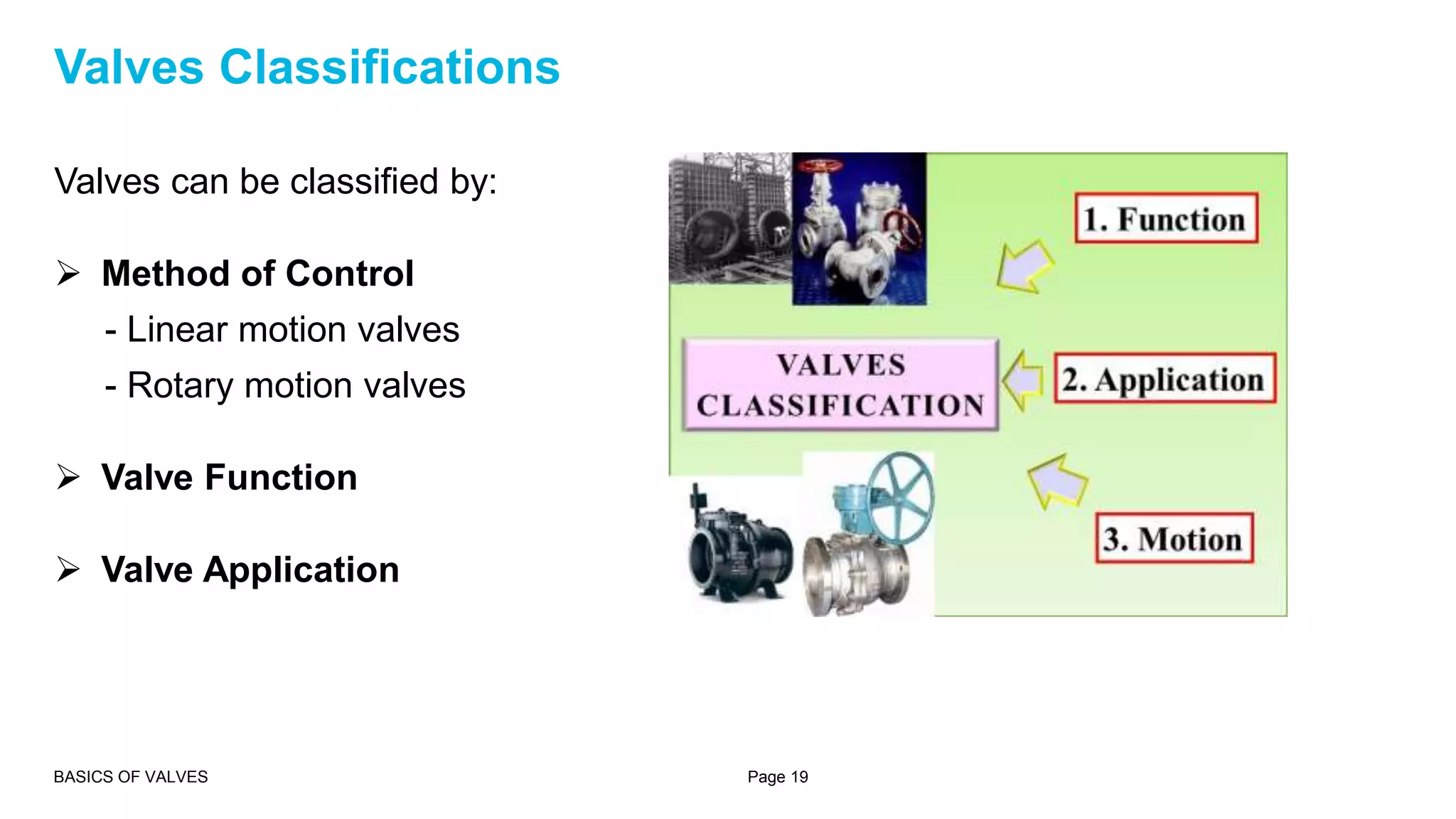
Valves can be classified by:
 Method of Control
- Linear motion valves
- Rotary motion valves
 Valve Function
 Valve Application
BASICS OF VALVES Page 19
Valves Classifications
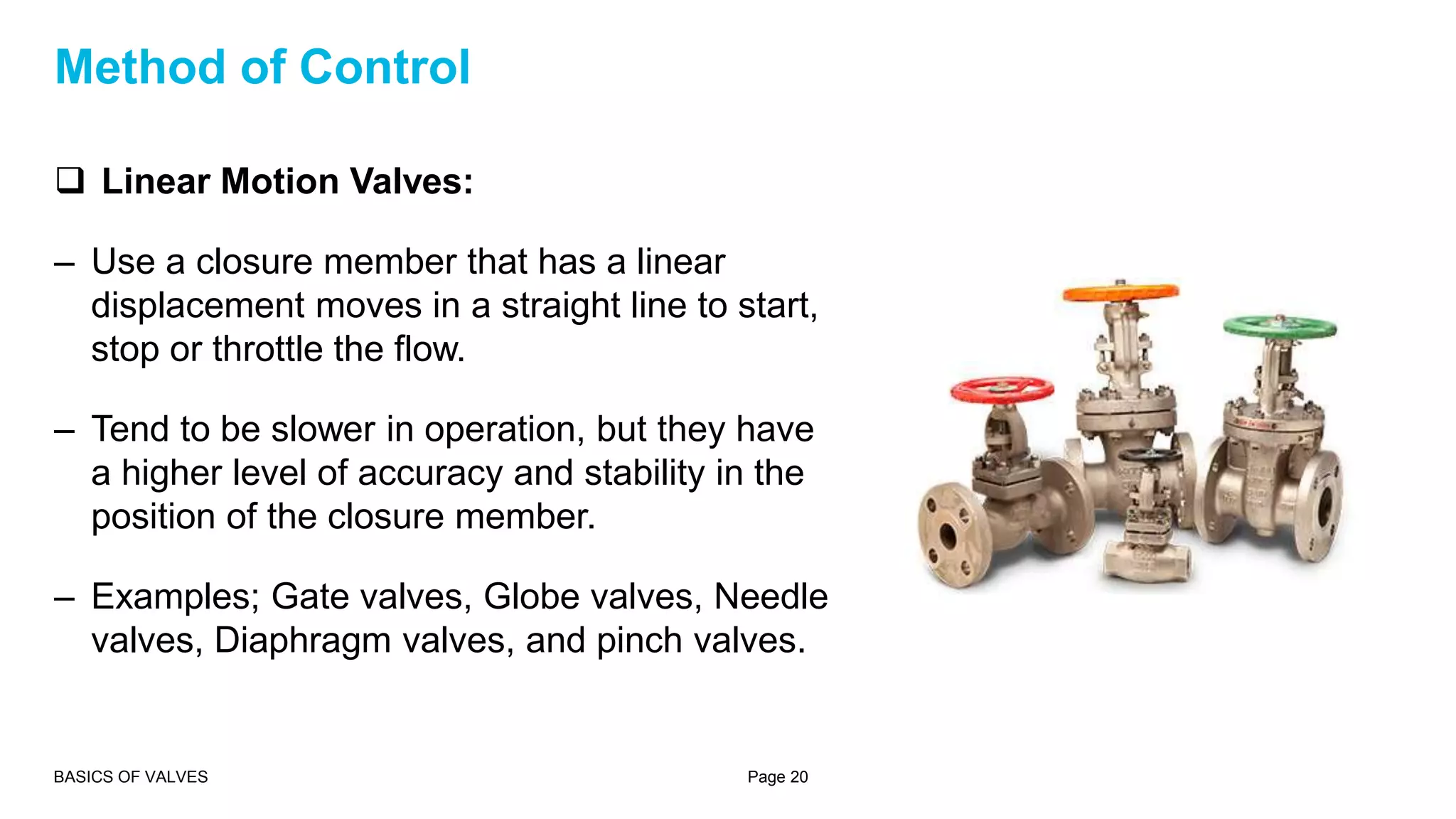
 Linear Motion Valves:
– Use a closure member that has a linear
displacement moves in a straight line to start,
stop or throttle the flow.
– Tend to be slower in operation, but they have
a higher level of accuracy and stability in the
position of the closure member.
– Examples; Gate valves, Globe valves, Needle
valves, Diaphragm valves, and pinch valves.
BASICS OF VALVES Page 20
Method of Control
 Rotary Motion Valves:
– The closure member as well its shaft turn
0°-90°; from the fully-open position to the
fully-closed position.
– Also known as quarter turn valves.
– Their operation is much quicker than linear
motion valves.
– Examples; Ball valves, Butterfly valves, and
Plug valves.
BASICS OF VALVES Page 21
Method of Control
Start/Stop valves (On/Off service valves).
The valve opens to allow flow and closes to
stop flow.
Throttle valves (Control valves/Regulating
valves). Control the speed and capacity of
flow, temperature, or pressure through a
system.
Non-return valves (Check valves). Control
the direction of flow.
Overpressure protection.
BASICS OF VALVES Page 22
Valve Function
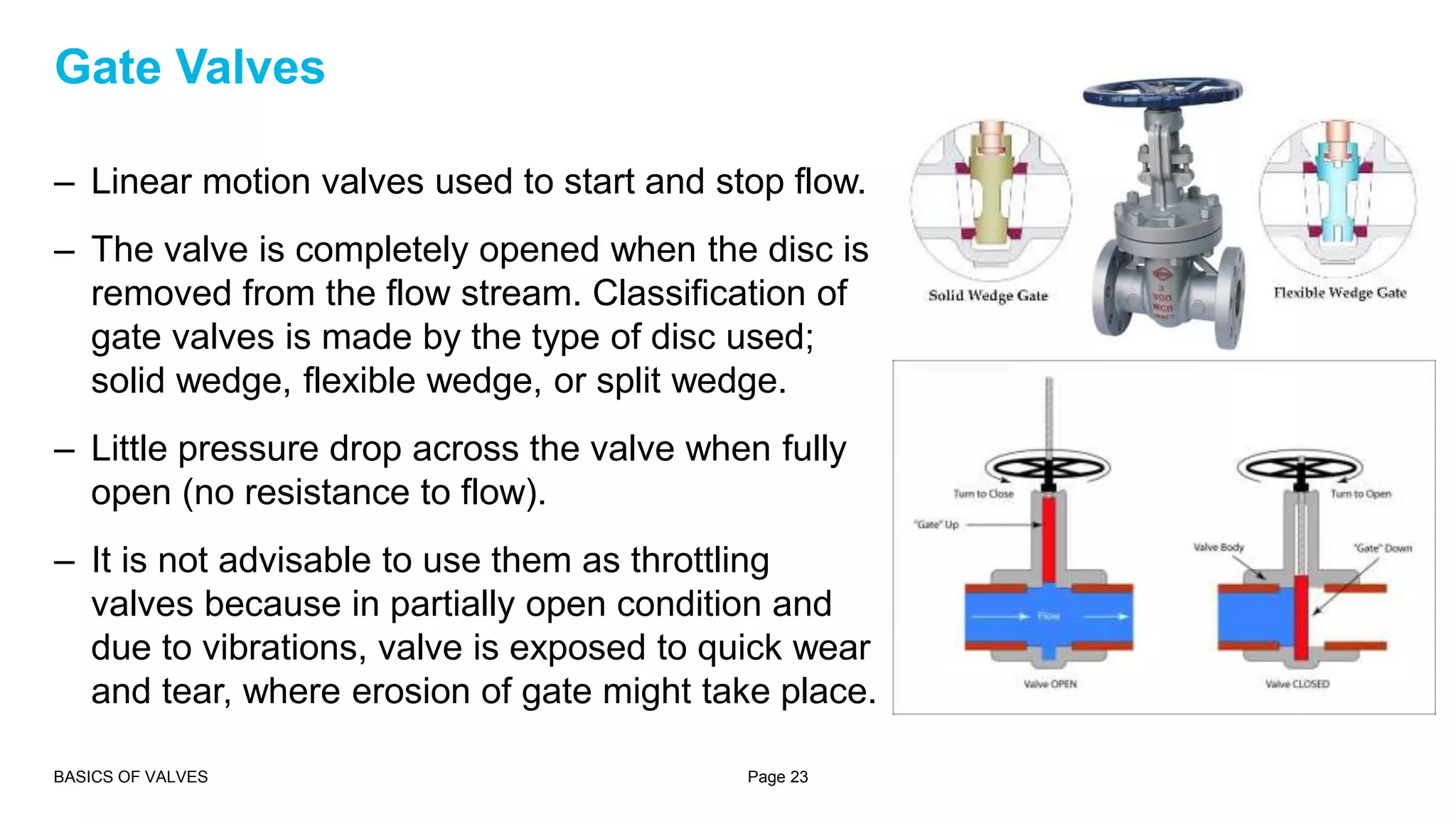
– Linear motion valves used to start and stop flow.
– The valve is completely opened when the disc is
removed from the flow stream. Classification of
gate valves is made by the type of disc used;
solid wedge, flexible wedge, or split wedge.
– Little pressure drop across the valve when fully
open (no resistance to flow).
– It is not advisable to use them as throttling
valves because in partially open condition and
due to vibrations, valve is exposed to quick wear
and tear, where erosion of gate might take place.
BASICS OF VALVES Page 23
Gate Valves
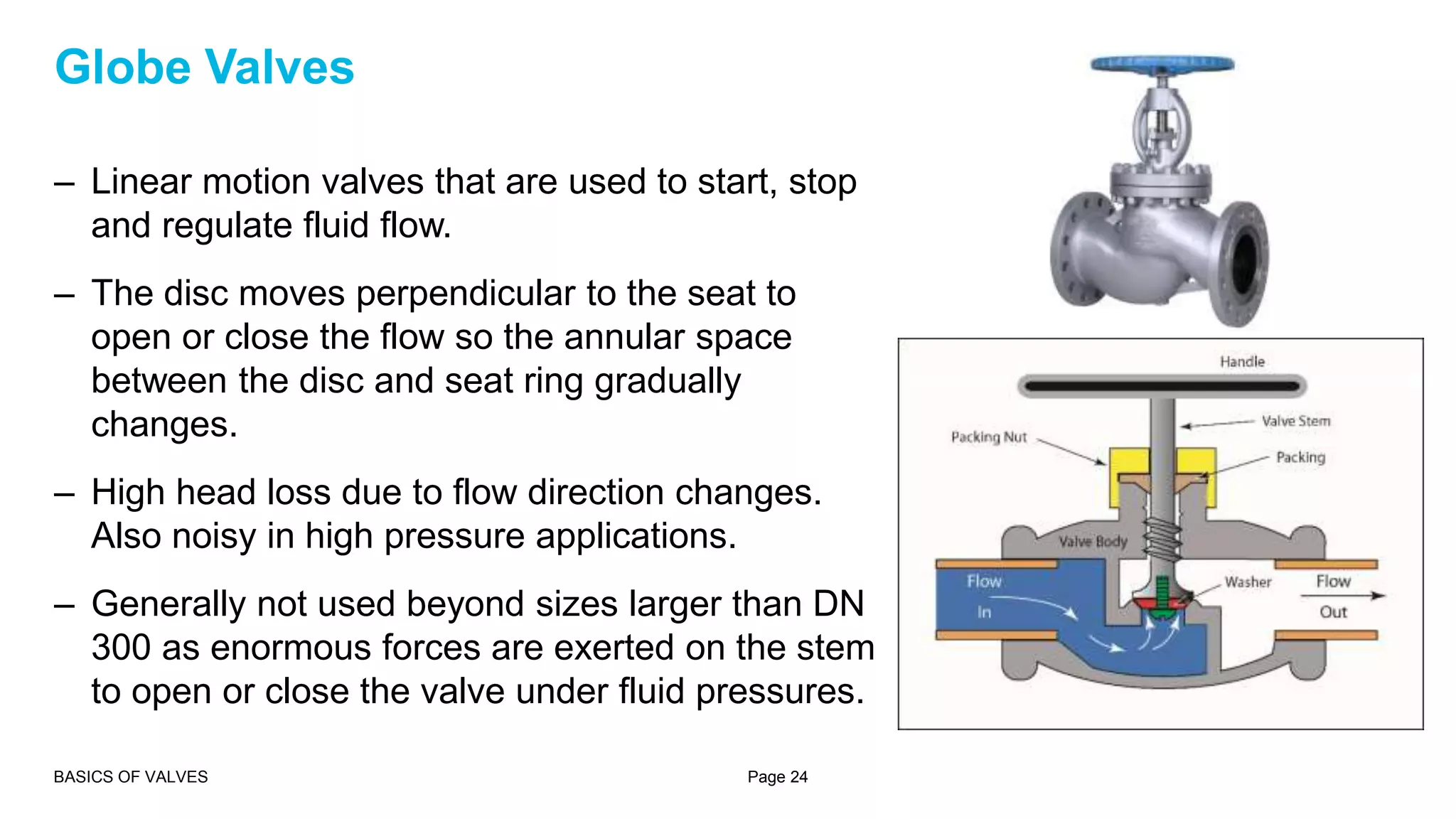
– Linear motion valves that are used to start, stop
and regulate fluid flow.
– The disc moves perpendicular to the seat to
open or close the flow so the annular space
between the disc and seat ring gradually
changes.
– High head loss due to flow direction changes.
Also noisy in high pressure applications.
– Generally not used beyond sizes larger than DN
300 as enormous forces are exerted on the stem
to open or close the valve under fluid pressures.
BASICS OF VALVES Page 24
Globe Valves
– Globe shaped body with inlet &
outlet at right angles to each other.
– Angle valve eliminates the need for
additional piping normally required
to change direction of flow.
BASICS OF VALVES Page 25
Angled Globe Valves (Angle Valves)
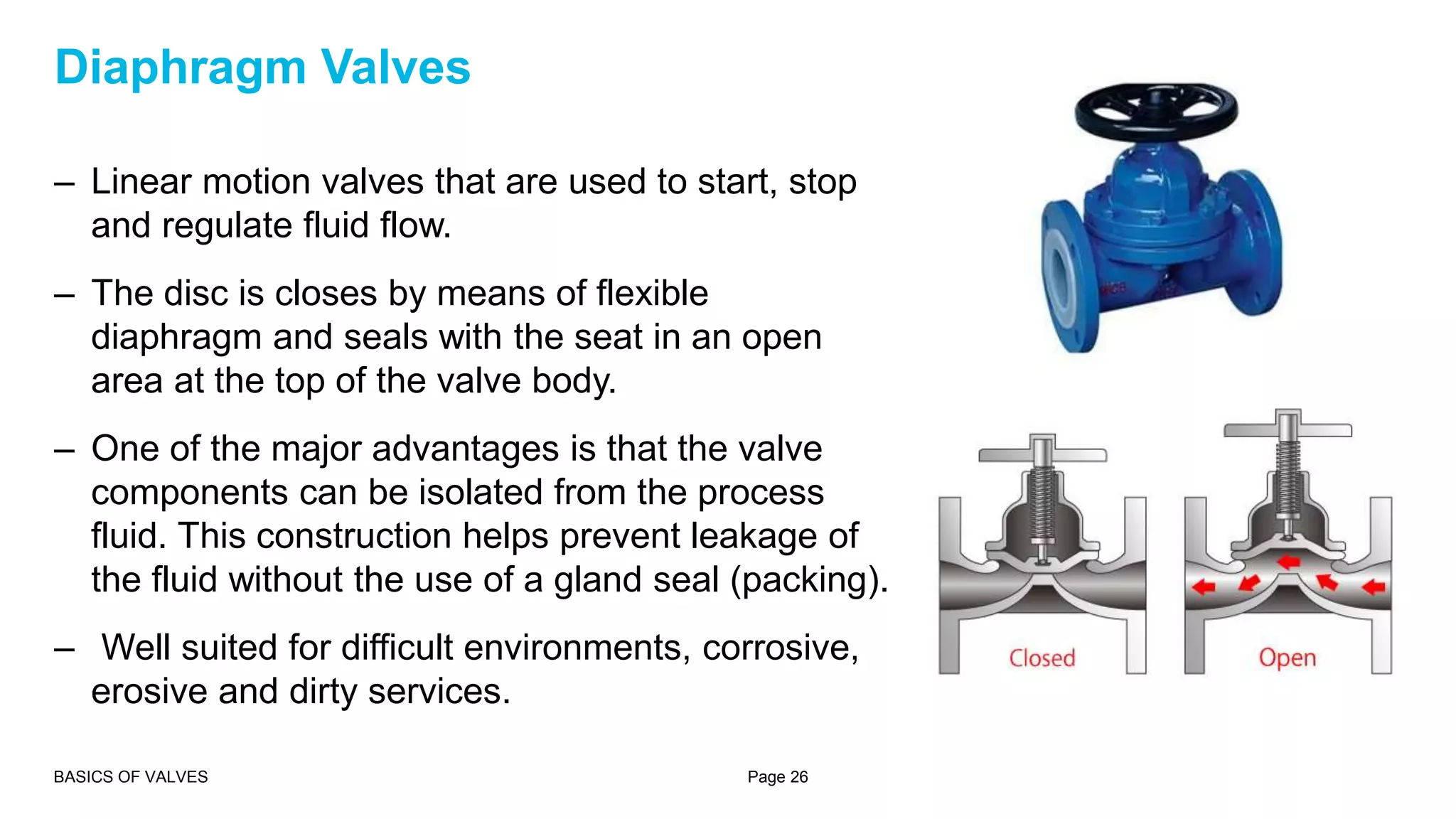
– Linear motion valves that are used to start, stop
and regulate fluid flow.
– The disc is closes by means of flexible
diaphragm and seals with the seat in an open
area at the top of the valve body.
– One of the major advantages is that the valve
components can be isolated from the process
fluid. This construction helps prevent leakage of
the fluid without the use of a gland seal (packing).
– Well suited for difficult environments, corrosive,
erosive and dirty services.
BASICS OF VALVES Page 26
Diaphragm Valves
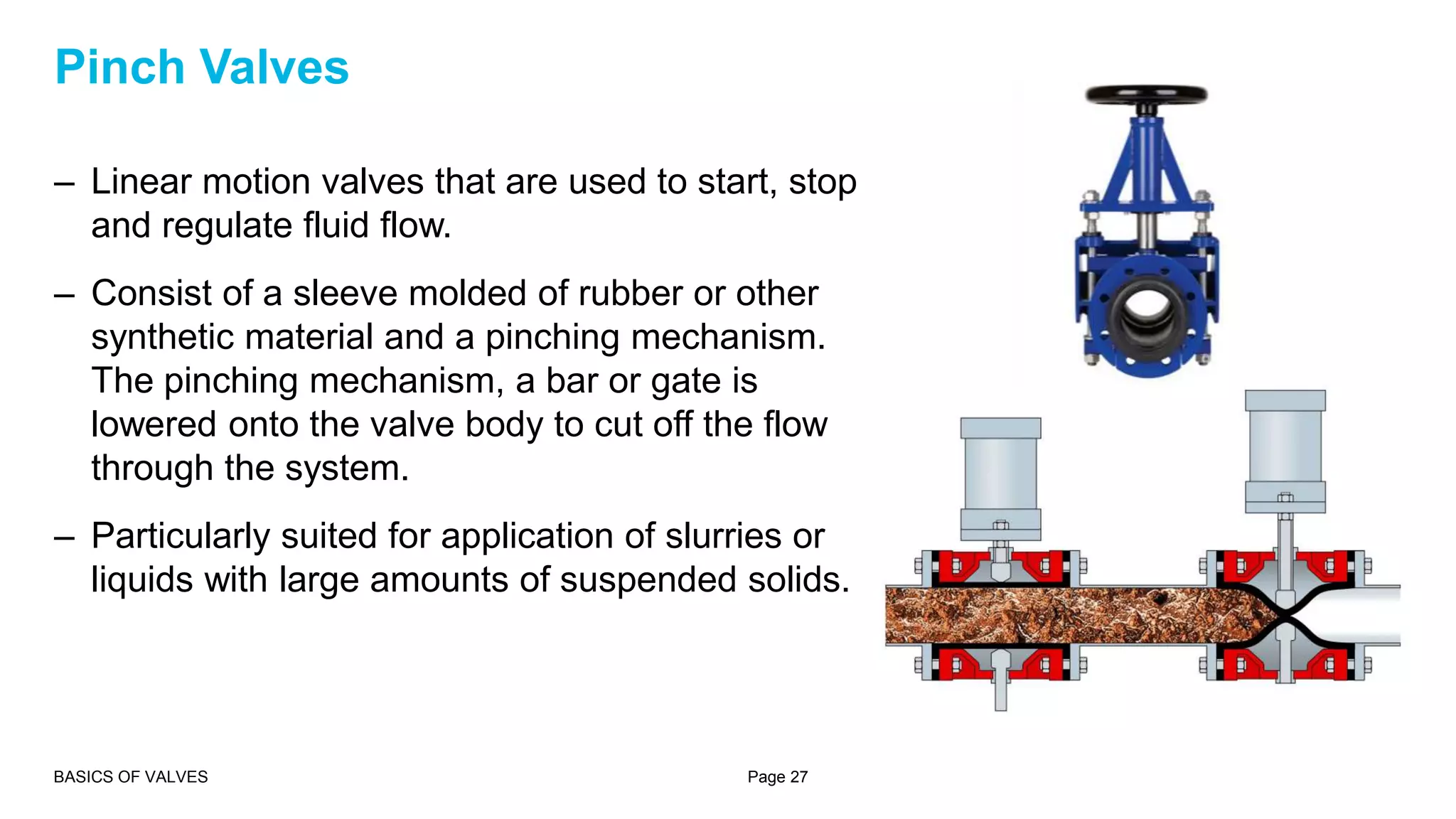
– Linear motion valves that are used to start, stop
and regulate fluid flow.
– Consist of a sleeve molded of rubber or other
synthetic material and a pinching mechanism.
The pinching mechanism, a bar or gate is
lowered onto the valve body to cut off the flow
through the system.
– Particularly suited for application of slurries or
liquids with large amounts of suspended solids.
BASICS OF VALVES Page 27
Pinch Valves
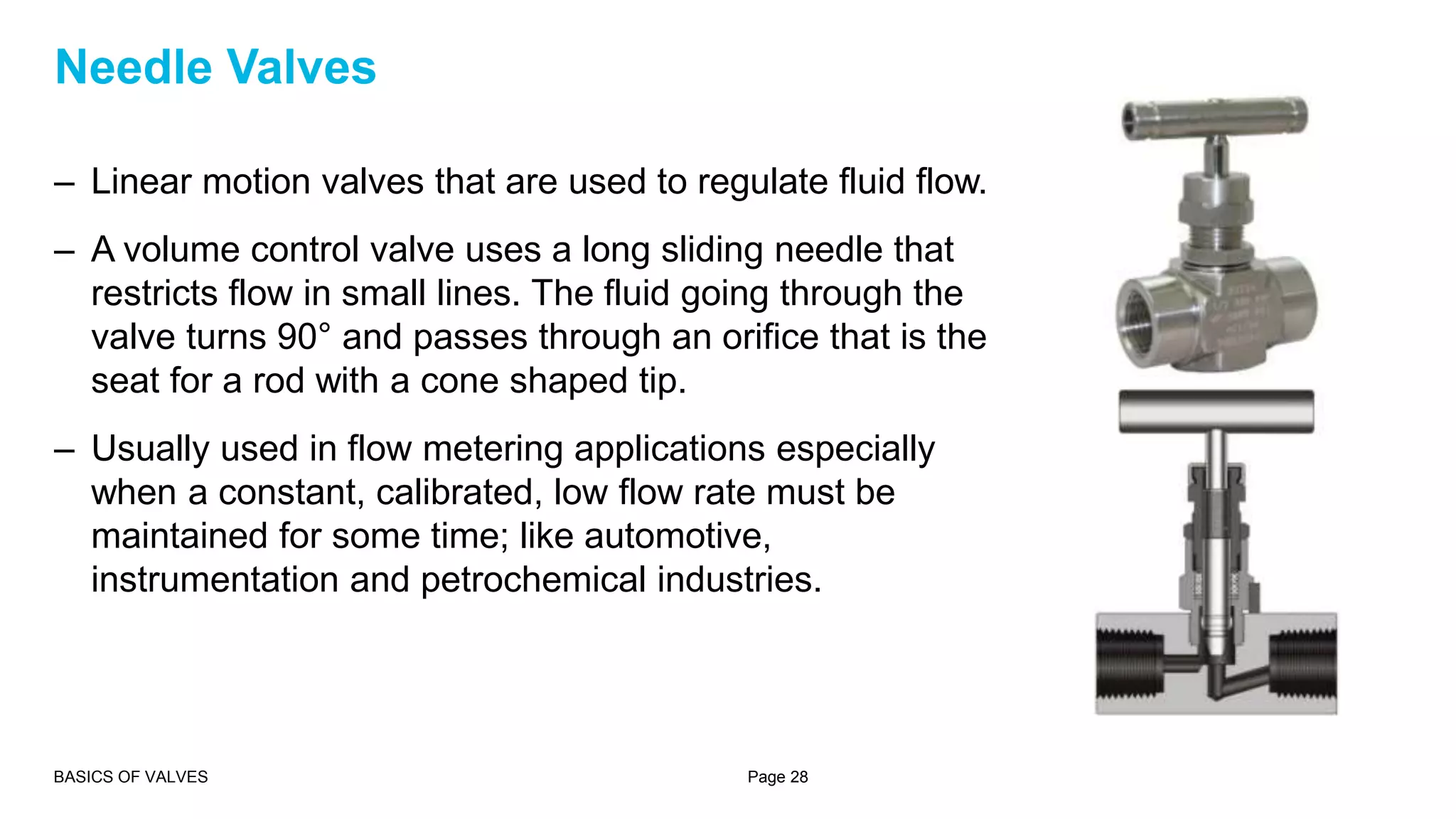
– Linear motion valves that are used to regulate fluid flow.
– A volume control valve uses a long sliding needle that
restricts flow in small lines. The fluid going through the
valve turns 90° and passes through an orifice that is the
seat for a rod with a cone shaped tip.
– Usually used in flow metering applications especially
when a constant, calibrated, low flow rate must be
maintained for some time; like automotive,
instrumentation and petrochemical industries.
BASICS OF VALVES Page 28
Needle Valves
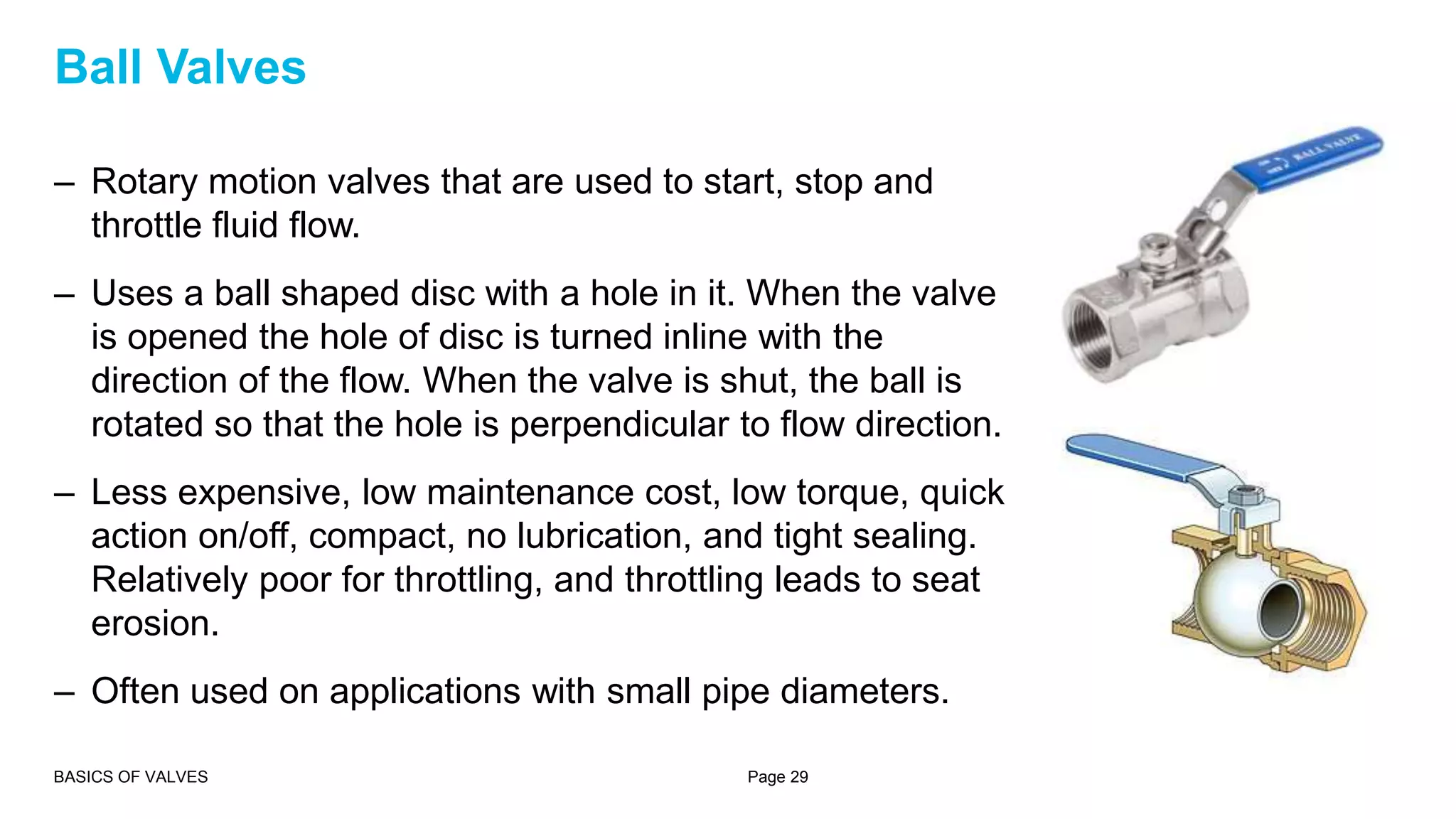
– Rotary motion valves that are used to start, stop and
throttle fluid flow.
– Uses a ball shaped disc with a hole in it. When the valve
is opened the hole of disc is turned inline with the
direction of the flow. When the valve is shut, the ball is
rotated so that the hole is perpendicular to flow direction.
– Less expensive, low maintenance cost, low torque, quick
action on/off, compact, no lubrication, and tight sealing.
Relatively poor for throttling, and throttling leads to seat
erosion.
– Often used on applications with small pipe diameters.
BASICS OF VALVES Page 29
Ball Valves
– Rotary motion valves that can be used in on/off
and throttling systems.
– The flow is regulated through a disc-type element
held in the center of the valve by a rod.
– Easily and quickly operated, good for large flow /
low pressure applications due to saving in weight,
size and cost. Good for slurries and fluids with
suspended solids as there are no cavities for
deposition of solid particles inside the valve body.
– Often used on applications with large pipe
diameters, but it is normally restricted for low
pressure, low temperature systems.
BASICS OF VALVES Page 30
Butterfly Valves
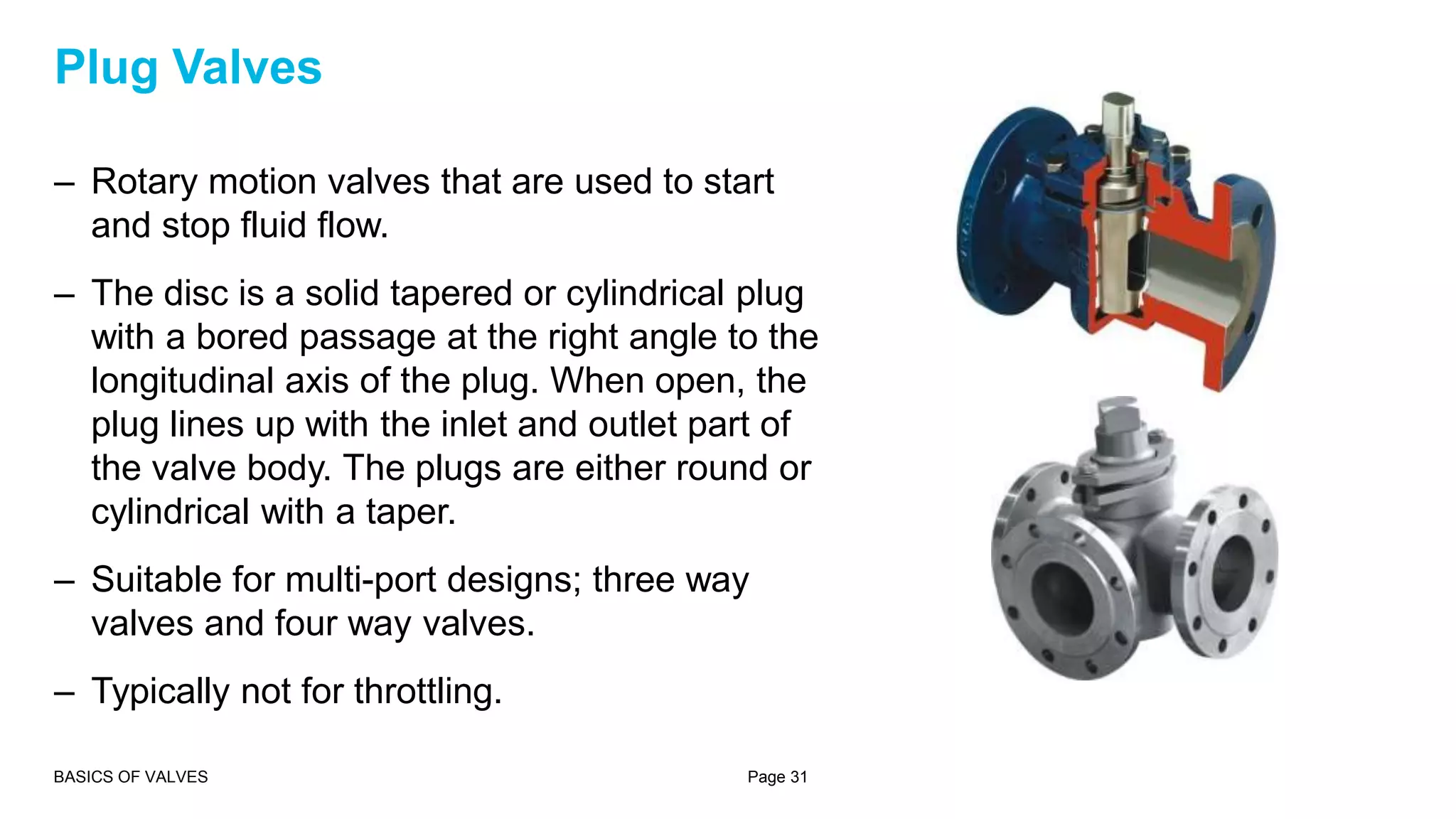
– Rotary motion valves that are used to start
and stop fluid flow.
– The disc is a solid tapered or cylindrical plug
with a bored passage at the right angle to the
longitudinal axis of the plug. When open, the
plug lines up with the inlet and outlet part of
the valve body. The plugs are either round or
cylindrical with a taper.
– Suitable for multi-port designs; three way
valves and four way valves.
– Typically not for throttling.
BASICS OF VALVES Page 31
Plug Valves
– Also called non-return valve.
– Allow the flow to pass through
in only one direction and stop
the flow in reverse direction.
BASICS OF VALVES Page 32
Check Valve
 Swing Check Valve
 Lift Check Valve
 Ball Check Valve
BASICS OF VALVES Page 33
Check Valve Types
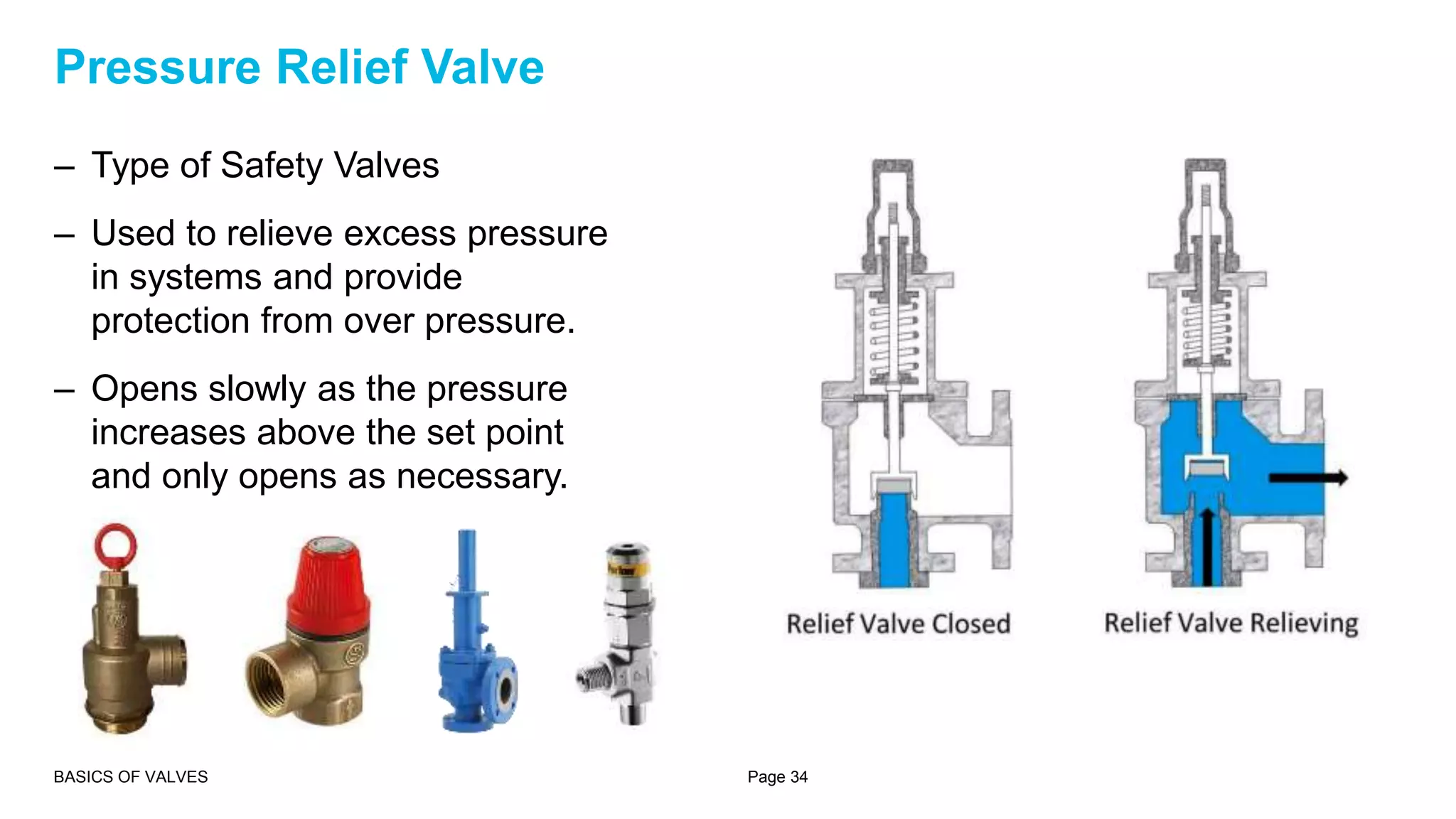
– Type of Safety Valves
– Used to relieve excess pressure
in systems and provide
protection from over pressure.
– Opens slowly as the pressure
increases above the set point
and only opens as necessary.
BASICS OF VALVES Page 34
Pressure Relief Valve
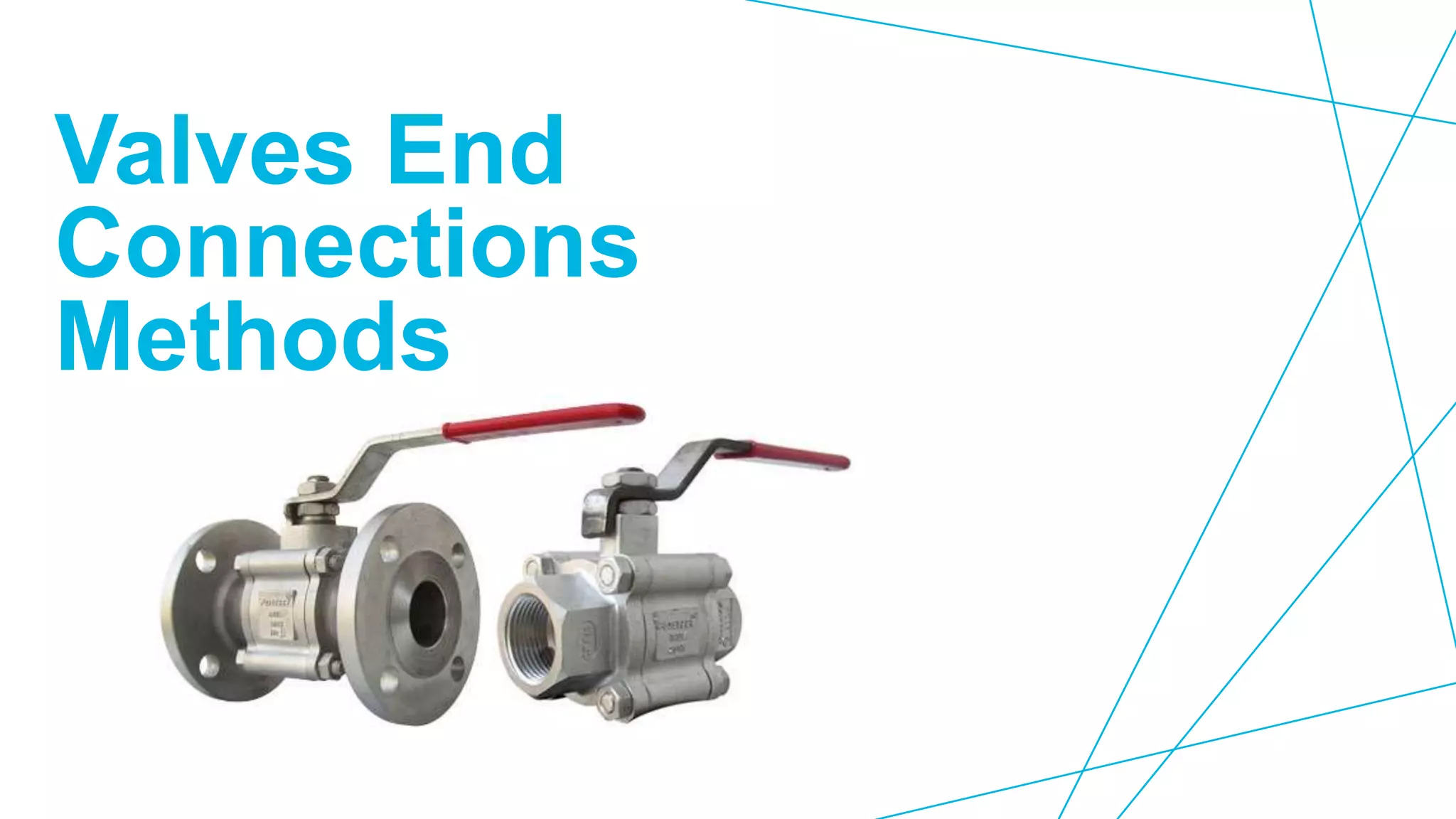
Valves End
Connections
Methods
– Cheap and the most widely used type. Found
in brass, iron, steel, and alloy piping
materials.
– Suited for all pressures, but usually used for
smaller pipe sizes (normally up to 4’’ Dia.).
The larger pipe sizes are more difficult to
make up the threaded joint.
– Should not be used with corrosive processes,
since the threads can either fail or become
inseparable.
BASICS OF VALVES Page 36
Threaded End
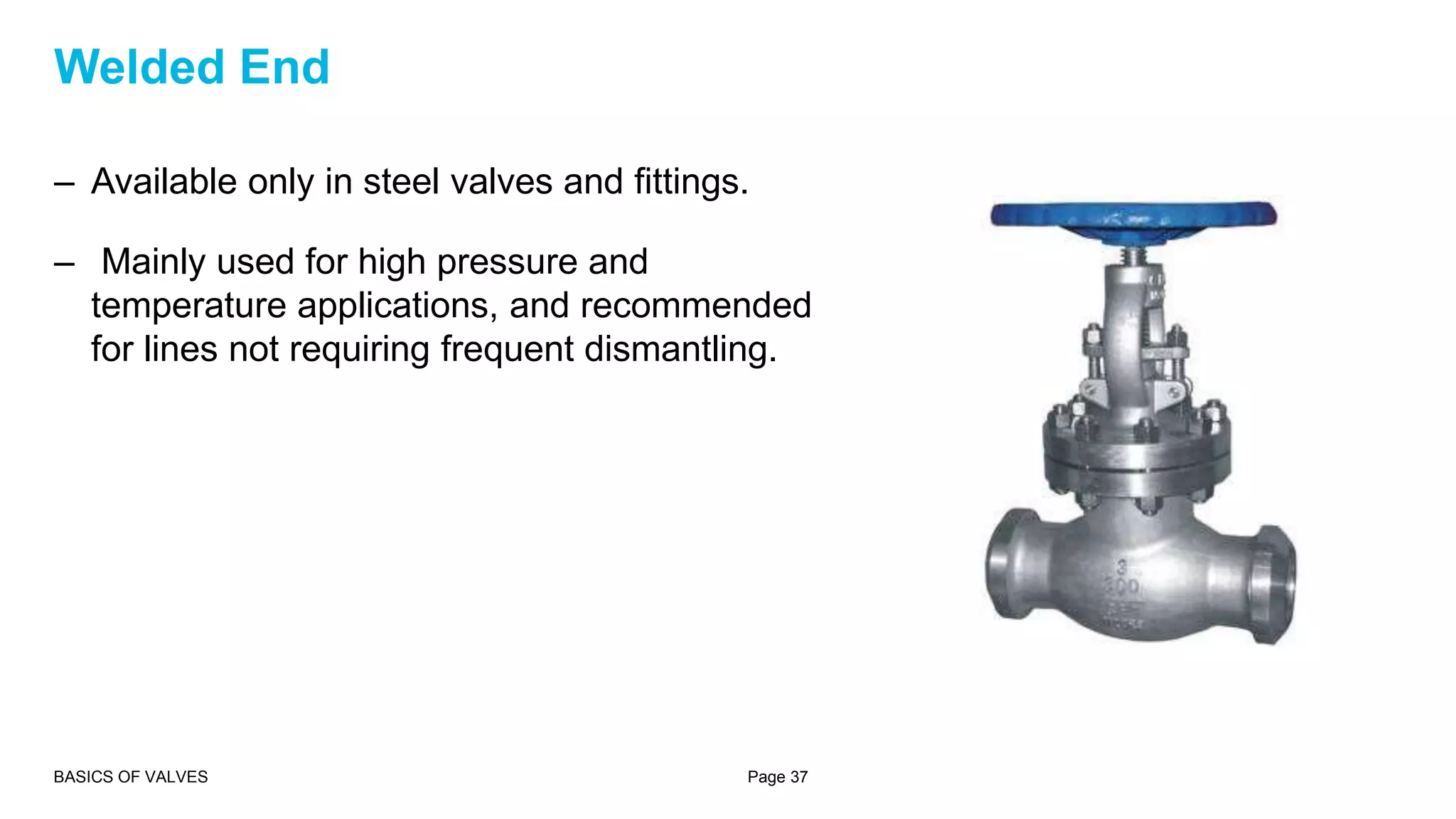
– Available only in steel valves and fittings.
– Mainly used for high pressure and
temperature applications, and recommended
for lines not requiring frequent dismantling.
BASICS OF VALVES Page 37
Welded End
– The most expensive but the best from an
installation and removal standpoint.
– The main advantage of flanges is that the
valve can be removed easily from the line.
– Generally used for large diameters lines due
to ease of assembly and dismantling.
– Flanged facings are available in various
designs depending on service requirements.
BASICS OF VALVES Page 38
Flanged End
Brazed End
BASICS OF VALVES Page 39
Other Ends Connections
Flared End Hub End
Valves Selection
 Pressure
 Temperature
 Type of fluid; liquid, gas, erosive, corrosive…etc.
 Flow considerations; on/off, throttling, prevent
backflow, concern for pressure drop, velocity…etc.
 Operating conditions; frequency of operation,
accessibility, space availability, type of control, fire
safety concerns, speed of closure…etc.
BASICS OF VALVES Page 41
Valves Selection Considerations
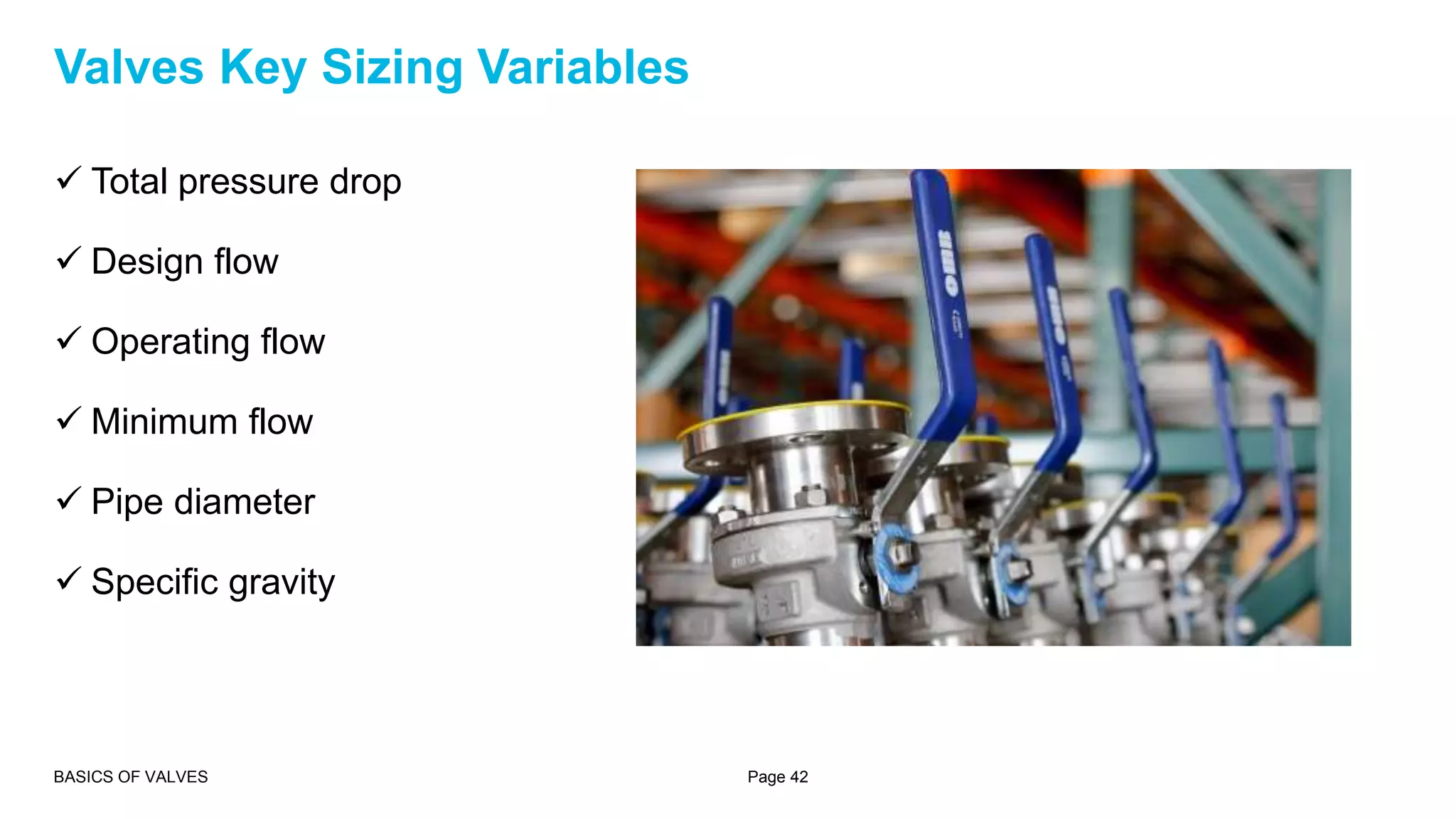
 Total pressure drop
 Design flow
 Operating flow
 Minimum flow
 Pipe diameter
 Specific gravity
BASICS OF VALVES Page 42
Valves Key Sizing Variables
Valves Standards
• ANSI – American National Standards Institute
• API – American Petroleum Institute
• ASME – American Society of Mechanical Engineers
• AWWA – American Water Works Association
• MAA – Manufacturers Standardization Society of the
Valves and Fittings Industry
• BSI – British Standards Institution
BASICS OF VALVES Page 44
Selected Valve Standards
Valves Maintenance
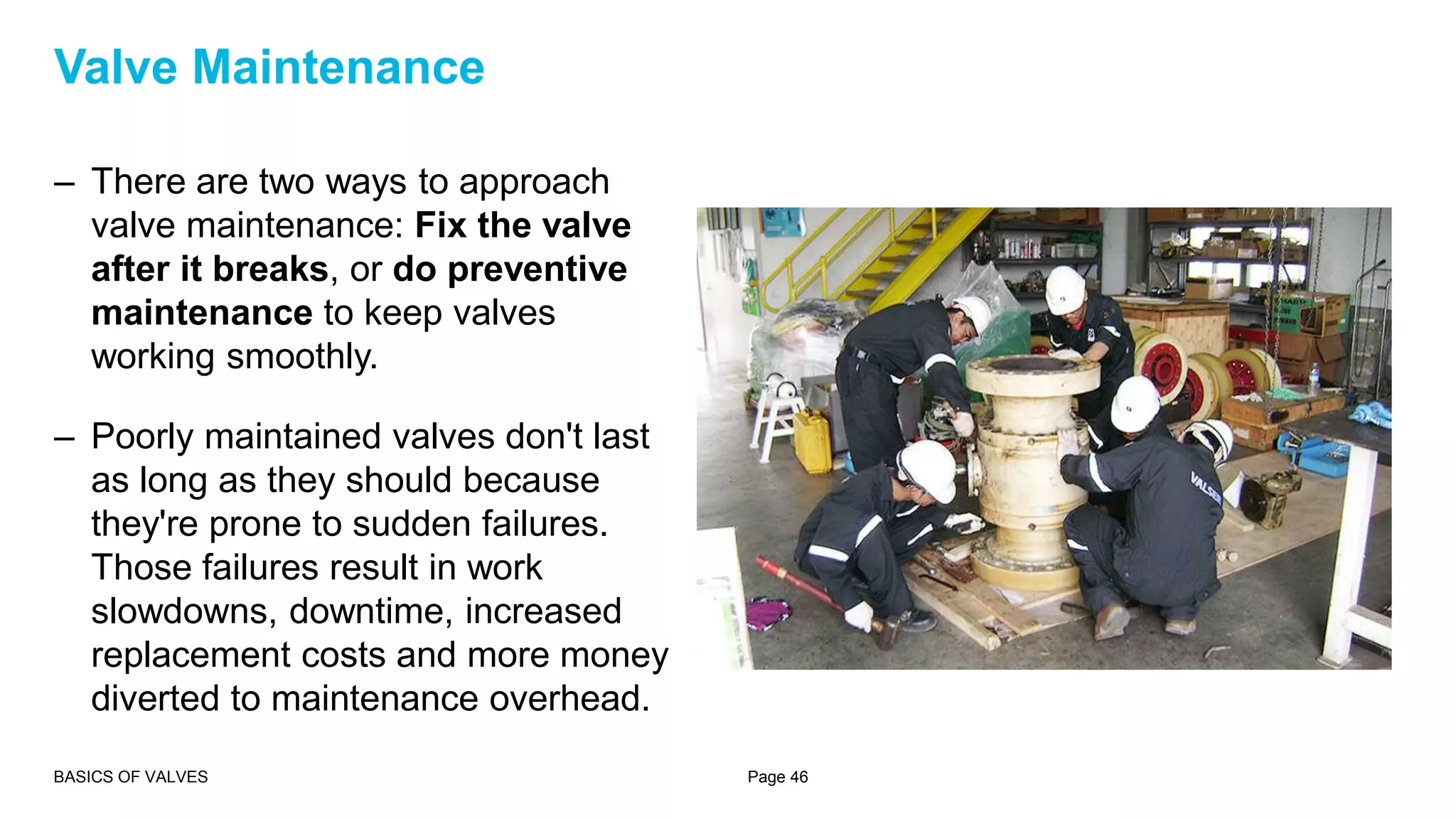
– There are two ways to approach
valve maintenance: Fix the valve
after it breaks, or do preventive
maintenance to keep valves
working smoothly.
– Poorly maintained valves don't last
as long as they should because
they're prone to sudden failures.
Those failures result in work
slowdowns, downtime, increased
replacement costs and more money
diverted to maintenance overhead.
BASICS OF VALVES Page 46
Valve Maintenance
1) Cleaning:
– Keeping Valves Clean and Working Smoothly.
– clean valves at least once a year, and if the
environment is dirty or dusty, clean them more
frequently.
– Use a cloth, wire brush or lubricant to clean
the valve casing. Keeping it clean will prevent
buildup on the valve stem and other moving
parts, and maximizing the life of the valve.
BASICS OF VALVES Page 47
Tips for Valve Maintenance
2) Routine Inspection:
– Valves under high pressure or extreme
temperatures should be checked on a
weekly or monthly basis, while valves
that aren't under much strain can be
checked every six months or yearly.
– If possible, open and close the valves to
make sure they aren't seizing from a
buildup of minerals or rust.
– Leak detection is an important part of the
valves routine inspection
BASICS OF VALVES Page 48
Tips for Valve Maintenance
3) Scheduled Shutdown Maintenance:
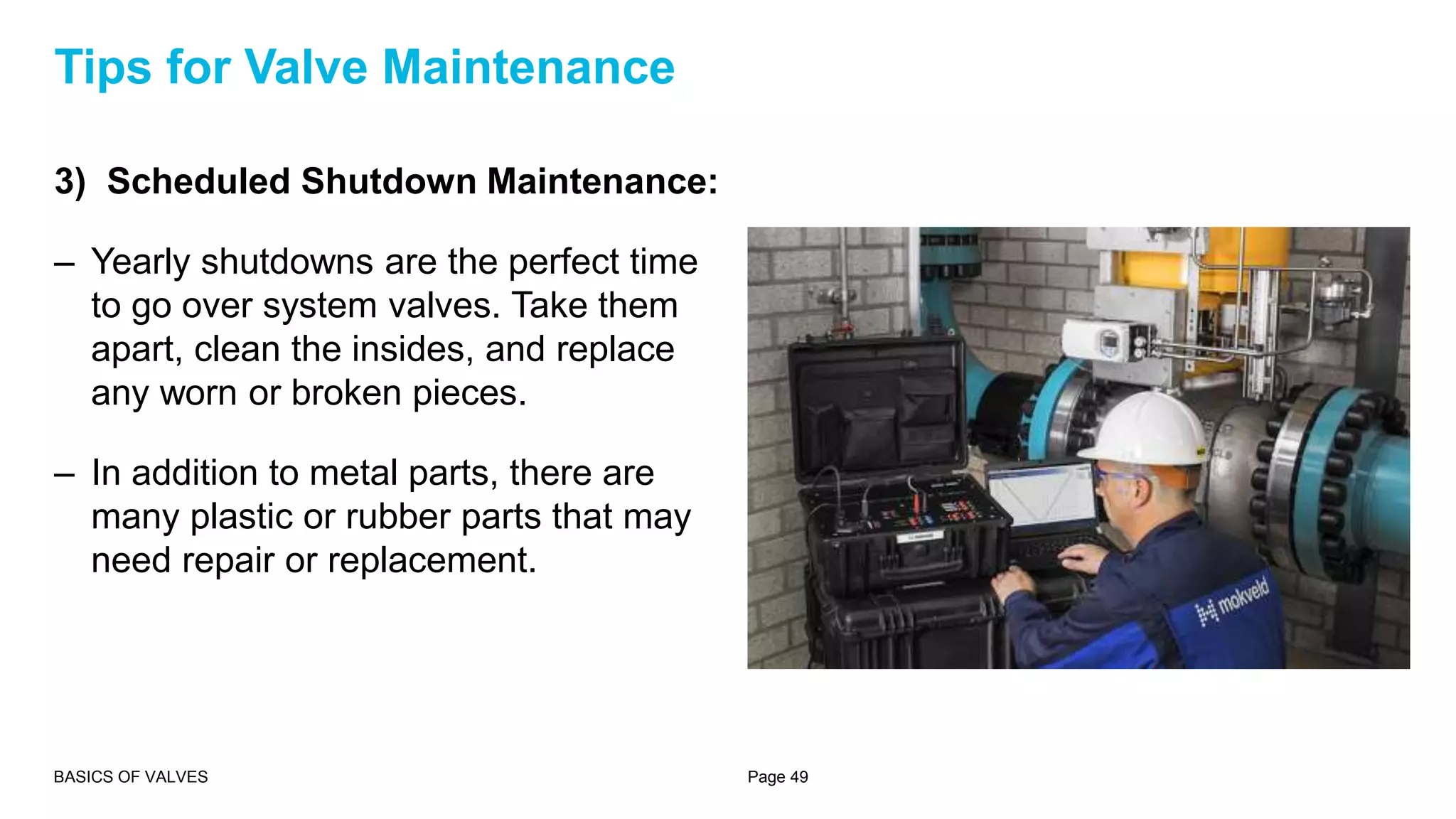
– Yearly shutdowns are the perfect time
to go over system valves. Take them
apart, clean the insides, and replace
any worn or broken pieces.
– In addition to metal parts, there are
many plastic or rubber parts that may
need repair or replacement.
BASICS OF VALVES Page 49
Tips for Valve Maintenance
 Packing: Inspect excessive packing gland leakage,
and packing adjustment.
 Flanges: Check for nicks and corrosion.
 Stem Bushing: Inspect for wear and damage.
 Valve stem: Inspect for bent, worn or corrosion.
 Checking stem straightness.
 Replace cracked or badly corroded bonnet/body.
 Disc: inspect for wear, damage and corrosion.
BASICS OF VALVES Page 50
Valve Inspection
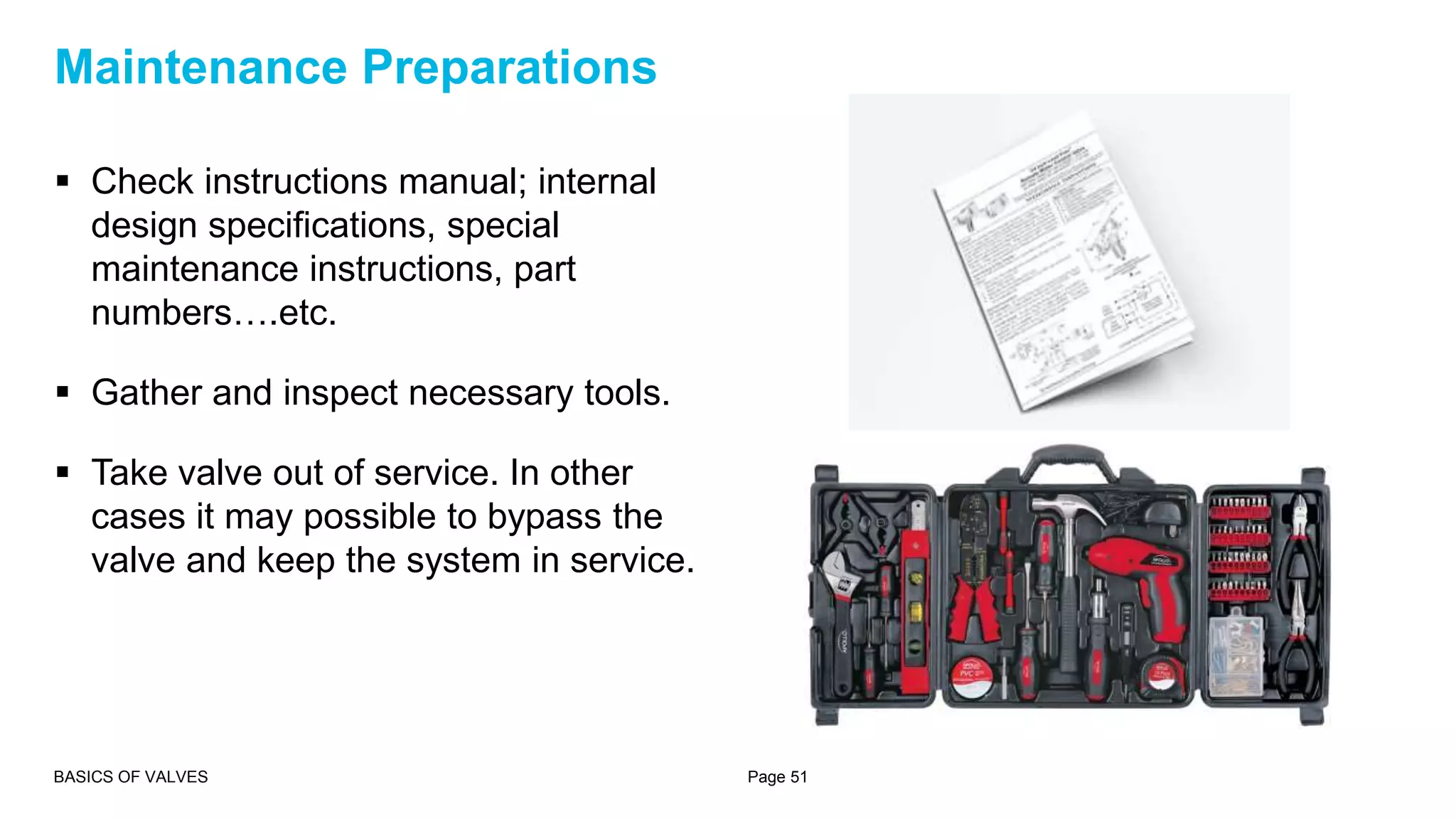
 Check instructions manual; internal
design specifications, special
maintenance instructions, part
numbers….etc.
 Gather and inspect necessary tools.
 Take valve out of service. In other
cases it may possible to bypass the
valve and keep the system in service.
BASICS OF VALVES Page 51
Maintenance Preparations
Thank You

Basics of valves

  • 1.
    Basics of Valves TahseenQamhieh Sr. Mechanical Engineer
  • 2.
     What areValves?  Functions of Valves  Common Parts of Valves  Valves Material  Types of Valves  Valves End Connections Methods  Valves Selection  Valves Standards  Valves Maintenance Page 2 Presentation Outline BASICS OF VALVES
  • 3.
    Mechanical devices thatcontrols the flow and pressure within a system or process. They are essential components of a piping system that conveys fluid. BASICS OF VALVES Page 3 What are Valves?
  • 4.
     Stopping andstarting flow  Reduce or increase a flow  Controlling the direction of flow  Regulating a flow or process pressure  Relieve a pipe system of a certain pressure BASICS OF VALVES Page 4 Functions of Valves
  • 5.
  • 6.
  • 7.
    • Serves asthe main element of a valve assembly because it is the framework that holds all the parts together. • The first pressure boundary of a valve, resists fluid pressure loads from connecting piping. • It receives inlet and outlet piping through threaded, bolted, or welded joints. BASICS OF VALVES Page 7 Valve Body
  • 8.
    • Acts asa cover on the valve body and support other valve components. • When dismantled from the body, it allows the access to the internal components of the valve to execute maintenance activities or replacement of parts. • Connected with the body by a threaded, bolted, or welded joint connections. And gaskets are used in between the body and the bonnet. BASICS OF VALVES Page 8 Valve Bonnet
  • 9.
    • A collectivename for the removal and replaceable valve internal parts that come in contact with the flow medium. • Typically these parts include valve seats, disc, glands, spacers, guides, bushings, and internal springs. BASICS OF VALVES Page 9 Valve Trim
  • 10.
    • The partwhich allows, throttles, or stops flow depending on its position. • In the case of a gate valve, the “gate” is the disc. Whereas the disc is called “ball” for ball valves. BASICS OF VALVES Page 10 Valve Disc
  • 11.
    • Provide theseating surface for the disc. • Can be threaded, press fit, or welded into body of the valve. • In some cases the seat is cast as a component of the valve body. • A valve may have one or more seats. BASICS OF VALVES Page 11 Valve Seats
  • 12.
    • Provides thenecessary movement to the disc, and is responsible for the proper positioning of the disc. • It is connected to the valve hand wheel, actuator, or the lever at one end and on the other side to the valve disc. BASICS OF VALVES Page 12 Valve Stem • Valve stem types:  Rising stem with outside screw and yoke  Rising stem with inside screw  Sliding stem  Non rising stem with inside screw  Rotary stem
  • 13.
    • The gasketthat seals the stem with the bonnet, and prevent fluid leaks from interior of the valve. • Components are:  Gland follower (1) – a sleeve that compresses the packing by a gland into the stuffing box.  Gland (2) – a type of bushing, which compresses the packing into the stuffing box.  Stuffing box with packing (3) – a chamber in which the packing gets compressed. Available in different materials, like Teflon, elastomeric material, fibrous material…etc.  Backseat (4) – a seating inside the bonnet. BASICS OF VALVES Page 13 Valve Packing
  • 14.
    • A devicethat produces linear and rotary motion able to open or close the valve of a source of power under the action of a source of control. • Main types of valves actuators:  Gear actuators  Electric Motor actuators  Pneumatic actuators  Hydraulic actuators  Solenoid actuators BASICS OF VALVES Page 14 Valve Actuator
  • 15.
    • Hand operatedvalves are generally equipped with a hand wheel that can be rotated clockwise or counter-clockwise to open and close the valve (typical for gate and globe valves). Ball, plug or butterfly are actuated using a lever (manual quarter turn valves). • There are applications where it is not possible or desirable to actuate the valve manually by hand wheel or lever:  Large valves that operate at high pressure.  Valves that need to be controlled from a remote location.  Valves that require (for the nature of the process) a very fast open or close operation. BASICS OF VALVES Page 15 Valve Actuator
  • 16.
  • 17.
     A valvemay be constructed of several materials, while material specifications depend on the application and operating conditions.  Typical available materials; Ductile iron, Carbon steel, Cast iron, Stainless steel, Brass, Bronze, and Plastic.  Body material for small valves are usually brass, bronze, or forged steel.  Body material for larger valves, cast iron, ductile iron, or carbon steel as required for the pressure and service. BASICS OF VALVES Page 17 Valves Material
  • 18.
  • 19.
    Valves can beclassified by:  Method of Control - Linear motion valves - Rotary motion valves  Valve Function  Valve Application BASICS OF VALVES Page 19 Valves Classifications
  • 20.
     Linear MotionValves: – Use a closure member that has a linear displacement moves in a straight line to start, stop or throttle the flow. – Tend to be slower in operation, but they have a higher level of accuracy and stability in the position of the closure member. – Examples; Gate valves, Globe valves, Needle valves, Diaphragm valves, and pinch valves. BASICS OF VALVES Page 20 Method of Control
  • 21.
     Rotary MotionValves: – The closure member as well its shaft turn 0°-90°; from the fully-open position to the fully-closed position. – Also known as quarter turn valves. – Their operation is much quicker than linear motion valves. – Examples; Ball valves, Butterfly valves, and Plug valves. BASICS OF VALVES Page 21 Method of Control
  • 22.
    Start/Stop valves (On/Offservice valves). The valve opens to allow flow and closes to stop flow. Throttle valves (Control valves/Regulating valves). Control the speed and capacity of flow, temperature, or pressure through a system. Non-return valves (Check valves). Control the direction of flow. Overpressure protection. BASICS OF VALVES Page 22 Valve Function
  • 23.
    – Linear motionvalves used to start and stop flow. – The valve is completely opened when the disc is removed from the flow stream. Classification of gate valves is made by the type of disc used; solid wedge, flexible wedge, or split wedge. – Little pressure drop across the valve when fully open (no resistance to flow). – It is not advisable to use them as throttling valves because in partially open condition and due to vibrations, valve is exposed to quick wear and tear, where erosion of gate might take place. BASICS OF VALVES Page 23 Gate Valves
  • 24.
    – Linear motionvalves that are used to start, stop and regulate fluid flow. – The disc moves perpendicular to the seat to open or close the flow so the annular space between the disc and seat ring gradually changes. – High head loss due to flow direction changes. Also noisy in high pressure applications. – Generally not used beyond sizes larger than DN 300 as enormous forces are exerted on the stem to open or close the valve under fluid pressures. BASICS OF VALVES Page 24 Globe Valves
  • 25.
    – Globe shapedbody with inlet & outlet at right angles to each other. – Angle valve eliminates the need for additional piping normally required to change direction of flow. BASICS OF VALVES Page 25 Angled Globe Valves (Angle Valves)
  • 26.
    – Linear motionvalves that are used to start, stop and regulate fluid flow. – The disc is closes by means of flexible diaphragm and seals with the seat in an open area at the top of the valve body. – One of the major advantages is that the valve components can be isolated from the process fluid. This construction helps prevent leakage of the fluid without the use of a gland seal (packing). – Well suited for difficult environments, corrosive, erosive and dirty services. BASICS OF VALVES Page 26 Diaphragm Valves
  • 27.
    – Linear motionvalves that are used to start, stop and regulate fluid flow. – Consist of a sleeve molded of rubber or other synthetic material and a pinching mechanism. The pinching mechanism, a bar or gate is lowered onto the valve body to cut off the flow through the system. – Particularly suited for application of slurries or liquids with large amounts of suspended solids. BASICS OF VALVES Page 27 Pinch Valves
  • 28.
    – Linear motionvalves that are used to regulate fluid flow. – A volume control valve uses a long sliding needle that restricts flow in small lines. The fluid going through the valve turns 90° and passes through an orifice that is the seat for a rod with a cone shaped tip. – Usually used in flow metering applications especially when a constant, calibrated, low flow rate must be maintained for some time; like automotive, instrumentation and petrochemical industries. BASICS OF VALVES Page 28 Needle Valves
  • 29.
    – Rotary motionvalves that are used to start, stop and throttle fluid flow. – Uses a ball shaped disc with a hole in it. When the valve is opened the hole of disc is turned inline with the direction of the flow. When the valve is shut, the ball is rotated so that the hole is perpendicular to flow direction. – Less expensive, low maintenance cost, low torque, quick action on/off, compact, no lubrication, and tight sealing. Relatively poor for throttling, and throttling leads to seat erosion. – Often used on applications with small pipe diameters. BASICS OF VALVES Page 29 Ball Valves
  • 30.
    – Rotary motionvalves that can be used in on/off and throttling systems. – The flow is regulated through a disc-type element held in the center of the valve by a rod. – Easily and quickly operated, good for large flow / low pressure applications due to saving in weight, size and cost. Good for slurries and fluids with suspended solids as there are no cavities for deposition of solid particles inside the valve body. – Often used on applications with large pipe diameters, but it is normally restricted for low pressure, low temperature systems. BASICS OF VALVES Page 30 Butterfly Valves
  • 31.
    – Rotary motionvalves that are used to start and stop fluid flow. – The disc is a solid tapered or cylindrical plug with a bored passage at the right angle to the longitudinal axis of the plug. When open, the plug lines up with the inlet and outlet part of the valve body. The plugs are either round or cylindrical with a taper. – Suitable for multi-port designs; three way valves and four way valves. – Typically not for throttling. BASICS OF VALVES Page 31 Plug Valves
  • 32.
    – Also callednon-return valve. – Allow the flow to pass through in only one direction and stop the flow in reverse direction. BASICS OF VALVES Page 32 Check Valve
  • 33.
     Swing CheckValve  Lift Check Valve  Ball Check Valve BASICS OF VALVES Page 33 Check Valve Types
  • 34.
    – Type ofSafety Valves – Used to relieve excess pressure in systems and provide protection from over pressure. – Opens slowly as the pressure increases above the set point and only opens as necessary. BASICS OF VALVES Page 34 Pressure Relief Valve
  • 35.
  • 36.
    – Cheap andthe most widely used type. Found in brass, iron, steel, and alloy piping materials. – Suited for all pressures, but usually used for smaller pipe sizes (normally up to 4’’ Dia.). The larger pipe sizes are more difficult to make up the threaded joint. – Should not be used with corrosive processes, since the threads can either fail or become inseparable. BASICS OF VALVES Page 36 Threaded End
  • 37.
    – Available onlyin steel valves and fittings. – Mainly used for high pressure and temperature applications, and recommended for lines not requiring frequent dismantling. BASICS OF VALVES Page 37 Welded End
  • 38.
    – The mostexpensive but the best from an installation and removal standpoint. – The main advantage of flanges is that the valve can be removed easily from the line. – Generally used for large diameters lines due to ease of assembly and dismantling. – Flanged facings are available in various designs depending on service requirements. BASICS OF VALVES Page 38 Flanged End
  • 39.
    Brazed End BASICS OFVALVES Page 39 Other Ends Connections Flared End Hub End
  • 40.
  • 41.
     Pressure  Temperature Type of fluid; liquid, gas, erosive, corrosive…etc.  Flow considerations; on/off, throttling, prevent backflow, concern for pressure drop, velocity…etc.  Operating conditions; frequency of operation, accessibility, space availability, type of control, fire safety concerns, speed of closure…etc. BASICS OF VALVES Page 41 Valves Selection Considerations
  • 42.
     Total pressuredrop  Design flow  Operating flow  Minimum flow  Pipe diameter  Specific gravity BASICS OF VALVES Page 42 Valves Key Sizing Variables
  • 43.
  • 44.
    • ANSI –American National Standards Institute • API – American Petroleum Institute • ASME – American Society of Mechanical Engineers • AWWA – American Water Works Association • MAA – Manufacturers Standardization Society of the Valves and Fittings Industry • BSI – British Standards Institution BASICS OF VALVES Page 44 Selected Valve Standards
  • 45.
  • 46.
    – There aretwo ways to approach valve maintenance: Fix the valve after it breaks, or do preventive maintenance to keep valves working smoothly. – Poorly maintained valves don't last as long as they should because they're prone to sudden failures. Those failures result in work slowdowns, downtime, increased replacement costs and more money diverted to maintenance overhead. BASICS OF VALVES Page 46 Valve Maintenance
  • 47.
    1) Cleaning: – KeepingValves Clean and Working Smoothly. – clean valves at least once a year, and if the environment is dirty or dusty, clean them more frequently. – Use a cloth, wire brush or lubricant to clean the valve casing. Keeping it clean will prevent buildup on the valve stem and other moving parts, and maximizing the life of the valve. BASICS OF VALVES Page 47 Tips for Valve Maintenance
  • 48.
    2) Routine Inspection: –Valves under high pressure or extreme temperatures should be checked on a weekly or monthly basis, while valves that aren't under much strain can be checked every six months or yearly. – If possible, open and close the valves to make sure they aren't seizing from a buildup of minerals or rust. – Leak detection is an important part of the valves routine inspection BASICS OF VALVES Page 48 Tips for Valve Maintenance
  • 49.
    3) Scheduled ShutdownMaintenance: – Yearly shutdowns are the perfect time to go over system valves. Take them apart, clean the insides, and replace any worn or broken pieces. – In addition to metal parts, there are many plastic or rubber parts that may need repair or replacement. BASICS OF VALVES Page 49 Tips for Valve Maintenance
  • 50.
     Packing: Inspectexcessive packing gland leakage, and packing adjustment.  Flanges: Check for nicks and corrosion.  Stem Bushing: Inspect for wear and damage.  Valve stem: Inspect for bent, worn or corrosion.  Checking stem straightness.  Replace cracked or badly corroded bonnet/body.  Disc: inspect for wear, damage and corrosion. BASICS OF VALVES Page 50 Valve Inspection
  • 51.
     Check instructionsmanual; internal design specifications, special maintenance instructions, part numbers….etc.  Gather and inspect necessary tools.  Take valve out of service. In other cases it may possible to bypass the valve and keep the system in service. BASICS OF VALVES Page 51 Maintenance Preparations
  • 52.