
Under the shadow
of Industrial
Training
Program by Batch
2017, Chemical
Department.
Valve:
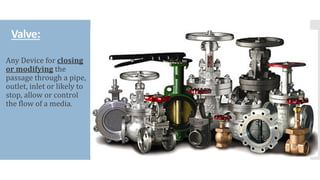
Any Device for closing
or modifying the
passage through a pipe,
outlet, inlet or likely to
stop, allow or control
the flow of a media.
VALVES
FUNCTION
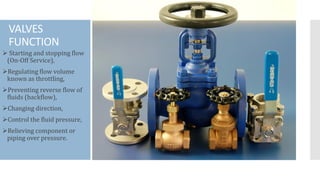
➢ Starting and stopping flow
(On-Off Service),
➢Regulating flow volume
known as throttling,
➢Preventing reverse flow of
fluids (backflow),
➢Changing direction,
➢Control the fluid pressure,
➢Relieving component or
piping over pressure.
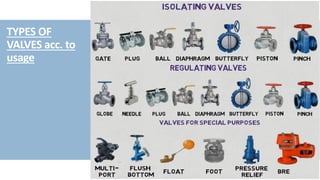
TYPES OF
VALVES acc. to
usage
Classification
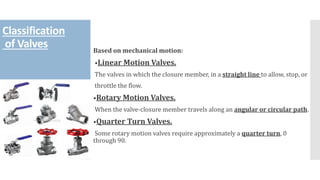
of Valves Based on mechanical motion:
•Linear Motion Valves.
The valves in which the closure member, in a straight line to allow, stop, or
throttle the flow.
•Rotary Motion Valves.
When the valve-closure member travels along an angular or circular path.
•Quarter Turn Valves.
Some rotary motion valves require approximately a quarter turn, 0
through 90.
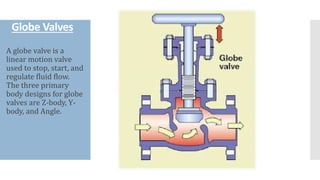
Globe Valves
A globe valve is a
linear motion valve
used to stop, start, and
regulate fluid flow.
The three primary
body designs for globe
valves are Z-body, Y-
body, and Angle.
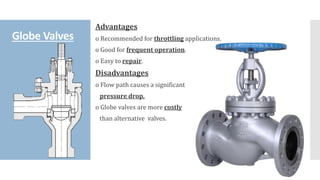
Globe Valves
Advantages
o Recommended for throttling applications.
o Good for frequent operation.
o Easy to repair.
Disadvantages
o Flow path causes a significant
pressure drop.
o Globe valves are more costly
than alternative valves.
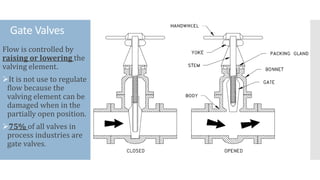
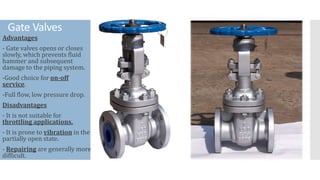
Gate Valves
Flow is controlled by
raising or lowering the
valving element.
➢It is not use to regulate
flow because the
valving element can be
damaged when in the
partially open position.
➢75% of all valves in
process industries are
gate valves.
Gate Valves
Advantages
- Gate valves opens or closes
slowly, which prevents fluid
hammer and subsequent
damage to the piping system.
-Good choice for on-off
service.
-Full flow, low pressure drop.
Disadvantages
- It is not suitable for
throttling applications.
- It is prone to vibration in the
partially open state.
- Repairing are generally more
difficult.
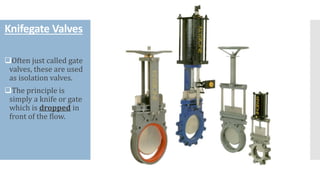
Knifegate Valves
❑Often just called gate
valves, these are used
as isolation valves.
❑The principle is
simply a knife or gate
which is dropped in
front of the flow.
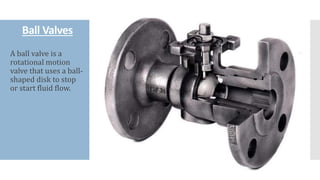
Ball Valves
A ball valve is a
rotational motion
valve that uses a ball-
shaped disk to stop
or start fluid flow.
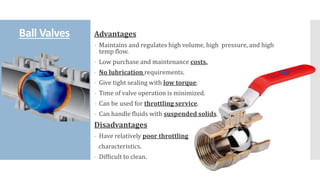
Ball Valves Advantages
- Maintains and regulates high volume, high pressure, and high
temp flow.
- Low purchase and maintenance costs.
- No lubrication requirements.
- Give tight sealing with low torque.
- Time of valve operation is minimized.
- Can be used for throttling service.
- Can handle fluids with suspended solids.
Disadvantages
- Have relatively poor throttling
characteristics.
- Difficult to clean.
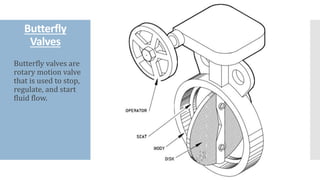
Butterfly
Valves
Butterfly valves are
rotary motion valve
that is used to stop,
regulate, and start
fluid flow.
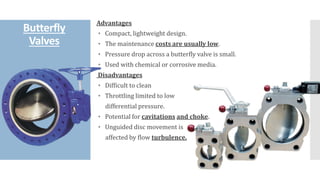
Butterfly
Valves
Advantages
◦ Compact, lightweight design.
◦ The maintenance costs are usually low.
◦ Pressure drop across a butterfly valve is small.
◦ Used with chemical or corrosive media.
Disadvantages
◦ Difficult to clean
◦ Throttling limited to low
differential pressure.
◦ Potential for cavitations and choke.
◦ Unguided disc movement is
affected by flow turbulence.
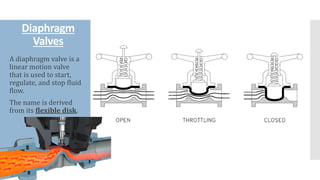
Diaphragm
Valves
A diaphragm valve is a
linear motion valve
that is used to start,
regulate, and stop fluid
flow.
The name is derived
from its flexible disk.
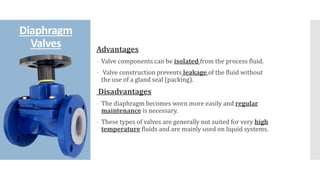
Diaphragm
Valves Advantages
- Valve components can be isolated from the process fluid.
- Valve construction prevents leakage of the fluid without
the use of a gland seal (packing).
Disadvantages
- The diaphragm becomes worn more easily and regular
maintenance is necessary.
- These types of valves are generally not suited for very high
temperature fluids and are mainly used on liquid systems.
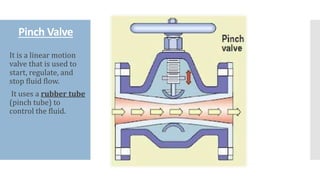
Pinch Valve
It is a linear motion
valve that is used to
start, regulate, and
stop fluid flow.
It uses a rubber tube
(pinch tube) to
control the fluid.
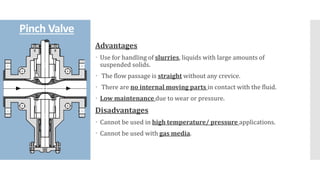
Pinch Valve
Advantages
 Use for handling of slurries, liquids with large amounts of
suspended solids.
 The flow passage is straight without any crevice.
 There are no internal moving parts in contact with the fluid.
 Low maintenance due to wear or pressure.
Disadvantages
 Cannot be used in high temperature/ pressure applications.
 Cannot be used with gas media.
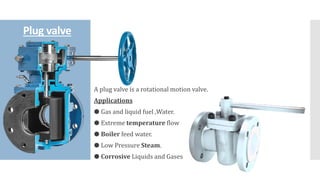
Plug valve
A plug valve is a rotational motion valve.
Applications
● Gas and liquid fuel ,Water.
● Extreme temperature flow
● Boiler feed water.
● Low Pressure Steam.
● Corrosive Liquids and Gases
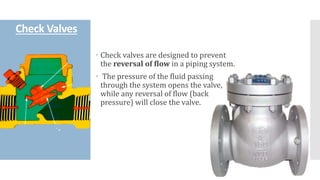
Check Valves
 Check valves are designed to prevent
the reversal of flow in a piping system.
 The pressure of the fluid passing
through the system opens the valve,
while any reversal of flow (back
pressure) will close the valve.
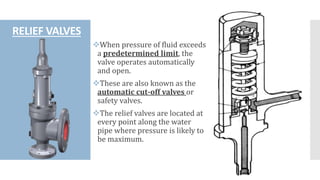
RELIEF VALVES
❖When pressure of fluid exceeds
a predetermined limit, the
valve operates automatically
and open.
❖These are also known as the
automatic cut-off valves or
safety valves.
❖The relief valves are located at
every point along the water
pipe where pressure is likely to
be maximum.
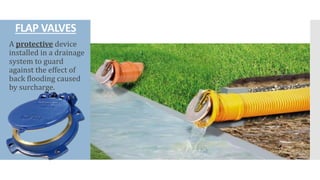
FLAP VALVES
A protective device
installed in a drainage
system to guard
against the effect of
back flooding caused
by surcharge.
FOOT VALVE
Foot valves are a type of
check valve. Unlike
other valves, a foot
valve is created with a
larger flow area.
Valves and its types

Valves and its types

  • 1.
    Under the shadow ofIndustrial Training Program by Batch 2017, Chemical Department.
  • 2.
    Valve: Any Device forclosing or modifying the passage through a pipe, outlet, inlet or likely to stop, allow or control the flow of a media.
  • 3.
    VALVES FUNCTION ➢ Starting andstopping flow (On-Off Service), ➢Regulating flow volume known as throttling, ➢Preventing reverse flow of fluids (backflow), ➢Changing direction, ➢Control the fluid pressure, ➢Relieving component or piping over pressure.
  • 4.
  • 5.
    Classification of Valves Basedon mechanical motion: •Linear Motion Valves. The valves in which the closure member, in a straight line to allow, stop, or throttle the flow. •Rotary Motion Valves. When the valve-closure member travels along an angular or circular path. •Quarter Turn Valves. Some rotary motion valves require approximately a quarter turn, 0 through 90.
  • 7.
    Globe Valves A globevalve is a linear motion valve used to stop, start, and regulate fluid flow. The three primary body designs for globe valves are Z-body, Y- body, and Angle.
  • 8.
    Globe Valves Advantages o Recommendedfor throttling applications. o Good for frequent operation. o Easy to repair. Disadvantages o Flow path causes a significant pressure drop. o Globe valves are more costly than alternative valves.
  • 9.
    Gate Valves Flow iscontrolled by raising or lowering the valving element. ➢It is not use to regulate flow because the valving element can be damaged when in the partially open position. ➢75% of all valves in process industries are gate valves.
  • 10.
    Gate Valves Advantages - Gatevalves opens or closes slowly, which prevents fluid hammer and subsequent damage to the piping system. -Good choice for on-off service. -Full flow, low pressure drop. Disadvantages - It is not suitable for throttling applications. - It is prone to vibration in the partially open state. - Repairing are generally more difficult.
  • 11.
    Knifegate Valves ❑Often justcalled gate valves, these are used as isolation valves. ❑The principle is simply a knife or gate which is dropped in front of the flow.
  • 12.
    Ball Valves A ballvalve is a rotational motion valve that uses a ball- shaped disk to stop or start fluid flow.
  • 13.
    Ball Valves Advantages -Maintains and regulates high volume, high pressure, and high temp flow. - Low purchase and maintenance costs. - No lubrication requirements. - Give tight sealing with low torque. - Time of valve operation is minimized. - Can be used for throttling service. - Can handle fluids with suspended solids. Disadvantages - Have relatively poor throttling characteristics. - Difficult to clean.
  • 14.
    Butterfly Valves Butterfly valves are rotarymotion valve that is used to stop, regulate, and start fluid flow.
  • 15.
    Butterfly Valves Advantages ◦ Compact, lightweightdesign. ◦ The maintenance costs are usually low. ◦ Pressure drop across a butterfly valve is small. ◦ Used with chemical or corrosive media. Disadvantages ◦ Difficult to clean ◦ Throttling limited to low differential pressure. ◦ Potential for cavitations and choke. ◦ Unguided disc movement is affected by flow turbulence.
  • 16.
    Diaphragm Valves A diaphragm valveis a linear motion valve that is used to start, regulate, and stop fluid flow. The name is derived from its flexible disk.
  • 17.
    Diaphragm Valves Advantages - Valvecomponents can be isolated from the process fluid. - Valve construction prevents leakage of the fluid without the use of a gland seal (packing). Disadvantages - The diaphragm becomes worn more easily and regular maintenance is necessary. - These types of valves are generally not suited for very high temperature fluids and are mainly used on liquid systems.
  • 18.
    Pinch Valve It isa linear motion valve that is used to start, regulate, and stop fluid flow. It uses a rubber tube (pinch tube) to control the fluid.
  • 19.
    Pinch Valve Advantages  Usefor handling of slurries, liquids with large amounts of suspended solids.  The flow passage is straight without any crevice.  There are no internal moving parts in contact with the fluid.  Low maintenance due to wear or pressure. Disadvantages  Cannot be used in high temperature/ pressure applications.  Cannot be used with gas media.
  • 20.
    Plug valve A plugvalve is a rotational motion valve. Applications ● Gas and liquid fuel ,Water. ● Extreme temperature flow ● Boiler feed water. ● Low Pressure Steam. ● Corrosive Liquids and Gases
  • 21.
    Check Valves  Checkvalves are designed to prevent the reversal of flow in a piping system.  The pressure of the fluid passing through the system opens the valve, while any reversal of flow (back pressure) will close the valve.
  • 22.
    RELIEF VALVES ❖When pressureof fluid exceeds a predetermined limit, the valve operates automatically and open. ❖These are also known as the automatic cut-off valves or safety valves. ❖The relief valves are located at every point along the water pipe where pressure is likely to be maximum.
  • 23.
    FLAP VALVES A protectivedevice installed in a drainage system to guard against the effect of back flooding caused by surcharge.
  • 24.
    FOOT VALVE Foot valvesare a type of check valve. Unlike other valves, a foot valve is created with a larger flow area.