Sr.No. Name Enrollment No. Sign
1. Samani Kunj 216200305018
2. Koriya Kashyap m. 216200305019
3. Chavda Niraj n. 216200305020
4. Makwana Katan k. 216200305021
5. Gada Sahil s. 216200305023
MICRO-PROJECT
Fluid Flow Operation
Guided by:
Mr. J. D. Kanani
Ms. P. D. Sorathia
Classification of valves
 What is valve ?
 Valve functions
 Classification of valves
 Valve types.
 A Valve is a devices that regulates, directs or
controls the flow of a fluid by opening, closing ,
or partially obstructing varios passageways.
 Stopping and starting fluid flow.
 Varying (throttling) the amount of fluid flow.
 Controlling the direction of fluid flow.
 Regulating downstream system or process
pressure.
 Relieving component or piping over pressure.
 The following are some of the commonly used
valve classification, based on mechanical
motion.
 Linear motion valves. The valves in which the
closure member, as in gate, globe, diaphragm, pinch
moves in a strainght line to allow , stop, or throttle
the flow.
 Rotary Motion Valves. When the valve-closure
member travels along an angular or circular path, as
in butterfly, ball, plug valves.
 Quarter turn valves. Some rotary motion valves
require approximately a quarter turn, 0 through 90,
motion of the stem to go to fully open from a fully
closed position or vice versa.
Slide a flat, cylindrical, or spherical surface across the
orifice.
1. Gate valve
Move a disc, or plug into or against an orifice globe or
needle type valve)
2. Globe valve
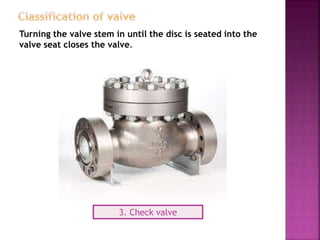
Turning the valve stem in until the disc is seated into the
valve seat closes the valve.
3. Check valve
.
Rotate a disc or ellipse about a shaft extending across the
diameter of an orifice.
4. Butterfly valve 5. Ball valve
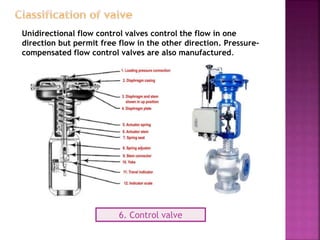
6. Control valve
Unidirectional flow control valves control the flow in one
direction but permit free flow in the other direction. Pressure-
compensated flow control valves are also manufactured.
Globe valve
Gate valve
Plug valve
Ball valve
Needle valve
Butterfly valve
Diaphragm valve
Pinch valve
Check valve
Safety/relief valve
Reducing valve
A globe valve is a linear motion valve used to stop, start,
and regulate fluid flow. The three primary body designs
for globe valves are z-body, y-body, and angle.
Flow is controlled by raising or lowering the valving
element. Gate valves are not usually used to regulate
flow because the valving element can be damaged
when in the partially open position. Similarly, they also
limit the pressure drop across the valve when fully
open.
A ball valve is a rotational motion valve that uses a ball-
shaped disk to stop or start fluid flow.
Butterfly valves are rotary motion valve that is used to stop,
regulate, and start fluid flow.
Check valves are designed to prevent the reversal of flow
in a piping system. These valves are activated by the
flowing material in the pipeline. The pressure of the fluid
passing through the system opens the valve, while any
reversal of flow will close the valve. Closure is
accomplished by the weight of the check mechanism, by
back pressure, by a spring, or by a combination of these
means. The general types of check valves are swing,
tilting-disk, piston, , and stop.

Share presentetion..pptx

  • 1.
    Sr.No. Name EnrollmentNo. Sign 1. Samani Kunj 216200305018 2. Koriya Kashyap m. 216200305019 3. Chavda Niraj n. 216200305020 4. Makwana Katan k. 216200305021 5. Gada Sahil s. 216200305023 MICRO-PROJECT Fluid Flow Operation Guided by: Mr. J. D. Kanani Ms. P. D. Sorathia
  • 2.
  • 3.
     What isvalve ?  Valve functions  Classification of valves  Valve types.
  • 4.
     A Valveis a devices that regulates, directs or controls the flow of a fluid by opening, closing , or partially obstructing varios passageways.  Stopping and starting fluid flow.  Varying (throttling) the amount of fluid flow.  Controlling the direction of fluid flow.  Regulating downstream system or process pressure.  Relieving component or piping over pressure.
  • 5.
     The followingare some of the commonly used valve classification, based on mechanical motion.  Linear motion valves. The valves in which the closure member, as in gate, globe, diaphragm, pinch moves in a strainght line to allow , stop, or throttle the flow.  Rotary Motion Valves. When the valve-closure member travels along an angular or circular path, as in butterfly, ball, plug valves.  Quarter turn valves. Some rotary motion valves require approximately a quarter turn, 0 through 90, motion of the stem to go to fully open from a fully closed position or vice versa.
  • 6.
    Slide a flat,cylindrical, or spherical surface across the orifice. 1. Gate valve
  • 7.
    Move a disc,or plug into or against an orifice globe or needle type valve) 2. Globe valve
  • 8.
    Turning the valvestem in until the disc is seated into the valve seat closes the valve. 3. Check valve
  • 9.
    . Rotate a discor ellipse about a shaft extending across the diameter of an orifice. 4. Butterfly valve 5. Ball valve
  • 10.
    6. Control valve Unidirectionalflow control valves control the flow in one direction but permit free flow in the other direction. Pressure- compensated flow control valves are also manufactured.
  • 11.
    Globe valve Gate valve Plugvalve Ball valve Needle valve Butterfly valve Diaphragm valve Pinch valve Check valve Safety/relief valve Reducing valve
  • 12.
    A globe valveis a linear motion valve used to stop, start, and regulate fluid flow. The three primary body designs for globe valves are z-body, y-body, and angle.
  • 13.
    Flow is controlledby raising or lowering the valving element. Gate valves are not usually used to regulate flow because the valving element can be damaged when in the partially open position. Similarly, they also limit the pressure drop across the valve when fully open.
  • 14.
    A ball valveis a rotational motion valve that uses a ball- shaped disk to stop or start fluid flow.
  • 15.
    Butterfly valves arerotary motion valve that is used to stop, regulate, and start fluid flow.
  • 16.
    Check valves aredesigned to prevent the reversal of flow in a piping system. These valves are activated by the flowing material in the pipeline. The pressure of the fluid passing through the system opens the valve, while any reversal of flow will close the valve. Closure is accomplished by the weight of the check mechanism, by back pressure, by a spring, or by a combination of these means. The general types of check valves are swing, tilting-disk, piston, , and stop.