Strategic
Advantag
e Profile
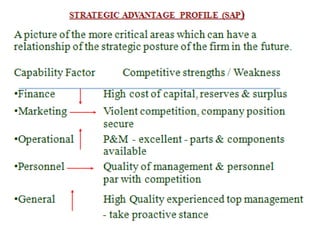
• Every f irm has st rat egic advant ages and
disadvant ages.
• For example, large f irms have f inancial
st r engt h but t hey t end t o move slowly,
compared t o smaller f irms, and of t en cannot
react t o changes quickly.
• No f irm is equally st rong in all it s f unct ions.
I n ot her words, every f irm has st rengt hs as
well as weaknesses.
• The St rat egist should look t o see if t he
f irm is st r onger in t hese f act ors t han it s
compet it ors.
• When a f irm is st rong in t he market , it has
a st rat egic advant age in launching new
product s or services and increasing market
share of present product s and services.
S.A.P.
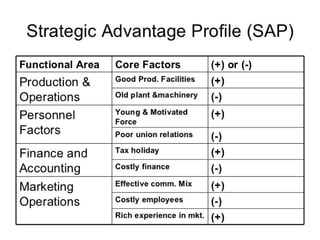
There are generally five functional areas in
most of t he
organizat ions.
These ar eas are:
Ø Product ion or Operat ion
Ø Finance or Account ing
Ø Market ing or Dist ribut ion
Ø Human Resource & Corporat e Planning
Ø Research & Development
Strategic Advantage Factors: Marketing
and Distribution
1. Competitive structure and market share: To what extent has the firm 
established a strong mark share in the total market or its key sub 
markets?
2. Efficient and effective market research system.
3. The product-service mix: quality of products and services.
4. Product-service line: completeness of product-service line 
and product-service mix; phase of life-cycle the main products and 
services are in.
5. Strong new-product and new- service leadership.
6. Patent protection (or equivalent legal protection for services).
7. Positive feelings about the firm and its products and services on the 
part of the ultimate consumer.
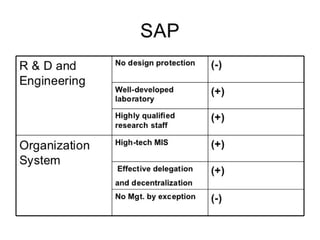
Strategic Advantage Factors: R&D and Engineering 
1. Basic research capabilities within the firm
2. Development capability for product.
3. Excellence in product design.
4. Excellence in process design and improvements.
5. Superior packaging developments being created.
6. Improvements in the use of old or new materials.
7. Ability to meet design goals and customer requirements.
8. Well-equipped laboratories and testing facilities.
9. Trained and experienced technicians and scientists.
10. Work environment suited to creativity and innovation.
10 strategic advantage profile

10 strategic advantage profile

  • 1.
  • 2.
    • Every firm has st rat egic advant ages and disadvant ages. • For example, large f irms have f inancial st r engt h but t hey t end t o move slowly, compared t o smaller f irms, and of t en cannot react t o changes quickly. • No f irm is equally st rong in all it s f unct ions. I n ot her words, every f irm has st rengt hs as well as weaknesses. • The St rat egist should look t o see if t he f irm is st r onger in t hese f act ors t han it s compet it ors. • When a f irm is st rong in t he market , it has a st rat egic advant age in launching new product s or services and increasing market share of present product s and services.
  • 3.
    S.A.P. There are generally fivefunctional areas in most of t he organizat ions. These ar eas are: Ø Product ion or Operat ion Ø Finance or Account ing Ø Market ing or Dist ribut ion Ø Human Resource & Corporat e Planning Ø Research & Development
  • 4.
    Strategic Advantage Factors:Marketing and Distribution 1. Competitive structure and market share: To what extent has the firm  established a strong mark share in the total market or its key sub  markets? 2. Efficient and effective market research system. 3. The product-service mix: quality of products and services. 4. Product-service line: completeness of product-service line  and product-service mix; phase of life-cycle the main products and  services are in. 5. Strong new-product and new- service leadership. 6. Patent protection (or equivalent legal protection for services). 7. Positive feelings about the firm and its products and services on the  part of the ultimate consumer.
  • 5.
    Strategic Advantage Factors:R&D and Engineering  1. Basic research capabilities within the firm 2. Development capability for product. 3. Excellence in product design. 4. Excellence in process design and improvements. 5. Superior packaging developments being created. 6. Improvements in the use of old or new materials. 7. Ability to meet design goals and customer requirements. 8. Well-equipped laboratories and testing facilities. 9. Trained and experienced technicians and scientists. 10. Work environment suited to creativity and innovation.