Porter’s Value
Chain
by: Nailul Khaira
Hello!
I am Nailul Khaira
You can find me at:
nailakhaira24@gmail.com
Or in Instagram :
@rara.khaira
2
Porter Value Chain
3
Value Chain
It evaluates which value each
particular activity adds to the
organizations products or
services.
This idea was built upon the
insight that an organization is
more than a random
compilation of machinery,
equipment, people and money.
Only if these things are
arranged into systems and
systematic activates it will
become possible to produce
something for which
customers are willing to pay a
price.
Porter argues that the ability
to perform particular activities
and to manage the linkages
between these activities is a
source of competitive
advantage.
(Michael Porter in his book "Competitive Advantage:
Creating and Sustaining superior Performance" (1985).
4
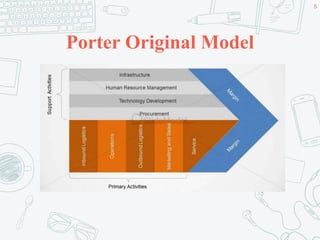
Porter Original Model
5
Primary Activities
Inbound Logistics: Here goods are received from a company's
suppliers. They are stored until they are needed on the
production/assembly line. Goods are moved around the
organization.
Operations:This is where goods are manufactured or assembled.
Individual operations could include room service in an hotel,
packing of books/videos/games by an online retailer, or the final
tune for a new car's engine.
Outbound Logistics:The goods are now finished, and they need to be
sent along the supply chain to wholesalers, retailers or the final
consumer.
Marketing and Sales: In true customer orientated fashion, at this stage
the organization prepares the offering to meet the needs of targeted
customers. This area focuses strongly upon marketing
communications and the promotions mix.
Service: This includes all areas of service such as installation, after-
sales service, complaints handling, training and so on.
6
Support Activities
Procurement :This function is responsible for all purchasing of goods,
services and materials. The aim is to secure the lowest possible price for
purchases of the highest possible quality.
Technology Development :Technology is an important source of
competitive advantage. Companies need to innovate to reduce costs and
to protect and sustain competitive advantage. This could include
production technology, Internet marketing activities, lean
manufacturing, Customer Relationship Management (CRM), and many
other technological developments.
Human Resource Management (HRM) :Employees are an expensive
and vital resource. An organization would manage recruitment and
selection, training and development, and rewards and remuneration.
Firm Infrastructure :This activity includes and is driven by corporate
or strategic planning. It includes the Management Information System
(MIS), and other mechanisms for planning and control such as the
accounting department.
7
Margin
Margin’ implies that organizations realize a profit
margin that depends on their ability to manage the
linkages between all activities in the value chain.
organization is able to deliver a product / service for
which the customer is willing to pay more than the
sum of the costs of all activities in the value chain.
8
Thanks!
Any questions?
You can find me at:
Instagram@rara.khaira
nailakhaira24@gmail.com
9

Porter value chain

  • 1.
  • 2.
    Hello! I am NailulKhaira You can find me at: nailakhaira24@gmail.com Or in Instagram : @rara.khaira 2
  • 3.
  • 4.
    Value Chain It evaluateswhich value each particular activity adds to the organizations products or services. This idea was built upon the insight that an organization is more than a random compilation of machinery, equipment, people and money. Only if these things are arranged into systems and systematic activates it will become possible to produce something for which customers are willing to pay a price. Porter argues that the ability to perform particular activities and to manage the linkages between these activities is a source of competitive advantage. (Michael Porter in his book "Competitive Advantage: Creating and Sustaining superior Performance" (1985). 4
  • 5.
  • 6.
    Primary Activities Inbound Logistics:Here goods are received from a company's suppliers. They are stored until they are needed on the production/assembly line. Goods are moved around the organization. Operations:This is where goods are manufactured or assembled. Individual operations could include room service in an hotel, packing of books/videos/games by an online retailer, or the final tune for a new car's engine. Outbound Logistics:The goods are now finished, and they need to be sent along the supply chain to wholesalers, retailers or the final consumer. Marketing and Sales: In true customer orientated fashion, at this stage the organization prepares the offering to meet the needs of targeted customers. This area focuses strongly upon marketing communications and the promotions mix. Service: This includes all areas of service such as installation, after- sales service, complaints handling, training and so on. 6
  • 7.
    Support Activities Procurement :Thisfunction is responsible for all purchasing of goods, services and materials. The aim is to secure the lowest possible price for purchases of the highest possible quality. Technology Development :Technology is an important source of competitive advantage. Companies need to innovate to reduce costs and to protect and sustain competitive advantage. This could include production technology, Internet marketing activities, lean manufacturing, Customer Relationship Management (CRM), and many other technological developments. Human Resource Management (HRM) :Employees are an expensive and vital resource. An organization would manage recruitment and selection, training and development, and rewards and remuneration. Firm Infrastructure :This activity includes and is driven by corporate or strategic planning. It includes the Management Information System (MIS), and other mechanisms for planning and control such as the accounting department. 7
  • 8.
    Margin Margin’ implies thatorganizations realize a profit margin that depends on their ability to manage the linkages between all activities in the value chain. organization is able to deliver a product / service for which the customer is willing to pay more than the sum of the costs of all activities in the value chain. 8
  • 9.
    Thanks! Any questions? You canfind me at: Instagram@rara.khaira nailakhaira24@gmail.com 9