Value Chain
Analysis
SOURAB KESAR
Value Chain Analysis
Introduction:
 Every business activity is composed of number of separate tasks which
ultimately lead to value creation in terms of company’s products/
services
 These activities put together in a successive sequence of value addition
we get a chain of activities called value chain
 The goal of these activities is to offer the customer a level of value that
exceeds the cost of the activities, thereby resulting in a profit margin
 Chain of activities starting from new material purchase to delivery of
finished products
 Every activity in a chain adds some value to the product, may it be cost
cutting or value addition
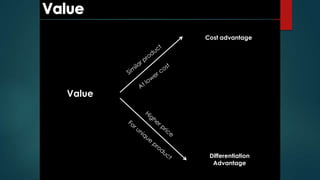
 A competitive advantage can be achieved by analyzing and
restructuring the value chain to provide lower cost or better
differentiation
Value
Cost advantage
Differentiation
Advantage
Porter’s Generic Value Chain
Inbound
Logistics
Operations
Outbound
Logistics
Marketing
& Sales
Services
SUPPORTED BY →
Firm’s Infrastructure
HR Management
Technology Development
Procurement
Inbound Logistics:-
Inbound Logistics:-
Value Chain Analysis
 Inbound Logistics:-
The receiving & warehousing of raw materials & their
distribution to manufacturing as they required.
Case of Tata Motors:
 Long term contract with service provider’s – transporters and agents.
 Transparency and monitoring through deployment of IT – all
transactions through SAP.
 Efficient storage facilities – easy storage and retrieval.
Operations:-
Value Chain Analysis
 Operations:-
 The process of transforming inputs into finished
products/services
 Apprentice Trainee Course – ensuring stable source of skilled
manpower.
 Automated manufacturing processes.
 Distributed manufacturing – Assembly units at South Africa, Thailand,
Bangladesh, Brazil etc.
 Capacity Utilization – Mercedes Benz cars make use of Tata Motors
paint shop facilities. .
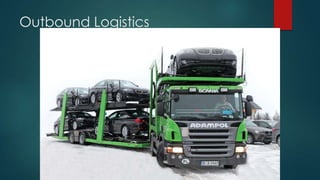
Outbound Logistics
Value Chain Analysis
 Outbound Logistics:-
The warehousing & distribution of finished goods
 Stockyards, all across the country.
 Long term contracts with transporter’s – higher volume of business to
transporters ensures competitive price.
 Regional Sales Office and Vehicle Dispatch Section linked through
SAP.
 Efficient security system for prevention of any kind of pilferage.
Marketing & Sales:-
Marketing & Sales:-
Value Chain Analysis
 Marketing & Sales:-
The identification of customer needs and the generation
of sales
 Clear identification of product requirements, leading to development
of innovative products – Tata 207 DI, Tata Ace
 Independent teams for addressing the requirements of institutional
customers – Defense, State Transport Units
 Helping to augment the scarce resources – Fiat selling vehicles
through Tata dealerships, in return Tata has access to Fiat’s
technology and unutilized capacity.
 Large network of dealers
Services:-
Value Chain Analysis
 Services:-
The support of customers after the products & services
are sold to them
 Easy availability of spare parts.
 Efficient collection of data from field and communication to the
respective plants.
 Large network of workshops – Dealer workshops and TASS.
 Training facilities – for dealer
Value Chain Analysis
Supported By
 Infrastructure:-
Organizational structure, control systems, company culture etc.
 Human Resource Management:-
Employee Recruiting, hiring, T&D, Compensation
 Technology Development:-
Technologies to support value creating activities
 Procurement:-
Purchasing inputs like materials, supplies, equipment
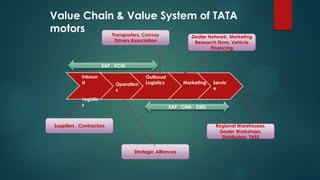
Value Chain & Value System of TATA
motors
Inboun
d
Logistic
s
Operation
s
Marketing Servic
e
Outboud
Logistics
Suppliers , Contractors
SAP , VCM
SAP , CRM - DMS
Strategic Alliances
Transporters, Convoy
Drivers Association
Dealer Network, Marketing
Research Firms, Vehicle
Financing
Regional Warehouses,
Dealer Workshops,
Distributors, TASS
Value Chain Analysis

Presentation1

  • 1.
  • 2.
    Value Chain Analysis Introduction: Every business activity is composed of number of separate tasks which ultimately lead to value creation in terms of company’s products/ services  These activities put together in a successive sequence of value addition we get a chain of activities called value chain  The goal of these activities is to offer the customer a level of value that exceeds the cost of the activities, thereby resulting in a profit margin  Chain of activities starting from new material purchase to delivery of finished products  Every activity in a chain adds some value to the product, may it be cost cutting or value addition  A competitive advantage can be achieved by analyzing and restructuring the value chain to provide lower cost or better differentiation
  • 3.
  • 4.
    Porter’s Generic ValueChain Inbound Logistics Operations Outbound Logistics Marketing & Sales Services SUPPORTED BY → Firm’s Infrastructure HR Management Technology Development Procurement
  • 5.
  • 6.
  • 7.
    Value Chain Analysis Inbound Logistics:- The receiving & warehousing of raw materials & their distribution to manufacturing as they required. Case of Tata Motors:  Long term contract with service provider’s – transporters and agents.  Transparency and monitoring through deployment of IT – all transactions through SAP.  Efficient storage facilities – easy storage and retrieval.
  • 8.
  • 9.
    Value Chain Analysis Operations:-  The process of transforming inputs into finished products/services  Apprentice Trainee Course – ensuring stable source of skilled manpower.  Automated manufacturing processes.  Distributed manufacturing – Assembly units at South Africa, Thailand, Bangladesh, Brazil etc.  Capacity Utilization – Mercedes Benz cars make use of Tata Motors paint shop facilities. .
  • 10.
  • 11.
    Value Chain Analysis Outbound Logistics:- The warehousing & distribution of finished goods  Stockyards, all across the country.  Long term contracts with transporter’s – higher volume of business to transporters ensures competitive price.  Regional Sales Office and Vehicle Dispatch Section linked through SAP.  Efficient security system for prevention of any kind of pilferage.
  • 12.
  • 13.
  • 14.
    Value Chain Analysis Marketing & Sales:- The identification of customer needs and the generation of sales  Clear identification of product requirements, leading to development of innovative products – Tata 207 DI, Tata Ace  Independent teams for addressing the requirements of institutional customers – Defense, State Transport Units  Helping to augment the scarce resources – Fiat selling vehicles through Tata dealerships, in return Tata has access to Fiat’s technology and unutilized capacity.  Large network of dealers
  • 15.
  • 16.
    Value Chain Analysis Services:- The support of customers after the products & services are sold to them  Easy availability of spare parts.  Efficient collection of data from field and communication to the respective plants.  Large network of workshops – Dealer workshops and TASS.  Training facilities – for dealer
  • 17.
    Value Chain Analysis SupportedBy  Infrastructure:- Organizational structure, control systems, company culture etc.  Human Resource Management:- Employee Recruiting, hiring, T&D, Compensation  Technology Development:- Technologies to support value creating activities  Procurement:- Purchasing inputs like materials, supplies, equipment
  • 18.
    Value Chain &Value System of TATA motors Inboun d Logistic s Operation s Marketing Servic e Outboud Logistics Suppliers , Contractors SAP , VCM SAP , CRM - DMS Strategic Alliances Transporters, Convoy Drivers Association Dealer Network, Marketing Research Firms, Vehicle Financing Regional Warehouses, Dealer Workshops, Distributors, TASS
  • 21.