CHAPTER 6:

         VALUE CHAIN
VALUE CREATION
    Necessarily processing, converting, improving or
     adding value to a particular product (from its original
     state) thereby giving more appeal, utility or value to a
     new product that promises a level of satisfaction to
     prospective clients or customers.

 Service of value - kind of service rendered by the firm
   that is being paid for by the clients.

 Value creation process – doing or rendering the service
   itself.
VALUE CHAIN SYSTEM
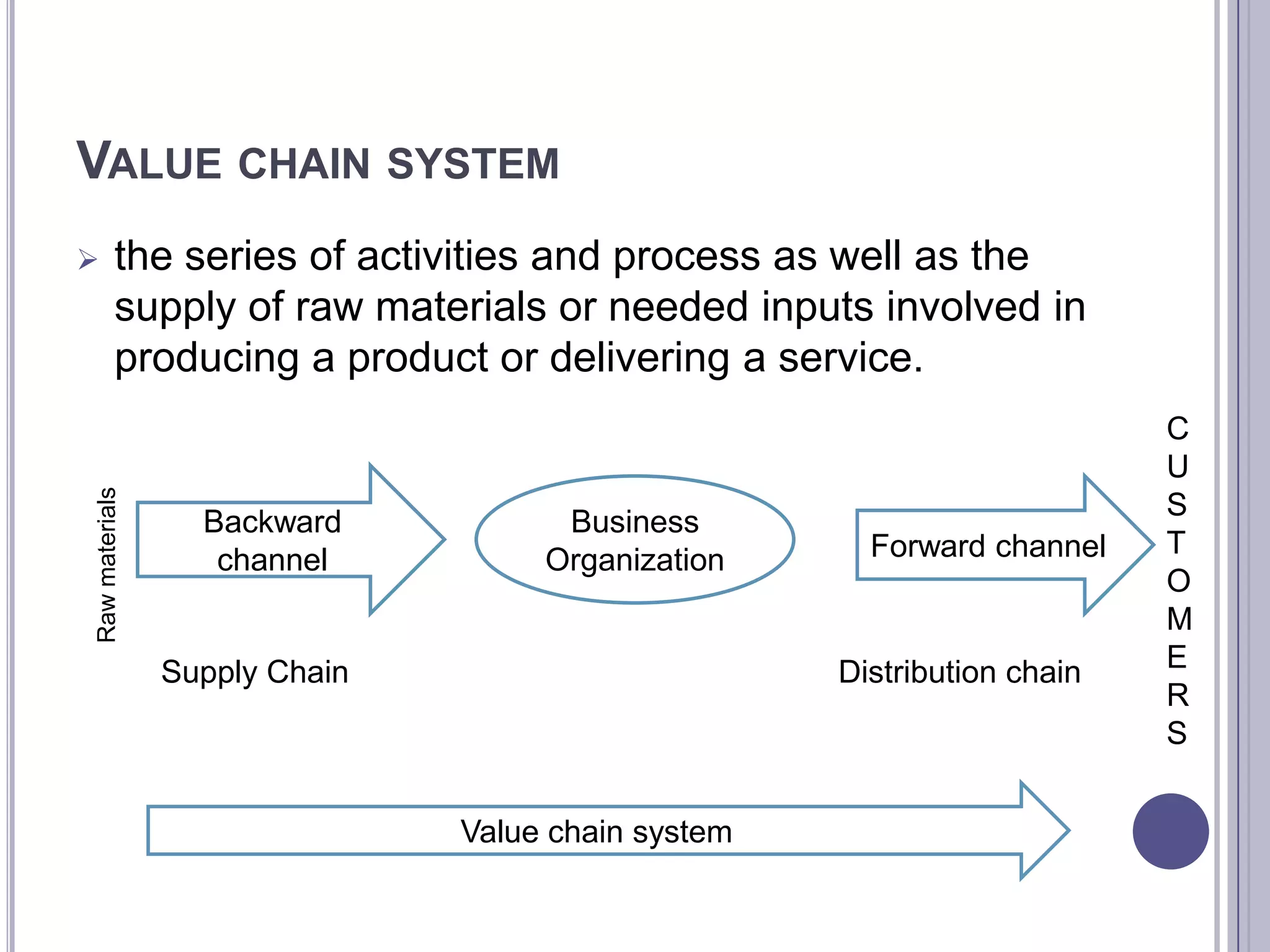
        the series of activities and process as well as the
         supply of raw materials or needed inputs involved in
         producing a product or delivering a service.
                                                                         C
                                                                         U
Raw materials


                                                                         S
                  Backward           Business
                                                      Forward channel    T
                   channel          Organization
                                                                         O
                                                                         M
                Supply Chain                        Distribution chain   E
                                                                         R
                                                                         S


                               Value chain system
SUPPLY CHAIN
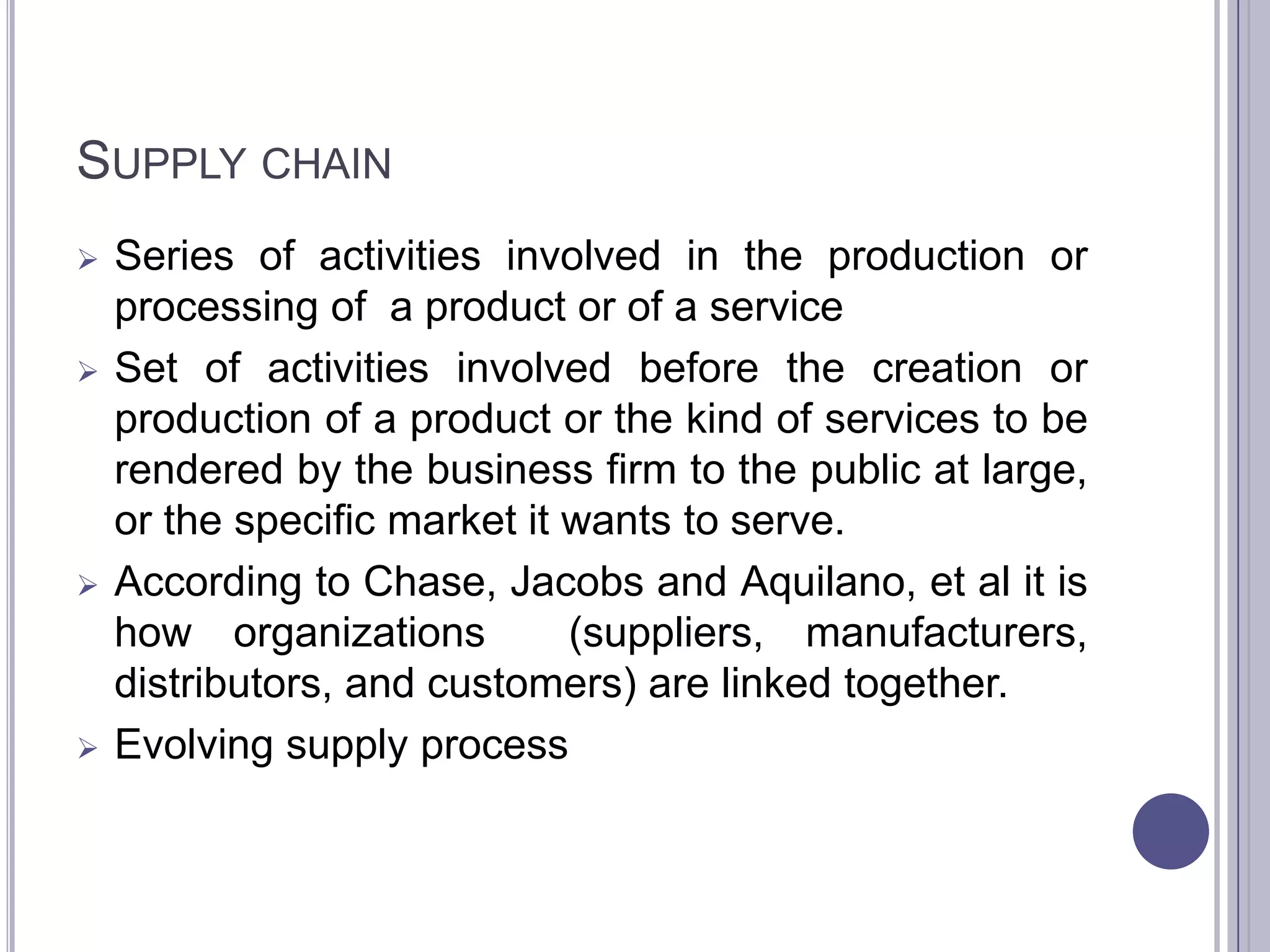
   Series of activities involved in the production or
    processing of a product or of a service
   Set of activities involved before the creation or
    production of a product or the kind of services to be
    rendered by the business firm to the public at large,
    or the specific market it wants to serve.
   According to Chase, Jacobs and Aquilano, et al it is
    how organizations         (suppliers, manufacturers,
    distributors, and customers) are linked together.
   Evolving supply process
SUPPLY CHAIN MANAGEMENT
   Total system approach to managing the entire flow
    of information, materials, and services from raw-
    material suppliers through factories and
    warehouses to the end customer. (Chase, Jacobs,
    and Aquilano)
   Strategic management of distribution channels and
    processes that support the entire business process.
DISTRIBUTION CHAIN
   Parties involved in moving the products from the
    confines or perimeters of business producing the
    product ( downstream activities)
   Covers all the other parties with direct and indirect
    roles in moving or causing the transfer of the
    product from its origin to various places or countries
    and all the way to final consumption or user stage
VALUE CHAIN
   Process involved in converting a product from raw
    material to its finished, saleable and consumable
    stage.
   Way of organizing the activities of a business so
    that each activity adds value (value added activity)
    or productivity to the total operation of the business.
   Sum total of the supply and distribution chain.
VALUE CHAIN
   Covers all the areas directly and indirectly involved
    in doing the business of value creation from the
    stage of procuring the basic raw material all the
    way to delivery of the finished product to the
    customer;
   Linked set of value-creating activities beginning
    with basic raw materials coming from suppliers,
    moving on to a series of value added activities
    involved in producing and marketing product or
    service, and ending with distributors getting the final
    goods in the hands of the ultimate consumers.
    (Wheelen and Hunger)
CENTER OF ACTIVITY
   Assembling the product or doing a series of
    activities to come up with a final product will be the
    opportunity for the firm to do its best.
   Core activities
   The raison d’etre of the business or reason for
    being so to speak.
   The area where trade secrets of the company lie
    upon.
GENERAL COMPONENTS OF A VALUE CHAIN
   Primary activities – operations in the business
    organization where most of the value creation
    efforts are made or done.

   Secondary activities- support activities that are
    undertaken to support the value creation activities
    both at the level of supply and distribution chain or
    the entire value chain system.
PRIMARY ACTIVITIES
1. Inbound logistics
     Activities associated with raw materials or inputs
      procurement activities covering vendor selection,
      comparative shopping, negotiating supply contracts,
      and just-in-time arrival of goods.
     They form part of the backward channel or supply side
      of the business.
PRIMARY ACTIVITIES
2. Operations
     activities involve the actual conversion of raw
      materials into a finished product.


3. Outbound logistics
     activity sequel to the inbound and processing activities
      particularly such aspects as storage, distribution and
      shipping of the finished product.
PRIMARY ACTIVITIES
4. Marketing and sales
     Activity deals with prospective clients including the
      ultimate customers or end-users.


5. Services
     Activity focuses on after-sales services to the customer
      whether end-user, a processor or secondary producer.
SECONDARY ACTIVITIES
1.   Corporate infrastructure
        The support backbone activities of the business
         operation.
2.   Human resources
        Unique activity of matching the right people to the job
         expected.
3.   Research and technology development
        Adds value in a way it improves the product and the
         business processes in the primary activities.
IMPORTANCE OF VALUE CHAIN
Backward channel
   Composed of the companies or organization providing
    raw materials or other forms of inputs for the company
    to undertake its value creation process.
   Suppliers of the business concern

Forward channel
   Distribution side of the business or parties involved
    beyond the production and storage line.
   This group includes organizations acting as distributors,
    dealers, agents, indentors, importers, transport/delivery
    firms and other organizations closing in to the ultimate
    users
REVAMPING THE VALUE CHAIN
a.   Abandon traditional business methods and shift to
     e-business technologies and use of the Internet;
b.   Use direct-to-end-user sales/marketing methods;
c.   Simply product design;
d.   Offer basic, no frills product/service;
e.   Shift to a simpler, less capital-intensive, or more
     flexible technological process;
REVAMPING THE VALUE CHAIN
f. Find ways to bypass use of high-cost raw materials;
g. Relocate facilities closer to supplier or customers;
h. Drop “something for everyone” approach and focus
    on a limited product/service; and
i. Reengineer core business processes.
INFORMATION SUPPORT SYSTEM
                   Support activities
                Organization: office automation
               Human resource: skills database

     Technology: computer-aided design and manufacturing
              Purchasing: online link to suppliers
                                            Marketing
  Inbound                     Outbound
              Operations                    and sales       Services
  logistics                    logistics

 Automated      Process                       Market         Remote
                                Online
warehousing    Controlled                    analysis        machine
              Manufacturing   order entry
  system                                     product        diagnostic
                                system
                                            profitability
                    Primary activities
VALUE CHAIN IN THE E-COMMERCE ERA
   Allows the so called seamless chain scenario or
    one that electronically connects various
    organization either in the supply or distribution
    chain side thereby ensuring timely information
    sharing and efficient logistical operations both at
    the supply and distribution aspects of the business.
   Expediency and efficiency both in the backward
    and forward channel of the business
INTERNET TECHNOLOGY BENEFITS:
a.   Powerful tool for better supply chain management;
b.   Critical to internal operation
c.   Extremely useful for collaborative data sharing
     with distribution channel partners – online systems
     reduce transactions costs.
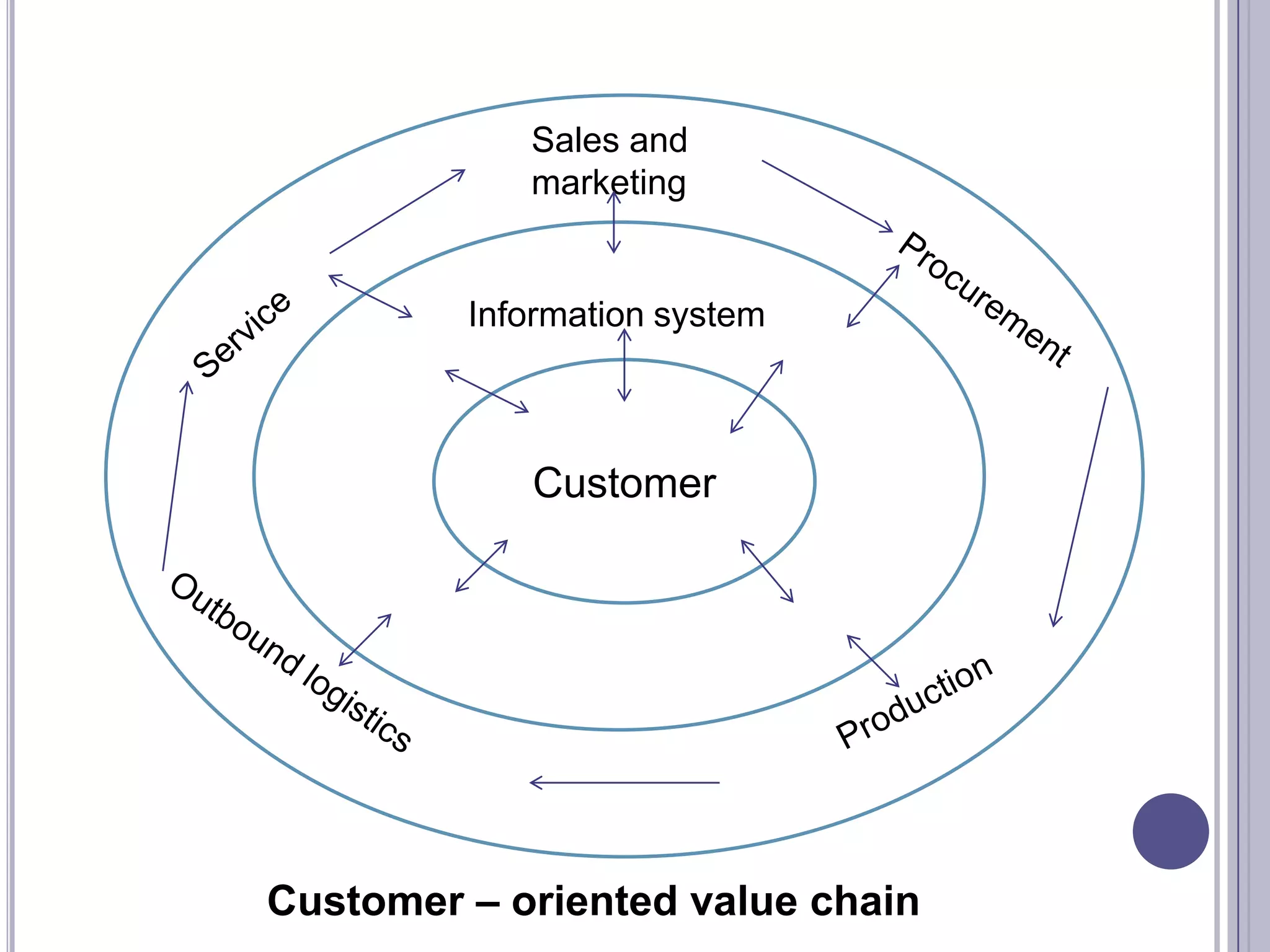
CUSTOMER-ORIENTED VALUE CHAIN
   It takes the form of a circular model to emphasize
    the philosophy that the customer – and not the
    business organization itself- is the focus to which all
    the other activities are directed to.
   Central to this kind of value chain model is that
    there exists an information system directly
    connecting the various functional unit thereby
    allowing a scheme somehow assuring that
    customer’s needs and wants are addressed by all
    functional units and in a way, competitiveness is
    assured.
Sales and
            marketing


         Information system


            Customer


Customer – oriented value chain
THE END…
MEMBERS:

    Malunes, Kaysee
    Moster, Marijoe
    Velasco, Rogelyn
    De Castro, Janice
    Sorezo, Shiela

Chapter 6 value chain

  • 1.
    CHAPTER 6: VALUE CHAIN
  • 2.
    VALUE CREATION  Necessarily processing, converting, improving or adding value to a particular product (from its original state) thereby giving more appeal, utility or value to a new product that promises a level of satisfaction to prospective clients or customers. Service of value - kind of service rendered by the firm that is being paid for by the clients. Value creation process – doing or rendering the service itself.
  • 3.
    VALUE CHAIN SYSTEM  the series of activities and process as well as the supply of raw materials or needed inputs involved in producing a product or delivering a service. C U Raw materials S Backward Business Forward channel T channel Organization O M Supply Chain Distribution chain E R S Value chain system
  • 4.
    SUPPLY CHAIN  Series of activities involved in the production or processing of a product or of a service  Set of activities involved before the creation or production of a product or the kind of services to be rendered by the business firm to the public at large, or the specific market it wants to serve.  According to Chase, Jacobs and Aquilano, et al it is how organizations (suppliers, manufacturers, distributors, and customers) are linked together.  Evolving supply process
  • 5.
    SUPPLY CHAIN MANAGEMENT  Total system approach to managing the entire flow of information, materials, and services from raw- material suppliers through factories and warehouses to the end customer. (Chase, Jacobs, and Aquilano)  Strategic management of distribution channels and processes that support the entire business process.
  • 6.
    DISTRIBUTION CHAIN  Parties involved in moving the products from the confines or perimeters of business producing the product ( downstream activities)  Covers all the other parties with direct and indirect roles in moving or causing the transfer of the product from its origin to various places or countries and all the way to final consumption or user stage
  • 7.
    VALUE CHAIN  Process involved in converting a product from raw material to its finished, saleable and consumable stage.  Way of organizing the activities of a business so that each activity adds value (value added activity) or productivity to the total operation of the business.  Sum total of the supply and distribution chain.
  • 8.
    VALUE CHAIN  Covers all the areas directly and indirectly involved in doing the business of value creation from the stage of procuring the basic raw material all the way to delivery of the finished product to the customer;  Linked set of value-creating activities beginning with basic raw materials coming from suppliers, moving on to a series of value added activities involved in producing and marketing product or service, and ending with distributors getting the final goods in the hands of the ultimate consumers. (Wheelen and Hunger)
  • 9.
    CENTER OF ACTIVITY  Assembling the product or doing a series of activities to come up with a final product will be the opportunity for the firm to do its best.  Core activities  The raison d’etre of the business or reason for being so to speak.  The area where trade secrets of the company lie upon.
  • 10.
    GENERAL COMPONENTS OFA VALUE CHAIN  Primary activities – operations in the business organization where most of the value creation efforts are made or done.  Secondary activities- support activities that are undertaken to support the value creation activities both at the level of supply and distribution chain or the entire value chain system.
  • 11.
    PRIMARY ACTIVITIES 1. Inboundlogistics  Activities associated with raw materials or inputs procurement activities covering vendor selection, comparative shopping, negotiating supply contracts, and just-in-time arrival of goods.  They form part of the backward channel or supply side of the business.
  • 12.
    PRIMARY ACTIVITIES 2. Operations  activities involve the actual conversion of raw materials into a finished product. 3. Outbound logistics  activity sequel to the inbound and processing activities particularly such aspects as storage, distribution and shipping of the finished product.
  • 13.
    PRIMARY ACTIVITIES 4. Marketingand sales  Activity deals with prospective clients including the ultimate customers or end-users. 5. Services  Activity focuses on after-sales services to the customer whether end-user, a processor or secondary producer.
  • 14.
    SECONDARY ACTIVITIES 1. Corporate infrastructure  The support backbone activities of the business operation. 2. Human resources  Unique activity of matching the right people to the job expected. 3. Research and technology development  Adds value in a way it improves the product and the business processes in the primary activities.
  • 15.
    IMPORTANCE OF VALUECHAIN Backward channel  Composed of the companies or organization providing raw materials or other forms of inputs for the company to undertake its value creation process.  Suppliers of the business concern Forward channel  Distribution side of the business or parties involved beyond the production and storage line.  This group includes organizations acting as distributors, dealers, agents, indentors, importers, transport/delivery firms and other organizations closing in to the ultimate users
  • 16.
    REVAMPING THE VALUECHAIN a. Abandon traditional business methods and shift to e-business technologies and use of the Internet; b. Use direct-to-end-user sales/marketing methods; c. Simply product design; d. Offer basic, no frills product/service; e. Shift to a simpler, less capital-intensive, or more flexible technological process;
  • 17.
    REVAMPING THE VALUECHAIN f. Find ways to bypass use of high-cost raw materials; g. Relocate facilities closer to supplier or customers; h. Drop “something for everyone” approach and focus on a limited product/service; and i. Reengineer core business processes.
  • 18.
    INFORMATION SUPPORT SYSTEM Support activities Organization: office automation Human resource: skills database Technology: computer-aided design and manufacturing Purchasing: online link to suppliers Marketing Inbound Outbound Operations and sales Services logistics logistics Automated Process Market Remote Online warehousing Controlled analysis machine Manufacturing order entry system product diagnostic system profitability Primary activities
  • 19.
    VALUE CHAIN INTHE E-COMMERCE ERA  Allows the so called seamless chain scenario or one that electronically connects various organization either in the supply or distribution chain side thereby ensuring timely information sharing and efficient logistical operations both at the supply and distribution aspects of the business.  Expediency and efficiency both in the backward and forward channel of the business
  • 20.
    INTERNET TECHNOLOGY BENEFITS: a. Powerful tool for better supply chain management; b. Critical to internal operation c. Extremely useful for collaborative data sharing with distribution channel partners – online systems reduce transactions costs.
  • 21.
    CUSTOMER-ORIENTED VALUE CHAIN  It takes the form of a circular model to emphasize the philosophy that the customer – and not the business organization itself- is the focus to which all the other activities are directed to.  Central to this kind of value chain model is that there exists an information system directly connecting the various functional unit thereby allowing a scheme somehow assuring that customer’s needs and wants are addressed by all functional units and in a way, competitiveness is assured.
  • 22.
    Sales and marketing Information system Customer Customer – oriented value chain
  • 23.
  • 24.
    MEMBERS: Malunes, Kaysee Moster, Marijoe Velasco, Rogelyn De Castro, Janice Sorezo, Shiela