Value Chain
Analysis
AUTOMOBILE INDUSTRY
PREPARED BY : KAPIL SHENDGE
Introduction
What is Value Chain
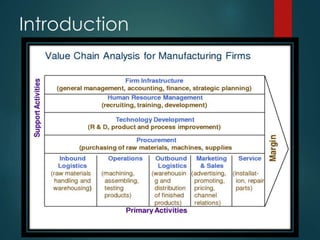
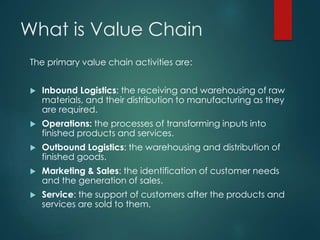
The primary value chain activities are:
 Inbound Logistics: the receiving and warehousing of raw
materials, and their distribution to manufacturing as they
are required.
 Operations: the processes of transforming inputs into
finished products and services.
 Outbound Logistics: the warehousing and distribution of
finished goods.
 Marketing & Sales: the identification of customer needs
and the generation of sales.
 Service: the support of customers after the products and
services are sold to them.
Continued…
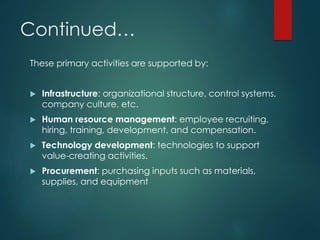
These primary activities are supported by:
 Infrastructure: organizational structure, control systems,
company culture, etc.
 Human resource management: employee recruiting,
hiring, training, development, and compensation.
 Technology development: technologies to support
value-creating activities.
 Procurement: purchasing inputs such as materials,
supplies, and equipment
Competitive Advantages
of Value Chain Analysis
 Cost advantage: by better understanding costs and
squeezing them out of the value-adding activities.
 Differentiation: by focusing on those activities associated
with core competencies and capabilities in order to
perform them better than do competitors.
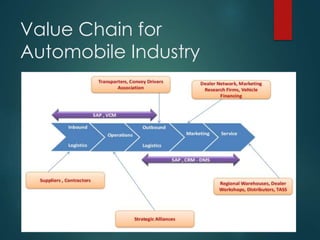
Value Chain for
Automobile Industry
Inbound Logistics
 Here goods are received from a company's suppliers.
 They are stored until they are needed on the
production/assembly line.
 Goods are moved around the organization.
 Purchases their raw material from all around the world, In
order to maximize their availability of raw material
Operations
 This is where goods are manufactured or assembled.
 Individual operations could include organizing the parts
to make new cars & the final tune for a new car's engine.
 Industries are known for their reliability which comes from
efficient operations.
For eg. Toyota’s JIT
Outbound Logistics
 The goods are now finished, and they need to be sent
along the supply chain to wholesalers, retailers or the final
consumer
 Many Manufacturers manage their own Showrooms in
different countries
 Sometimes even raw parts are supplied to different
Manufacturing units
Marketing and Sales
 This area focuses strongly upon marketing communications
and the promotions mix
 Communication channels can be :
1. Newspaper Advertisements
2. TV commercials
3. Social Media Marketing
4. Demo Cars
5. Exclusive Showrooms
Services
 Large Network of Workshops available for Services
 This includes all areas of service such as ;
1. Final Checking
2. After Sales Services
3. Complaint handling
4. Training
5. On-call Services
Support Activities
 Procurement :
 This function is responsible for all purchasing of goods,
services and materials
 Aim is to secure the lowest possible price for purchases of the
highest possible quality.
 Technology Development :
 Important source of competitive advantage.
 Companies need to innovate to reduce costs and to protect
and sustain competitive advantage.
Support Activities
 Human Resource Management :
 Employees are an expensive and vital resource.
 It Manages recruitment and selection, training and
development, & rewards and remuneration.
 For eg. Toyota motors consider their employees as HUMAN
CAPITAL.
 Infrastructure :
 This activity includes corporate or strategic planning.
 Manufacturing plants, Machineries, etc
Competitive Advantages
 Cost Advantage
 Cheaper Supplier
 Efficient Assembly Line
 Brand Owned Showroom
 Differentiation
 Use of JIT approach
 Efficient Operations Management System
 CRM , HRM & MIS
 Lean Manufacturing
 Innovative Marketing Strategies
Value chain analysis Model for automobile Industry

Value chain analysis Model for automobile Industry

  • 1.
  • 2.
  • 3.
    What is ValueChain The primary value chain activities are:  Inbound Logistics: the receiving and warehousing of raw materials, and their distribution to manufacturing as they are required.  Operations: the processes of transforming inputs into finished products and services.  Outbound Logistics: the warehousing and distribution of finished goods.  Marketing & Sales: the identification of customer needs and the generation of sales.  Service: the support of customers after the products and services are sold to them.
  • 4.
    Continued… These primary activitiesare supported by:  Infrastructure: organizational structure, control systems, company culture, etc.  Human resource management: employee recruiting, hiring, training, development, and compensation.  Technology development: technologies to support value-creating activities.  Procurement: purchasing inputs such as materials, supplies, and equipment
  • 5.
    Competitive Advantages of ValueChain Analysis  Cost advantage: by better understanding costs and squeezing them out of the value-adding activities.  Differentiation: by focusing on those activities associated with core competencies and capabilities in order to perform them better than do competitors.
  • 6.
  • 7.
    Inbound Logistics  Heregoods are received from a company's suppliers.  They are stored until they are needed on the production/assembly line.  Goods are moved around the organization.  Purchases their raw material from all around the world, In order to maximize their availability of raw material
  • 8.
    Operations  This iswhere goods are manufactured or assembled.  Individual operations could include organizing the parts to make new cars & the final tune for a new car's engine.  Industries are known for their reliability which comes from efficient operations. For eg. Toyota’s JIT
  • 9.
    Outbound Logistics  Thegoods are now finished, and they need to be sent along the supply chain to wholesalers, retailers or the final consumer  Many Manufacturers manage their own Showrooms in different countries  Sometimes even raw parts are supplied to different Manufacturing units
  • 10.
    Marketing and Sales This area focuses strongly upon marketing communications and the promotions mix  Communication channels can be : 1. Newspaper Advertisements 2. TV commercials 3. Social Media Marketing 4. Demo Cars 5. Exclusive Showrooms
  • 11.
    Services  Large Networkof Workshops available for Services  This includes all areas of service such as ; 1. Final Checking 2. After Sales Services 3. Complaint handling 4. Training 5. On-call Services
  • 12.
    Support Activities  Procurement:  This function is responsible for all purchasing of goods, services and materials  Aim is to secure the lowest possible price for purchases of the highest possible quality.  Technology Development :  Important source of competitive advantage.  Companies need to innovate to reduce costs and to protect and sustain competitive advantage.
  • 13.
    Support Activities  HumanResource Management :  Employees are an expensive and vital resource.  It Manages recruitment and selection, training and development, & rewards and remuneration.  For eg. Toyota motors consider their employees as HUMAN CAPITAL.  Infrastructure :  This activity includes corporate or strategic planning.  Manufacturing plants, Machineries, etc
  • 14.
    Competitive Advantages  CostAdvantage  Cheaper Supplier  Efficient Assembly Line  Brand Owned Showroom  Differentiation  Use of JIT approach  Efficient Operations Management System  CRM , HRM & MIS  Lean Manufacturing  Innovative Marketing Strategies