Ch:- 3Grand Strategy
Meaning	GRAND STRATEGIESGrand strategies are the decisions or choices of long term plans from available alternatives.Grand strategies also called as master or corporate strategy.It is based on analysis of internal and external environment.This direct the organization towards achievement of overall long term objectives (strategic intent).They involve Expansion, Quality Improvement, Market Development, Innovation, Liquidation, etc.Usually they are selected by top level managers such as directors, executives etc.Classification of Grand StrategyIt is classified into following:-Stability StrategyGrowth StrategyRetrenchment StrategyCombination Strategy
Stability Strategy
Stability StrategyA strategy is stability strategy when a firm attempts to maintain its status-quo with existing levels of efforts and it is satisfied with only incremental growth/improvement by marginally changing the business and concentrates its resources where it has or can develop rapidly a meaningful competitive advantages in the narrowest possible product market scope.Absence of significant change i.e. continuing to serve the same clients by offering the same product or service, maintaining market share, and sustaining the organization's return-on investment.
When do organization followIt is common for most of the organizations to follow this strategy at some point of time in their life cycle.When a firm serves defined market and its segments to fulfills its mission.When a firm can relate itself with the environment and environmental factors do not show any appreciable change. This is possible for most of the firms in a short run, but for a few in long runs.When organization continues to pursue the same objectives by adjusting to the same level of achievement about the same percentage. Thus stability does not mean absence of growth but the growth is limited within specified limits and there is no substantial addition of facilities.
Cont….When there is scope for incremental improvement in the same line of business to take the fullest advantage of situation. E.g. when a company has technological or other break through it continues to be in the same business until it has competitive advantage. Thus when a company is pioneer in a new business, it reaps the benefit of initiation. Then when competition increases and profitability reduces, it may go for other strategy.When a firm looks for functional improvement and there by efficiency and economy of operations so as to gain competitive advantage, it follows this strategy.
Why do organization followWhen management perception about performance in the present business is satisfactory, they tend to follow stability strategy because they are not always sure of a set of factors attributing to success. Thus they decide to continue the same business.This strategy involves low risk unless there is a major change in the environment. So it provides safe business. Therefore it is preferred by risk avoiding managers.“Slow or resistant to change” organizations follow this strategy. As they become larger and more successful, they develop such tendency & prefer stability.Organization’s past history may be full of changes, so to reap the advantages of such past, stability is preferred for some time, usually after growth strategy.
Cont….A firm having strategic advantage in the present business & market does not opt. for other strategy and prefers stability.A company lacking in sufficient resources to effect major changes in business have to opt. for stability.The environmental factors such as govt. norms, prohibition & restriction of certain products & process, licensing etc. prevent other strategies & a firm has to adopt stability strategy.A firm may have a product or group of products which is not prestigious to it, its market share as well as contribution to total sales is very small and its market is declining. So before retrenching such product, the firm wants to generate as much profit as possible, even by scarifying its market share, and follows stability strategy
Alternatives of stability strategy.Incremental growth strategyIt is one in which a firm sets its objectives/achievement levels based on past accomplishment adjusted for inflation. It may be average achievement level of industry or even low. It is followed when environmental factors are more or less stable.The organization is doing well or perceives as doing well in its present form.It being a less risky and the organization does not go for higher risk.The organization is change resistant and prefers change only in extraordinary times.It is easier to pursue as it does not disturb the organizational routines.
Cont….Profit strategy / End game strategy / Harvesting strategyIt is one in which organization or its SBU aims at generating profit/cash, sometimes at the cost of market share also because the product is not prestigious,its market share & also contribution to total sales are very small.The product is in stable or declining marketHere, company wants to encase as much profit as possible before retrenchment.
Cont….Sustainable growth strategyIt is one in which a firm tries to maintain its existence in unfavorable critical conditions like constraints on finance resources, raw material resources etc., govt. policy, cheaper imports, competitor by big and capable competitors etc.Stability as a pause/breathing spell/proceed with caution strategyIt is one in which organization has followed growth strategy aggressively in recent past and want a pause on growth to consolidate its position by allowing structured changes to take place and the system to adopt to new strategies thereby it wants to take full advantage of future growth opportunities and strong present factors. Thus this strategy becomes intermediate choice between past & future, for some time.
Growth Strategy
Growth StrategyGrowth Strategies are means by which an organization plans to achieve the increased level of objective that is much higher than its past achievement level.Organizations may select a growth strategyto increase their profits, sales or market share.to reduce cost of production per unit.increase in performance objectives.
Reasons for followingIn the long run, growth is necessary for the very survival of the organizations. The organization that does not grow may be pushed out of the business becauseOf the new entrants in the fieldHigher wages, higher costs of other inputs, and lower level of efficiency because of certain obsolescence in plant and machinery.Growth offers many economies because of large-scale operations.Per unit cost of production can be very low The economies of increasing scale enhance degrees of specialization. With more people available to do the different kinds of workGreater penetration can be made These eventually lead to certain competitive advantage to the organization concerned.
Cont….Growth strategy is taken up because of managerial motivation to do so. Managers with high degree of achievement and recognition always prefer to grow. The needs on the part of managers push them to think as to how they can achieve their need satisfaction. The answer lies in the continuous growth of the organization or the group of organizations as a whole. There are certain intangible advantages of growth. These may be in the form ofIncreased prestige of the organizationSatisfaction to employees and Social benefitsPreferred by investorsGrowing companies have high level of prestige in the corporate world.
Alternatives of Growth StrategyConcentric Expansion StrategyIt means investing the resources in one or more of a firm’s business so as to expand its present business.i.e. doing more what we are already doing and where we are best at doing; when potential for growth, attractiveness and maturity factors are favorable in the industry of the firm.It can be aimed at-Market penetration (capture the market share in the existing product and expand its business at rate higher than the industry growth)Market development (increase sales by developing new markets, geography-wise or segment-wise)Product development (achieve growth through product innovation to penetrate in new segment)
Cont….Vertical Integration Growth StrategyIt represents a decision by an organization to utilize internal transactions rather than market transactions to accomplish its objectives.A firm starts undertaking & contributing activities, in addition to present activities, along the line of value addition stages from raw material stage to production and ultimately distribution of goods to customers, so as to gain ownership or increased control and thereby expand the business.Vertical integration can be achieved in two waysForward IntegrationBackward Integration
Cont….Diversification StrategyIt is the process of entry into a business which is new to an organization.Diversified organizations can be classified into followingConcentric Diversification (Related diversification)Market-wiseTechnology –wiseBothConglomerate Diversification (Unrelated diversification)
Cont….External StrategyMerger strategyIt means that two or more organizations merge together by formally losing their corporate identities and form another organization through combining assets & liabilities & issuing new stock, for mutual synergetic benefits. The new co. is called holding company and the merging companies are called subsidiary companies. According to the nature of business of merging companies, merger may be HorizontalVerticalConcentricConglomerate
Cont….Acquisition or takeoverIt means that one company attempts to acquire ownership or control over management of other co. either by mutual consent of or against the wishes of latter’s (other co.) management or stock holders. It may be Friendly takeoverHostile takeoverJoin ventureIt means that two or more companies combine to form a new company by equity participation and sharing of resources like finance, managerial talents, technology etc., so as to create new entity distinct from its parentsJV b/w Government of India and another companyJV b/w two or more Indian private sector companiesJV b/w Indian company and a foreign company
Cont….Strategic AllianceIt is one in which two (or more) firms unite by “a win-win type” agreement mutually acceptable to both (or all), In strategic alliance partners join hands together for certain specified objectives, when these objectives are achieved partners terminate their alliance.Types of Strategic Alliance (Based on its focus)Technology Development AllianceOperations and Logistics AllianceMarketing, Sales and Service AllianceSingle Country or Multicountry AllianceX and Y Alliance
Retrenchment Strategy
Retrenchment StrategyIt is a defensive strategy in which a firm having declining performance decides to improve its performance through contraction in this activities i.e. reducing the scope of its business by total or partial withdrawal from present business.focusing on functional improvement with special emphasis on cost reduction orreducing  the number of functions it performs, by being a captive firm orreducing the no. of products, markets, customer functions etc. orliquidation of business (as a last alternative) orcombinations of above.
Reasons for adoptingWhen the organization is not doing well and perceives that it may not do better in future too in a particular line of business it is advisable to delete that line of business. After deletion, the organization can concentrate in other areas, where it has some advantages.If the organization is not meeting its objectives even after following other alternative strategies it may go for retrenchment strategy. Also when the management is under pressure to improve the performance, this strategy can be pursued as a last resort.
Alternatives of Retrenchment StrategyTurnaround StrategyIt is also known as cutback strategy “hold the present business and cut the costs”It is one in which a company tries to recover from its declining state by improving internal efficiency.Turnaround actions may include:Change in the product mixSelling of assets which are not useful for long time or in future also to generate cash.Closing down plants & divisions which are not rewarding.Replacement of obsolete machineryFocus on specific products and customers and improved marketing, etc.
Cont….Divestment StrategyIn divestment strategy the organization decides to get out of certain businesses and sells off units or divisions.Divestment is done through:-Outright sale of unit to another company for which the divested unit is a strategic fit. Or Leveraged buyout- a company’s shareholder are bought out by company’s management and other private investors using borrowed funds Or Spin off i.e. creating a new co. financially and managerially independent one from parent company and retaining or not retaining partial ownership by distribution of shares of new company to shareholders of parent company.
Cont….Liquidation StrategyIt is one in which a firm closes down & sells its entire business at a fair price on the basis of tangible assets, management good will & also intangible assets and invests the realization somewhere else or distributes among debtors and members whenBusiness can’t be revived and its retaining value is less than its selling.Business is in peak form (value, but future is quite uncertain, having no direction,Business has accumulated losses and some other organization offers higher price to get tax benefits,Liquidation value is more than discounted present value of future flow of income etc.
Combination Strategy
Combination StrategyCombination strategy is not an independent classification but it is a combination of different strategies – stability, growth, retrenchment – in various forms.Thus the possible combinations of strategies may be:Stability in some businesses and growth in other businessesStability in some businesses and retrenchment in other businessesGrowth in some businesses and retrenchment in other businessesStability, growth and retrenchment in different businesses.
Reasons for followingDifferent products in different product life cycleWhen different products of the organization are at different product life-cycle stages, they require different types of investment.Business CycleBusiness cycle may affect the prospect of various businesses differently.Number of businessesWhen the number of businesses in an organization has gone beyond the optimum number, they are required to be reduced because some business may not be that attractive from long-term point of view.
BCG Matrix
BCG MatrixBoston Consulting Group MatrixDeveloped by Bruce Henderson (in 1970’s)It is a chart that had been created to help corporations with analyzing their business units or product lines.Helps to evaluate company’s position in terms of its range of products.Helps to make decision regarding which product/service to be kept, which it should let it go and in which it should invest in further.
QUESTION MARKS:High market growth rateLow market shareLow cash generation than cash consumption.Analyze carefully the market situationInvestment into high growth potential market.Critical decision making for managers.
StarsHigh market growth rateHigh market shareHuge cash generation Huge cash consumptionHuge investment in growing marketBecomes cash cows when market growth rate declines
Cash CowsLow market growth rateHigh market shareHuge cash generation than consumptionLow prospects for future growth-so no new investment in this category.Investment into STARS and QUESTION MARKS.
DogLow market growth rateLow market shareNeither large cash generation nor consumption.Also known as CASH TRAPS.Dogs should be sold off or liquidated.
Business Level Strategy
Business Level StrategyA business level strategy is the integrated and co-ordinate course of actions/plans adopted by a firm for each of its businesses separately.Types of Generic Business StrategyCost Leadership StrategyDifferentiation StrategyFocus Strategy
Cost Leadership Strategy
Cost Leadership StrategyCost leadership strategy is one in which a firm attains competitive advantage & hence increased market share by offering products and services having the same utility/quality features as competitors’ products and services/substitute products and services; but the price/cost lower than themCost leadership strategy works well in the following conditions:-Competition is based purely on price factor.No significant differentiation in product/service features.There is almost no customer loyalty, with the result, they can switch over from a firm to another firm.
Cont….Sources of Becoming Cost LeaderA firm can lower its cost on the basis of economy of scale.High capacity utilizationBy going through vertical integration which is relevant for value creation.A firm can save cost by standardizing its products and product-producing activities.Investment in cost-saving technologies may help a firm to minimise its cost.
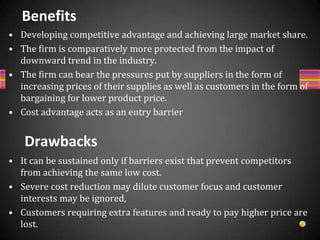
BenefitsDeveloping competitive advantage and achieving large market share.The firm is comparatively more protected from the impact of downward trend in the industry.The firm can bear the pressures put by suppliers in the form of increasing prices of their supplies as well as customers in the form of bargaining for lower product price.Cost advantage acts as an entry barrierIt can be sustained only if barriers exist that prevent competitors from achieving the same low cost.Severe cost reduction may dilute customer focus and customer interests may be ignored,Customers requiring extra features and ready to pay higher price are lost.Drawbacks
Differentiation Strategy
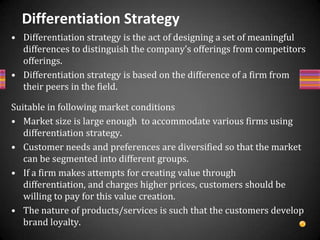
Differentiation StrategyDifferentiation strategy is the act of designing a set of meaningful differences to distinguish the company’s offerings from competitors offerings.Differentiation strategy is based on the difference of a firm from their peers in the field.Suitable in following market conditionsMarket size is large enough  to accommodate various firms using differentiation strategy.Customer needs and preferences are diversified so that the market can be segmented into different groups.If a firm makes attempts for creating value through differentiation, and charges higher prices, customers should be willing to pay for this value creation.The nature of products/services is such that the customers develop brand loyalty.
BenefitsIt can create a captive market for a companyHigh brand loyalty refrains new entrants in the market.Customer group is not able to put pressure on the firm to lower down pricesIn case of bargains for higher prices for supplies, the firm can offset this price increase by increase in product/service prices because of brand loyalty
DrawbacksHas to make huge promotional efforts. It may not be a strong base to prevent the entry of new entrants.
If many firms start differentiation in any industry price becomes an ultimate decision factor.
The features not desired and not valued by customers do not create response or brand loyalty. So differentiation becomes meaningless,
Failure to communicate the benefits of differentiation or the intrinsic differentiating features themselves to customers may lead to failure of this strategyFocus Strategy
Focus StrategyIn a focus strategy, firms focus on meeting the needs of a unique market segment in the best possible way.A focus strategy is a niche strategy.Conditions:The firm should have ingenuity to look for something out of ordinary and a sharp eye for identifying niches,Niche segment should be unique so that only specialized features could satisfy it,Special features should be so distinct that common customers do not expect them to fulfillNiche segment should be sufficiently profitable & having growth potentialThe firm should be able to create loyalty of customers on the basis of acknowledged superiority to serve them. It should also be able to create new niches.
BenefitsFirm is protected from competition to the extent that other firms operating in broader markets do not pose competitive rivalry.Customer Loyalty.Prevent new entrants.Cost structures of firms are higher.Differentiators with comparatively lower cost can penetrate in the niche markets.Niche markets turn to be attractive in many cases for the cost leaders and differentiators due to technological development.Drawbacks

Chapter 3 grand strategy

  • 1.
  • 2.
    Meaning GRAND STRATEGIESGrand strategiesare the decisions or choices of long term plans from available alternatives.Grand strategies also called as master or corporate strategy.It is based on analysis of internal and external environment.This direct the organization towards achievement of overall long term objectives (strategic intent).They involve Expansion, Quality Improvement, Market Development, Innovation, Liquidation, etc.Usually they are selected by top level managers such as directors, executives etc.Classification of Grand StrategyIt is classified into following:-Stability StrategyGrowth StrategyRetrenchment StrategyCombination Strategy
  • 3.
  • 4.
    Stability StrategyA strategyis stability strategy when a firm attempts to maintain its status-quo with existing levels of efforts and it is satisfied with only incremental growth/improvement by marginally changing the business and concentrates its resources where it has or can develop rapidly a meaningful competitive advantages in the narrowest possible product market scope.Absence of significant change i.e. continuing to serve the same clients by offering the same product or service, maintaining market share, and sustaining the organization's return-on investment.
  • 5.
    When do organizationfollowIt is common for most of the organizations to follow this strategy at some point of time in their life cycle.When a firm serves defined market and its segments to fulfills its mission.When a firm can relate itself with the environment and environmental factors do not show any appreciable change. This is possible for most of the firms in a short run, but for a few in long runs.When organization continues to pursue the same objectives by adjusting to the same level of achievement about the same percentage. Thus stability does not mean absence of growth but the growth is limited within specified limits and there is no substantial addition of facilities.
  • 6.
    Cont….When there isscope for incremental improvement in the same line of business to take the fullest advantage of situation. E.g. when a company has technological or other break through it continues to be in the same business until it has competitive advantage. Thus when a company is pioneer in a new business, it reaps the benefit of initiation. Then when competition increases and profitability reduces, it may go for other strategy.When a firm looks for functional improvement and there by efficiency and economy of operations so as to gain competitive advantage, it follows this strategy.
  • 7.
    Why do organizationfollowWhen management perception about performance in the present business is satisfactory, they tend to follow stability strategy because they are not always sure of a set of factors attributing to success. Thus they decide to continue the same business.This strategy involves low risk unless there is a major change in the environment. So it provides safe business. Therefore it is preferred by risk avoiding managers.“Slow or resistant to change” organizations follow this strategy. As they become larger and more successful, they develop such tendency & prefer stability.Organization’s past history may be full of changes, so to reap the advantages of such past, stability is preferred for some time, usually after growth strategy.
  • 8.
    Cont….A firm havingstrategic advantage in the present business & market does not opt. for other strategy and prefers stability.A company lacking in sufficient resources to effect major changes in business have to opt. for stability.The environmental factors such as govt. norms, prohibition & restriction of certain products & process, licensing etc. prevent other strategies & a firm has to adopt stability strategy.A firm may have a product or group of products which is not prestigious to it, its market share as well as contribution to total sales is very small and its market is declining. So before retrenching such product, the firm wants to generate as much profit as possible, even by scarifying its market share, and follows stability strategy
  • 9.
    Alternatives of stabilitystrategy.Incremental growth strategyIt is one in which a firm sets its objectives/achievement levels based on past accomplishment adjusted for inflation. It may be average achievement level of industry or even low. It is followed when environmental factors are more or less stable.The organization is doing well or perceives as doing well in its present form.It being a less risky and the organization does not go for higher risk.The organization is change resistant and prefers change only in extraordinary times.It is easier to pursue as it does not disturb the organizational routines.
  • 10.
    Cont….Profit strategy /End game strategy / Harvesting strategyIt is one in which organization or its SBU aims at generating profit/cash, sometimes at the cost of market share also because the product is not prestigious,its market share & also contribution to total sales are very small.The product is in stable or declining marketHere, company wants to encase as much profit as possible before retrenchment.
  • 11.
    Cont….Sustainable growth strategyItis one in which a firm tries to maintain its existence in unfavorable critical conditions like constraints on finance resources, raw material resources etc., govt. policy, cheaper imports, competitor by big and capable competitors etc.Stability as a pause/breathing spell/proceed with caution strategyIt is one in which organization has followed growth strategy aggressively in recent past and want a pause on growth to consolidate its position by allowing structured changes to take place and the system to adopt to new strategies thereby it wants to take full advantage of future growth opportunities and strong present factors. Thus this strategy becomes intermediate choice between past & future, for some time.
  • 12.
  • 13.
    Growth StrategyGrowth Strategiesare means by which an organization plans to achieve the increased level of objective that is much higher than its past achievement level.Organizations may select a growth strategyto increase their profits, sales or market share.to reduce cost of production per unit.increase in performance objectives.
  • 14.
    Reasons for followingInthe long run, growth is necessary for the very survival of the organizations. The organization that does not grow may be pushed out of the business becauseOf the new entrants in the fieldHigher wages, higher costs of other inputs, and lower level of efficiency because of certain obsolescence in plant and machinery.Growth offers many economies because of large-scale operations.Per unit cost of production can be very low The economies of increasing scale enhance degrees of specialization. With more people available to do the different kinds of workGreater penetration can be made These eventually lead to certain competitive advantage to the organization concerned.
  • 15.
    Cont….Growth strategy istaken up because of managerial motivation to do so. Managers with high degree of achievement and recognition always prefer to grow. The needs on the part of managers push them to think as to how they can achieve their need satisfaction. The answer lies in the continuous growth of the organization or the group of organizations as a whole. There are certain intangible advantages of growth. These may be in the form ofIncreased prestige of the organizationSatisfaction to employees and Social benefitsPreferred by investorsGrowing companies have high level of prestige in the corporate world.
  • 16.
    Alternatives of GrowthStrategyConcentric Expansion StrategyIt means investing the resources in one or more of a firm’s business so as to expand its present business.i.e. doing more what we are already doing and where we are best at doing; when potential for growth, attractiveness and maturity factors are favorable in the industry of the firm.It can be aimed at-Market penetration (capture the market share in the existing product and expand its business at rate higher than the industry growth)Market development (increase sales by developing new markets, geography-wise or segment-wise)Product development (achieve growth through product innovation to penetrate in new segment)
  • 17.
    Cont….Vertical Integration GrowthStrategyIt represents a decision by an organization to utilize internal transactions rather than market transactions to accomplish its objectives.A firm starts undertaking & contributing activities, in addition to present activities, along the line of value addition stages from raw material stage to production and ultimately distribution of goods to customers, so as to gain ownership or increased control and thereby expand the business.Vertical integration can be achieved in two waysForward IntegrationBackward Integration
  • 18.
    Cont….Diversification StrategyIt isthe process of entry into a business which is new to an organization.Diversified organizations can be classified into followingConcentric Diversification (Related diversification)Market-wiseTechnology –wiseBothConglomerate Diversification (Unrelated diversification)
  • 19.
    Cont….External StrategyMerger strategyItmeans that two or more organizations merge together by formally losing their corporate identities and form another organization through combining assets & liabilities & issuing new stock, for mutual synergetic benefits. The new co. is called holding company and the merging companies are called subsidiary companies. According to the nature of business of merging companies, merger may be HorizontalVerticalConcentricConglomerate
  • 20.
    Cont….Acquisition or takeoverItmeans that one company attempts to acquire ownership or control over management of other co. either by mutual consent of or against the wishes of latter’s (other co.) management or stock holders. It may be Friendly takeoverHostile takeoverJoin ventureIt means that two or more companies combine to form a new company by equity participation and sharing of resources like finance, managerial talents, technology etc., so as to create new entity distinct from its parentsJV b/w Government of India and another companyJV b/w two or more Indian private sector companiesJV b/w Indian company and a foreign company
  • 21.
    Cont….Strategic AllianceIt isone in which two (or more) firms unite by “a win-win type” agreement mutually acceptable to both (or all), In strategic alliance partners join hands together for certain specified objectives, when these objectives are achieved partners terminate their alliance.Types of Strategic Alliance (Based on its focus)Technology Development AllianceOperations and Logistics AllianceMarketing, Sales and Service AllianceSingle Country or Multicountry AllianceX and Y Alliance
  • 22.
  • 23.
    Retrenchment StrategyIt isa defensive strategy in which a firm having declining performance decides to improve its performance through contraction in this activities i.e. reducing the scope of its business by total or partial withdrawal from present business.focusing on functional improvement with special emphasis on cost reduction orreducing the number of functions it performs, by being a captive firm orreducing the no. of products, markets, customer functions etc. orliquidation of business (as a last alternative) orcombinations of above.
  • 24.
    Reasons for adoptingWhenthe organization is not doing well and perceives that it may not do better in future too in a particular line of business it is advisable to delete that line of business. After deletion, the organization can concentrate in other areas, where it has some advantages.If the organization is not meeting its objectives even after following other alternative strategies it may go for retrenchment strategy. Also when the management is under pressure to improve the performance, this strategy can be pursued as a last resort.
  • 25.
    Alternatives of RetrenchmentStrategyTurnaround StrategyIt is also known as cutback strategy “hold the present business and cut the costs”It is one in which a company tries to recover from its declining state by improving internal efficiency.Turnaround actions may include:Change in the product mixSelling of assets which are not useful for long time or in future also to generate cash.Closing down plants & divisions which are not rewarding.Replacement of obsolete machineryFocus on specific products and customers and improved marketing, etc.
  • 26.
    Cont….Divestment StrategyIn divestmentstrategy the organization decides to get out of certain businesses and sells off units or divisions.Divestment is done through:-Outright sale of unit to another company for which the divested unit is a strategic fit. Or Leveraged buyout- a company’s shareholder are bought out by company’s management and other private investors using borrowed funds Or Spin off i.e. creating a new co. financially and managerially independent one from parent company and retaining or not retaining partial ownership by distribution of shares of new company to shareholders of parent company.
  • 27.
    Cont….Liquidation StrategyIt isone in which a firm closes down & sells its entire business at a fair price on the basis of tangible assets, management good will & also intangible assets and invests the realization somewhere else or distributes among debtors and members whenBusiness can’t be revived and its retaining value is less than its selling.Business is in peak form (value, but future is quite uncertain, having no direction,Business has accumulated losses and some other organization offers higher price to get tax benefits,Liquidation value is more than discounted present value of future flow of income etc.
  • 28.
  • 29.
    Combination StrategyCombination strategyis not an independent classification but it is a combination of different strategies – stability, growth, retrenchment – in various forms.Thus the possible combinations of strategies may be:Stability in some businesses and growth in other businessesStability in some businesses and retrenchment in other businessesGrowth in some businesses and retrenchment in other businessesStability, growth and retrenchment in different businesses.
  • 30.
    Reasons for followingDifferentproducts in different product life cycleWhen different products of the organization are at different product life-cycle stages, they require different types of investment.Business CycleBusiness cycle may affect the prospect of various businesses differently.Number of businessesWhen the number of businesses in an organization has gone beyond the optimum number, they are required to be reduced because some business may not be that attractive from long-term point of view.
  • 31.
  • 32.
    BCG MatrixBoston ConsultingGroup MatrixDeveloped by Bruce Henderson (in 1970’s)It is a chart that had been created to help corporations with analyzing their business units or product lines.Helps to evaluate company’s position in terms of its range of products.Helps to make decision regarding which product/service to be kept, which it should let it go and in which it should invest in further.
  • 34.
    QUESTION MARKS:High marketgrowth rateLow market shareLow cash generation than cash consumption.Analyze carefully the market situationInvestment into high growth potential market.Critical decision making for managers.
  • 35.
    StarsHigh market growthrateHigh market shareHuge cash generation Huge cash consumptionHuge investment in growing marketBecomes cash cows when market growth rate declines
  • 36.
    Cash CowsLow marketgrowth rateHigh market shareHuge cash generation than consumptionLow prospects for future growth-so no new investment in this category.Investment into STARS and QUESTION MARKS.
  • 37.
    DogLow market growthrateLow market shareNeither large cash generation nor consumption.Also known as CASH TRAPS.Dogs should be sold off or liquidated.
  • 39.
  • 40.
    Business Level StrategyAbusiness level strategy is the integrated and co-ordinate course of actions/plans adopted by a firm for each of its businesses separately.Types of Generic Business StrategyCost Leadership StrategyDifferentiation StrategyFocus Strategy
  • 42.
  • 43.
    Cost Leadership StrategyCostleadership strategy is one in which a firm attains competitive advantage & hence increased market share by offering products and services having the same utility/quality features as competitors’ products and services/substitute products and services; but the price/cost lower than themCost leadership strategy works well in the following conditions:-Competition is based purely on price factor.No significant differentiation in product/service features.There is almost no customer loyalty, with the result, they can switch over from a firm to another firm.
  • 44.
    Cont….Sources of BecomingCost LeaderA firm can lower its cost on the basis of economy of scale.High capacity utilizationBy going through vertical integration which is relevant for value creation.A firm can save cost by standardizing its products and product-producing activities.Investment in cost-saving technologies may help a firm to minimise its cost.
  • 45.
    BenefitsDeveloping competitive advantageand achieving large market share.The firm is comparatively more protected from the impact of downward trend in the industry.The firm can bear the pressures put by suppliers in the form of increasing prices of their supplies as well as customers in the form of bargaining for lower product price.Cost advantage acts as an entry barrierIt can be sustained only if barriers exist that prevent competitors from achieving the same low cost.Severe cost reduction may dilute customer focus and customer interests may be ignored,Customers requiring extra features and ready to pay higher price are lost.Drawbacks
  • 46.
  • 47.
    Differentiation StrategyDifferentiation strategyis the act of designing a set of meaningful differences to distinguish the company’s offerings from competitors offerings.Differentiation strategy is based on the difference of a firm from their peers in the field.Suitable in following market conditionsMarket size is large enough to accommodate various firms using differentiation strategy.Customer needs and preferences are diversified so that the market can be segmented into different groups.If a firm makes attempts for creating value through differentiation, and charges higher prices, customers should be willing to pay for this value creation.The nature of products/services is such that the customers develop brand loyalty.
  • 48.
    BenefitsIt can createa captive market for a companyHigh brand loyalty refrains new entrants in the market.Customer group is not able to put pressure on the firm to lower down pricesIn case of bargains for higher prices for supplies, the firm can offset this price increase by increase in product/service prices because of brand loyalty
  • 49.
    DrawbacksHas to makehuge promotional efforts. It may not be a strong base to prevent the entry of new entrants.
  • 50.
    If many firmsstart differentiation in any industry price becomes an ultimate decision factor.
  • 51.
    The features notdesired and not valued by customers do not create response or brand loyalty. So differentiation becomes meaningless,
  • 52.
    Failure to communicatethe benefits of differentiation or the intrinsic differentiating features themselves to customers may lead to failure of this strategyFocus Strategy
  • 53.
    Focus StrategyIn afocus strategy, firms focus on meeting the needs of a unique market segment in the best possible way.A focus strategy is a niche strategy.Conditions:The firm should have ingenuity to look for something out of ordinary and a sharp eye for identifying niches,Niche segment should be unique so that only specialized features could satisfy it,Special features should be so distinct that common customers do not expect them to fulfillNiche segment should be sufficiently profitable & having growth potentialThe firm should be able to create loyalty of customers on the basis of acknowledged superiority to serve them. It should also be able to create new niches.
  • 54.
    BenefitsFirm is protectedfrom competition to the extent that other firms operating in broader markets do not pose competitive rivalry.Customer Loyalty.Prevent new entrants.Cost structures of firms are higher.Differentiators with comparatively lower cost can penetrate in the niche markets.Niche markets turn to be attractive in many cases for the cost leaders and differentiators due to technological development.Drawbacks