Group IV

Gandharav Mendiratta(067)
Sakshi Mehra (70)
Harshit Arya (79)
Aditya Bansal (66)
Juhi Negi (76)
Competitive Strategies

 Strategies that strongly position the company against
 competitor and give the company strongest possible
 strategic advantage.

   Competitive Strategies helps in:
1. Building profitable customer relationships
2. Gaining competitive advantage
3. Analyzing their competitors
Continued….

 No company can follow only one strategy.


 For example, Johnson & Johnson uses one
 marketing strategy for its common product such as
 BAND-AID & Johnson’s baby products; and different
 marketing strategy for its High Tech healthcare
 products such as Vicryl Plus, antibacterial surgical
 sutures or NeuFlex finger joint implants.
Basic competitive strategies

 Over cost leadership
 Companies try to achieve the lowest production and
  distribution cost.
 Low costs let its price lower than its competitors and
  win a large market share.
 Example:- Big bazaar
 Differentiation
 Company concentrates on creating a highly
  differentiated product line and marketing program
  so that it comes across as the class leader in the
  industry.
 Example:- IBM & Samsung follow this strategy in
  information, technology and services and consumer
  electronics and household appliances, respectively.
 Focus
 Company focuses its efforts on serving a few market
  segments well rather than going after the whole
  market.
 Example:- Tetra food supply 80% of pet tropical fish
  food.
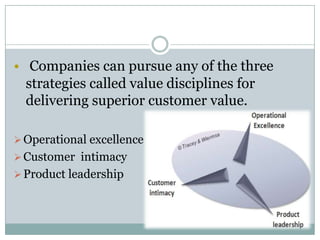
• Companies can pursue any of the three
  strategies called value disciplines for
  delivering superior customer value.

 Operational excellence
 Customer intimacy
 Product leadership
First value disciplines

1. Operational Excellence :
 To be a leader in operational excellence, a company
  must provide reliable products or services that can be
  purchased at competitive prices and with minimal
  difficulty or inconvenience.
 Organizations that have adopted a strategy of
  operational excellence boast
  highly efficient delivery
  processes built around
  sophisticated information
  systems.
 Wal-Mart is recognized over the world for its cost
  efficiencies. If a price war were to break out
  tomorrow, the giant retailer could outlast all its
  competitors. It can therefore maintain the lowest
  prices and attract those customers who base their
  buying decision primarily on price.
 Likewise, Dell Computer competes successfully with
  its higher-profile counterparts, because it has a
  substantially lower cost structure
Second value disciplines
2. Customer Intimacy :
 While companies that excel at operational excellence run
  their businesses as lean, mean machines and those
  pursuing a strategy of customer intimacy provide
  superior value by tailoring and shaping products and
  services to unique customer needs.
 Value-added services, focused
  marketing, and responsive/flexible
  processes are the hallmarks of this
  value discipline.
 Ritz Carlton Hotels was identified as a customer
  intimacy leader.
 The Ritz Carlton has built a database on its
  customers. Every time a customer stays at the
  hotel, that information is accessed to establish the
  needs of that customer.
 The hotel responds accordingly, whether it is by
  leaving fruit instead of chocolates in the room, or
  placing the telephone on the other side of the bed for
  left-handed guests. It is attentive to customer needs.
Third value discipline

3. Product Leadership :
 A product leader continually develops new and
  unique products and services that have an emotional
  and rational surplus value for clients.
 Product leaders do not have to have the lowest-cost
  operations because their customers are not price-
  sensitive — their priority is getting the hottest new
  product, whatever it might cost.
 3M has a policy stating that 25 per cent of its
  corporate revenues must come from products that
  have been created in the last three years.
 Another product leader, Intel, is constantly
  reinventing the computer chip, often displacing its
  own products in the
  market.
Conclusion

 Classifying competitive strategies as value
  disciplines defines marketing strategy in terms of
  single minded pursuit of delivering superior value to
  customers.
 Each value discipline defines a specific way to build
  lasting customer relationship.
 It helps the firms to analyze their competitors and
  design effective competitive marketing strategies to
  gain competitive advantage.
THANK YOU

Competitive Strategy

  • 1.
    Group IV Gandharav Mendiratta(067) SakshiMehra (70) Harshit Arya (79) Aditya Bansal (66) Juhi Negi (76)
  • 2.
    Competitive Strategies Strategiesthat strongly position the company against competitor and give the company strongest possible strategic advantage. Competitive Strategies helps in: 1. Building profitable customer relationships 2. Gaining competitive advantage 3. Analyzing their competitors
  • 3.
    Continued….  No companycan follow only one strategy. For example, Johnson & Johnson uses one marketing strategy for its common product such as BAND-AID & Johnson’s baby products; and different marketing strategy for its High Tech healthcare products such as Vicryl Plus, antibacterial surgical sutures or NeuFlex finger joint implants.
  • 4.
    Basic competitive strategies Over cost leadership  Companies try to achieve the lowest production and distribution cost.  Low costs let its price lower than its competitors and win a large market share.  Example:- Big bazaar
  • 5.
     Differentiation  Companyconcentrates on creating a highly differentiated product line and marketing program so that it comes across as the class leader in the industry.  Example:- IBM & Samsung follow this strategy in information, technology and services and consumer electronics and household appliances, respectively.
  • 6.
     Focus  Companyfocuses its efforts on serving a few market segments well rather than going after the whole market.  Example:- Tetra food supply 80% of pet tropical fish food.
  • 7.
    • Companies canpursue any of the three strategies called value disciplines for delivering superior customer value.  Operational excellence  Customer intimacy  Product leadership
  • 8.
    First value disciplines 1.Operational Excellence :  To be a leader in operational excellence, a company must provide reliable products or services that can be purchased at competitive prices and with minimal difficulty or inconvenience.  Organizations that have adopted a strategy of operational excellence boast highly efficient delivery processes built around sophisticated information systems.
  • 9.
     Wal-Mart isrecognized over the world for its cost efficiencies. If a price war were to break out tomorrow, the giant retailer could outlast all its competitors. It can therefore maintain the lowest prices and attract those customers who base their buying decision primarily on price.  Likewise, Dell Computer competes successfully with its higher-profile counterparts, because it has a substantially lower cost structure
  • 10.
    Second value disciplines 2.Customer Intimacy :  While companies that excel at operational excellence run their businesses as lean, mean machines and those pursuing a strategy of customer intimacy provide superior value by tailoring and shaping products and services to unique customer needs.  Value-added services, focused marketing, and responsive/flexible processes are the hallmarks of this value discipline.
  • 11.
     Ritz CarltonHotels was identified as a customer intimacy leader.  The Ritz Carlton has built a database on its customers. Every time a customer stays at the hotel, that information is accessed to establish the needs of that customer.  The hotel responds accordingly, whether it is by leaving fruit instead of chocolates in the room, or placing the telephone on the other side of the bed for left-handed guests. It is attentive to customer needs.
  • 12.
    Third value discipline 3.Product Leadership :  A product leader continually develops new and unique products and services that have an emotional and rational surplus value for clients.  Product leaders do not have to have the lowest-cost operations because their customers are not price- sensitive — their priority is getting the hottest new product, whatever it might cost.
  • 13.
     3M hasa policy stating that 25 per cent of its corporate revenues must come from products that have been created in the last three years.  Another product leader, Intel, is constantly reinventing the computer chip, often displacing its own products in the market.
  • 14.
    Conclusion  Classifying competitivestrategies as value disciplines defines marketing strategy in terms of single minded pursuit of delivering superior value to customers.  Each value discipline defines a specific way to build lasting customer relationship.  It helps the firms to analyze their competitors and design effective competitive marketing strategies to gain competitive advantage.
  • 15.