ERP AND Value Chain
Management
ERP SYSTEM:
 ERP, or enterprise resource planning, is a modular
software system designed to integrate the main
functional areas of an organization's business processes
into a unified system.
 An ERP system includes core software components,
often called modules, that focus on essential business
areas, such as finance and accounting, HR, production
and materials management, customer relationship
management (CRM) and supply chain management.
Organizations choose which core modules to use based
on which are most important to their particular business.
Every organization, whether supplying goods or services, has
a value chain i.e. the collection of activities that are performed by a
company to
create value for its customers. Porter’s Value Chain Analysis dissects
the organization’s activities into a generic value chain and highlights the
key tenets of Value Creation in the Value Chain. what effect this has on
costs and profit.
Every organization, whether supplying goods or services, has a value
chain i.e. the collection of activities that are performed by a company to
create value for its customers. Porter’s Value Chain Analysis dissects
the organization’s activities into a generic value chain and highlights the
key tenets of Value Creation in the Value Chain. what effect this has on
costs and profit.
Enterprise ERP Trends
The ERP field can be slow to change, but the last couple of years have
unleashed new technology trends which are fundamentally shifting
the entire area. The following new and continuing computing trends
have an impact on the growth of enterprise ERP software:
 Mobile ERP
Executives and employees want real-time access to information,
regardless of where they are. It is expected that businesses will
embrace mobile ERP for the reports, dashboards and to conduct
key business processes.
 Cloud ERP
The cloud has been advancing steadily into the enterprise for some
time, but many ERP users have been reluctant to place data in the
cloud. Those reservations have gradually been evaporating,
however, as the advantages of the cloud become apparent.
 Social ERP
 There has been much hype around social media and
how important —or not — it is to add to ERP systems.
Certainly, vendors have been quick to seize the initiative,
adding social media packages to their ERP systems with
much fanfare. But some wonder if there is really much
gain to be had by integrating social media with ERP.
 Two-tier ERP
 Enterprises once attempted to build an all-encompassing
ERP system to take care of every aspect of
organizational systems. But some expensive failures
have gradually brought about a change in strategy –
adopting two tiers of ERP.
VALUE CHAIN ANALYSIS
 A value chain is a business model that describes the full range of
activities needed to create a product or service. For companies that
produce goods, a value chain comprises the steps that involve
bringing a product from conception to distribution, and everything in
between—such as procuring raw materials, manufacturing functions,
and marketing activities.
 A company conducts a value-chain analysis by evaluating the
detailed procedures involved in each step of its business. The
purpose of value-chain analyses is to increase production efficiency
so that a company may deliver maximum value for the least possible
cost.
 A value chain can help a company to discern areas of its business
that are inefficient, then implement strategies that will optimize its
procedures for maximum efficiency and profitability.
Porter’s value chain
 The term value chain was used by Michael
Porter (1985)
 Organisations are more than the random
compilation of resources but an arrangement of
the resources into systems and activities that
result in products which customers are willing to
pay for
 Management of these activities and their
linkages give an organisation competitive
advantage
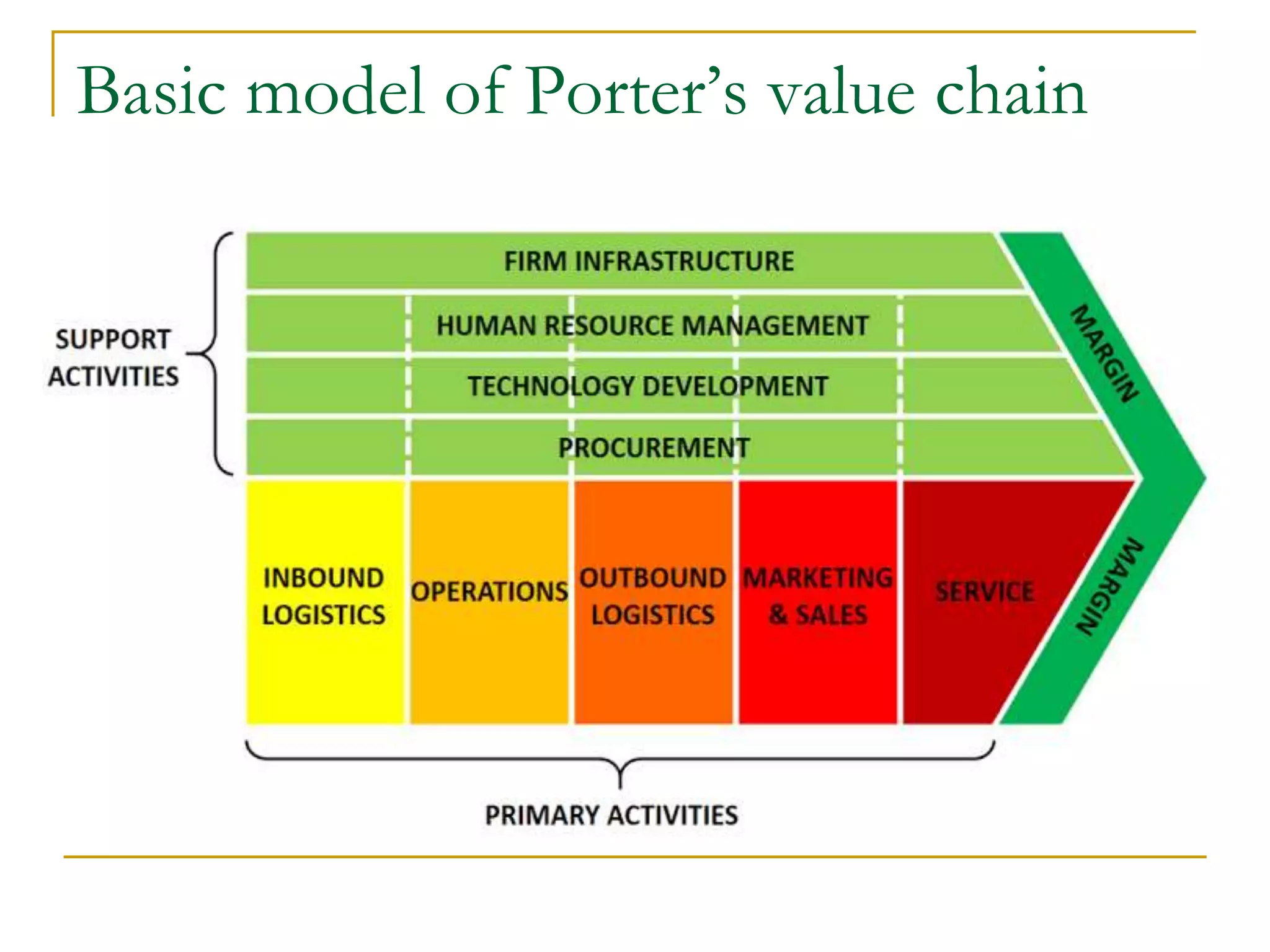
Basic model of Porter’s value chain
Primary activities
 Distinguishes between primary and support
activities
 Primary activities are directly concerned with the
creation or delivery of the product or service
 Can be grouped into five main areas:
 Inbound logistics
 Operations
 Outbound logistics
 Marketing and sales
 service
PRIMARY ACTIVITIES:
 Inbound Logistics
Inbound logistics include the receiving, warehousing and inventory
control of a company's raw materials. This also covers all
relationships with suppliers. For example, for an e-commerce
company, inbound logistics would be the receiving and storing
products from a manufacturer that it plans to sell.
 Operations
Operations include procedures for converting raw materials into a
finished product or service. This includes changing all inputs to
ready them as outputs. In the above e-commerce example, this
would include adding labels or branding or packaging several
products as a bundle to add value to the product.
 Outbound Logistics
All activities to distribute a final product to a consumer is considered
outbound logistics. This includes delivery of the product but also
includes storage and distribution systems and can be external or
internal.
SECONDARY ACTIVITIES
 Procurement
Procurement is the acquisition of inputs, or resources, for the firm.
This is how a company obtains raw materials, thus, it includes
finding and negotiating prices with suppliers and vendors. This
relates heavily to the inbound logistics primary activity, where an e-
commerce company would look to procure materials or good for
resale.
 Human Resource Management
Hiring and retaining employees who will fulfill business strategy, as
well as help design, market, and sell the product. Overall, managing
employees is useful for all primary activities, where employees and
effective hiring are needed for marketing, logistics, and operations,
among others.
 Infrastructure
Infrastructure covers a company's support systems and
the functions that allow it to maintain operations. This
includes all accounting, legal, and administrative
functions. A solid infrastructure is necessary for all
primary functions.
 Technological Development
Technological development is used during research and
development and can include designing and developing
manufacturing techniques and automating processes.
Supporting activities
 Each of the primary activities is linked to
support activities which help to improve their
effectiveness or efficiency
 The four support activities are:
 Procurement
 technology development (including R&D)
 Human resource management
 Infrastructure ( systems for planning, finance,
quality, information management etc)
Margin
 Implies that organizations realize profits margins
that depend on their ability to manage linkages
between all activities in a value chain
 An organisation is able to deliver a product or
service for which the customer is willing to pay
more than the sum of the costs of all activities
 Linkages: flows of information, goods and
services, as well as systems and processes for
adjusting activities
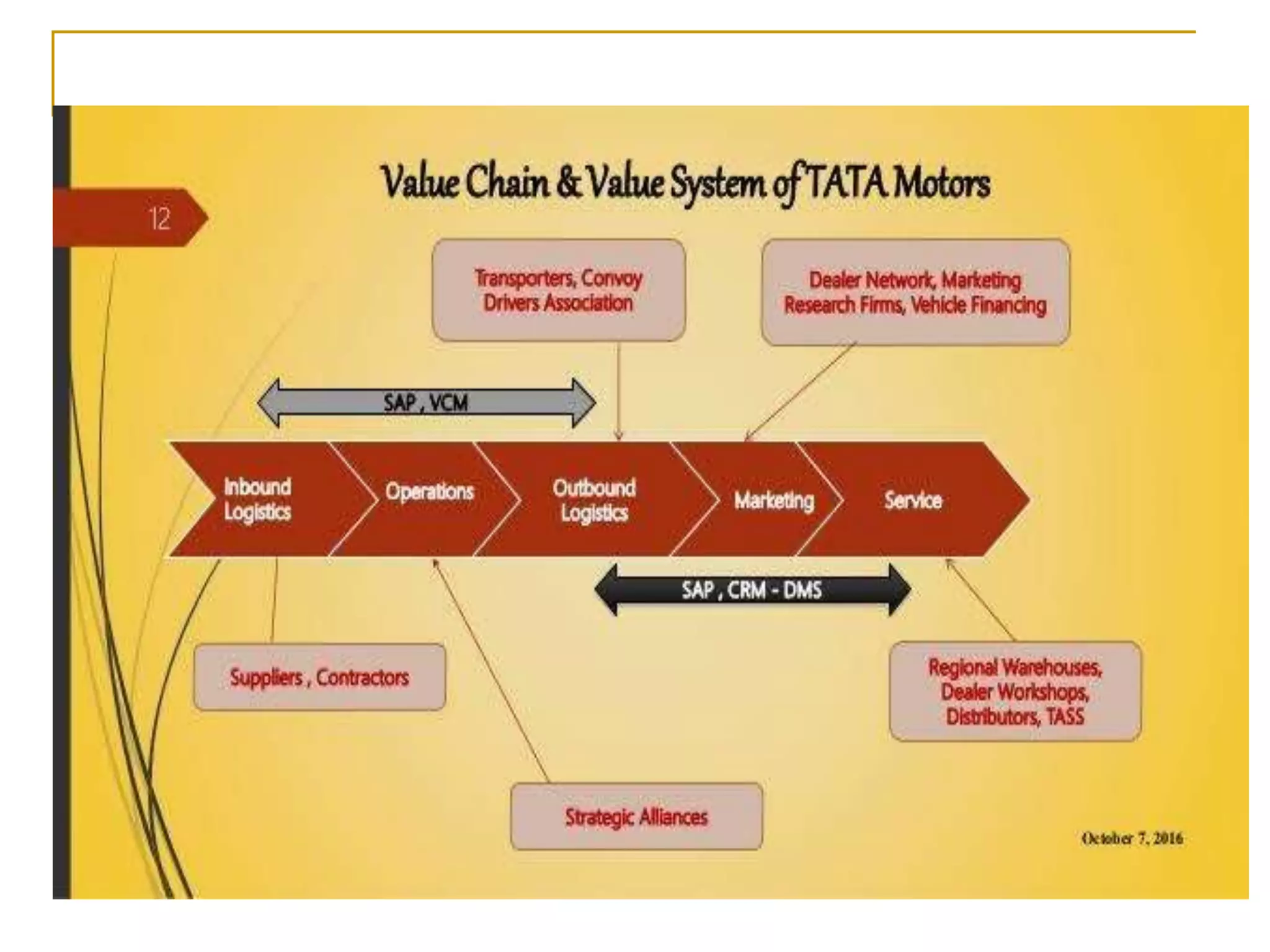
Tata Motors Ltd Value Chain Analysis
Advantages of conducting Value Chain Analysis of Tata Motors Ltd
Value Chain Analysis of Tata Motors Ltd can offer various
advantages:
 1.Identify competitive advantage sources:
By conducting the Value Chain Analysis of Tata Motors Ltd during
the planning process, possible sources of competitive advantage
can be identified. The firm/company is a collection of different
activities that share relatedness to some extent. Tata Motors Ltd
cannot trade all activities in the external market. The Value Chain
approach suggests that a company can consider these activities as
economic rent sources. These activities can also act as barriers to
new entrants or cause cost disadvantages to competitors.
 2. Identify complex inter-relationships and interdependencies :Tata Motors Ltd can
identify various internal and external linkages among activities
through the value chain lens.
 3. Improved flow of materials, information and finances:
The use of Value Chain Analysis can optimise the finances, products
and information flow. The improved information flow can help the
company identify and exploit new opportunities and reduce external
threats. The continuous Value Chain evaluation can result in timely
filling important gaps that may affect a firm's productivity.
.4 Marketing and Sales:examples of Tata Motors Ltd's marketing and sales
activities are- sales force, advertising, promotional activities, pricing,
channel selection, quoting and building relations with channel
members. The company can use the marketing funnel approach to
structure its marketing and sales activities. The marketing strategies
can either be push or pull in nature, depending on the Tata Motors
Ltd’s business objectives, brand image, competitive dynamics and
current standing in the market.
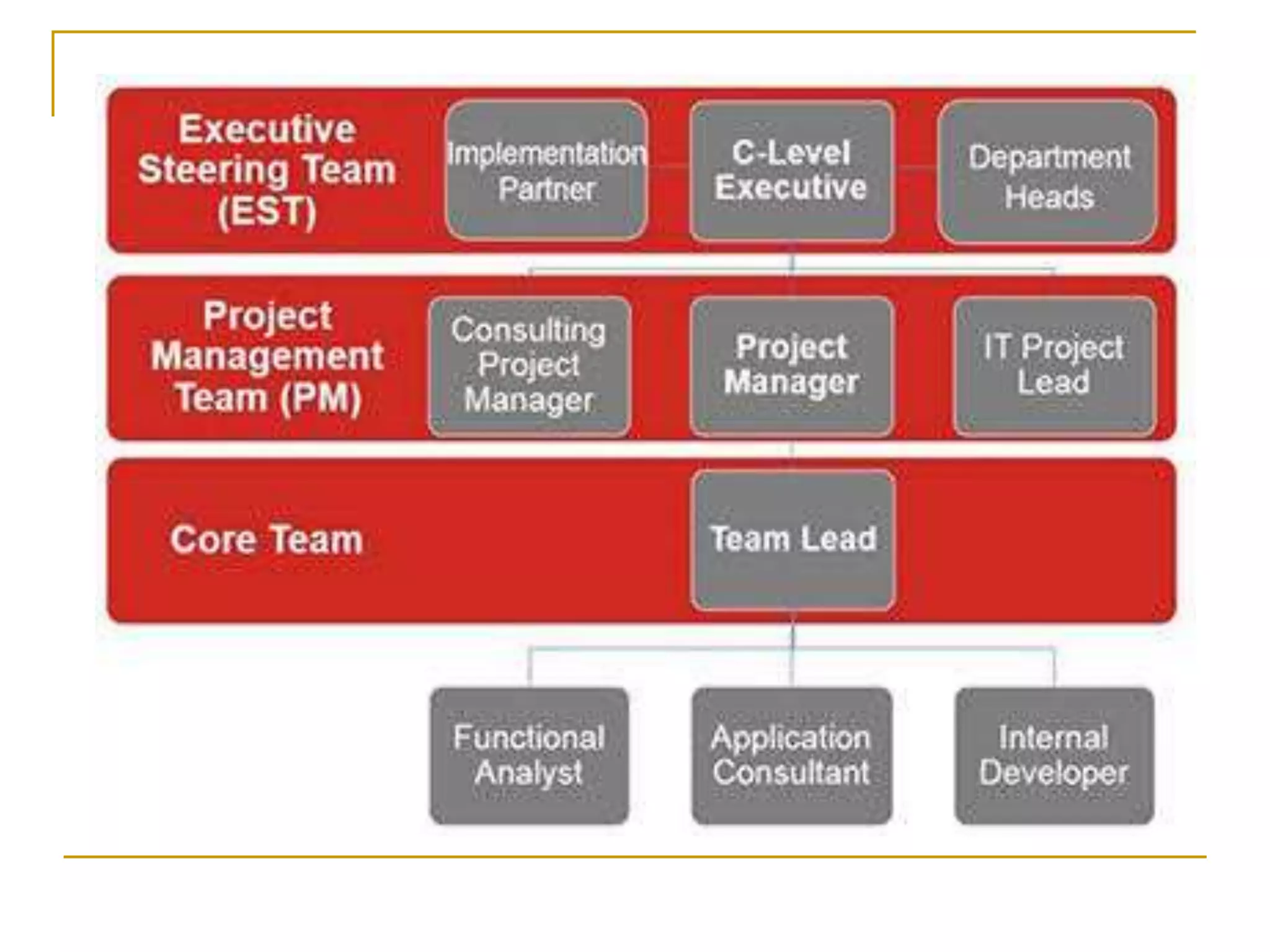
ERP PROJECT TEAM
 Executive Sponsors:
Representing the Executive level decision making body, the
Executive Sponsors are the highest level in the organizational chain.
Executive Sponsors receive periodic updates from the ERP Project
Manager (PM) and the Project Champion.At times, they may also
receive updates from Core Team members. Tracking the progress
of the project at a milestone level, the Executive Sponsors need to
be informed of identified risks and accompanying action plans.
Corporate level decisions or issues should be handled by these
sponsors.
 Project Champion:The role of Project Champion is identified as an
element of the overall Project Approach because of the nature of the
role and its significance to the project. The Champion will participate
in the project from beginning to end.At the end of the project
lifecycle, the Champion will be the most knowledgeable person
about the project and its processes within the company, other than
perhaps the Project Manager.
 Project Manager:This is a key role, as the success of the implementation
depends on a good Project Manager. Consequently, it is important
that the customer appoints one of their best people to fulfill the role
and ensure they have the time available to devote to the
implementation.This might require a temporary re-allocation of some
of the person’s existing responsibilities. It is possible for the roles of
Project Manager and Project Champion to be filled by one
individual.
 Core Team:The core team has tactical responsibility for the project.
Members of the team deal with the project on a daily basis. Each
team member represents a primary discipline within the company.
They “own” the responsibility for their discipline throughout the
project.
 Site Teams:Combined with the Core Team, the site team makes up the
remainder of the full Project Team at each site. Typically, a site team
exists at each location, including corporate.
 IT Staff:This is not just an IT project. But your IT staff are important to
the project. The software you chose has hardware and network
requirements to keep it running at its best. If you need to purchase
anything, get it early in the project so it is tested along with your
processes.
Recap….
 Businesses exist to create value, and value
created is often seen by the profits that a
supply chain makes
 The concept of value creation is discussed by
Porter.
 The development chain shows that product
chain decisions do have an effect on supply
chains and vice versa….
 ERP project team description.
PRESENTED BY:PRIYANSH KESARWANI
PRIYANKA SRIVASTAVA
RAHUL PANDEY

Erp and value chain management presentation priyansh kesarwani

  • 1.
    ERP AND ValueChain Management
  • 2.
    ERP SYSTEM:  ERP,or enterprise resource planning, is a modular software system designed to integrate the main functional areas of an organization's business processes into a unified system.  An ERP system includes core software components, often called modules, that focus on essential business areas, such as finance and accounting, HR, production and materials management, customer relationship management (CRM) and supply chain management. Organizations choose which core modules to use based on which are most important to their particular business.
  • 3.
    Every organization, whethersupplying goods or services, has a value chain i.e. the collection of activities that are performed by a company to create value for its customers. Porter’s Value Chain Analysis dissects the organization’s activities into a generic value chain and highlights the key tenets of Value Creation in the Value Chain. what effect this has on costs and profit. Every organization, whether supplying goods or services, has a value chain i.e. the collection of activities that are performed by a company to create value for its customers. Porter’s Value Chain Analysis dissects the organization’s activities into a generic value chain and highlights the key tenets of Value Creation in the Value Chain. what effect this has on costs and profit.
  • 4.
    Enterprise ERP Trends TheERP field can be slow to change, but the last couple of years have unleashed new technology trends which are fundamentally shifting the entire area. The following new and continuing computing trends have an impact on the growth of enterprise ERP software:  Mobile ERP Executives and employees want real-time access to information, regardless of where they are. It is expected that businesses will embrace mobile ERP for the reports, dashboards and to conduct key business processes.  Cloud ERP The cloud has been advancing steadily into the enterprise for some time, but many ERP users have been reluctant to place data in the cloud. Those reservations have gradually been evaporating, however, as the advantages of the cloud become apparent.
  • 5.
     Social ERP There has been much hype around social media and how important —or not — it is to add to ERP systems. Certainly, vendors have been quick to seize the initiative, adding social media packages to their ERP systems with much fanfare. But some wonder if there is really much gain to be had by integrating social media with ERP.  Two-tier ERP  Enterprises once attempted to build an all-encompassing ERP system to take care of every aspect of organizational systems. But some expensive failures have gradually brought about a change in strategy – adopting two tiers of ERP.
  • 6.
  • 7.
     A valuechain is a business model that describes the full range of activities needed to create a product or service. For companies that produce goods, a value chain comprises the steps that involve bringing a product from conception to distribution, and everything in between—such as procuring raw materials, manufacturing functions, and marketing activities.  A company conducts a value-chain analysis by evaluating the detailed procedures involved in each step of its business. The purpose of value-chain analyses is to increase production efficiency so that a company may deliver maximum value for the least possible cost.  A value chain can help a company to discern areas of its business that are inefficient, then implement strategies that will optimize its procedures for maximum efficiency and profitability.
  • 8.
    Porter’s value chain The term value chain was used by Michael Porter (1985)  Organisations are more than the random compilation of resources but an arrangement of the resources into systems and activities that result in products which customers are willing to pay for  Management of these activities and their linkages give an organisation competitive advantage
  • 9.
    Basic model ofPorter’s value chain
  • 10.
    Primary activities  Distinguishesbetween primary and support activities  Primary activities are directly concerned with the creation or delivery of the product or service  Can be grouped into five main areas:  Inbound logistics  Operations  Outbound logistics  Marketing and sales  service
  • 11.
    PRIMARY ACTIVITIES:  InboundLogistics Inbound logistics include the receiving, warehousing and inventory control of a company's raw materials. This also covers all relationships with suppliers. For example, for an e-commerce company, inbound logistics would be the receiving and storing products from a manufacturer that it plans to sell.  Operations Operations include procedures for converting raw materials into a finished product or service. This includes changing all inputs to ready them as outputs. In the above e-commerce example, this would include adding labels or branding or packaging several products as a bundle to add value to the product.  Outbound Logistics All activities to distribute a final product to a consumer is considered outbound logistics. This includes delivery of the product but also includes storage and distribution systems and can be external or internal.
  • 12.
    SECONDARY ACTIVITIES  Procurement Procurementis the acquisition of inputs, or resources, for the firm. This is how a company obtains raw materials, thus, it includes finding and negotiating prices with suppliers and vendors. This relates heavily to the inbound logistics primary activity, where an e- commerce company would look to procure materials or good for resale.  Human Resource Management Hiring and retaining employees who will fulfill business strategy, as well as help design, market, and sell the product. Overall, managing employees is useful for all primary activities, where employees and effective hiring are needed for marketing, logistics, and operations, among others.
  • 13.
     Infrastructure Infrastructure coversa company's support systems and the functions that allow it to maintain operations. This includes all accounting, legal, and administrative functions. A solid infrastructure is necessary for all primary functions.  Technological Development Technological development is used during research and development and can include designing and developing manufacturing techniques and automating processes.
  • 14.
    Supporting activities  Eachof the primary activities is linked to support activities which help to improve their effectiveness or efficiency  The four support activities are:  Procurement  technology development (including R&D)  Human resource management  Infrastructure ( systems for planning, finance, quality, information management etc)
  • 15.
    Margin  Implies thatorganizations realize profits margins that depend on their ability to manage linkages between all activities in a value chain  An organisation is able to deliver a product or service for which the customer is willing to pay more than the sum of the costs of all activities  Linkages: flows of information, goods and services, as well as systems and processes for adjusting activities
  • 17.
    Tata Motors LtdValue Chain Analysis Advantages of conducting Value Chain Analysis of Tata Motors Ltd Value Chain Analysis of Tata Motors Ltd can offer various advantages:  1.Identify competitive advantage sources: By conducting the Value Chain Analysis of Tata Motors Ltd during the planning process, possible sources of competitive advantage can be identified. The firm/company is a collection of different activities that share relatedness to some extent. Tata Motors Ltd cannot trade all activities in the external market. The Value Chain approach suggests that a company can consider these activities as economic rent sources. These activities can also act as barriers to new entrants or cause cost disadvantages to competitors.  2. Identify complex inter-relationships and interdependencies :Tata Motors Ltd can identify various internal and external linkages among activities through the value chain lens.
  • 18.
     3. Improvedflow of materials, information and finances: The use of Value Chain Analysis can optimise the finances, products and information flow. The improved information flow can help the company identify and exploit new opportunities and reduce external threats. The continuous Value Chain evaluation can result in timely filling important gaps that may affect a firm's productivity. .4 Marketing and Sales:examples of Tata Motors Ltd's marketing and sales activities are- sales force, advertising, promotional activities, pricing, channel selection, quoting and building relations with channel members. The company can use the marketing funnel approach to structure its marketing and sales activities. The marketing strategies can either be push or pull in nature, depending on the Tata Motors Ltd’s business objectives, brand image, competitive dynamics and current standing in the market.
  • 19.
  • 21.
     Executive Sponsors: Representingthe Executive level decision making body, the Executive Sponsors are the highest level in the organizational chain. Executive Sponsors receive periodic updates from the ERP Project Manager (PM) and the Project Champion.At times, they may also receive updates from Core Team members. Tracking the progress of the project at a milestone level, the Executive Sponsors need to be informed of identified risks and accompanying action plans. Corporate level decisions or issues should be handled by these sponsors.  Project Champion:The role of Project Champion is identified as an element of the overall Project Approach because of the nature of the role and its significance to the project. The Champion will participate in the project from beginning to end.At the end of the project lifecycle, the Champion will be the most knowledgeable person about the project and its processes within the company, other than perhaps the Project Manager.
  • 22.
     Project Manager:Thisis a key role, as the success of the implementation depends on a good Project Manager. Consequently, it is important that the customer appoints one of their best people to fulfill the role and ensure they have the time available to devote to the implementation.This might require a temporary re-allocation of some of the person’s existing responsibilities. It is possible for the roles of Project Manager and Project Champion to be filled by one individual.  Core Team:The core team has tactical responsibility for the project. Members of the team deal with the project on a daily basis. Each team member represents a primary discipline within the company. They “own” the responsibility for their discipline throughout the project.  Site Teams:Combined with the Core Team, the site team makes up the remainder of the full Project Team at each site. Typically, a site team exists at each location, including corporate.
  • 23.
     IT Staff:Thisis not just an IT project. But your IT staff are important to the project. The software you chose has hardware and network requirements to keep it running at its best. If you need to purchase anything, get it early in the project so it is tested along with your processes.
  • 24.
    Recap….  Businesses existto create value, and value created is often seen by the profits that a supply chain makes  The concept of value creation is discussed by Porter.  The development chain shows that product chain decisions do have an effect on supply chains and vice versa….  ERP project team description.
  • 25.