V2X,V2I and the Cellular
Infrastructure
Prof. Sanjay Shakkottai, Director
Ashley H. Priddy Centennial Professor of Engineering
Director,Wireless Networking and Communications Group
1
Wireless Networking and Communications Group
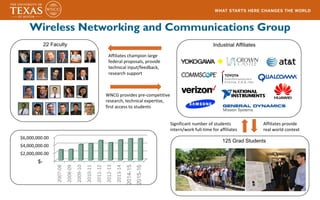
125 Grad Students
Affiliates	champion	large	
federal	proposals,	provide	
technical	input/feedback,	
research	support
WNCG	provides	pre-competitive	
research,	technical	expertise,	
first	access	to	students
Significant	number	of	students	
intern/work	full-time	for	affiliates
Affiliates	provide	
real	world	context
Industrial Affiliates22 Faculty
$-
$2,000,000.00	
$4,000,000.00	
$6,000,000.00	
2007-08
2008-09
2009-10
2010-11
2011-12
2012-13
2013-14
2014-15
2015-16
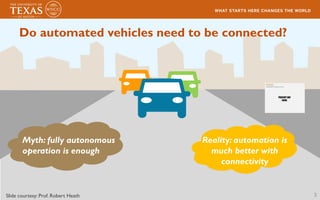
Do automated vehicles need to be connected?
3
Myth: fully autonomous
operation is enough
Reality: automation is
much better with
connectivity
Slide courtesy: Prof. Robert Heath
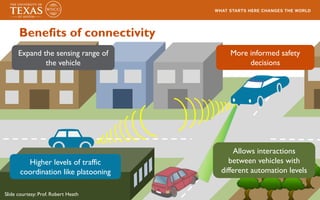
Expand the sensing range of
the vehicle
Allows interactions
between vehicles with
different automation levels
More informed safety
decisions
Benefits of connectivity
Higher levels of traffic
coordination like platooning
Slide courtesy: Prof. Robert Heath
10
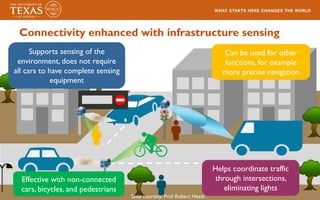
Connectivity enhanced with infrastructure sensing
Can be used for other
functions, for example
more precise navigation
Supports sensing of the
environment, does not require
all cars to have complete sensing
equipment
Helps coordinate traffic
through intersections,
eliminating lights
Effective with non-connected
cars, bicycles, and pedestrians
Slide courtesy: Prof. Robert Heath
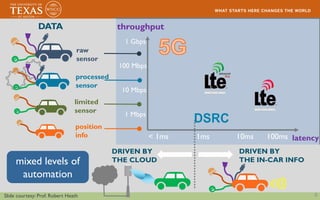
< 1ms 1ms 10ms 100ms
1 Mbps
10 Mbps
100 Mbps
1 Gbps
throughput
latency
6
DRIVEN BY
THE CLOUD
DRIVEN BY
THE IN-CAR INFO
DATA
position
info
limited
sensor
processed
sensor
raw
sensor
mixed levels of
automation
Slide courtesy: Prof. Robert Heath
u Current State
ª Cellular: Large cells with tens of users per sector/cell
ª Cellular:Time-scale separation between scheduling and mobile-to-cell
association
u Moving Forward
ª Many small cells with few(er) users per cell; fast(er) transitions between cells
ª Heterogeneous capabilities
ª Mixture of cellular and D2D (e.g.V2V) traffic over shared spectrum
ª Much smaller slot timescales (100s of microsecs instead of milliseconds)
ª Much larger bandwidth
ª Sensing built into the infrastructure?
Cellular Infrastructure: Today’s Setting and Moving Forward
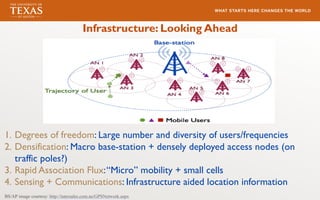
Infrastructure: Looking Ahead
1. Degrees of freedom: Large number and diversity of users/frequencies
2. Densification: Macro base-station + densely deployed access nodes (on
traffic poles?)
3. Rapid Association Flux:“Micro” mobility + small cells
4. Sensing + Communications: Infrastructure aided location information
BS/AP image courtesy: http://intersales.com.au/GPSNetwork.aspx
Network Architecture #1:Who Controls the Network?
u Association flux – much more rapid
u Cellular: Users transition between cells at a faster time-scale
ª Number of users per cell smaller
ª Time-scale separation between scheduling and association unclear
u D2D traffic embedded with cellular over shared spectrum
ª Control needs to rapidly switch between D2D (V2V) and cellular
u More efficient to implement these tasks on the device
Network Inversion: Device driven association
and channel resource allocation
Network Architecture #2:The MAC Architecture
u Local backlogs or HOL delay used for scheduling
u Data center used for planning / long-term parameter settings
u Looking Forward
ªMove from a interference limited regime to a link budget
limited regime
ªMoving from a state-driven allocation to a statistics-driven
allocation
ªSwitch between sensing and communications, while dealing with
hysteresis
Leverage the cellular data center for
real-time global resource allocation

V2X, V2I, and the Cellular Infrastructure

  • 1.
    V2X,V2I and theCellular Infrastructure Prof. Sanjay Shakkottai, Director Ashley H. Priddy Centennial Professor of Engineering Director,Wireless Networking and Communications Group 1
  • 2.
    Wireless Networking andCommunications Group 125 Grad Students Affiliates champion large federal proposals, provide technical input/feedback, research support WNCG provides pre-competitive research, technical expertise, first access to students Significant number of students intern/work full-time for affiliates Affiliates provide real world context Industrial Affiliates22 Faculty $- $2,000,000.00 $4,000,000.00 $6,000,000.00 2007-08 2008-09 2009-10 2010-11 2011-12 2012-13 2013-14 2014-15 2015-16
  • 3.
    Do automated vehiclesneed to be connected? 3 Myth: fully autonomous operation is enough Reality: automation is much better with connectivity Slide courtesy: Prof. Robert Heath
  • 4.
    Expand the sensingrange of the vehicle Allows interactions between vehicles with different automation levels More informed safety decisions Benefits of connectivity Higher levels of traffic coordination like platooning Slide courtesy: Prof. Robert Heath
  • 5.
    10 Connectivity enhanced withinfrastructure sensing Can be used for other functions, for example more precise navigation Supports sensing of the environment, does not require all cars to have complete sensing equipment Helps coordinate traffic through intersections, eliminating lights Effective with non-connected cars, bicycles, and pedestrians Slide courtesy: Prof. Robert Heath
  • 6.
    < 1ms 1ms10ms 100ms 1 Mbps 10 Mbps 100 Mbps 1 Gbps throughput latency 6 DRIVEN BY THE CLOUD DRIVEN BY THE IN-CAR INFO DATA position info limited sensor processed sensor raw sensor mixed levels of automation Slide courtesy: Prof. Robert Heath
  • 7.
    u Current State ªCellular: Large cells with tens of users per sector/cell ª Cellular:Time-scale separation between scheduling and mobile-to-cell association u Moving Forward ª Many small cells with few(er) users per cell; fast(er) transitions between cells ª Heterogeneous capabilities ª Mixture of cellular and D2D (e.g.V2V) traffic over shared spectrum ª Much smaller slot timescales (100s of microsecs instead of milliseconds) ª Much larger bandwidth ª Sensing built into the infrastructure? Cellular Infrastructure: Today’s Setting and Moving Forward
  • 8.
    Infrastructure: Looking Ahead 1.Degrees of freedom: Large number and diversity of users/frequencies 2. Densification: Macro base-station + densely deployed access nodes (on traffic poles?) 3. Rapid Association Flux:“Micro” mobility + small cells 4. Sensing + Communications: Infrastructure aided location information BS/AP image courtesy: http://intersales.com.au/GPSNetwork.aspx
  • 9.
    Network Architecture #1:WhoControls the Network? u Association flux – much more rapid u Cellular: Users transition between cells at a faster time-scale ª Number of users per cell smaller ª Time-scale separation between scheduling and association unclear u D2D traffic embedded with cellular over shared spectrum ª Control needs to rapidly switch between D2D (V2V) and cellular u More efficient to implement these tasks on the device Network Inversion: Device driven association and channel resource allocation
  • 10.
    Network Architecture #2:TheMAC Architecture u Local backlogs or HOL delay used for scheduling u Data center used for planning / long-term parameter settings u Looking Forward ªMove from a interference limited regime to a link budget limited regime ªMoving from a state-driven allocation to a statistics-driven allocation ªSwitch between sensing and communications, while dealing with hysteresis Leverage the cellular data center for real-time global resource allocation