VEDANT A. GODHAMGAONKAR
AGENDA
 Introduction
 Schematic Representation of a VANET
 Vehicular Communication
 VANET Architecture
 Applications of VANET
 Characteristics
 Current Research
 Conclusion
 References
WHAT IS VANET?
 A VANET, is a technology that uses moving cars as
nodes in a network to create a mobile network.
 It is used to provide communications among nearby
vehicles and between vehicles and nearest fixed
equipment, usually described as roadside equipment.
 “VANET make transportation systems more intelligent”
Motivation for VANET
 Increase safety
Hundreds of thousands of people are killed world-
wide due to road accidents yearly.
Many more are injured.
 Traffic optimization
Congestion/traffic jams cost time and fuel.
Both these problems can be solved
by giving timely information to the drivers!
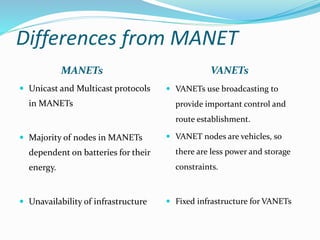
Differences from MANET
MANETs VANETs
 Unicast and Multicast protocols
in MANETs
 Majority of nodes in MANETs
dependent on batteries for their
energy.
 Unavailability of infrastructure
 VANETs use broadcasting to
provide important control and
route establishment.
 VANET nodes are vehicles, so
there are less power and storage
constraints.
 Fixed infrastructure for VANETs
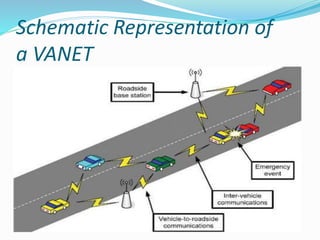
Schematic Representation of
a VANET
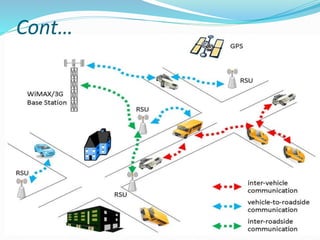
Vehicular Communication
 VANET communicates through Wireless Access for
Vehicular Environments (WAVE).
 The WAVE uses different types of Wireless
Commutation devices such as (Wi-Fi / Wi-Max).
 The sensors or wireless devices can form a VANET
network which resides on top of the vehicle.
Cont…
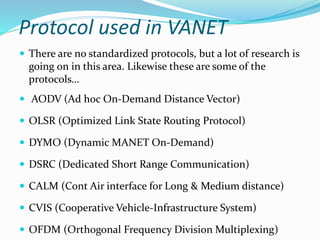
Protocol used in VANET
 There are no standardized protocols, but a lot of research is
going on in this area. Likewise these are some of the
protocols…
 AODV (Ad hoc On-Demand Distance Vector)
 OLSR (Optimized Link State Routing Protocol)
 DYMO (Dynamic MANET On-Demand)
 DSRC (Dedicated Short Range Communication)
 CALM (Cont Air interface for Long & Medium distance)
 CVIS (Cooperative Vehicle-Infrastructure System)
 OFDM (Orthogonal Frequency Division Multiplexing)
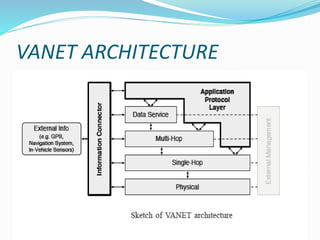
VANET ARCHITECTURE
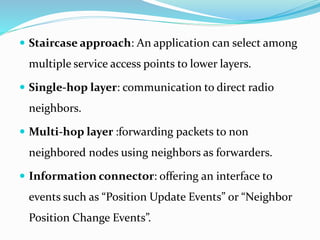
 Staircase approach: An application can select among
multiple service access points to lower layers.
 Single-hop layer: communication to direct radio
neighbors.
 Multi-hop layer :forwarding packets to non
neighbored nodes using neighbors as forwarders.
 Information connector: offering an interface to
events such as “Position Update Events” or “Neighbor
Position Change Events”.
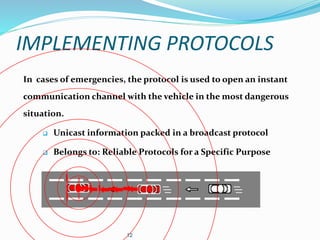
IMPLEMENTING PROTOCOLS
In cases of emergencies, the protocol is used to open an instant
communication channel with the vehicle in the most dangerous
situation.
 Unicast information packed in a broadcast protocol
 Belongs to: Reliable Protocols for a Specific Purpose
12
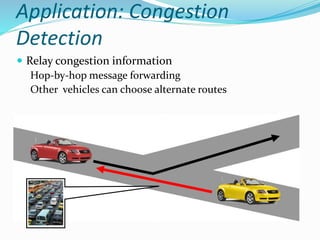
Application: Congestion
Detection
 Relay congestion information
Hop-by-hop message forwarding
Other vehicles can choose alternate routes
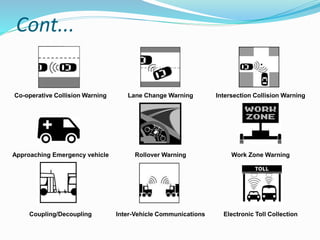
Cont...
Co-operative Collision Warning Lane Change Warning Intersection Collision Warning
Approaching Emergency vehicle Rollover Warning Work Zone Warning
Coupling/Decoupling Inter-Vehicle Communications Electronic Toll Collection
VANET Characteristics
The main characteristics of VANETs
 High mobility of nodes
 No prior information about location of nodes
 Predictable topology (to some extent)
 The communication link in a VANET is short lived
 No problem with power
 High possibility to be fragmented
Current Research
 USA:
1)Vehicle Safety Communications Consortium(VSCC)
2)DSRC/WAVE Technology
3)Vehicle Infrastructure Integration (VII)
 Europe:
1)Car to Car Communication Consortium
2)Network on Wheels (“NOW”)(Germany)
 Japan:
Internet ITS Consortium
Conclusions
 VANETs have many practical applications, but the
most important ones are in terms of active safety.
 There are no standardized protocols, but a lot of
research is going on in this area.
 VANETs are likely to become the most important
realization of mobile ad hoc networks.
REFERENCES
 http://pcquest.ciol.com/content/technology/2009/1090201
01.asp
 http://en.wikipedia.org/wiki/Vehicular_ad-
hoc_network#Applications
 http://ieeexplore.ieee.org/xpl/freeabs_all.jsp?arnumber=4
458046
 http://aivanetblog.blogspot.com/
 Ad-hoc wireless network by MURTHY MANOJ
THANK YOU…!!!

VANET (BY-VEDANT)

  • 1.
  • 2.
    AGENDA  Introduction  SchematicRepresentation of a VANET  Vehicular Communication  VANET Architecture  Applications of VANET  Characteristics  Current Research  Conclusion  References
  • 3.
    WHAT IS VANET? A VANET, is a technology that uses moving cars as nodes in a network to create a mobile network.  It is used to provide communications among nearby vehicles and between vehicles and nearest fixed equipment, usually described as roadside equipment.  “VANET make transportation systems more intelligent”
  • 4.
    Motivation for VANET Increase safety Hundreds of thousands of people are killed world- wide due to road accidents yearly. Many more are injured.  Traffic optimization Congestion/traffic jams cost time and fuel. Both these problems can be solved by giving timely information to the drivers!
  • 5.
    Differences from MANET MANETsVANETs  Unicast and Multicast protocols in MANETs  Majority of nodes in MANETs dependent on batteries for their energy.  Unavailability of infrastructure  VANETs use broadcasting to provide important control and route establishment.  VANET nodes are vehicles, so there are less power and storage constraints.  Fixed infrastructure for VANETs
  • 6.
  • 7.
    Vehicular Communication  VANETcommunicates through Wireless Access for Vehicular Environments (WAVE).  The WAVE uses different types of Wireless Commutation devices such as (Wi-Fi / Wi-Max).  The sensors or wireless devices can form a VANET network which resides on top of the vehicle.
  • 8.
  • 9.
    Protocol used inVANET  There are no standardized protocols, but a lot of research is going on in this area. Likewise these are some of the protocols…  AODV (Ad hoc On-Demand Distance Vector)  OLSR (Optimized Link State Routing Protocol)  DYMO (Dynamic MANET On-Demand)  DSRC (Dedicated Short Range Communication)  CALM (Cont Air interface for Long & Medium distance)  CVIS (Cooperative Vehicle-Infrastructure System)  OFDM (Orthogonal Frequency Division Multiplexing)
  • 10.
  • 11.
     Staircase approach:An application can select among multiple service access points to lower layers.  Single-hop layer: communication to direct radio neighbors.  Multi-hop layer :forwarding packets to non neighbored nodes using neighbors as forwarders.  Information connector: offering an interface to events such as “Position Update Events” or “Neighbor Position Change Events”.
  • 12.
    IMPLEMENTING PROTOCOLS In casesof emergencies, the protocol is used to open an instant communication channel with the vehicle in the most dangerous situation.  Unicast information packed in a broadcast protocol  Belongs to: Reliable Protocols for a Specific Purpose 12
  • 13.
    Application: Congestion Detection  Relaycongestion information Hop-by-hop message forwarding Other vehicles can choose alternate routes
  • 14.
    Cont... Co-operative Collision WarningLane Change Warning Intersection Collision Warning Approaching Emergency vehicle Rollover Warning Work Zone Warning Coupling/Decoupling Inter-Vehicle Communications Electronic Toll Collection
  • 15.
    VANET Characteristics The maincharacteristics of VANETs  High mobility of nodes  No prior information about location of nodes  Predictable topology (to some extent)  The communication link in a VANET is short lived  No problem with power  High possibility to be fragmented
  • 16.
    Current Research  USA: 1)VehicleSafety Communications Consortium(VSCC) 2)DSRC/WAVE Technology 3)Vehicle Infrastructure Integration (VII)  Europe: 1)Car to Car Communication Consortium 2)Network on Wheels (“NOW”)(Germany)  Japan: Internet ITS Consortium
  • 17.
    Conclusions  VANETs havemany practical applications, but the most important ones are in terms of active safety.  There are no standardized protocols, but a lot of research is going on in this area.  VANETs are likely to become the most important realization of mobile ad hoc networks.
  • 18.
    REFERENCES  http://pcquest.ciol.com/content/technology/2009/1090201 01.asp  http://en.wikipedia.org/wiki/Vehicular_ad- hoc_network#Applications http://ieeexplore.ieee.org/xpl/freeabs_all.jsp?arnumber=4 458046  http://aivanetblog.blogspot.com/  Ad-hoc wireless network by MURTHY MANOJ
  • 19.