1
2
• PRESENTED BY: AKASH R


• GUIDED BY: Smt. GEETHA RAJ R


• CO-ORDINATED BY: Smt. ANJU J


                                 3
•   What is a VANET?
•   Intelligent transportation system
•   Vehicle to vehicle communication
•   Vehicle to infrastructure communication
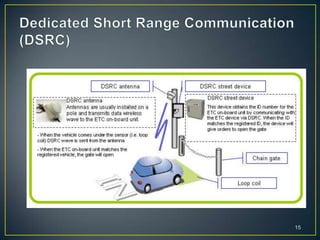
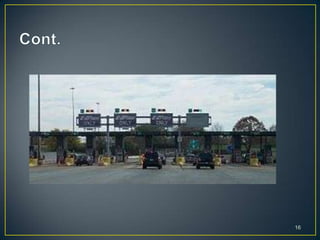
•   Dedicated Short Range Communication
•   challenges
•   Applications of VANET
•   conclusion
•   references


                                              4
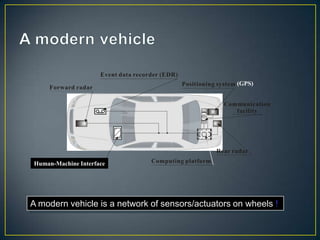
Event data recorder (EDR)
                                                 Positioning system (GPS)
     Forward radar

                                                               Communication
                                                                  facility


                                                            Rear radar

Human-Machine Display
              Interface              Computing platform


A modern vehicle is a network of sensors/actuators on wheels !
 Vehicles Transformed into “Computers on the
 Wheels” or “Networks on the Wheel”
 Vehicular Communication System (VCS):- Two main
 type of communications
 Vehicle to Vehicle (V2V) Communication:-
    Vehicle to Infrastructure (V2I) communication:-
 Advantage and Usage of VCS:-
  Information sharing
  Co-operative driving
  Other value added services like Navigation, internet
access etc.
 ad-hoc means to a system of network elements that
    combine to form a network requiring little or no planning

                                                                6
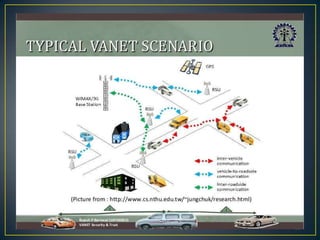
 Communication between V2V and V2I are “ad-hoc" in
  nature.
 This special kind of communication network is known as
  “Vehicular Ad-hoc Network (VANET)”
 VANET will become Worlds largest ad-hoc network


                                                           7
8
• Communication:- Wireless Access in Vehicular
   Environment (WAVE): IEEE 1609.2 Standard also Known
   DSRC 802.11p
• Supports Multi-Hop communication for vehicles out of
   range (Max. Range DSRC is 1000m)
• On-Board Unit (OBU):- A device which is inside the
   vehicle which
       processes the data collected from various sensors
fitted inside the cars and gives conditions of the vehicles
      is responsible for communication with outside network
i.e with other vehicles and infrastructure.

                                                          9
• Road Side Unit (RSU): Infrastructure for communication
  between the cars for sharing and information from
  various vehicles.


                                                       10
 It allows safe and free flow traffic.

 It uses GPS and DGPS equipped devices.

 It uses various technology like:-
1. Wireless communications
2. Computational technologies
3. Floating car data/floating cellular data
4. Sensing technologies
5. Inductive loop detection
6. Video vehicle detection
7. Bluetooth Detection                        11
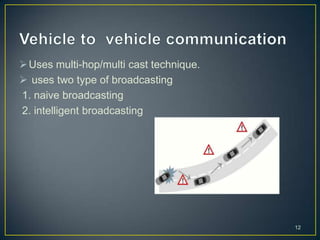
 Uses multi-hop/multi cast technique.
 uses two type of broadcasting
1. naive broadcasting
2. intelligent broadcasting


                                         12
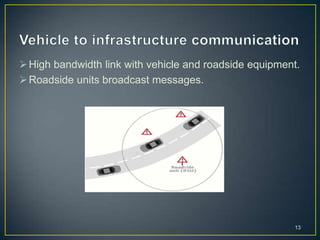
 High bandwidth link with vehicle and roadside equipment.
 Roadside units broadcast messages.


                                                        13
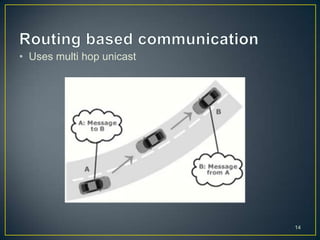
• Uses multi hop unicast


                           14
15
16
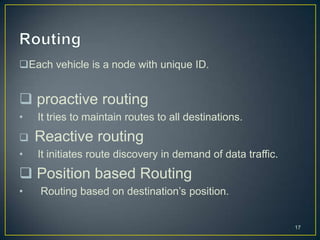
Each vehicle is a node with unique ID.


 proactive routing
•   It tries to maintain routes to all destinations.
   Reactive routing
•   It initiates route discovery in demand of data traffic.
 Position based Routing
•   Routing based on destination’s position.


                                                              17
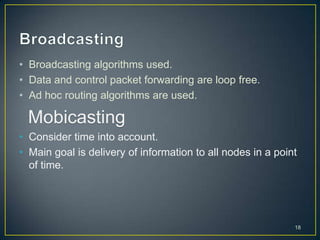
• Broadcasting algorithms used.
• Data and control packet forwarding are loop free.
• Ad hoc routing algorithms are used.

 Mobicasting
• Consider time into account.
• Main goal is delivery of information to all nodes in a point
  of time.


                                                             18
• Indicates level of performance given to user.
• Provide robust routes among nodes.


Security

• Many threats for Vanet.
• Avoid some threats using digital signatures.


                                                  19
 Routing
• Large end-to-end delays and decreased packet delivery
  ratio.
 Security Frameworks
• Need lightweight, scalable authentication frameworks.
• Need reliable and secureness .
• Need fast and low-cost message exchange facility.


                                                          20
 Quality of Service.
• QoS challenges are packet delivery ratio and connection
  duration.

 Broadcasting.
• Most messages in Vanet are broadcast messages.
• Collisions affects message delivery.


                                                        21
22
Three major classes of applications possible in VANET are
 safety oriented
 convenience oriented
 commercial oriented


                                                        23
24
• Consists of vehicle-to-vehicle, vehicle-to-infrastructure
  communication.

• It improves the safety of vehicles.

• Supports Intelligent Transportation system.


                                                              25
• Raya, M. and Hubaux, J.,     “The Security of Vehicular Ad Hoc
Networks”, in Proceedings of the 3rdACM Workshop on Security of
Ad Hoc and Sensor Networks (SASN 2005), Alexandria, VA,

• Harsch, C., Festag, A. & Papadimitratos, P., “Secure Position-Based
Routing for VANETs”,      in Proceedings of     IEEE 66thVehicular
Technology Conference (VTC-2007).

• Gerlach, M., Full Paper: Assessing and Improving Privacy in
VANETs, www.networkon-wheels.de/downloads/escar2006gerlach.pdf
.


                                                                   26
• Jinyuan, S., Chi, Z. & Yuguang, F., “An ID-based Framework Achieving
Privacy and Non-Repudiation”, in Proceedings of IEEE Vehicular Ad Hoc
Networks, Military Communications Conference (MILCOM 2007).

• Stampoulis, A. & Chai, Z., A Survey of Security in Vehicular Networks.

• Balon, N., Introduction to Vehicular Ad Hoc Networks and the Broadcast
Storm   Problem,http://www.csie.ntpu.edu.tw/~yschen/course/96-
2/Wireless/papers/broadcast-5.pdf .


                                                                           27
28
29

Vanet ppt

  • 1.
  • 2.
  • 3.
    • PRESENTED BY:AKASH R • GUIDED BY: Smt. GEETHA RAJ R • CO-ORDINATED BY: Smt. ANJU J 3
  • 4.
    What is a VANET? • Intelligent transportation system • Vehicle to vehicle communication • Vehicle to infrastructure communication • Dedicated Short Range Communication • challenges • Applications of VANET • conclusion • references 4
  • 5.
    Event data recorder(EDR) Positioning system (GPS) Forward radar Communication facility Rear radar Human-Machine Display Interface Computing platform A modern vehicle is a network of sensors/actuators on wheels !
  • 6.
     Vehicles Transformedinto “Computers on the Wheels” or “Networks on the Wheel”  Vehicular Communication System (VCS):- Two main type of communications Vehicle to Vehicle (V2V) Communication:- Vehicle to Infrastructure (V2I) communication:-  Advantage and Usage of VCS:- Information sharing Co-operative driving Other value added services like Navigation, internet access etc.  ad-hoc means to a system of network elements that combine to form a network requiring little or no planning 6
  • 7.
     Communication betweenV2V and V2I are “ad-hoc" in nature.  This special kind of communication network is known as “Vehicular Ad-hoc Network (VANET)”  VANET will become Worlds largest ad-hoc network 7
  • 8.
  • 9.
    • Communication:- WirelessAccess in Vehicular Environment (WAVE): IEEE 1609.2 Standard also Known DSRC 802.11p • Supports Multi-Hop communication for vehicles out of range (Max. Range DSRC is 1000m) • On-Board Unit (OBU):- A device which is inside the vehicle which processes the data collected from various sensors fitted inside the cars and gives conditions of the vehicles is responsible for communication with outside network i.e with other vehicles and infrastructure. 9
  • 10.
    • Road SideUnit (RSU): Infrastructure for communication between the cars for sharing and information from various vehicles. 10
  • 11.
     It allowssafe and free flow traffic.  It uses GPS and DGPS equipped devices.  It uses various technology like:- 1. Wireless communications 2. Computational technologies 3. Floating car data/floating cellular data 4. Sensing technologies 5. Inductive loop detection 6. Video vehicle detection 7. Bluetooth Detection 11
  • 12.
     Uses multi-hop/multicast technique.  uses two type of broadcasting 1. naive broadcasting 2. intelligent broadcasting 12
  • 13.
     High bandwidthlink with vehicle and roadside equipment.  Roadside units broadcast messages. 13
  • 14.
    • Uses multihop unicast 14
  • 15.
  • 16.
  • 17.
    Each vehicle isa node with unique ID.  proactive routing • It tries to maintain routes to all destinations.  Reactive routing • It initiates route discovery in demand of data traffic.  Position based Routing • Routing based on destination’s position. 17
  • 18.
    • Broadcasting algorithmsused. • Data and control packet forwarding are loop free. • Ad hoc routing algorithms are used. Mobicasting • Consider time into account. • Main goal is delivery of information to all nodes in a point of time. 18
  • 19.
    • Indicates levelof performance given to user. • Provide robust routes among nodes. Security • Many threats for Vanet. • Avoid some threats using digital signatures. 19
  • 20.
     Routing • Largeend-to-end delays and decreased packet delivery ratio.  Security Frameworks • Need lightweight, scalable authentication frameworks. • Need reliable and secureness . • Need fast and low-cost message exchange facility. 20
  • 21.
     Quality ofService. • QoS challenges are packet delivery ratio and connection duration.  Broadcasting. • Most messages in Vanet are broadcast messages. • Collisions affects message delivery. 21
  • 22.
  • 23.
    Three major classesof applications possible in VANET are  safety oriented  convenience oriented  commercial oriented 23
  • 24.
  • 25.
    • Consists ofvehicle-to-vehicle, vehicle-to-infrastructure communication. • It improves the safety of vehicles. • Supports Intelligent Transportation system. 25
  • 26.
    • Raya, M.and Hubaux, J., “The Security of Vehicular Ad Hoc Networks”, in Proceedings of the 3rdACM Workshop on Security of Ad Hoc and Sensor Networks (SASN 2005), Alexandria, VA, • Harsch, C., Festag, A. & Papadimitratos, P., “Secure Position-Based Routing for VANETs”, in Proceedings of IEEE 66thVehicular Technology Conference (VTC-2007). • Gerlach, M., Full Paper: Assessing and Improving Privacy in VANETs, www.networkon-wheels.de/downloads/escar2006gerlach.pdf . 26
  • 27.
    • Jinyuan, S.,Chi, Z. & Yuguang, F., “An ID-based Framework Achieving Privacy and Non-Repudiation”, in Proceedings of IEEE Vehicular Ad Hoc Networks, Military Communications Conference (MILCOM 2007). • Stampoulis, A. & Chai, Z., A Survey of Security in Vehicular Networks. • Balon, N., Introduction to Vehicular Ad Hoc Networks and the Broadcast Storm Problem,http://www.csie.ntpu.edu.tw/~yschen/course/96- 2/Wireless/papers/broadcast-5.pdf . 27
  • 28.
  • 29.