Existing example of V2I
(based on smartphone)
Intelligent Parking Information System
(IPIS)
Submitted by: Ahmed Shehab
Submitted to: Francois Guichard
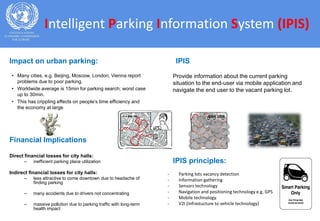
• Many cities, e.g. Beijing, Moscow, London, Vienna report
problems due to poor parking.
• Worldwide average is 15min for parking search; worst case
up to 30min.
• This has crippling effects on people’s time efficiency and
the economy at large
Provide information about the current parking
situation to the end-user via mobile application and
navigate the end user to the vacant parking lot.
Financial Implications
Direct financial losses for city halls:
– inefficient parking place utilization
Indirect financial losses for city halls:
– less attractive to come downtown due to headache of
finding parking
– many accidents due to drivers not concentrating
– massive pollution due to parking traffic with long-term
health impact
IPIS
IPIS principles:
- Parking lots vacancy detection
- Information gathering
- Sensors technology
- Navigation and positioning technology e.g. GPS
- Mobile technology.
- V2I (Infrastucture to vehicle technology)
Intelligent Parking Information System (IPIS)
Impact on urban parking:
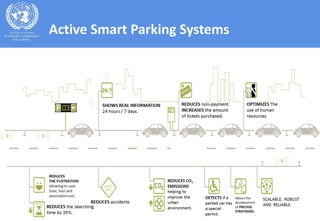
Active Smart Parking Systems
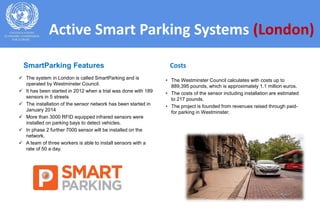
 The system in London is called SmartParking and is
operated by Westminster Council.
 It has been started in 2012 when a trial was done with 189
sensors in 5 streets
 The installation of the sensor network has been started in
January 2014
 More than 3000 RFID equipped infrared sensors were
installed on parking bays to detect vehicles.
 In phase 2 further 7000 sensor will be installed on the
network.
 A team of three workers is able to install sensors with a
rate of 50 a day.
• The Westminster Council calculates with costs up to
889,395 pounds, which is approximately 1.1 million euros.
• The costs of the sensor including installation are estimated
to 217 pounds.
• The project is founded from revenues raised through paid-
for parking in Westminster.
Active Smart Parking Systems (London)
CostsSmartParking Features
Active Smart Parking Systems (London)
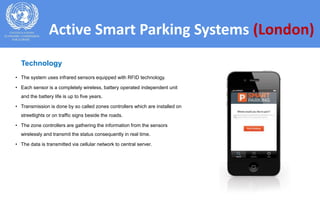
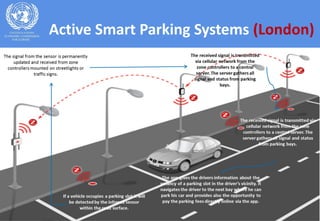
• The system uses infrared sensors equipped with RFID technology.
• Each sensor is a completely wireless, battery operated independent unit
and the battery life is up to five years.
• Transmission is done by so called zones controllers which are installed on
streetlights or on traffic signs beside the roads.
• The zone controllers are gathering the information from the sensors
wirelessly and transmit the status consequently in real time.
• The data is transmitted via cellular network to central server.
Technology
Active Smart Parking Systems (London)
• The system employed, called Fastprk, is considered to be the largest smart parking project in the world.
• The technology was first trialed in the winter of 2011/12 and has been commercially operational since November 2012. The installation was
realized in four stages:
 The first stage: Took place in November 2012. 1,000 sensors were successfully installed in paying parking areas.
 The second stage: (May-June 2013) included the instrumentation of around 2,000 parking spaces in total.
 The third stage: (Dec 2013/Jan 2014) involved the installation of 12,000 parking sensors. With this deployment, Moscow’s becomes
the largest smart parking project in the world.
 The fourth stage: (Mid 2014) include more than 50,000 sensors.
• On the top of the platform there is an integrated control system provided by ITS
• Active displays also installed on Moscow’s paid-parking streets.
• Fastprk has been adapted to serve the disabled (10% of the spots), emergency services, ambulances and police cars.
Active Smart Parking Systems (Moscow)
Fastprk Features
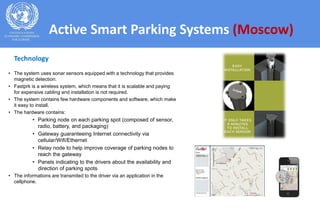
• The system uses sonar sensors equipped with a technology that provides
magnetic detection.
• Fastprk is a wireless system, which means that it is scalable and paying
for expensive cabling and installation is not required.
• The system contains few hardware components and software, which make
it easy to install.
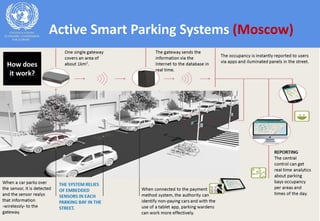
• The hardware contains:
• Parking node on each parking spot (composed of sensor,
radio, battery, and packaging)
• Gateway guaranteeing Internet connectivity via
cellular/Wifi/Ethernet
• Relay node to help improve coverage of parking nodes to
reach the gateway
• Panels indicating to the drivers about the availability and
direction of parking spots
• The informations are transmited to the driver via an application in the
cellphone.
Technology
Active Smart Parking Systems (Moscow)

Existing example of V2I (IPIS)

  • 1.
    Existing example ofV2I (based on smartphone) Intelligent Parking Information System (IPIS) Submitted by: Ahmed Shehab Submitted to: Francois Guichard
  • 2.
    • Many cities,e.g. Beijing, Moscow, London, Vienna report problems due to poor parking. • Worldwide average is 15min for parking search; worst case up to 30min. • This has crippling effects on people’s time efficiency and the economy at large Provide information about the current parking situation to the end-user via mobile application and navigate the end user to the vacant parking lot. Financial Implications Direct financial losses for city halls: – inefficient parking place utilization Indirect financial losses for city halls: – less attractive to come downtown due to headache of finding parking – many accidents due to drivers not concentrating – massive pollution due to parking traffic with long-term health impact IPIS IPIS principles: - Parking lots vacancy detection - Information gathering - Sensors technology - Navigation and positioning technology e.g. GPS - Mobile technology. - V2I (Infrastucture to vehicle technology) Intelligent Parking Information System (IPIS) Impact on urban parking:
  • 3.
  • 4.
     The systemin London is called SmartParking and is operated by Westminster Council.  It has been started in 2012 when a trial was done with 189 sensors in 5 streets  The installation of the sensor network has been started in January 2014  More than 3000 RFID equipped infrared sensors were installed on parking bays to detect vehicles.  In phase 2 further 7000 sensor will be installed on the network.  A team of three workers is able to install sensors with a rate of 50 a day. • The Westminster Council calculates with costs up to 889,395 pounds, which is approximately 1.1 million euros. • The costs of the sensor including installation are estimated to 217 pounds. • The project is founded from revenues raised through paid- for parking in Westminster. Active Smart Parking Systems (London) CostsSmartParking Features
  • 5.
    Active Smart ParkingSystems (London) • The system uses infrared sensors equipped with RFID technology. • Each sensor is a completely wireless, battery operated independent unit and the battery life is up to five years. • Transmission is done by so called zones controllers which are installed on streetlights or on traffic signs beside the roads. • The zone controllers are gathering the information from the sensors wirelessly and transmit the status consequently in real time. • The data is transmitted via cellular network to central server. Technology
  • 6.
    Active Smart ParkingSystems (London)
  • 7.
    • The systememployed, called Fastprk, is considered to be the largest smart parking project in the world. • The technology was first trialed in the winter of 2011/12 and has been commercially operational since November 2012. The installation was realized in four stages:  The first stage: Took place in November 2012. 1,000 sensors were successfully installed in paying parking areas.  The second stage: (May-June 2013) included the instrumentation of around 2,000 parking spaces in total.  The third stage: (Dec 2013/Jan 2014) involved the installation of 12,000 parking sensors. With this deployment, Moscow’s becomes the largest smart parking project in the world.  The fourth stage: (Mid 2014) include more than 50,000 sensors. • On the top of the platform there is an integrated control system provided by ITS • Active displays also installed on Moscow’s paid-parking streets. • Fastprk has been adapted to serve the disabled (10% of the spots), emergency services, ambulances and police cars. Active Smart Parking Systems (Moscow) Fastprk Features
  • 8.
    • The systemuses sonar sensors equipped with a technology that provides magnetic detection. • Fastprk is a wireless system, which means that it is scalable and paying for expensive cabling and installation is not required. • The system contains few hardware components and software, which make it easy to install. • The hardware contains: • Parking node on each parking spot (composed of sensor, radio, battery, and packaging) • Gateway guaranteeing Internet connectivity via cellular/Wifi/Ethernet • Relay node to help improve coverage of parking nodes to reach the gateway • Panels indicating to the drivers about the availability and direction of parking spots • The informations are transmited to the driver via an application in the cellphone. Technology Active Smart Parking Systems (Moscow)
  • 9.
    Active Smart ParkingSystems (Moscow)