Pharmaceutical Analysis 3.2
Pharm D 3rd Year
Ultraviolet and Visible Spectrophotometry
Introduction
Dr. Meenakshi Dhanawat
Associate Professor
MM College of Pharmacy
MM (Deemed to be University), Mullana
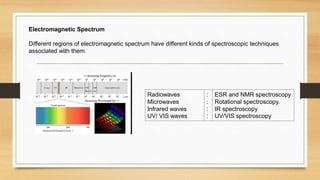
Radiowaves
Microwaves
Infrared waves
UV/ VIS waves
:
:
:
:
ESR and NMR spectroscopy
Rotational spectroscopy.
IR spectroscopy
UV/VIS spectroscopy
Electromagnetic Spectrum
Different regions of electromagnetic spectrum have different kinds of spectroscopic techniques
associated with them.
Principle
Molecules absorb energy and this energy can bring about translational, rotational or vibrational
motion or ionization of the molecules depending upon the frequency of the electromagnetic
radiation they receive. Excited molecules are unstable and quickly drop down to ground state
again giving off the energy they have received as electromagnetic radiation
Spectrum
Spectrum is the display of the energy level of an e.m.r. as a function of wave
number of electromagnetic radiation energy. The energy level of an e.m.r. may
be expressed in any of the following terms:
• Absorbance (e.m.r. absorbed)
• Transmittance (e.m.r. passed through)
• Intensity (radiant power of e.m.r)
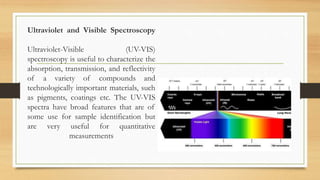
Ultraviolet and Visible Spectroscopy
Ultraviolet-Visible (UV-VIS)
spectroscopy is useful to characterize the
absorption, transmission, and reflectivity
of a variety of compounds and
technologically important materials, such
as pigments, coatings etc. The UV-VIS
spectra have broad features that are of
some use for sample identification but
are very useful for quantitative
measurements
Electronic Transitions
The absorption of UV or visible radiation corresponds to the three types of
electronic transition :
1. Transitions involving π, σ, and n electrons
2. Transitions involving charge-transfer electrons
3. Transitions involving d and f electrons
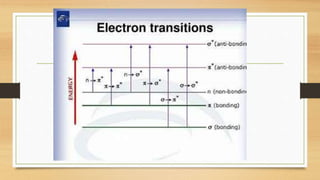
Possible electronic transitions of π, σ, and n electrons are;
Uv and Visibal Spectroscopy-Introduction

Uv and Visibal Spectroscopy-Introduction

  • 1.
    Pharmaceutical Analysis 3.2 PharmD 3rd Year Ultraviolet and Visible Spectrophotometry Introduction Dr. Meenakshi Dhanawat Associate Professor MM College of Pharmacy MM (Deemed to be University), Mullana
  • 2.
    Radiowaves Microwaves Infrared waves UV/ VISwaves : : : : ESR and NMR spectroscopy Rotational spectroscopy. IR spectroscopy UV/VIS spectroscopy Electromagnetic Spectrum Different regions of electromagnetic spectrum have different kinds of spectroscopic techniques associated with them.
  • 3.
    Principle Molecules absorb energyand this energy can bring about translational, rotational or vibrational motion or ionization of the molecules depending upon the frequency of the electromagnetic radiation they receive. Excited molecules are unstable and quickly drop down to ground state again giving off the energy they have received as electromagnetic radiation Spectrum Spectrum is the display of the energy level of an e.m.r. as a function of wave number of electromagnetic radiation energy. The energy level of an e.m.r. may be expressed in any of the following terms: • Absorbance (e.m.r. absorbed) • Transmittance (e.m.r. passed through) • Intensity (radiant power of e.m.r)
  • 4.
    Ultraviolet and VisibleSpectroscopy Ultraviolet-Visible (UV-VIS) spectroscopy is useful to characterize the absorption, transmission, and reflectivity of a variety of compounds and technologically important materials, such as pigments, coatings etc. The UV-VIS spectra have broad features that are of some use for sample identification but are very useful for quantitative measurements
  • 5.
    Electronic Transitions The absorptionof UV or visible radiation corresponds to the three types of electronic transition : 1. Transitions involving π, σ, and n electrons 2. Transitions involving charge-transfer electrons 3. Transitions involving d and f electrons Possible electronic transitions of π, σ, and n electrons are;