Dr.G.Rajkumar
Assistant Professor
Department of Chemistry
Vivekananda College
Tiruvedakam West – 625 234
Madurai
E-mail: rajkchem@gmail.com
Basics of NMR
Nuclear magnetic resonance (NMR) spectroscopy is the study of
molecules by recording the interaction of radiofrequency (Rf)
electromagnetic radiations with the nuclei of molecules placed in a
strong magnetic field.
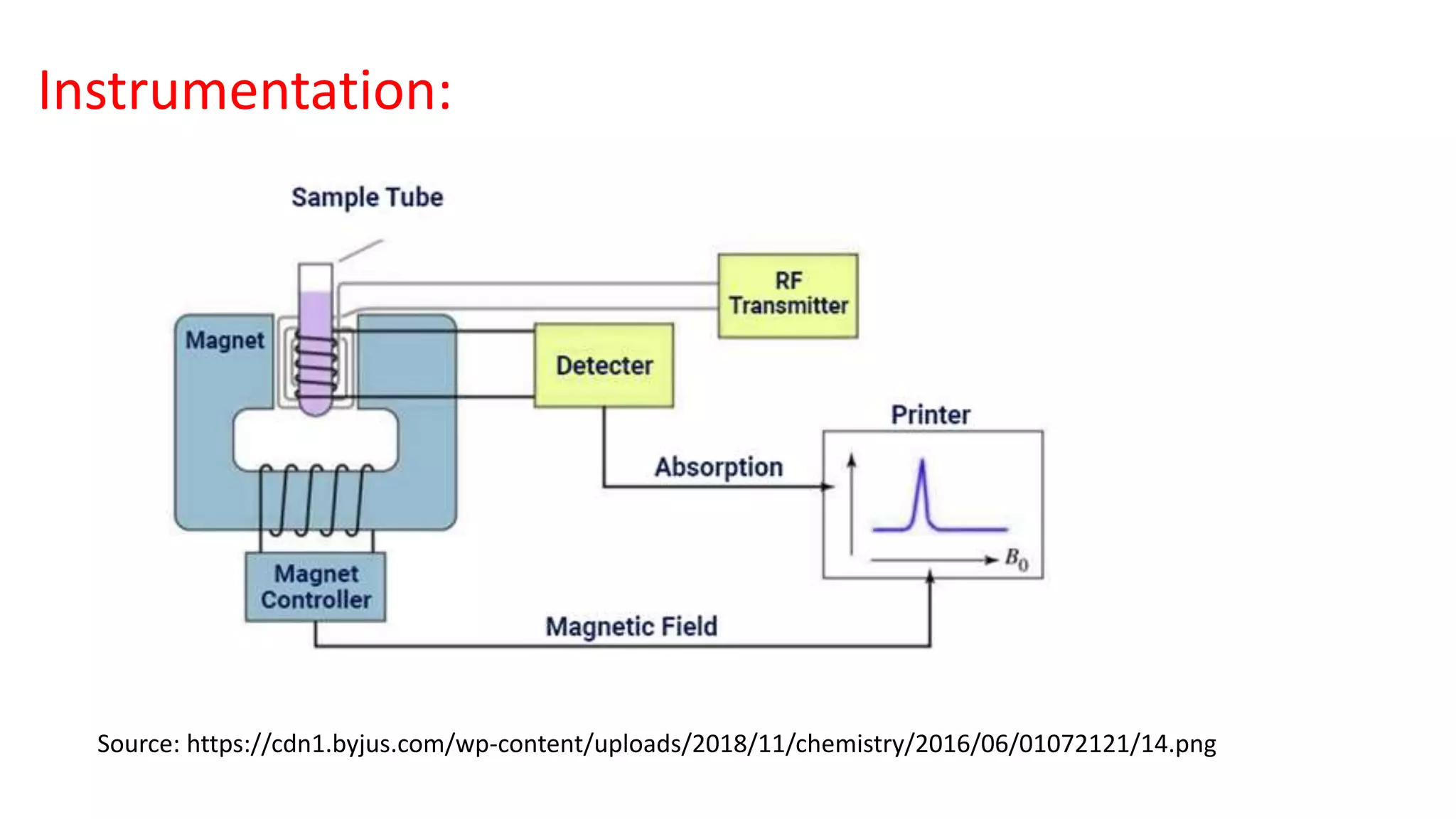
Instrumentation:
Source: https://cdn1.byjus.com/wp-content/uploads/2018/11/chemistry/2016/06/01072121/14.png
NMR Spectroscopy Instrumentation
This instrument consists of nine major parts. They are discussed below:
•Sample holder – It is a glass tube which is 8.5 cm long and 0.3 cm in diameter.
•Magnetic coils – Magnetic coil generates magnetic field whenever current flows
through it
•Permanent magnet – It helps in providing a homogenous magnetic field at 60 –
100 MHZ
•Sweep generator – Modifies the strength of the magnetic field which is already
applied.
•Radiofrequency transmitter – It produces a powerful but short pulse of the
radio waves.
•Radiofrequency – It helps in detecting receiver radio frequencies.
•RF detector – It helps in determining unabsorbed radio frequencies.
•Recorder – It records the NMR signals which are received by the RF detector.
•Readout system – A computer that records the data.
 All nuclei are electrically charged and many have spin.
 Transfer of energy is possible from base energy to higher energy levels
when an external magnetic field is applied.
 The transfer of energy occurs at a wavelength that coincides with the
radio frequency.
 Also, energy is emitted at the same frequency when the spin comes back
to its base level.
 Therefore, by measuring the signal which matches this transfer the
processing of the NMR spectrum for the concerned nucleus is yield
NMR Spectroscopy Principle
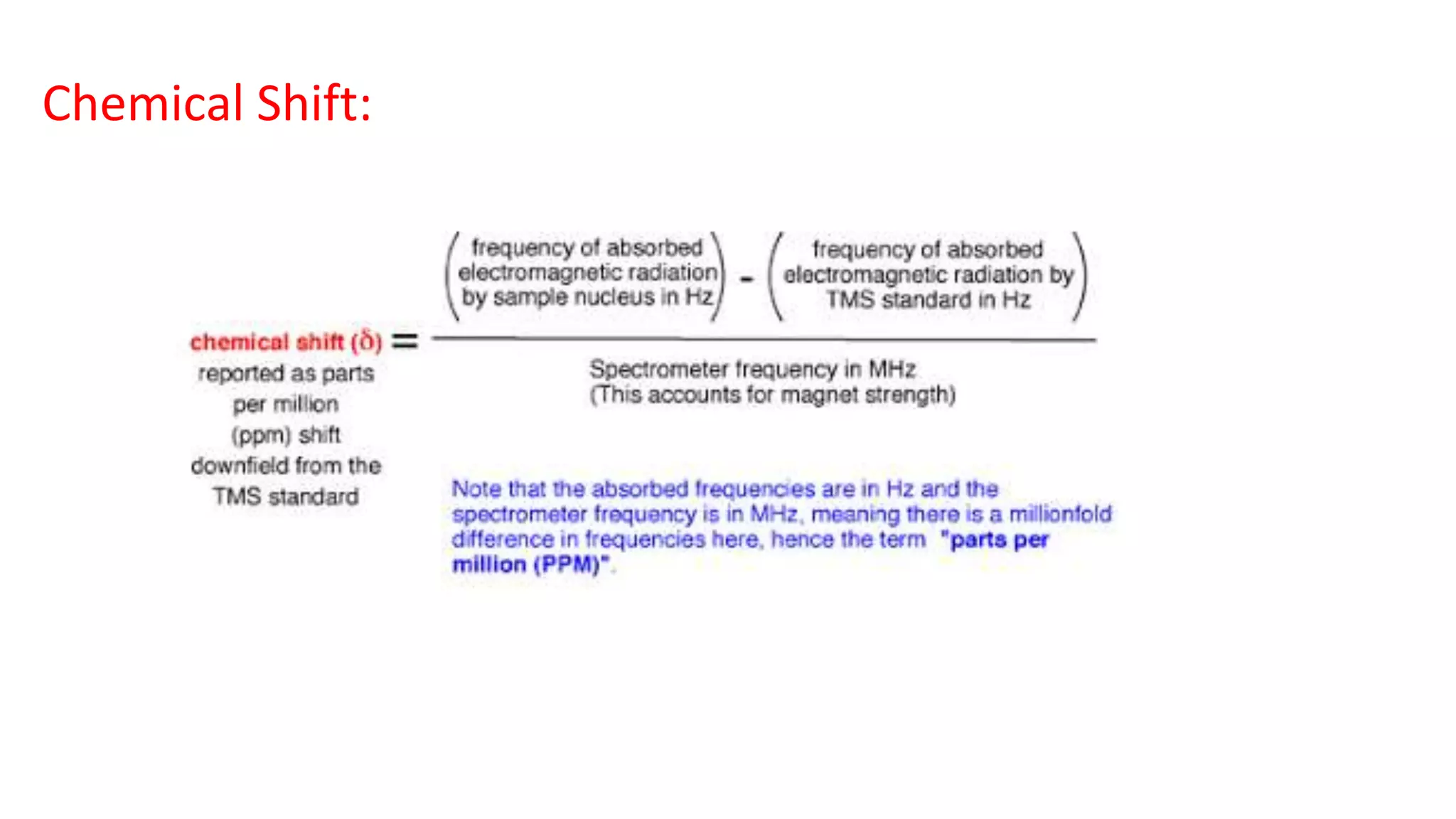
Chemical Shift:
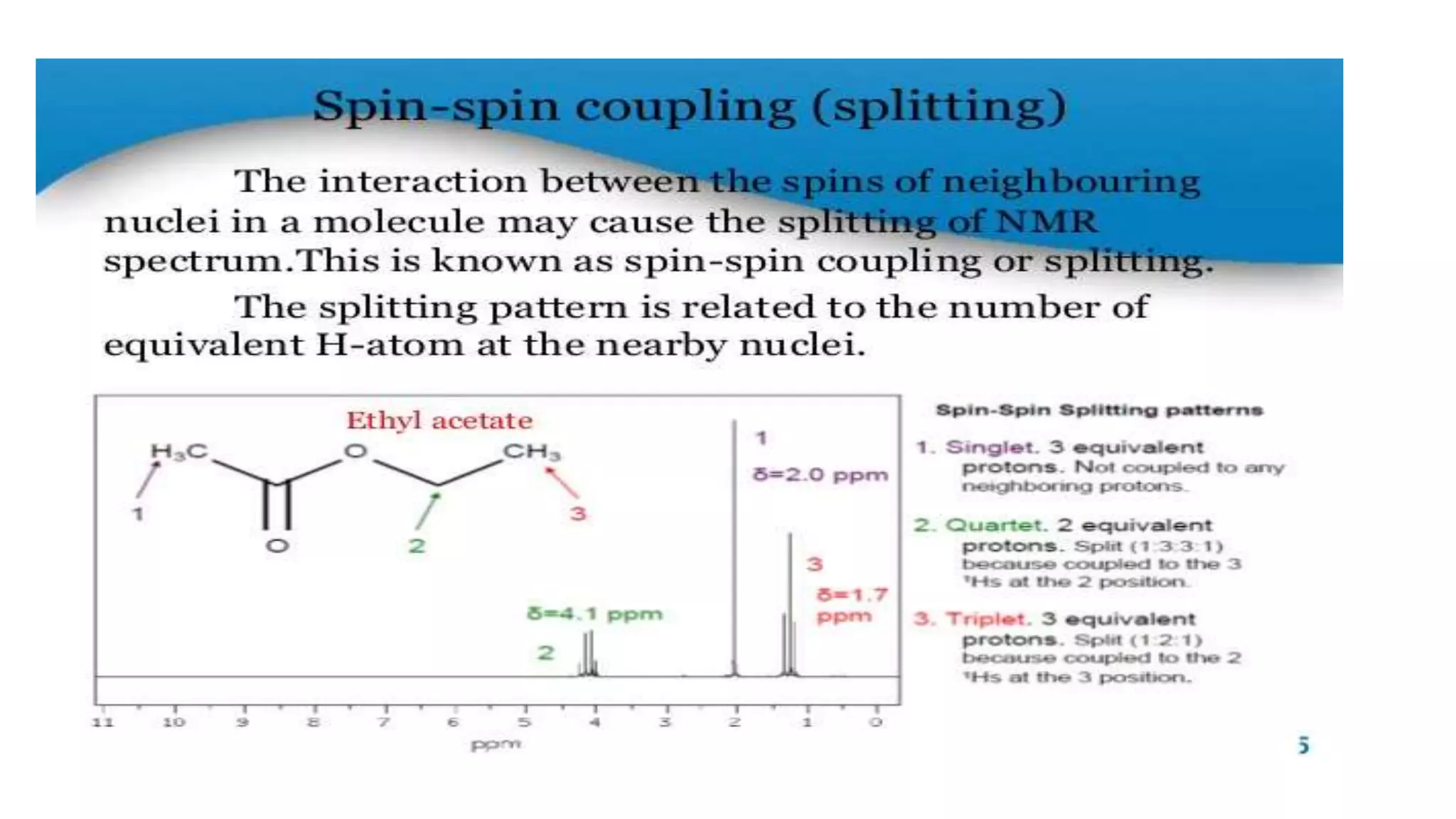
NMR spectra of ethanol:
triplet
quartet
singlet
Dr.G.Rajkumar
Assistant Professor
Department of Chemistry
Vivekananda College
Tiruvedakam West – 625 234
Madurai
E-mail: rajkchem@gmail.com
Thank You

Basics of NMR

  • 1.
    Dr.G.Rajkumar Assistant Professor Department ofChemistry Vivekananda College Tiruvedakam West – 625 234 Madurai E-mail: rajkchem@gmail.com Basics of NMR
  • 2.
    Nuclear magnetic resonance(NMR) spectroscopy is the study of molecules by recording the interaction of radiofrequency (Rf) electromagnetic radiations with the nuclei of molecules placed in a strong magnetic field.
  • 3.
  • 4.
    NMR Spectroscopy Instrumentation Thisinstrument consists of nine major parts. They are discussed below: •Sample holder – It is a glass tube which is 8.5 cm long and 0.3 cm in diameter. •Magnetic coils – Magnetic coil generates magnetic field whenever current flows through it •Permanent magnet – It helps in providing a homogenous magnetic field at 60 – 100 MHZ •Sweep generator – Modifies the strength of the magnetic field which is already applied. •Radiofrequency transmitter – It produces a powerful but short pulse of the radio waves. •Radiofrequency – It helps in detecting receiver radio frequencies. •RF detector – It helps in determining unabsorbed radio frequencies. •Recorder – It records the NMR signals which are received by the RF detector. •Readout system – A computer that records the data.
  • 5.
     All nucleiare electrically charged and many have spin.  Transfer of energy is possible from base energy to higher energy levels when an external magnetic field is applied.  The transfer of energy occurs at a wavelength that coincides with the radio frequency.  Also, energy is emitted at the same frequency when the spin comes back to its base level.  Therefore, by measuring the signal which matches this transfer the processing of the NMR spectrum for the concerned nucleus is yield NMR Spectroscopy Principle
  • 6.
  • 10.
    NMR spectra ofethanol: triplet quartet singlet
  • 11.
    Dr.G.Rajkumar Assistant Professor Department ofChemistry Vivekananda College Tiruvedakam West – 625 234 Madurai E-mail: rajkchem@gmail.com Thank You