Using Student Blogs  As Reflective Practice Ken Ronkowitz NJIT PCCC
This presentation is available online at: http://www.slideshare.net/ronko4 Additional information on reflective practices http:// dl.njit.edu /serendipity
The progression in the past decade of blogs from personal web journals to a platform for established professionals, corporations and writers has also created opportunities for education.  The Evolution of Blogs
Quick History  Precursors: Usenet, Genie, CompuServe and Bulletin Board Systems and 1990s Internet forums with threaded conversations "weblog" 1997 "blog" used as noun and verb "blogger" was Pyra Labs’ Blogger product (acquired by Google). From eMarketer (May 2008)  94.1 million US blog readers in 2007 (50% of Internet users) 22.6 million US bloggers in 2007 (12%)
Blogs Are Typically A web site, usually maintained by an individual with regular entries of commentary, descriptions of events, or other material such as graphics or video.  Entries are commonly displayed in reverse-chronological order.  personal “diary” or public forum on a topic (politics, hobby, research...)
Blogs In Education Much discussion & research focuses on them as a technology a “portfolio” a “web 2.0” way of addressing traditional writing practices a way to add discussion (commenting) to writing  a method to give writers an audience (worldwide)
This Presentation looks at my use of blogs with graduate students at NJIT since 2007 as a method for generating regular student  reflection  on their learning.
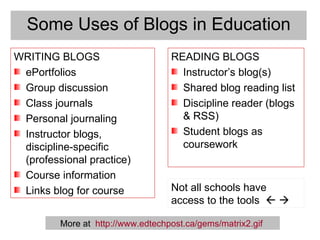
Some Uses of Blogs in Education WRITING BLOGS ePortfolios Group discussion Class journals Personal journaling Instructor blogs, discipline-specific (professional practice)  Course information Links blog for course READING BLOGS Instructor’s blog(s) Shared blog reading list Discipline reader (blogs & RSS) Student blogs as coursework More at   http://www.edtechpost.ca/gems/matrix2.gif   Not all schools have access to the tools     
Blogs Offer Students & Teachers online discussion (time-stamped comments) video posting (vlog)  podcasting platform posting via email & cell phone free web space for class materials minimal web skills required A way to address topics in writing audience, voice, publishing practices, copyright and plagiarism… through authentic writing in a digital medium.
Reflective Practice
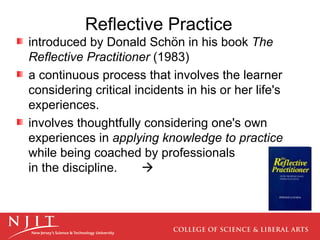
Reflective Practice introduced by Donald Schön in his book  The Reflective Practitioner  (1983) a continuous process that involves the learner considering critical incidents in his or her life's experiences.  involves thoughtfully considering one's own experiences in  applying knowledge to practice  while being coached by professionals  in the discipline.  
Reflective Practice Asks you to reconsider the role of  technical knowledge versus "artistry"  in developing professional excellence.  Used most widely in teacher education, health professions and architectural design.  Example: In education, the process of the educator studying his or her own teaching methods. The “art” of teaching vs. the educational psychology textbook. A “meta” activity.
Portfolios & Reflection Reflection A key element of learning - and of portfolios Many educators who work with portfolios consider the reflection component the most critical element of a good portfolio.  Students miss significant benefits of the portfolio process if they are not asked to reflect upon the quality and growth of their work. Making unconscious reflection conscious
Students Might Be Asked To… comment on why specific samples were  selected comment on what they liked /did not like in the samples (not always writing) identify the  processes  involved in developing specific products or performances describe and point to examples of how specific  skills  or knowledge improved (or did not) identify  strengths and weaknesses   set goals  corresponding to the strengths & weaknesses & identify strategies for reaching them do  self-assessments  (task, skill, growth…)
Elements of Design – NJIT – PTC605 required online grad course in a fully-online MS degree in Professional Technical Communication (and a Grad Certificate program) provides an understanding of and competency in the visual presentation of information design principles, hands-on practice in visual literacy, layout and design, and graphic tools integrates theories of design & composition with the technologies of electronic and print publishing.   http://msptc.njit.edu   
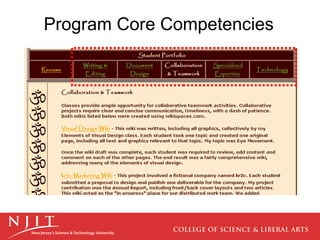
Elements of Design – NJIT – PTC605 Program already requires an ePortfolio   which is developed in a number of the courses including 605 Student blog collects reflections on the elements, modules, projects and their own work and is also a design tool and  a product itself for core competencies of web & document design, writing & technical expertise
A Quick Look: Sample ePortfolios
Program Core Competencies
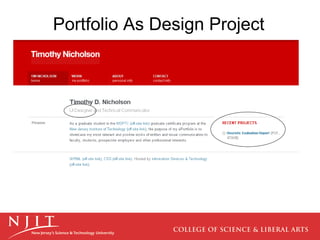
Portfolio As Design Project
Portfolio To Demo Expertise
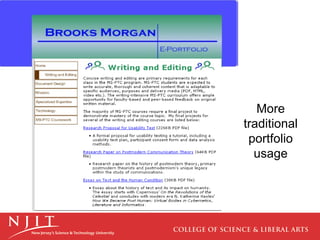
More traditional portfolio usage
Sample Student Blogs
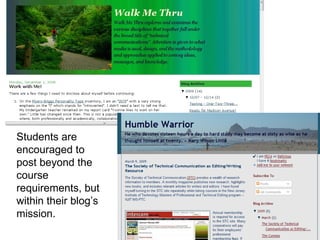
Students are encouraged to post beyond the course requirements, but within their blog’s mission.
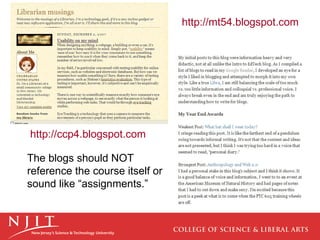
http://mt54.blogspot.com http://ccp4.blogspot.com   The blogs should NOT reference the course itself or sound like “assignments.”
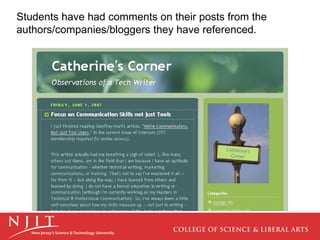
Students have had comments on their posts from the authors/companies/bloggers they have referenced.
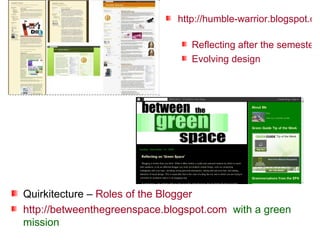
http://humble-warrior.blogspot.com   Reflecting after the semester Evolving design Quirkitecture –  Roles of the Blogger http://betweenthegreenspace.blogspot.com   with a green mission
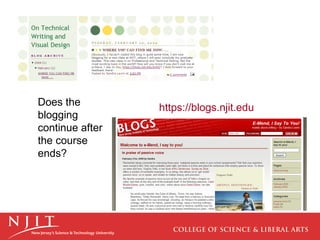
https://blogs.njit.edu   Does the blogging continue after the course ends?
Lessons From Reflection Why are you blogging? (Is it just coursework?) Blogs need a “mission statement” that shows the  intent  of the blog and helps establish your  audience ?  an ideal reader    your emerging audience needs Your blog will find an audience but you can also help an audience find you. Citation, copyright, IP   issues   
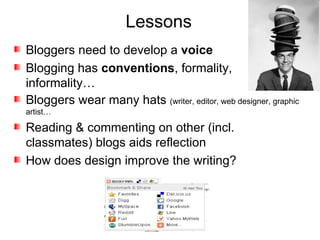
Lessons Bloggers need to develop a  voice Blogging has  conventions , formality, informality… Bloggers wear many hats  (writer, editor, web designer, graphic artist… Reading & commenting on other (incl. classmates) blogs aids reflection How does design improve the writing?
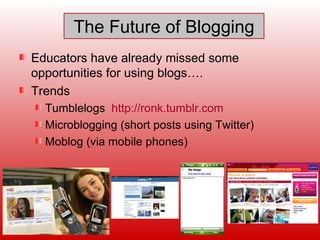
The Future of Blogging Educators have already missed some opportunities for using blogs…. Trends Tumblelogs  http://ronk.tumblr.com   Microblogging (short posts using Twitter) Moblog (via mobile phones)
Shameless Self-Promotion Save the Date : Tuesday, April 7, 2009 Better Writers, Not Just Better Writing: Online Strategies to Support Writers in All Disciplines  Location:  Metro Writing Studio at the Metropolitan Campus of FDU in Teaneck, NJ (no fee!) This hands-on workshop will take participants through the process of planning, developing, designing, and delivering online writing resources to support students across the disciplines. Ellen Spaldo , Director of Writing, Fairleigh Dickinson University;  Janet Boyd , Coordinator, Metro Writing Studio, FDU;  Kenneth Ronkowitz , Director, Writing Initiative, Passaic County Community College;  Elizabeth Nesius , Coordinator of the Writing Center, PCCC http://www.njedge.net/activities
Teachers of Writing Should Write and… Teachers who use blogging in class… Some of my blogging can be accessed via this aggregator  http://ronk.tumblr.com   http://dl.njit.edu/serendipity/   is  Serendipity35  on learning and technology http://poetsonline.blogspot.com   is a companion blog to a poetry website at  poetsonline.org
Starting Out With Your Students
WRITERS AS READERS Reading & Subscribing to Blogs  Using RSS and services that aggregate your subscriptions in one place.  Bloglines.com or Google Reader  allow you to pull blogs that you have subscribed to and show you unread entries in one place You can browse their directories in different categories and see what is popular. All it takes to add a site is a click.
Blog Hosting Services FREE  blogger.com (from Google) or livejournal.com,  wordpress.com edublogs.org -  ad-free WordPress blog incl. free assessment tool from the Chalkface Project and an ad-free wikispace   Services like ning.com offer blogs + social networking features Students may be already familiar with sites such as MySpace.com or Vox.com which offer “blogging” Paid services such as typepad.com Does your school offer a blogging platform? (including Moodle and CMS tools)
Blogosphere Conventions To Address Regular posting Hyperlinks to additional materials & sources References to other blogs via links Less formal writing style? Allowing/encouraging comments, interaction and sharing of content
Professionals Blogging & Profe $$ ional Blogging Google  http://googleblog.blogspot.com/ Sun Microsystem's offers blogs to "any Sun employee to write about anything"  http://blogs.sun.com   Microsoft has several public product blogs  http://blogs.msdn.com/ie/   http://www.nytimes.com/ref/topnews/blog-index.html   The  Times  has many writers also blogging. Check at  http://technorati.com/pop/blogs/
Ken Ronkowitz Director, Writing Initiative [email_address]

Using Student Blogs As Reflective Practice

  • 1.
    Using Student Blogs As Reflective Practice Ken Ronkowitz NJIT PCCC
  • 2.
    This presentation isavailable online at: http://www.slideshare.net/ronko4 Additional information on reflective practices http:// dl.njit.edu /serendipity
  • 3.
    The progression inthe past decade of blogs from personal web journals to a platform for established professionals, corporations and writers has also created opportunities for education. The Evolution of Blogs
  • 4.
    Quick History Precursors: Usenet, Genie, CompuServe and Bulletin Board Systems and 1990s Internet forums with threaded conversations "weblog" 1997 "blog" used as noun and verb "blogger" was Pyra Labs’ Blogger product (acquired by Google). From eMarketer (May 2008) 94.1 million US blog readers in 2007 (50% of Internet users) 22.6 million US bloggers in 2007 (12%)
  • 5.
    Blogs Are TypicallyA web site, usually maintained by an individual with regular entries of commentary, descriptions of events, or other material such as graphics or video. Entries are commonly displayed in reverse-chronological order. personal “diary” or public forum on a topic (politics, hobby, research...)
  • 6.
    Blogs In EducationMuch discussion & research focuses on them as a technology a “portfolio” a “web 2.0” way of addressing traditional writing practices a way to add discussion (commenting) to writing a method to give writers an audience (worldwide)
  • 7.
    This Presentation looksat my use of blogs with graduate students at NJIT since 2007 as a method for generating regular student reflection on their learning.
  • 8.
    Some Uses ofBlogs in Education WRITING BLOGS ePortfolios Group discussion Class journals Personal journaling Instructor blogs, discipline-specific (professional practice) Course information Links blog for course READING BLOGS Instructor’s blog(s) Shared blog reading list Discipline reader (blogs & RSS) Student blogs as coursework More at http://www.edtechpost.ca/gems/matrix2.gif Not all schools have access to the tools  
  • 9.
    Blogs Offer Students& Teachers online discussion (time-stamped comments) video posting (vlog) podcasting platform posting via email & cell phone free web space for class materials minimal web skills required A way to address topics in writing audience, voice, publishing practices, copyright and plagiarism… through authentic writing in a digital medium.
  • 10.
  • 11.
    Reflective Practice introducedby Donald Schön in his book The Reflective Practitioner (1983) a continuous process that involves the learner considering critical incidents in his or her life's experiences. involves thoughtfully considering one's own experiences in applying knowledge to practice while being coached by professionals in the discipline. 
  • 12.
    Reflective Practice Asksyou to reconsider the role of technical knowledge versus "artistry" in developing professional excellence. Used most widely in teacher education, health professions and architectural design. Example: In education, the process of the educator studying his or her own teaching methods. The “art” of teaching vs. the educational psychology textbook. A “meta” activity.
  • 13.
    Portfolios & ReflectionReflection A key element of learning - and of portfolios Many educators who work with portfolios consider the reflection component the most critical element of a good portfolio. Students miss significant benefits of the portfolio process if they are not asked to reflect upon the quality and growth of their work. Making unconscious reflection conscious
  • 14.
    Students Might BeAsked To… comment on why specific samples were selected comment on what they liked /did not like in the samples (not always writing) identify the processes involved in developing specific products or performances describe and point to examples of how specific skills or knowledge improved (or did not) identify strengths and weaknesses set goals corresponding to the strengths & weaknesses & identify strategies for reaching them do self-assessments (task, skill, growth…)
  • 15.
    Elements of Design– NJIT – PTC605 required online grad course in a fully-online MS degree in Professional Technical Communication (and a Grad Certificate program) provides an understanding of and competency in the visual presentation of information design principles, hands-on practice in visual literacy, layout and design, and graphic tools integrates theories of design & composition with the technologies of electronic and print publishing. http://msptc.njit.edu 
  • 16.
    Elements of Design– NJIT – PTC605 Program already requires an ePortfolio which is developed in a number of the courses including 605 Student blog collects reflections on the elements, modules, projects and their own work and is also a design tool and a product itself for core competencies of web & document design, writing & technical expertise
  • 17.
    A Quick Look:Sample ePortfolios
  • 18.
  • 19.
  • 20.
  • 21.
  • 22.
  • 23.
    Students are encouragedto post beyond the course requirements, but within their blog’s mission.
  • 24.
    http://mt54.blogspot.com http://ccp4.blogspot.com The blogs should NOT reference the course itself or sound like “assignments.”
  • 25.
    Students have hadcomments on their posts from the authors/companies/bloggers they have referenced.
  • 26.
    http://humble-warrior.blogspot.com Reflecting after the semester Evolving design Quirkitecture – Roles of the Blogger http://betweenthegreenspace.blogspot.com with a green mission
  • 27.
    https://blogs.njit.edu Does the blogging continue after the course ends?
  • 28.
    Lessons From ReflectionWhy are you blogging? (Is it just coursework?) Blogs need a “mission statement” that shows the intent of the blog and helps establish your audience ? an ideal reader  your emerging audience needs Your blog will find an audience but you can also help an audience find you. Citation, copyright, IP issues 
  • 29.
    Lessons Bloggers needto develop a voice Blogging has conventions , formality, informality… Bloggers wear many hats (writer, editor, web designer, graphic artist… Reading & commenting on other (incl. classmates) blogs aids reflection How does design improve the writing?
  • 30.
    The Future ofBlogging Educators have already missed some opportunities for using blogs…. Trends Tumblelogs http://ronk.tumblr.com Microblogging (short posts using Twitter) Moblog (via mobile phones)
  • 31.
    Shameless Self-Promotion Savethe Date : Tuesday, April 7, 2009 Better Writers, Not Just Better Writing: Online Strategies to Support Writers in All Disciplines Location: Metro Writing Studio at the Metropolitan Campus of FDU in Teaneck, NJ (no fee!) This hands-on workshop will take participants through the process of planning, developing, designing, and delivering online writing resources to support students across the disciplines. Ellen Spaldo , Director of Writing, Fairleigh Dickinson University; Janet Boyd , Coordinator, Metro Writing Studio, FDU; Kenneth Ronkowitz , Director, Writing Initiative, Passaic County Community College; Elizabeth Nesius , Coordinator of the Writing Center, PCCC http://www.njedge.net/activities
  • 32.
    Teachers of WritingShould Write and… Teachers who use blogging in class… Some of my blogging can be accessed via this aggregator http://ronk.tumblr.com http://dl.njit.edu/serendipity/ is Serendipity35 on learning and technology http://poetsonline.blogspot.com is a companion blog to a poetry website at poetsonline.org
  • 33.
    Starting Out WithYour Students
  • 34.
    WRITERS AS READERSReading & Subscribing to Blogs Using RSS and services that aggregate your subscriptions in one place. Bloglines.com or Google Reader allow you to pull blogs that you have subscribed to and show you unread entries in one place You can browse their directories in different categories and see what is popular. All it takes to add a site is a click.
  • 35.
    Blog Hosting ServicesFREE blogger.com (from Google) or livejournal.com, wordpress.com edublogs.org - ad-free WordPress blog incl. free assessment tool from the Chalkface Project and an ad-free wikispace Services like ning.com offer blogs + social networking features Students may be already familiar with sites such as MySpace.com or Vox.com which offer “blogging” Paid services such as typepad.com Does your school offer a blogging platform? (including Moodle and CMS tools)
  • 36.
    Blogosphere Conventions ToAddress Regular posting Hyperlinks to additional materials & sources References to other blogs via links Less formal writing style? Allowing/encouraging comments, interaction and sharing of content
  • 37.
    Professionals Blogging &Profe $$ ional Blogging Google http://googleblog.blogspot.com/ Sun Microsystem's offers blogs to "any Sun employee to write about anything" http://blogs.sun.com Microsoft has several public product blogs http://blogs.msdn.com/ie/ http://www.nytimes.com/ref/topnews/blog-index.html The Times has many writers also blogging. Check at http://technorati.com/pop/blogs/
  • 38.
    Ken Ronkowitz Director,Writing Initiative [email_address]