Inclusive Curriculum Design:IntroORIC - Open Educational Resources for the Inclusive Curriculumhttp://www.oric.brad.ac.ukThis work is licensed under a Creative Commons Attribution-NonCommercial-ShareAlike 3.0 Unported License - http://creativecommons.org/licenses/by-nc-sa/3.0/1
Welcome and introduction.Why bother?Wtructureand assessment.Aims of today.Module intro This work is licensed under a Creative Commons Attribution-NonCommercial-ShareAlike 3.0 Unported License - http://creativecommons.org/licenses/by-nc-sa/3.0/2
Why seek to develop an inclusive curriculum?Enhance the status of learning and teaching.Approach the craft of teaching from analytic and critical perspectives.Work out ways we can all do it better!Welcome and introduction This work is licensed under a Creative Commons Attribution-NonCommercial-ShareAlike 3.0 Unported License - http://creativecommons.org/licenses/by-nc-sa/3.0/3
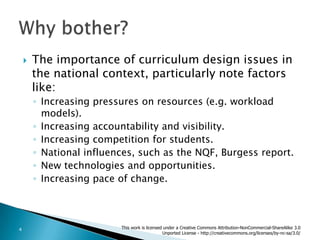
The importance of curriculum design issues in the national context, particularly note factors like:Increasing pressures on resources (e.g. workload models).Increasing accountability and visibility.Increasing competition for students.National influences, such as the NQF, Burgess report.New technologies and opportunities.Increasing pace of change.Why bother? This work is licensed under a Creative Commons Attribution-NonCommercial-ShareAlike 3.0 Unported License - http://creativecommons.org/licenses/by-nc-sa/3.0/4
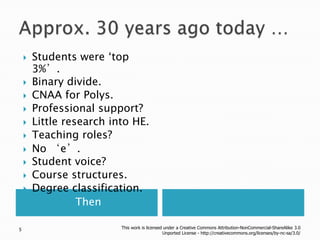
Approx. 30 years ago today …ThenStudents were ‘top 3%’.Binary divide.CNAA for Polys.Professional support?Little research into HE.Teaching roles?No ‘e’.Student voice?Course structures.Degree classification.This work is licensed under a Creative Commons Attribution-NonCommercial-ShareAlike 3.0 Unported License - http://creativecommons.org/licenses/by-nc-sa/3.0/5
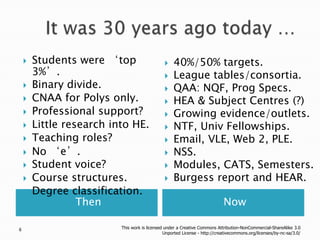
It was 30 years ago today …ThenStudents were ‘top 3%’.Binary divide.CNAA for Polysonly.Professional support?Little research into HE.Teaching roles?No ‘e’.Student voice?Course structures.Degree classification.40%/50% targets.League tables/consortia.QAA: NQF, ProgSpecs.HEA & Subject Centres (?)Growing evidence/outlets.NTF, UnivFellowships.Email, VLE, Web 2, PLE.NSS.Modules, CATS, Semesters.Burgess report and HEAR.NowThis work is licensed under a Creative Commons Attribution-NonCommercial-ShareAlike 3.0 Unported License - http://creativecommons.org/licenses/by-nc-sa/3.0/6
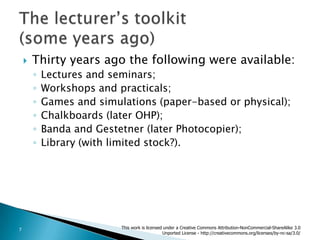
Thirty years ago the following were available:Lectures and seminars;Workshops and practicals;Games and simulations (paper-based or physical);Chalkboards (later OHP);Banda and Gestetner (later Photocopier);Library (with limited stock?).The lecturer’s toolkit (some years ago)This work is licensed under a Creative Commons Attribution-NonCommercial-ShareAlike 3.0 Unported License - http://creativecommons.org/licenses/by-nc-sa/3.0/7
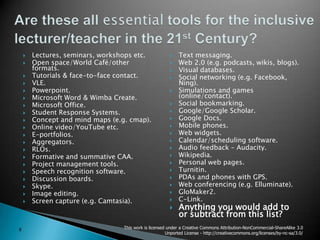
Lectures, seminars, workshops etc.Open space/World Café/other formats.Tutorials & face-to-face contact.VLE.Powerpoint.Microsoft Word & WimbaCreate.Microsoft Office.Student Response Systems.Concept and mind maps (e.g. cmap).Online video/YouTube etc.E-portfolios.Aggregators.RLOs.Formative and summative CAA.Project management tools.Speech recognition software.Discussion boards.Skype.Image editing.Screen capture (e.g. Camtasia).Text messaging.Web 2.0 (e.g. podcasts, wikis, blogs).Visual databases.Social networking (e.g. Facebook, Ning).Simulations and games (online/contact).Social bookmarking.Google/Google Scholar.Google Docs.Mobile phones.Web widgets.Calendar/scheduling software.Audio feedback – Audacity.Wikipedia.Personal web pages.Turnitin.PDAs and phones with GPS.Web conferencing (e.g. Elluminate).GloMaker2.C-Link.Anything you would add toor subtract from this list?Are these all essential tools for the inclusive lecturer/teacher in the 21st Century?This work is licensed under a Creative Commons Attribution-NonCommercial-ShareAlike 3.0 Unported License - http://creativecommons.org/licenses/by-nc-sa/3.0/8
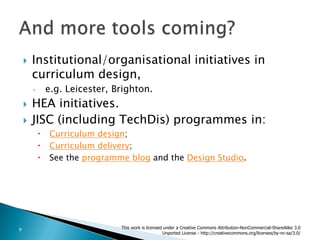
Institutional/organisational initiatives in curriculum design,e.g. Leicester, Brighton.HEA initiatives.JISC (including TechDis) programmes in:Curriculum design;Curriculum delivery;See the programme blog and the Design Studio.And more tools coming?This work is licensed under a Creative Commons Attribution-NonCommercial-ShareAlike 3.0 Unported License - http://creativecommons.org/licenses/by-nc-sa/3.0/9
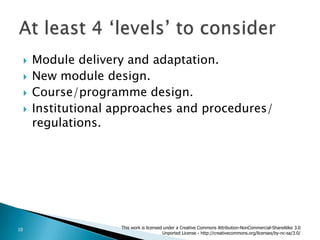
Module delivery and adaptation.New module design.Course/programmedesign.Institutional approaches and procedures/ regulations.At least 4 ‘levels’ to considerThis work is licensed under a Creative Commons Attribution-NonCommercial-ShareAlike 3.0 Unported License - http://creativecommons.org/licenses/by-nc-sa/3.0/10
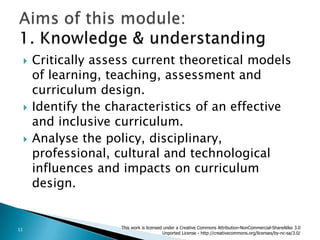
Critically assess current theoretical models of learning, teaching, assessment and curriculum design.Identify the characteristics of an effective and inclusive curriculum.Analyse the policy, disciplinary, professional, cultural and technological influences and impacts on curriculum design.Aims of this module:1. Knowledge & understandingThis work is licensed under a Creative Commons Attribution-NonCommercial-ShareAlike 3.0 Unported License - http://creativecommons.org/licenses/by-nc-sa/3.0/11
Demonstrate an evidence-informed approach to inclusive curriculum design and assessment.Evaluate existing modules in terms of effectiveness and inclusivity for learners.Design an effective and inclusive learning environment.2. Subject-specific Skills  This work is licensed under a Creative Commons Attribution-NonCommercial-ShareAlike 3.0 Unported License - http://creativecommons.org/licenses/by-nc-sa/3.0/12
Demonstrate effective communication and IT skills.3. Personal Transferable Skills  This work is licensed under a Creative Commons Attribution-NonCommercial-ShareAlike 3.0 Unported License - http://creativecommons.org/licenses/by-nc-sa/3.0/13
Are these ‘good’ learning outcomes?And for subsequent discussionHow do the learning outcomes relate to the assessment criteria and to the modes of assessment?Is this module satisfactorily aligned?In the spirit of self-analysis …This work is licensed under a Creative Commons Attribution-NonCommercial-ShareAlike 3.0 Unported License - http://creativecommons.org/licenses/by-nc-sa/3.0/14
Class sessionsLearning SetsBlackboard support: information and resources plus opportunities for questions/discussionOpportunities for individual meetingsStructure This work is licensed under a Creative Commons Attribution-NonCommercial-ShareAlike 3.0 Unported License - http://creativecommons.org/licenses/by-nc-sa/3.0/15
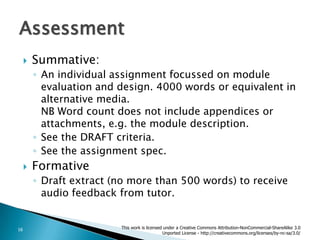
Summative:An individual assignment focussed on module evaluation and design. 4000 words or equivalent in alternative media.NB Word count does not include appendices or attachments, e.g. the module description.See the DRAFT criteria.See the assignment spec.FormativeDraft extract (no more than 500 words) to receive audio feedback from tutor.AssessmentThis work is licensed under a Creative Commons Attribution-NonCommercial-ShareAlike 3.0 Unported License - http://creativecommons.org/licenses/by-nc-sa/3.0/16
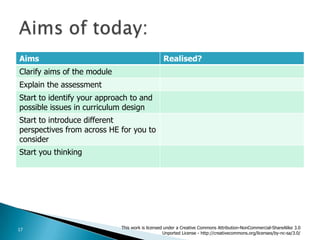
Aims of today: This work is licensed under a Creative Commons Attribution-NonCommercial-ShareAlike 3.0 Unported License - http://creativecommons.org/licenses/by-nc-sa/3.0/17
Each Learning Set:Draw a collective concept map:What are the most important characteristics of curriculum design in UK HE?And the first task:This work is licensed under a Creative Commons Attribution-NonCommercial-ShareAlike 3.0 Unported License - http://creativecommons.org/licenses/by-nc-sa/3.0/18
Each Learning Set:Draw a collective concept map:What are the most important characteristics of curriculum design in UK HE?And then I’ll show you mine!And the first task:This work is licensed under a Creative Commons Attribution-NonCommercial-ShareAlike 3.0 Unported License - http://creativecommons.org/licenses/by-nc-sa/3.0/19

Oric introductory session

  • 1.
    Inclusive Curriculum Design:IntroORIC- Open Educational Resources for the Inclusive Curriculumhttp://www.oric.brad.ac.ukThis work is licensed under a Creative Commons Attribution-NonCommercial-ShareAlike 3.0 Unported License - http://creativecommons.org/licenses/by-nc-sa/3.0/1
  • 2.
    Welcome and introduction.Whybother?Wtructureand assessment.Aims of today.Module intro This work is licensed under a Creative Commons Attribution-NonCommercial-ShareAlike 3.0 Unported License - http://creativecommons.org/licenses/by-nc-sa/3.0/2
  • 3.
    Why seek todevelop an inclusive curriculum?Enhance the status of learning and teaching.Approach the craft of teaching from analytic and critical perspectives.Work out ways we can all do it better!Welcome and introduction This work is licensed under a Creative Commons Attribution-NonCommercial-ShareAlike 3.0 Unported License - http://creativecommons.org/licenses/by-nc-sa/3.0/3
  • 4.
    The importance ofcurriculum design issues in the national context, particularly note factors like:Increasing pressures on resources (e.g. workload models).Increasing accountability and visibility.Increasing competition for students.National influences, such as the NQF, Burgess report.New technologies and opportunities.Increasing pace of change.Why bother? This work is licensed under a Creative Commons Attribution-NonCommercial-ShareAlike 3.0 Unported License - http://creativecommons.org/licenses/by-nc-sa/3.0/4
  • 5.
    Approx. 30 yearsago today …ThenStudents were ‘top 3%’.Binary divide.CNAA for Polys.Professional support?Little research into HE.Teaching roles?No ‘e’.Student voice?Course structures.Degree classification.This work is licensed under a Creative Commons Attribution-NonCommercial-ShareAlike 3.0 Unported License - http://creativecommons.org/licenses/by-nc-sa/3.0/5
  • 6.
    It was 30years ago today …ThenStudents were ‘top 3%’.Binary divide.CNAA for Polysonly.Professional support?Little research into HE.Teaching roles?No ‘e’.Student voice?Course structures.Degree classification.40%/50% targets.League tables/consortia.QAA: NQF, ProgSpecs.HEA & Subject Centres (?)Growing evidence/outlets.NTF, UnivFellowships.Email, VLE, Web 2, PLE.NSS.Modules, CATS, Semesters.Burgess report and HEAR.NowThis work is licensed under a Creative Commons Attribution-NonCommercial-ShareAlike 3.0 Unported License - http://creativecommons.org/licenses/by-nc-sa/3.0/6
  • 7.
    Thirty years agothe following were available:Lectures and seminars;Workshops and practicals;Games and simulations (paper-based or physical);Chalkboards (later OHP);Banda and Gestetner (later Photocopier);Library (with limited stock?).The lecturer’s toolkit (some years ago)This work is licensed under a Creative Commons Attribution-NonCommercial-ShareAlike 3.0 Unported License - http://creativecommons.org/licenses/by-nc-sa/3.0/7
  • 8.
    Lectures, seminars, workshopsetc.Open space/World Café/other formats.Tutorials & face-to-face contact.VLE.Powerpoint.Microsoft Word & WimbaCreate.Microsoft Office.Student Response Systems.Concept and mind maps (e.g. cmap).Online video/YouTube etc.E-portfolios.Aggregators.RLOs.Formative and summative CAA.Project management tools.Speech recognition software.Discussion boards.Skype.Image editing.Screen capture (e.g. Camtasia).Text messaging.Web 2.0 (e.g. podcasts, wikis, blogs).Visual databases.Social networking (e.g. Facebook, Ning).Simulations and games (online/contact).Social bookmarking.Google/Google Scholar.Google Docs.Mobile phones.Web widgets.Calendar/scheduling software.Audio feedback – Audacity.Wikipedia.Personal web pages.Turnitin.PDAs and phones with GPS.Web conferencing (e.g. Elluminate).GloMaker2.C-Link.Anything you would add toor subtract from this list?Are these all essential tools for the inclusive lecturer/teacher in the 21st Century?This work is licensed under a Creative Commons Attribution-NonCommercial-ShareAlike 3.0 Unported License - http://creativecommons.org/licenses/by-nc-sa/3.0/8
  • 9.
    Institutional/organisational initiatives incurriculum design,e.g. Leicester, Brighton.HEA initiatives.JISC (including TechDis) programmes in:Curriculum design;Curriculum delivery;See the programme blog and the Design Studio.And more tools coming?This work is licensed under a Creative Commons Attribution-NonCommercial-ShareAlike 3.0 Unported License - http://creativecommons.org/licenses/by-nc-sa/3.0/9
  • 10.
    Module delivery andadaptation.New module design.Course/programmedesign.Institutional approaches and procedures/ regulations.At least 4 ‘levels’ to considerThis work is licensed under a Creative Commons Attribution-NonCommercial-ShareAlike 3.0 Unported License - http://creativecommons.org/licenses/by-nc-sa/3.0/10
  • 11.
    Critically assess currenttheoretical models of learning, teaching, assessment and curriculum design.Identify the characteristics of an effective and inclusive curriculum.Analyse the policy, disciplinary, professional, cultural and technological influences and impacts on curriculum design.Aims of this module:1. Knowledge & understandingThis work is licensed under a Creative Commons Attribution-NonCommercial-ShareAlike 3.0 Unported License - http://creativecommons.org/licenses/by-nc-sa/3.0/11
  • 12.
    Demonstrate an evidence-informedapproach to inclusive curriculum design and assessment.Evaluate existing modules in terms of effectiveness and inclusivity for learners.Design an effective and inclusive learning environment.2. Subject-specific Skills This work is licensed under a Creative Commons Attribution-NonCommercial-ShareAlike 3.0 Unported License - http://creativecommons.org/licenses/by-nc-sa/3.0/12
  • 13.
    Demonstrate effective communicationand IT skills.3. Personal Transferable Skills This work is licensed under a Creative Commons Attribution-NonCommercial-ShareAlike 3.0 Unported License - http://creativecommons.org/licenses/by-nc-sa/3.0/13
  • 14.
    Are these ‘good’learning outcomes?And for subsequent discussionHow do the learning outcomes relate to the assessment criteria and to the modes of assessment?Is this module satisfactorily aligned?In the spirit of self-analysis …This work is licensed under a Creative Commons Attribution-NonCommercial-ShareAlike 3.0 Unported License - http://creativecommons.org/licenses/by-nc-sa/3.0/14
  • 15.
    Class sessionsLearning SetsBlackboardsupport: information and resources plus opportunities for questions/discussionOpportunities for individual meetingsStructure This work is licensed under a Creative Commons Attribution-NonCommercial-ShareAlike 3.0 Unported License - http://creativecommons.org/licenses/by-nc-sa/3.0/15
  • 16.
    Summative:An individual assignmentfocussed on module evaluation and design. 4000 words or equivalent in alternative media.NB Word count does not include appendices or attachments, e.g. the module description.See the DRAFT criteria.See the assignment spec.FormativeDraft extract (no more than 500 words) to receive audio feedback from tutor.AssessmentThis work is licensed under a Creative Commons Attribution-NonCommercial-ShareAlike 3.0 Unported License - http://creativecommons.org/licenses/by-nc-sa/3.0/16
  • 17.
    Aims of today:This work is licensed under a Creative Commons Attribution-NonCommercial-ShareAlike 3.0 Unported License - http://creativecommons.org/licenses/by-nc-sa/3.0/17
  • 18.
    Each Learning Set:Drawa collective concept map:What are the most important characteristics of curriculum design in UK HE?And the first task:This work is licensed under a Creative Commons Attribution-NonCommercial-ShareAlike 3.0 Unported License - http://creativecommons.org/licenses/by-nc-sa/3.0/18
  • 19.
    Each Learning Set:Drawa collective concept map:What are the most important characteristics of curriculum design in UK HE?And then I’ll show you mine!And the first task:This work is licensed under a Creative Commons Attribution-NonCommercial-ShareAlike 3.0 Unported License - http://creativecommons.org/licenses/by-nc-sa/3.0/19