



















Blogging as Pedagogic Practice Across the Curriculum Ken Ronkowitz Bloomfield College  Faculty Technology Showcase January 2009
Most discussion and research on blogs and teaching and learning in higher education focuses on them as another technological tool.  This session looks at the use of blogging as a way to address traditional writing practices.
OVERVIEW WHY use blogging? WHEN did this begin? WHAT is it being used for in education? HOW do you get started? WHO is doing this? WHERE can I get more information?
- Howard Rheingold,  Participative Pedagogy for a Literacy of  Literacies If print culture shaped the environment in which the Enlightenment blossomed and set the scene for the Industrial Revolution, participatory media might similarly shape the cognitive and social environments in which twenty-first century life will take place (a shift in the way our culture operates). For this reason, participatory media literacy is  not  another subject to be shoehorned into the curriculum as job training for knowledge workers.
Educational Blogging Using college-wide blogging tools or free blogging services, instructors in varied disciplines are addressing: e-portfolios Writing concepts (audience, voice…) Publishing copyright and plagiarism authentic writing writing in a digital age
Those of us striving to integrate participatory media literacy practices into our classes often face resistance.  Other faculty might argue that we are turning away from the foundations of print literacy, or worse, pandering to our tech-obsessed students.   Meanwhile, students might resist too, wondering why they have to learn to use a wiki in an anthropology class.     
The surprising-to-most-people-fact is that  students would prefer less technology in the classroom   - especially participatory technologies that force them to do something other than sit back and memorize material for a regurgitation exercise.   We use social media in the classroom not because our students use it, but because we are afraid that social media might be  using them  - that they are using social media blindly, without recognition of the new challenges and opportunities they might create.  Michael Wesch,  Participatory Media Literacy: Why it matters  on his blog  Digital Ethnography
WHEN
History  "weblog" was coined by Jorn Barger in 1997 and the shortened "blog" Peter Merholz, who jokingly broke the word weblog into the phrase “we blog” on his blog Peterme.com in 1999. Evan Williams at Pyra Labs used "blog" as both a noun and verb and devised the term "blogger" in connection with their Blogger product (acquired by Google). Precursors might include Usenet, online services such as Genie & CompuServe and Bulletin Board Systems. In the 1990s, Internet forum software created running conversations with "threads" - topical connections between messages on a metaphorical "corkboard."
Web + Log = blog A web site, usually maintained by an individual with regular entries of commentary, descriptions of events, or other material such as graphics or video.  Entries are commonly displayed in reverse-chronological order.  personal “diary” or public forum on a topic (politics, hobby, research...) corporate and commercial blogs http://technorati.com/pop/blogs/
Reading Blogs According to 2006 survey by the Pew Internet and American Life Project 39% of Internet users (57 million American adults) said they read blogs An increase of 27% from 2004 Universal McCann (March 2008) determined that there are 184 million blogs worldwide and 26.4 million are in the United States.  Blog readers = 346 million worldwide with 60.3 million being Americans.  77% of active Internet users report that they read blogs.
Where are blogs headed? Tumblelogs  http://ronk.tumblr.com   Microblogging (short posts using Twitter) Moblog (via mobile phones)  It may already be too late to save blogging in education….
WHAT
http://www.edtechpost.ca/gems/matrix2.gif
Blogs Offer Students & Teachers online discussion through time-stamped comments video posting (vlog)  podcasting posting via email & cell phone free web space for class materials, portfolios, projects minimal web design skills required
Blogs being used as... Hypertext Journalism (politics) & convergence journalism (NY Times) Promotional tool – corporate, product blogs Community of interest – poets, software (non-corporate) Personal writing  Media delivery– Vlog (Video), Photolog, linklog, sketchlog (artist portfolio), podcasting
Early Lessons Your blog should have a basic “mission statement” or “about” that shows the  intent  of the blog Who is your  audience ?  an ideal reader & your emerging audience needs Developing a  voice Conventions, formality Citation, copyright
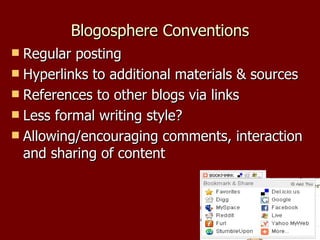
Blogosphere Conventions Regular posting Hyperlinks to additional materials & sources References to other blogs via links Less formal writing style? Allowing/encouraging comments, interaction and sharing of content
WRITERS AS READERS Reading & Subscribing to Blogs  Using RSS and services that aggregate your subscriptions in one place.  Bloglines.com or Google Reader  allow you to pull blogs that you have subscribed to and show you unread entries in one place You can browse their directories in different categories and see what is popular. All it takes to add a site is a click.
HOW
Getting Started - Blog Hosts FREE  blogger.com (from Google) and  livejournal.com,  wordpress.com edublogs.org -  Create your own ad-free fully featured WordPress blog including free assessment tool from the Chalkface Project and an ad-free wikispace   Students may be familiar with sites such as MySpace.com, Vox.com which offer blogging. And paid services such as typepad.com
Many Styles & Templates Offered
WHO
Elements of Design - NJIT Blog as writing portfolio Reflections on course modules A tool for web design
http://globonautenglish.blogspot.com/ http://walkmethru.blogspot.com/ http://quirkitecture.blogspot.com/
BLOGGING FOR DOLLARS:   AN ENGAGING STUDENT ACTIVITY by  Jonathan Goodman, FDU
Premise: Online Advertising Dollars In 2006, advertisers spent $16.9 billion on-line, up steadily each year from $6 billion in 2002. According to the Internet Advertising Bureau In the first half of 2007, on-line advertising reached nearly $10 billion, a nearly 27 percent increase over the first half of 2006.
His Blog Project Students built individual blogs. Subjects chosen by students ranged from horticulture to who is hotter. Installed Google advertising application Installed Google analytics program Installed AddThis button for easy submission of data to websites. Discussed Google Alerts.
16 Students – 11 Seniors, 2 Juniors, 2 Sophomore, 1 Non-Matriculated Majority Majors: Entrepreneurial Studies, Communication, Management No Previous Blog Experience
Top Performer Posted 31 times throughout semester Primary Focus – Hot or Not 257 Visitors 673 Page Views Average Time on Site: 3:46 Bounce Rate: 55.25% - Refers to the number of visitors who only go to home page and then leave. New Visitors: 36.19% - Momentum of interest by return viewers. $6.84 Advertising Revenue Top Five Countries: United States, Israel, Australia, United Kingdom, Canada Top US States: NJ, NY, PA, CA, VA Top NJ Towns: South Orange, Short Hills, Livingston, Summit, East Orange Traffic: Direct, Blogger, Facebook
WHERE
Colleges Blogging As Marketing http://mylife.udayton.edu   www.clarkson.edu/clarkson_experience/blogs   Ball State University  http://www.bsu.edu/reallife   St. Thomas (Minnesota)  www.stthomas.edu/admis/undergraduate/blogs /   University of Vermont  http:// adms.blog.uvm.edu University of Sydney  http://blogs.usyd.edu.au/sydneylife/   http:// archinect.com   collects blogs by architecture students at schools all over the world.
Corporate Blogging Google  http:// googleblog.blogspot.com / Sun Microsystem's offers blogs to "any Sun employee to write about anything"  http://blogs.sun.com   Microsoft has several public product blogs  http://blogs.msdn.com/ie/   http://www.nytimes.com/ref/topnews/blog-index.html   The  Times  has many writers also blogging.
Two of My Own Blogs http://dl.njit.edu/serendipity/   Serendipity35 on learning and technology http://poetsonline.blogspot.com   companion blog to a website for poetry at  poetsonline.org
CONTACT Ken Ronkowitz [email_address]

Blogging As Pedagogic Practice Across the Curriculum

  • 1.
    Blogging as PedagogicPractice Across the Curriculum Ken Ronkowitz Bloomfield College  Faculty Technology Showcase January 2009
  • 2.
    Most discussion andresearch on blogs and teaching and learning in higher education focuses on them as another technological tool. This session looks at the use of blogging as a way to address traditional writing practices.
  • 3.
    OVERVIEW WHY useblogging? WHEN did this begin? WHAT is it being used for in education? HOW do you get started? WHO is doing this? WHERE can I get more information?
  • 4.
    - Howard Rheingold, Participative Pedagogy for a Literacy of Literacies If print culture shaped the environment in which the Enlightenment blossomed and set the scene for the Industrial Revolution, participatory media might similarly shape the cognitive and social environments in which twenty-first century life will take place (a shift in the way our culture operates). For this reason, participatory media literacy is not another subject to be shoehorned into the curriculum as job training for knowledge workers.
  • 5.
    Educational Blogging Usingcollege-wide blogging tools or free blogging services, instructors in varied disciplines are addressing: e-portfolios Writing concepts (audience, voice…) Publishing copyright and plagiarism authentic writing writing in a digital age
  • 6.
    Those of usstriving to integrate participatory media literacy practices into our classes often face resistance.  Other faculty might argue that we are turning away from the foundations of print literacy, or worse, pandering to our tech-obsessed students.  Meanwhile, students might resist too, wondering why they have to learn to use a wiki in an anthropology class.    
  • 7.
    The surprising-to-most-people-fact isthat students would prefer less technology in the classroom - especially participatory technologies that force them to do something other than sit back and memorize material for a regurgitation exercise.  We use social media in the classroom not because our students use it, but because we are afraid that social media might be using them - that they are using social media blindly, without recognition of the new challenges and opportunities they might create. Michael Wesch, Participatory Media Literacy: Why it matters on his blog Digital Ethnography
  • 8.
  • 9.
    History "weblog"was coined by Jorn Barger in 1997 and the shortened "blog" Peter Merholz, who jokingly broke the word weblog into the phrase “we blog” on his blog Peterme.com in 1999. Evan Williams at Pyra Labs used "blog" as both a noun and verb and devised the term "blogger" in connection with their Blogger product (acquired by Google). Precursors might include Usenet, online services such as Genie & CompuServe and Bulletin Board Systems. In the 1990s, Internet forum software created running conversations with "threads" - topical connections between messages on a metaphorical "corkboard."
  • 10.
    Web + Log= blog A web site, usually maintained by an individual with regular entries of commentary, descriptions of events, or other material such as graphics or video. Entries are commonly displayed in reverse-chronological order. personal “diary” or public forum on a topic (politics, hobby, research...) corporate and commercial blogs http://technorati.com/pop/blogs/
  • 11.
    Reading Blogs Accordingto 2006 survey by the Pew Internet and American Life Project 39% of Internet users (57 million American adults) said they read blogs An increase of 27% from 2004 Universal McCann (March 2008) determined that there are 184 million blogs worldwide and 26.4 million are in the United States. Blog readers = 346 million worldwide with 60.3 million being Americans. 77% of active Internet users report that they read blogs.
  • 12.
    Where are blogsheaded? Tumblelogs http://ronk.tumblr.com Microblogging (short posts using Twitter) Moblog (via mobile phones) It may already be too late to save blogging in education….
  • 13.
  • 14.
  • 15.
    Blogs Offer Students& Teachers online discussion through time-stamped comments video posting (vlog) podcasting posting via email & cell phone free web space for class materials, portfolios, projects minimal web design skills required
  • 16.
    Blogs being usedas... Hypertext Journalism (politics) & convergence journalism (NY Times) Promotional tool – corporate, product blogs Community of interest – poets, software (non-corporate) Personal writing Media delivery– Vlog (Video), Photolog, linklog, sketchlog (artist portfolio), podcasting
  • 17.
    Early Lessons Yourblog should have a basic “mission statement” or “about” that shows the intent of the blog Who is your audience ? an ideal reader & your emerging audience needs Developing a voice Conventions, formality Citation, copyright
  • 18.
    Blogosphere Conventions Regularposting Hyperlinks to additional materials & sources References to other blogs via links Less formal writing style? Allowing/encouraging comments, interaction and sharing of content
  • 19.
    WRITERS AS READERSReading & Subscribing to Blogs Using RSS and services that aggregate your subscriptions in one place. Bloglines.com or Google Reader allow you to pull blogs that you have subscribed to and show you unread entries in one place You can browse their directories in different categories and see what is popular. All it takes to add a site is a click.
  • 20.
  • 21.
    Getting Started -Blog Hosts FREE blogger.com (from Google) and livejournal.com, wordpress.com edublogs.org - Create your own ad-free fully featured WordPress blog including free assessment tool from the Chalkface Project and an ad-free wikispace Students may be familiar with sites such as MySpace.com, Vox.com which offer blogging. And paid services such as typepad.com
  • 22.
    Many Styles &Templates Offered
  • 23.
  • 24.
    Elements of Design- NJIT Blog as writing portfolio Reflections on course modules A tool for web design
  • 25.
  • 26.
    BLOGGING FOR DOLLARS: AN ENGAGING STUDENT ACTIVITY by Jonathan Goodman, FDU
  • 27.
    Premise: Online AdvertisingDollars In 2006, advertisers spent $16.9 billion on-line, up steadily each year from $6 billion in 2002. According to the Internet Advertising Bureau In the first half of 2007, on-line advertising reached nearly $10 billion, a nearly 27 percent increase over the first half of 2006.
  • 28.
    His Blog ProjectStudents built individual blogs. Subjects chosen by students ranged from horticulture to who is hotter. Installed Google advertising application Installed Google analytics program Installed AddThis button for easy submission of data to websites. Discussed Google Alerts.
  • 29.
    16 Students –11 Seniors, 2 Juniors, 2 Sophomore, 1 Non-Matriculated Majority Majors: Entrepreneurial Studies, Communication, Management No Previous Blog Experience
  • 30.
    Top Performer Posted31 times throughout semester Primary Focus – Hot or Not 257 Visitors 673 Page Views Average Time on Site: 3:46 Bounce Rate: 55.25% - Refers to the number of visitors who only go to home page and then leave. New Visitors: 36.19% - Momentum of interest by return viewers. $6.84 Advertising Revenue Top Five Countries: United States, Israel, Australia, United Kingdom, Canada Top US States: NJ, NY, PA, CA, VA Top NJ Towns: South Orange, Short Hills, Livingston, Summit, East Orange Traffic: Direct, Blogger, Facebook
  • 31.
  • 32.
    Colleges Blogging AsMarketing http://mylife.udayton.edu www.clarkson.edu/clarkson_experience/blogs Ball State University http://www.bsu.edu/reallife St. Thomas (Minnesota) www.stthomas.edu/admis/undergraduate/blogs / University of Vermont http:// adms.blog.uvm.edu University of Sydney http://blogs.usyd.edu.au/sydneylife/ http:// archinect.com collects blogs by architecture students at schools all over the world.
  • 33.
    Corporate Blogging Google http:// googleblog.blogspot.com / Sun Microsystem's offers blogs to "any Sun employee to write about anything" http://blogs.sun.com Microsoft has several public product blogs http://blogs.msdn.com/ie/ http://www.nytimes.com/ref/topnews/blog-index.html The Times has many writers also blogging.
  • 34.
    Two of MyOwn Blogs http://dl.njit.edu/serendipity/ Serendipity35 on learning and technology http://poetsonline.blogspot.com companion blog to a website for poetry at poetsonline.org
  • 35.
    CONTACT Ken Ronkowitz[email_address]