Reflective Practice Module 1 Session 2
* Paula Nottingham: note some slides repeated from 2013 presentation to CILIP
Postgraduate Course Feedback
Reflective Practice
“Reflective practice can enable practitioners to
learn from experience about themselves, their
work and the way they relate to home and work,
significant others and wider society and
culture…
It challenges assumptions ideological illusions,
damaging social and cultural biases,
inequalities, and questions personal behaviours
which perhaps silence the choices of others or
otherwise marginalise them” (Bolton, 2010, p.3).
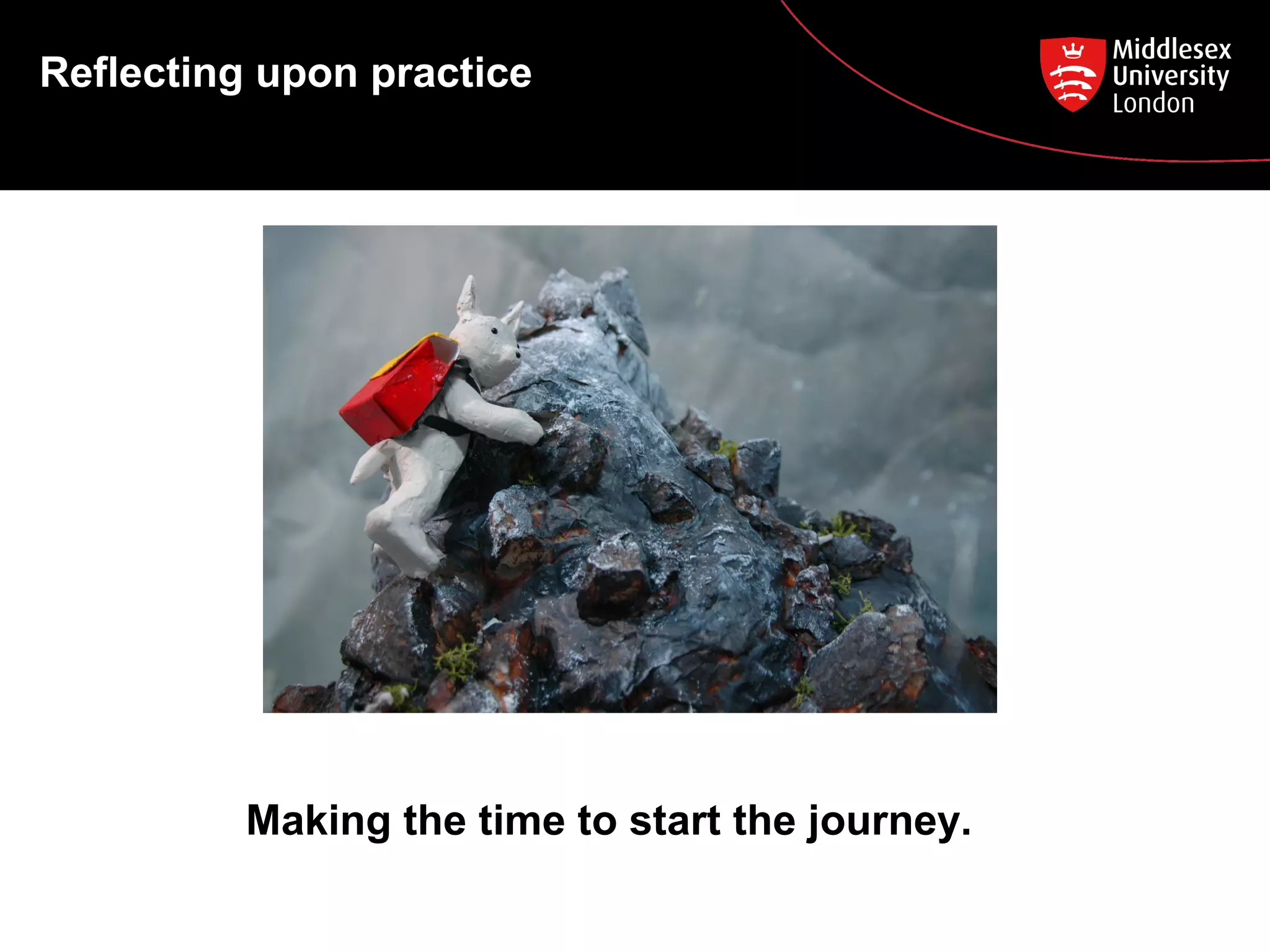
Reflecting upon practice
Making the time to start the journey.
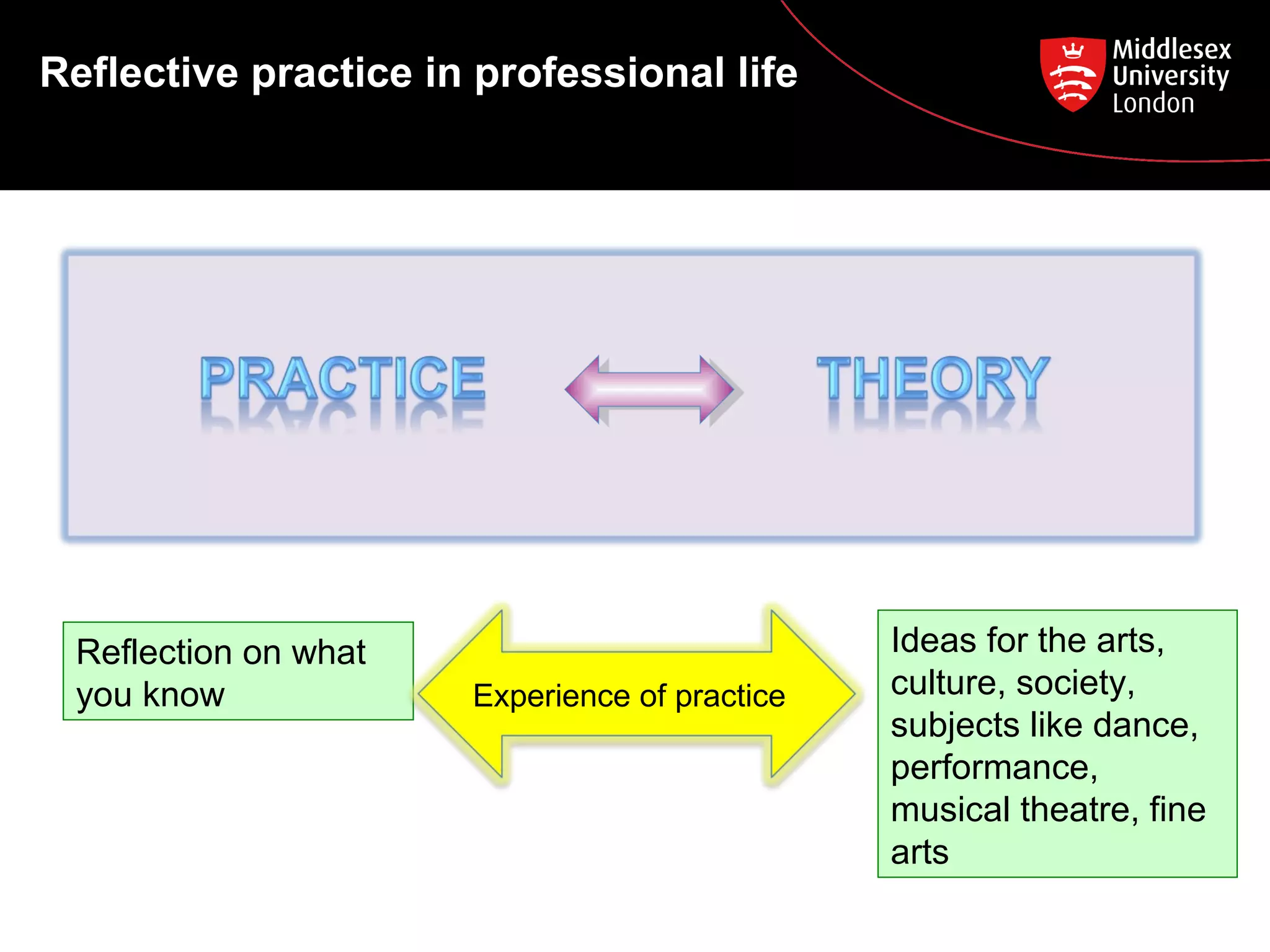
Reflective practice in professional life
Ideas for the arts,
culture, society,
subjects like dance,
performance,
musical theatre, fine
arts
Reflection on what
you know Experience of practice
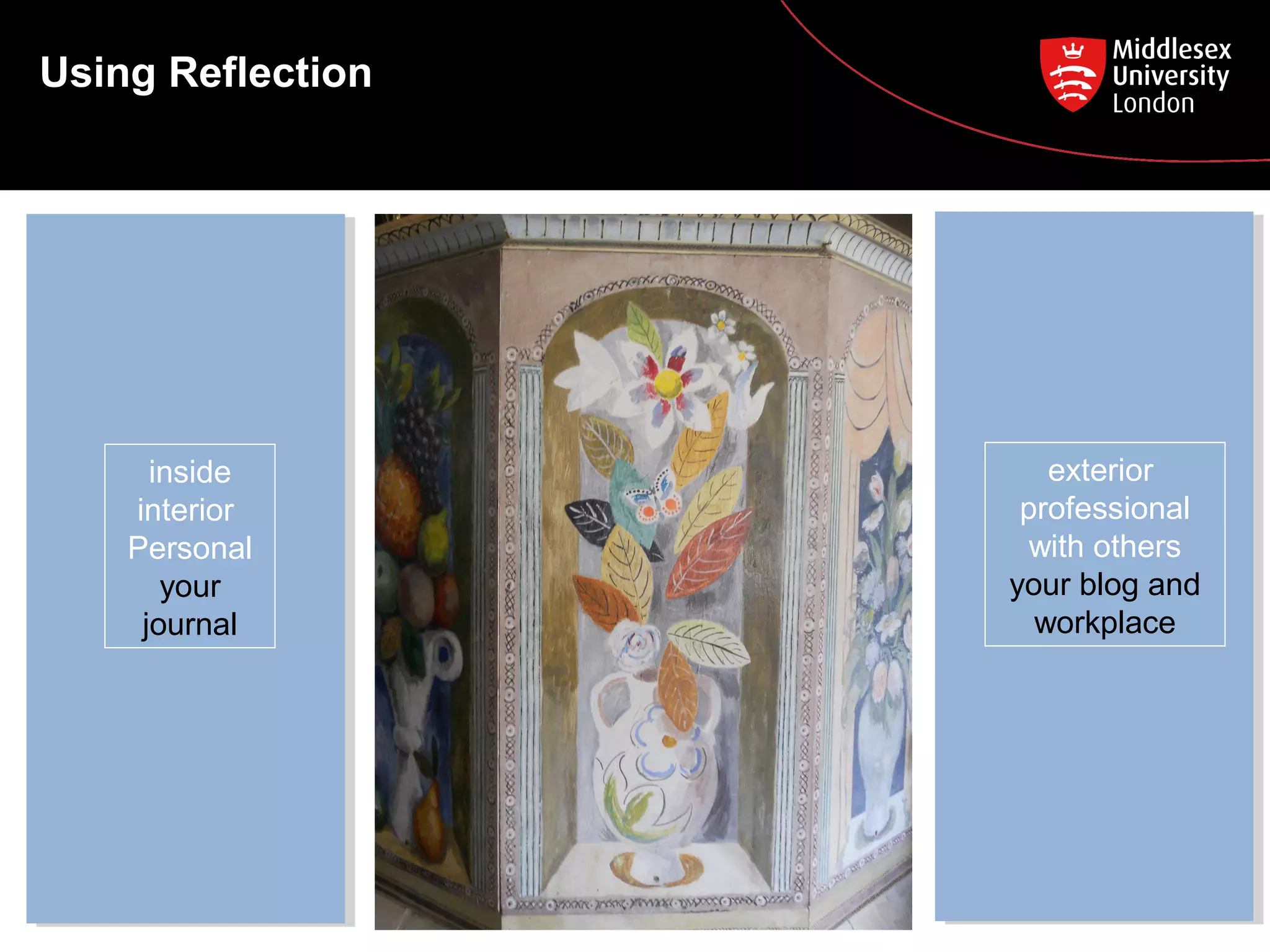
Using Reflection
inside
interior
Personal
your
journal
exterior
professional
with others
your blog and
workplace
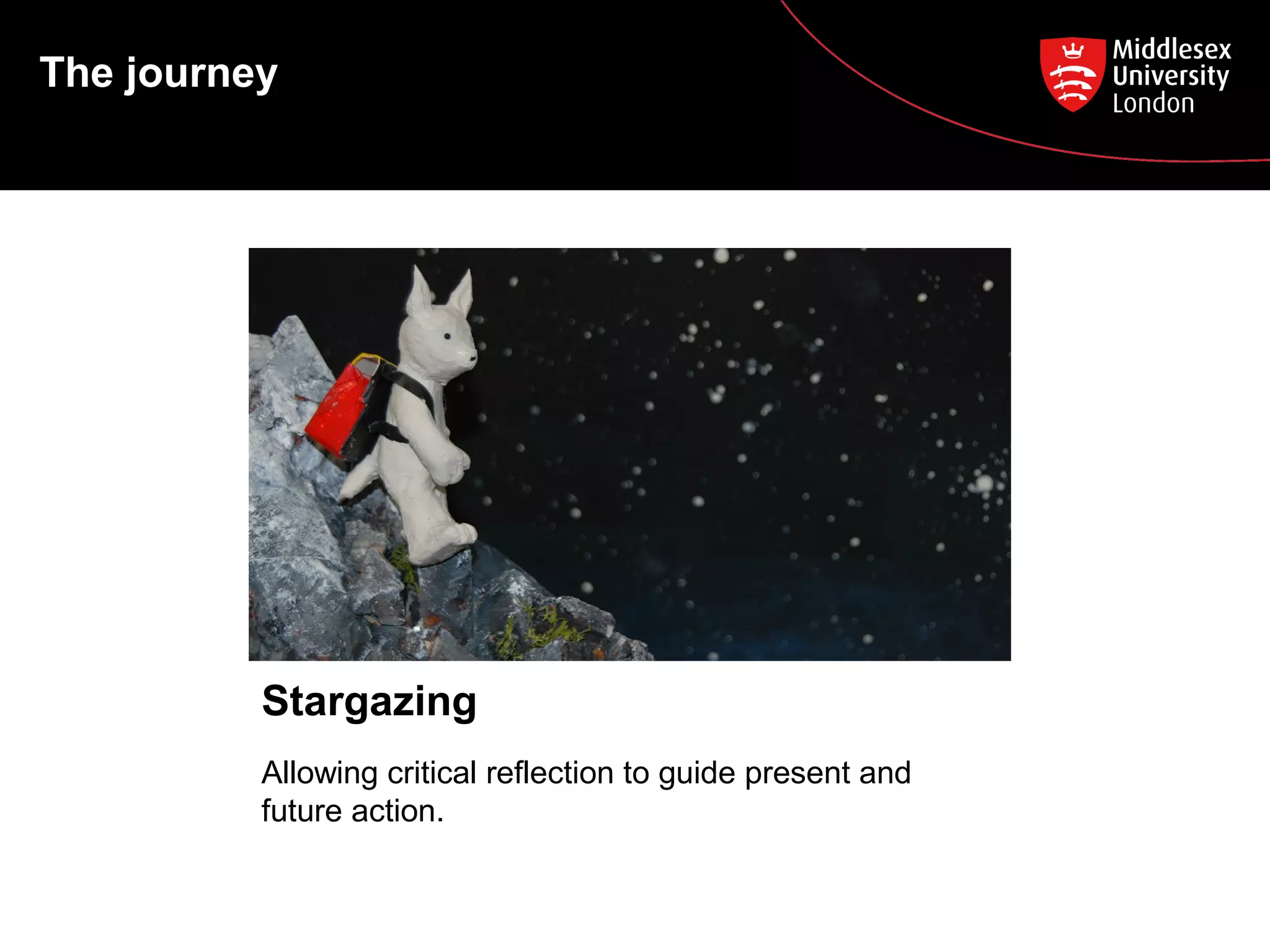
The journey
Allowing critical reflection to guide present and
future action.
Stargazing
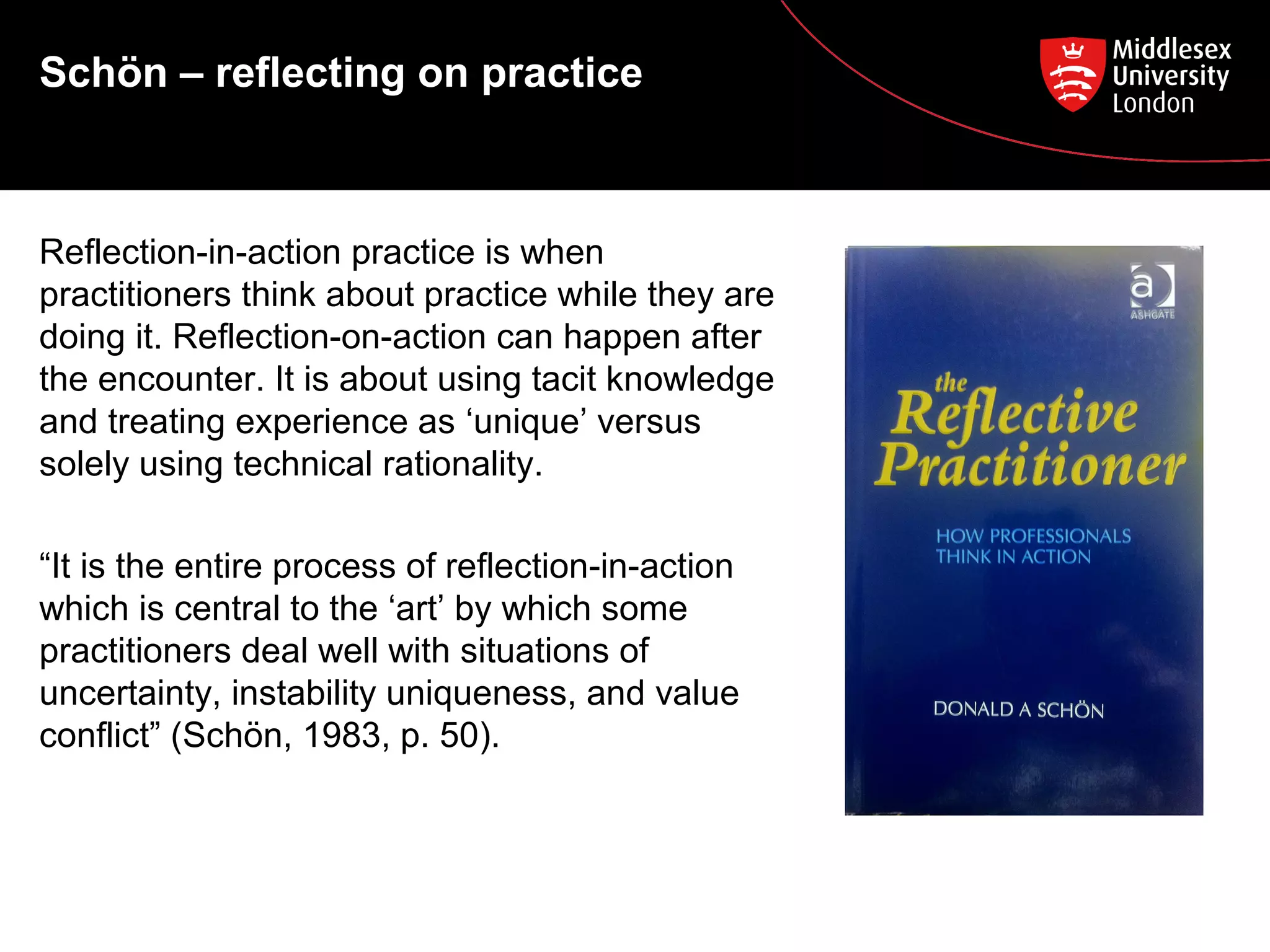
Schön – reflecting on practice
Reflection-in-action practice is when
practitioners think about practice while they are
doing it. Reflection-on-action can happen after
the encounter. It is about using tacit knowledge
and treating experience as ‘unique’ versus
solely using technical rationality.
“It is the entire process of reflection-in-action
which is central to the ‘art’ by which some
practitioners deal well with situations of
uncertainty, instability uniqueness, and value
conflict” (Schön, 1983, p. 50).
Honey and Mumford – how you
learn – one example
We learn in different ways
– Activist - learning by doing
– Reflectors - learning by observing
– Theorist - learning by thinking through in a logical manner
– Pragmatist - learning through putting ideas into practice
and testing them out
“Honey and Alan Mumford developed their learning styles system as a
variation on the Kolb model…” (Infed, 2013, online).
Experiential models for reflection
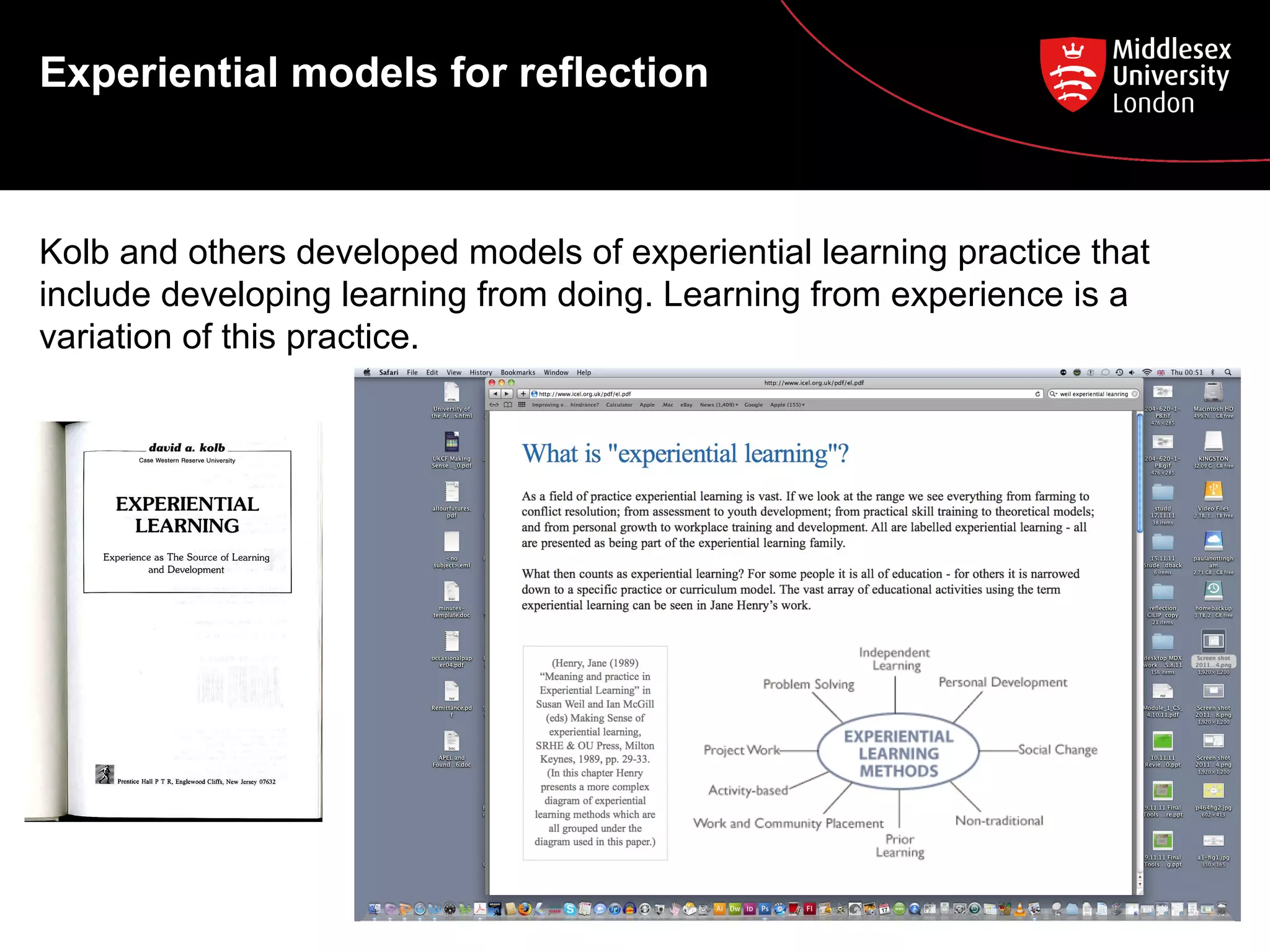
Kolb and others developed models of experiential learning practice that
include developing learning from doing. Learning from experience is a
variation of this practice.
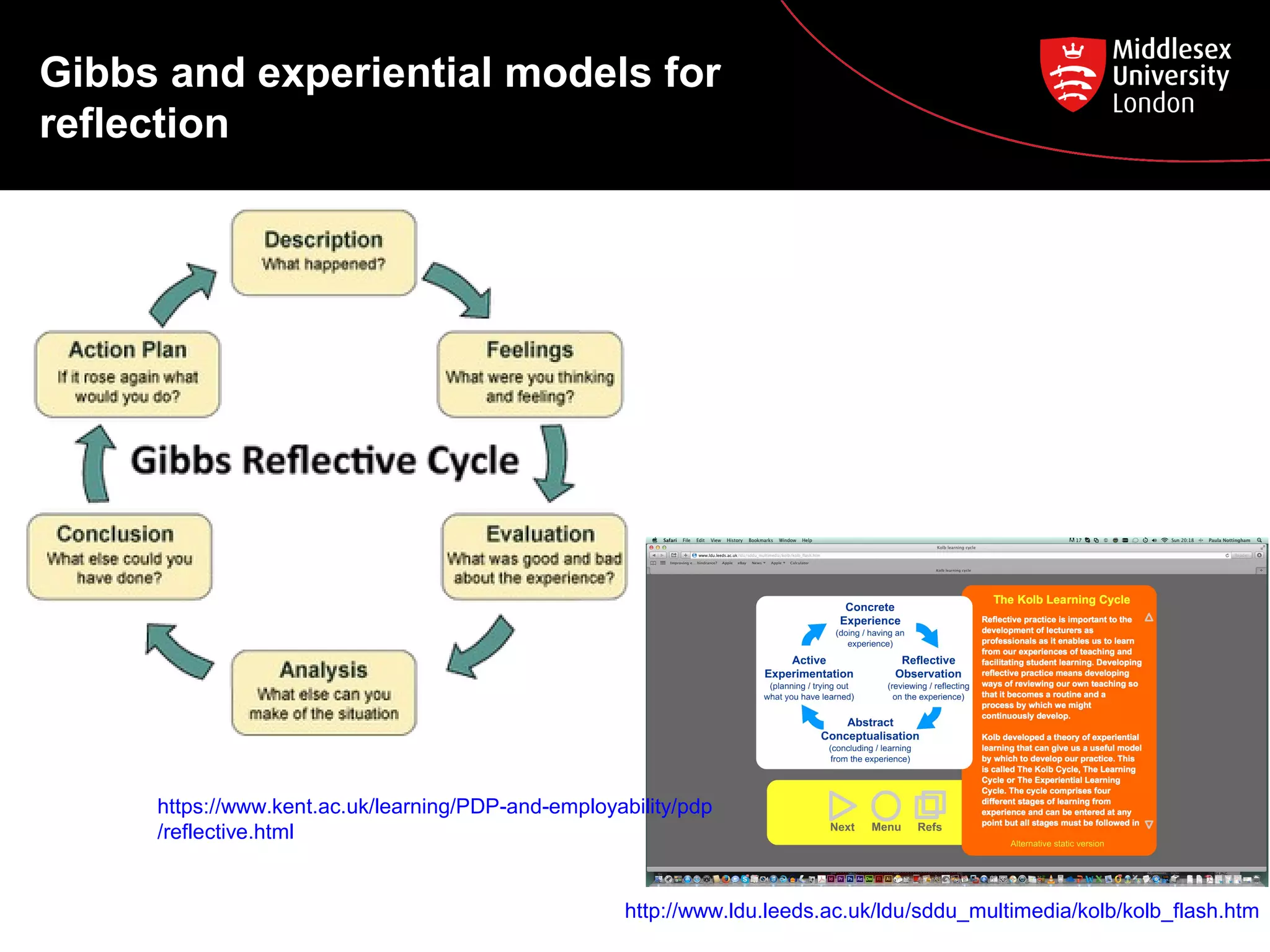
Gibbs and experiential models for
reflection
http://www.ldu.leeds.ac.uk/ldu/sddu_multimedia/kolb/kolb_flash.htm
https://www.kent.ac.uk/learning/PDP-and-employability/pdp
/reflective.html
What is Reflective Practice?
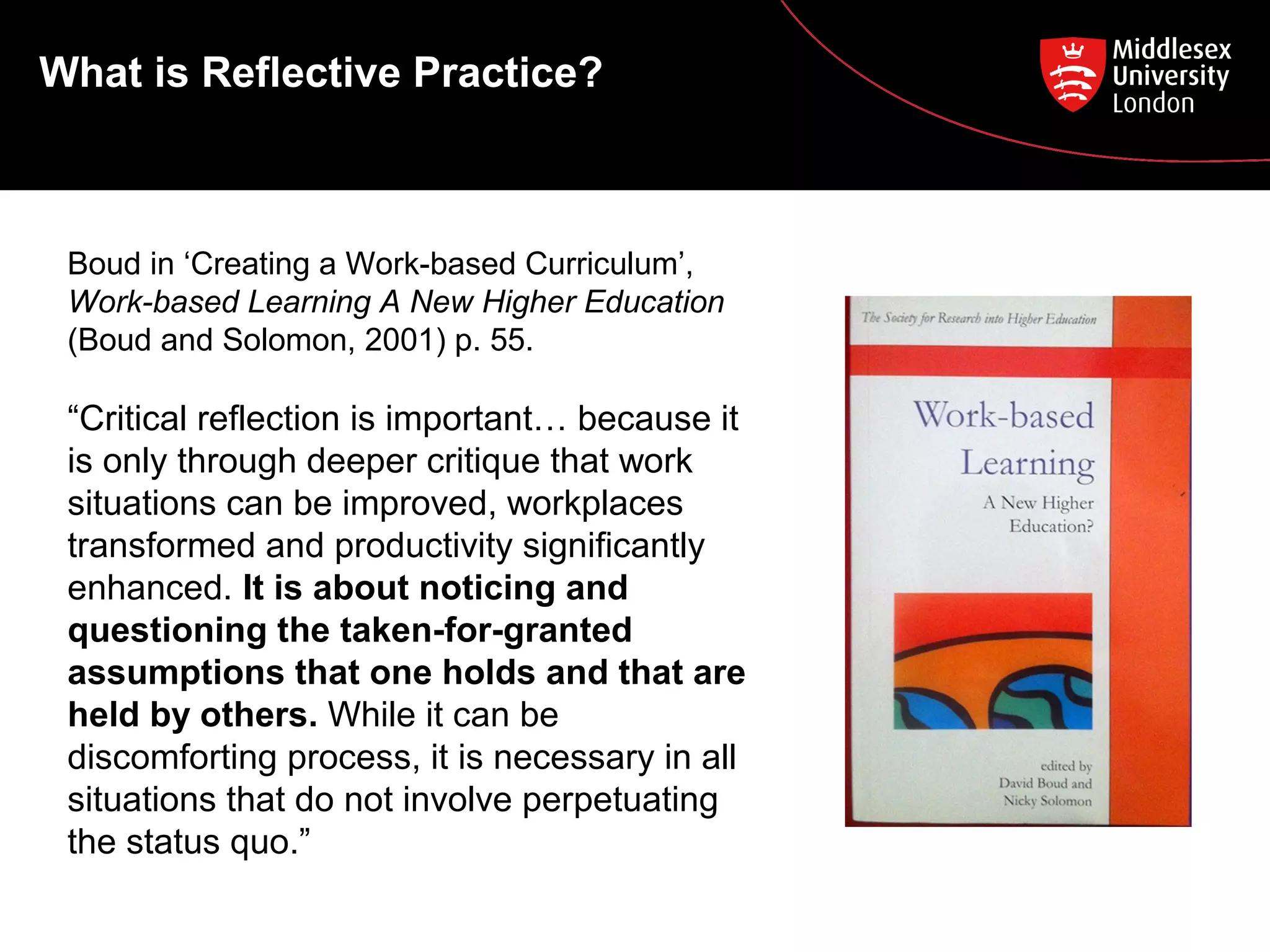
Boud in ‘Creating a Work-based Curriculum’,
Work-based Learning A New Higher Education
(Boud and Solomon, 2001) p. 55.
“Critical reflection is important… because it
is only through deeper critique that work
situations can be improved, workplaces
transformed and productivity significantly
enhanced. It is about noticing and
questioning the taken-for-granted
assumptions that one holds and that are
held by others. While it can be
discomforting process, it is necessary in all
situations that do not involve perpetuating
the status quo.”
Dewey
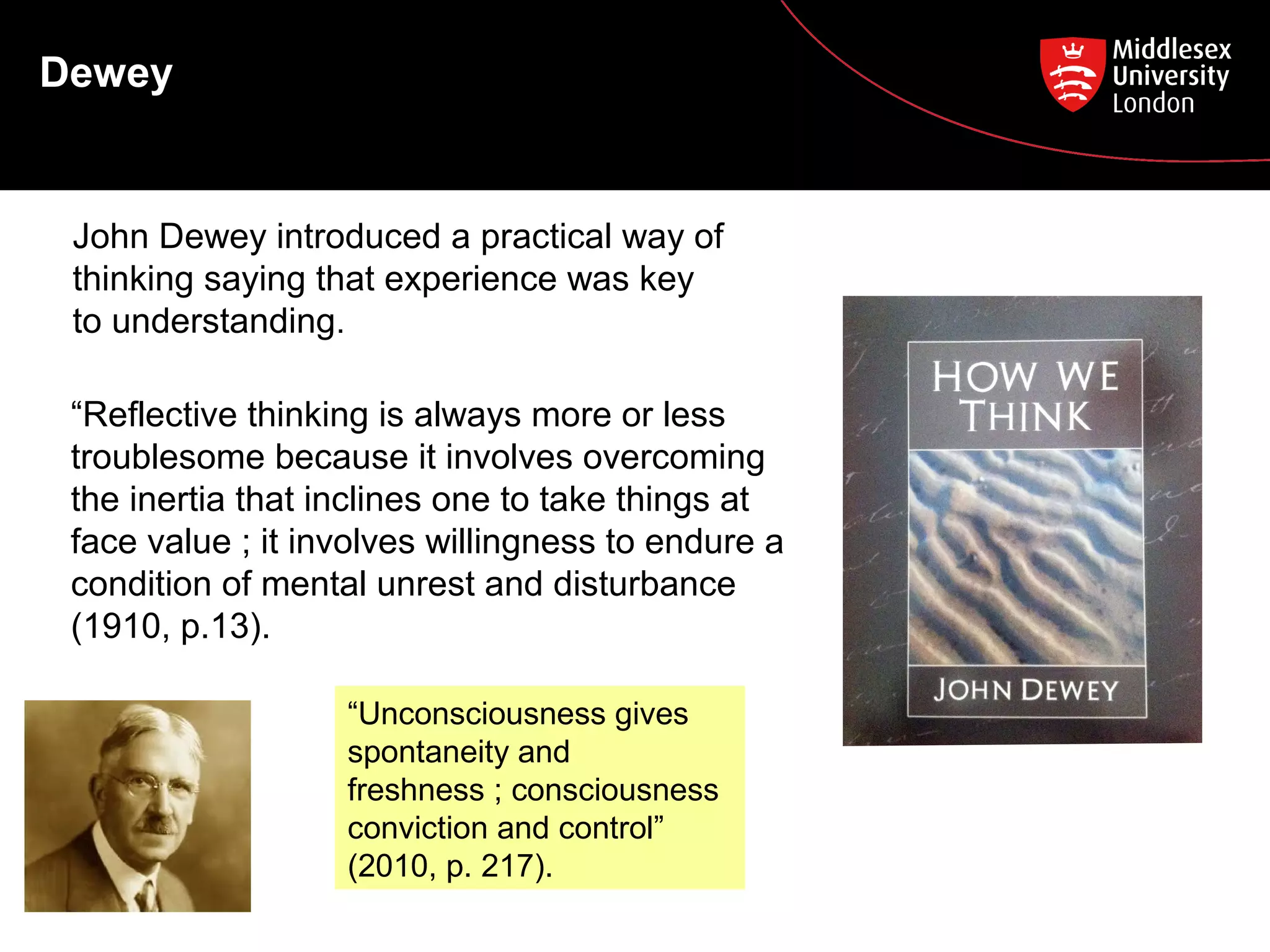
John Dewey introduced a practical way of
thinking saying that experience was key
to understanding.
“Reflective thinking is always more or less
troublesome because it involves overcoming
the inertia that inclines one to take things at
face value ; it involves willingness to endure a
condition of mental unrest and disturbance
(1910, p.13).
“Unconsciousness gives
spontaneity and
freshness ; consciousness
conviction and control”
(2010, p. 217).
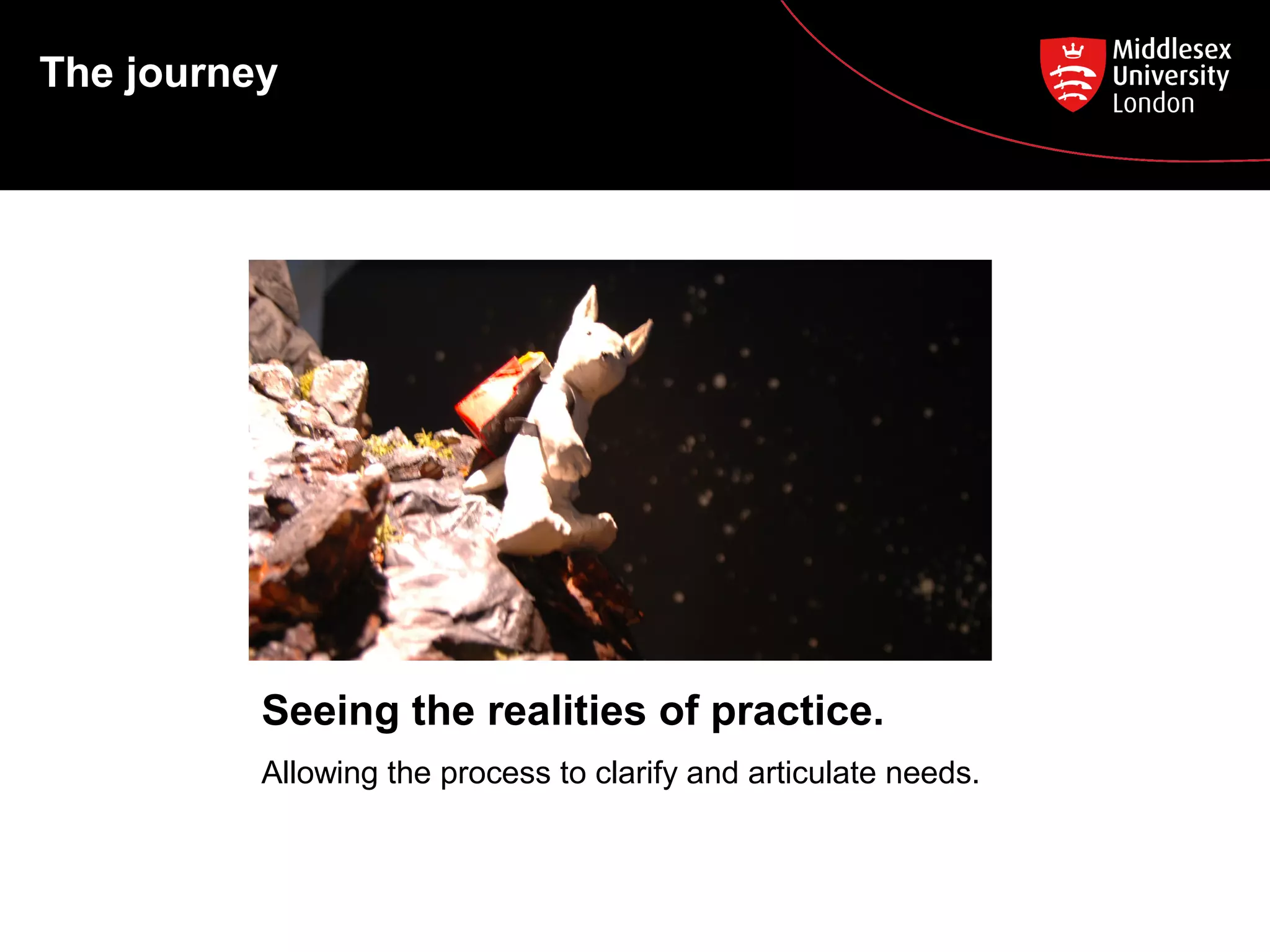
The journey
Seeing the realities of practice.
Allowing the process to clarify and articulate needs.
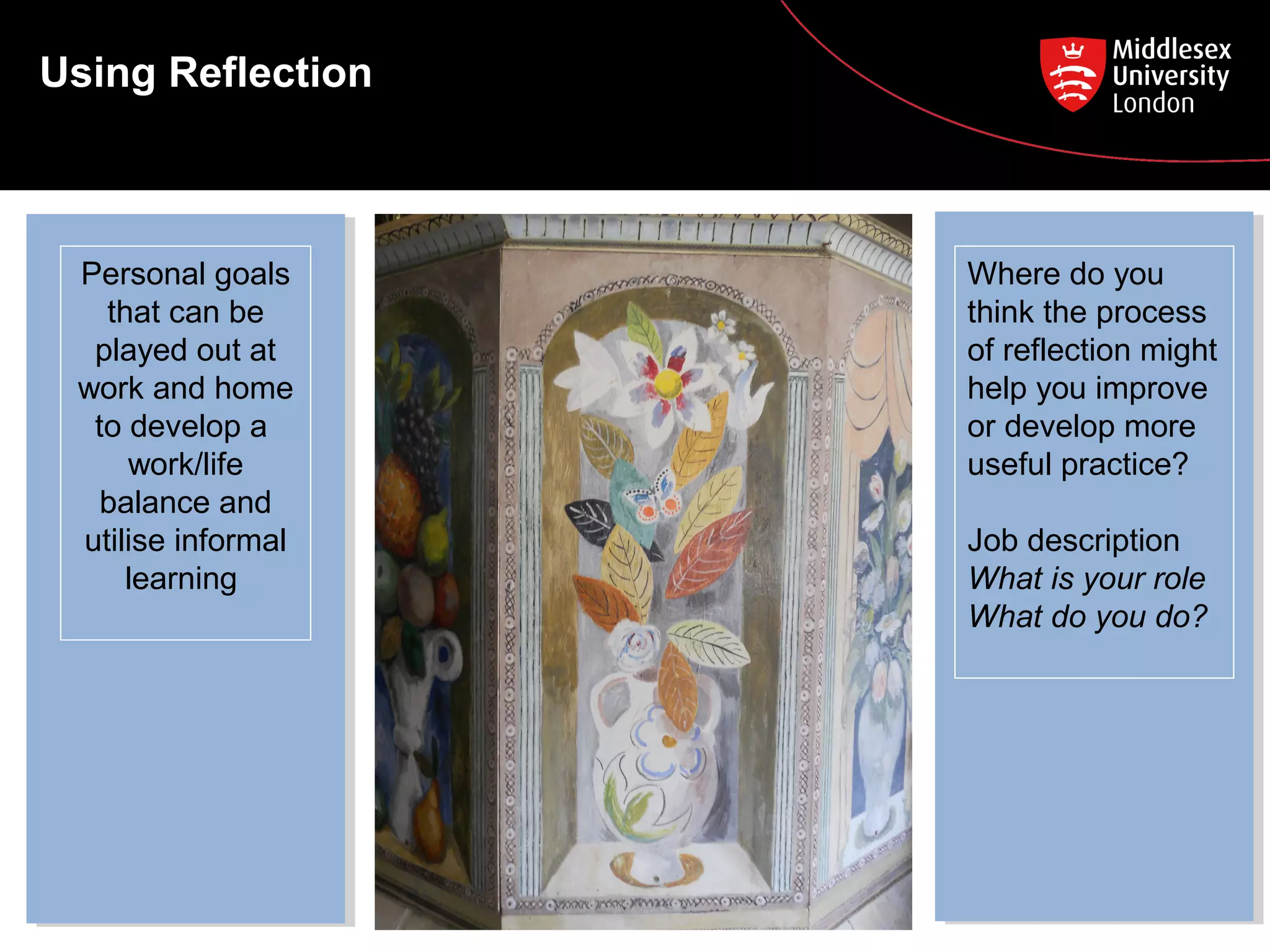
Using Reflection
Personal goals
that can be
played out at
work and home
to develop a
work/life
balance and
utilise informal
learning
Where do you
think the process
of reflection might
help you improve
or develop more
useful practice?
Job description
What is your role
What do you do?
Twyla Thwarp suggests in The Creative
Habit (2003) reflected using her dance
practice (see Reader 2)
Mihaly Csikszenrmihalyi talks about ‘flow’ and
suggests that emersing yourself in a ‘domain’
that you truly love will allow the “foundations for
creativity” to be in place”. (2006)
https://www.ted.com/talks/mihaly_csikszentmihalyi_on_flow?language
=en
Pronounced Chick – sent – me - high
http://www.twylatharp.org
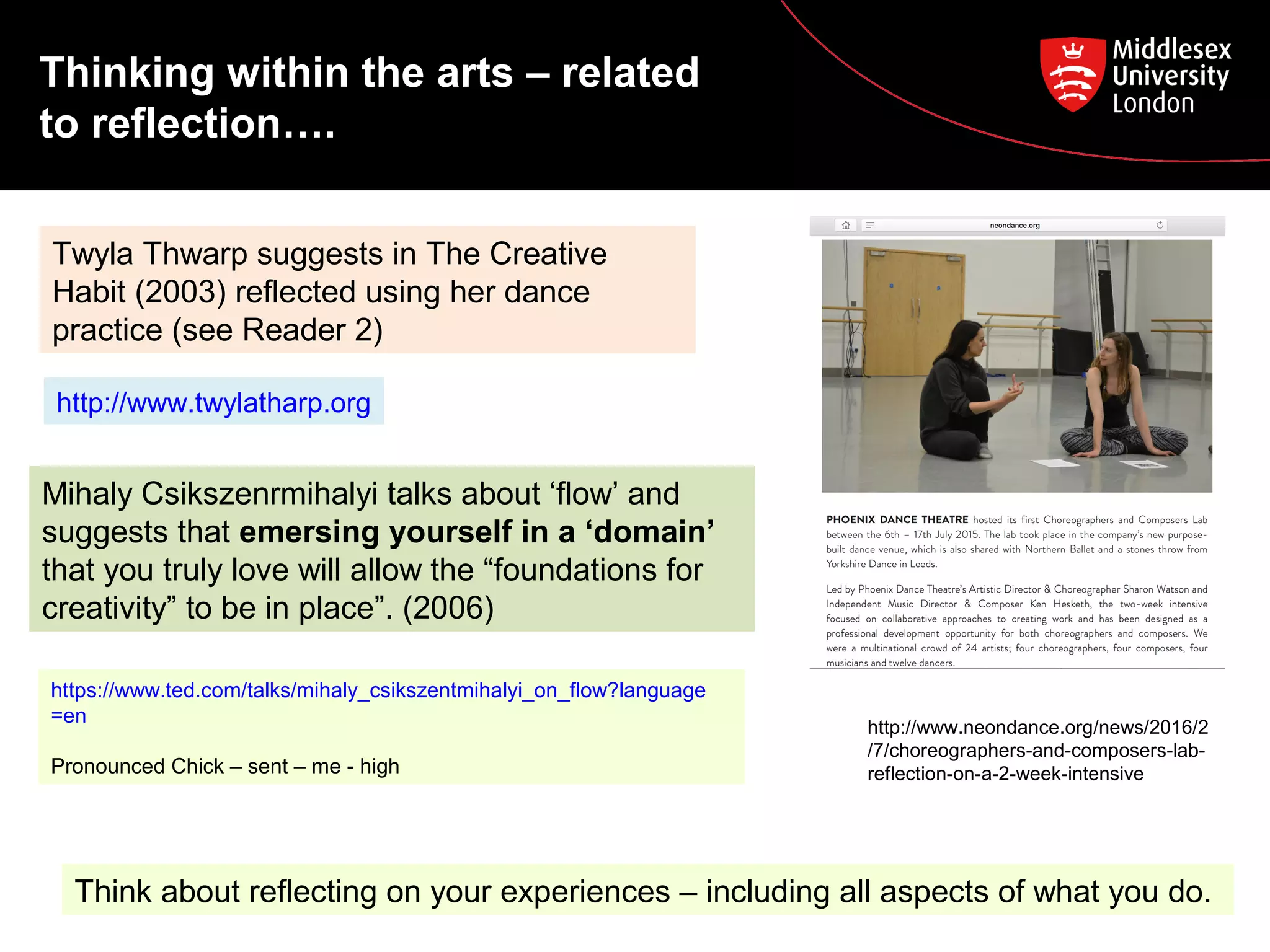
Thinking within the arts – related
to reflection….
http://www.neondance.org/news/2016/2
/7/choreographers-and-composers-lab-
reflection-on-a-2-week-intensive
Think about reflecting on your experiences – including all aspects of what you do.
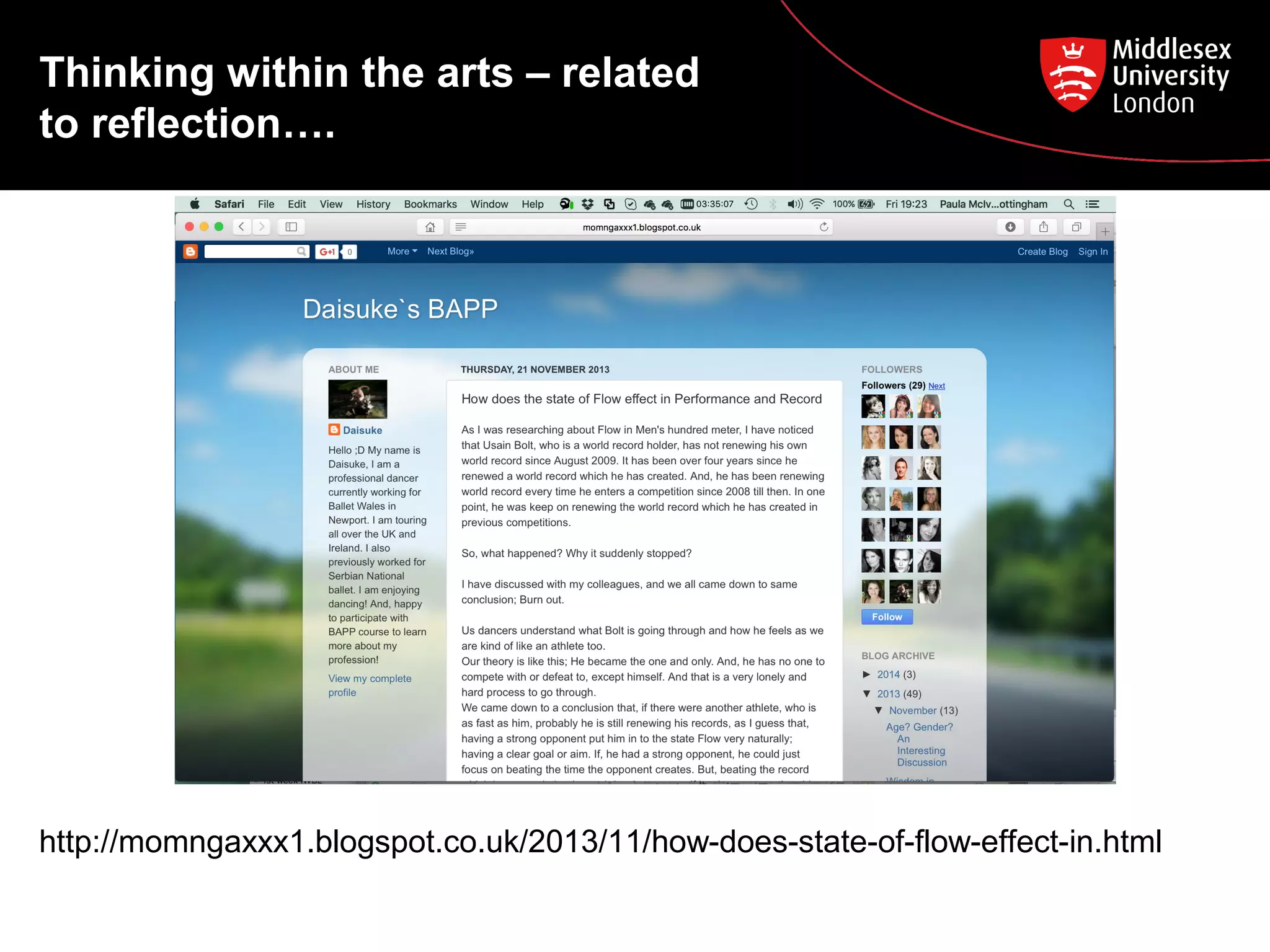
Thinking within the arts – related
to reflection….
http://momngaxxx1.blogspot.co.uk/2013/11/how-does-state-of-flow-effect-in.html
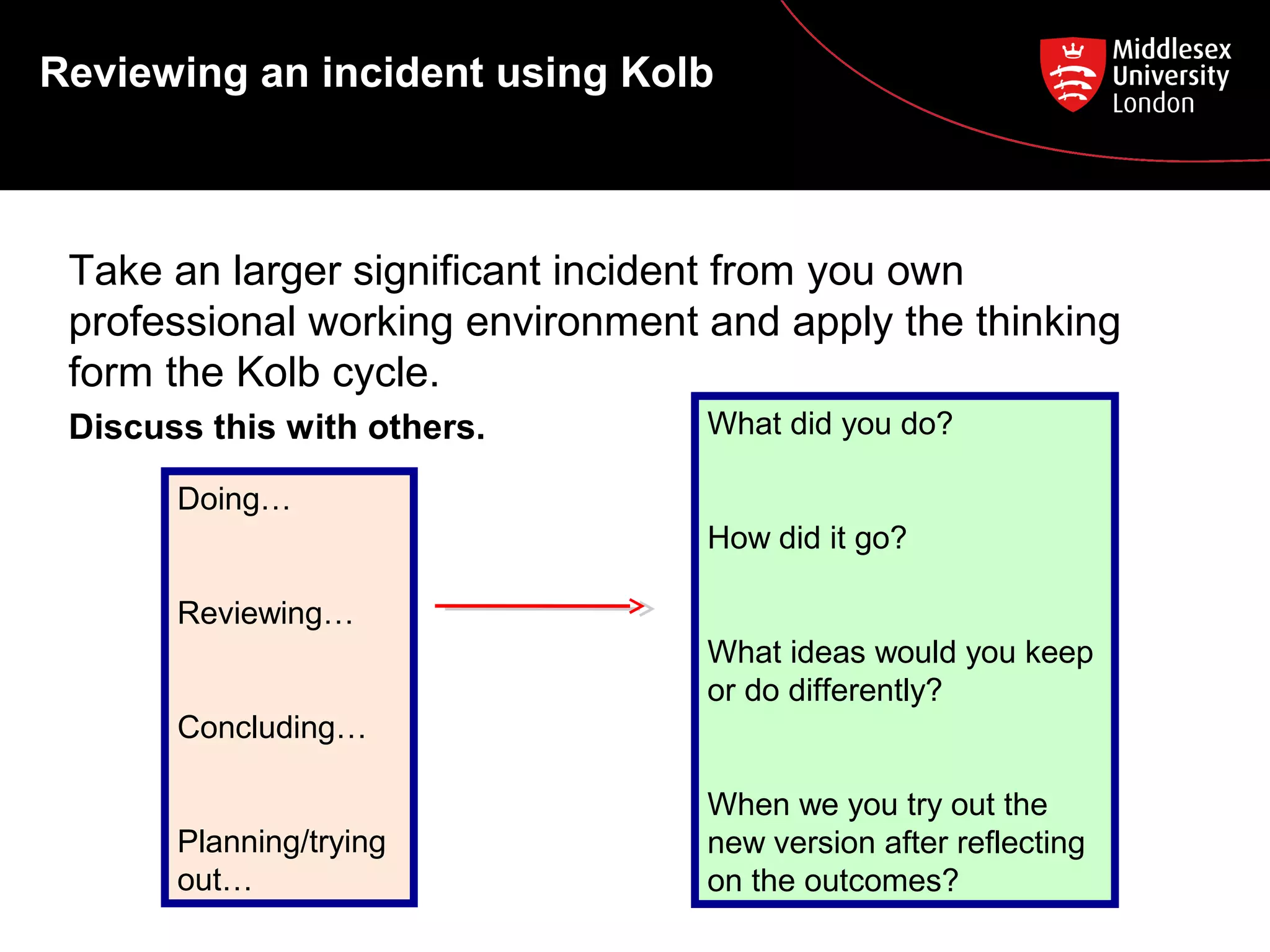
Reviewing an incident using Kolb
Take an larger significant incident from you own
professional working environment and apply the thinking
form the Kolb cycle.
Discuss this with others.
Doing…
Reviewing…
Concluding…
Planning/trying
out…
What did you do?
How did it go?
What ideas would you keep
or do differently?
When we you try out the
new version after reflecting
on the outcomes?
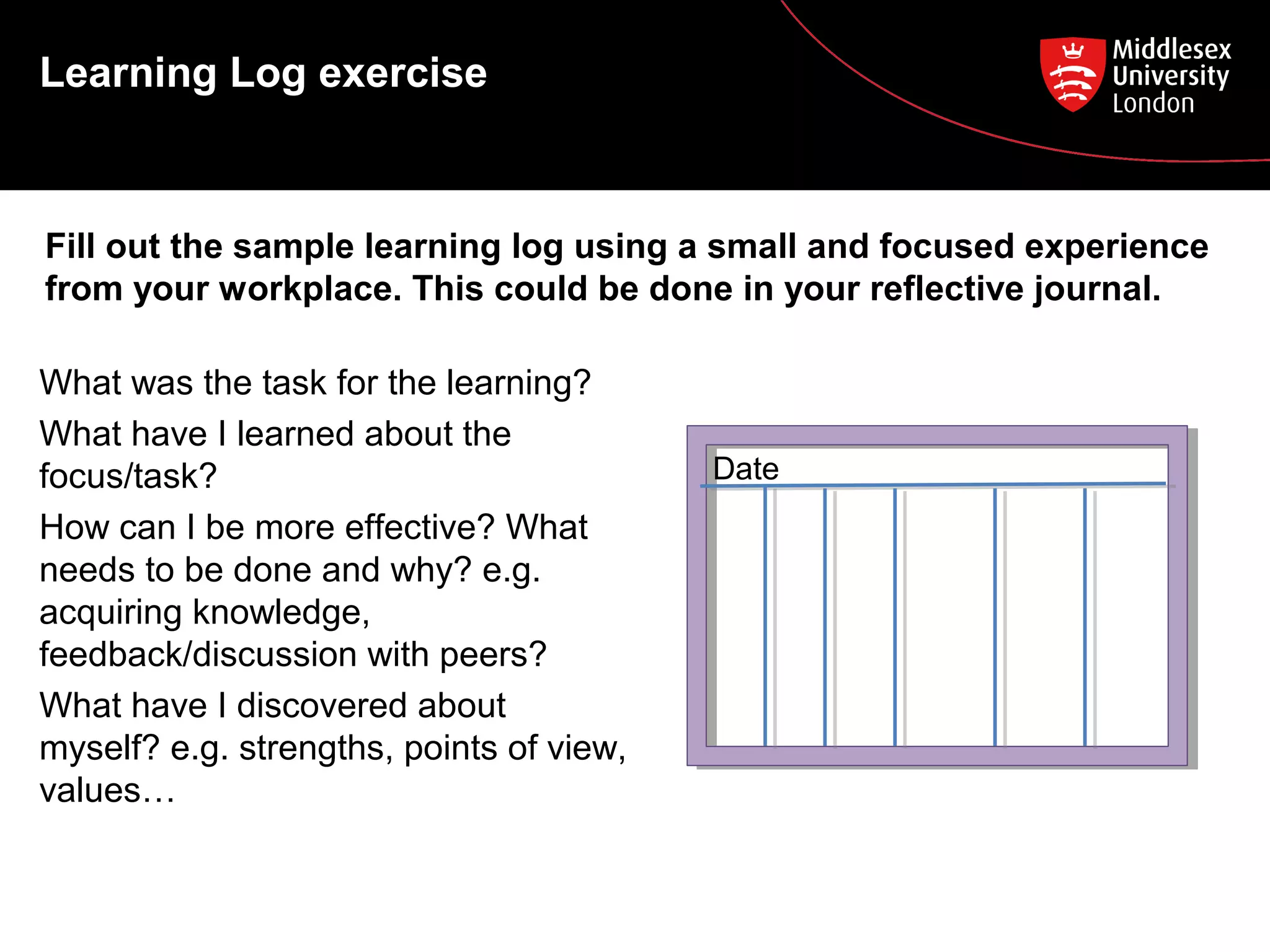
Learning Log exercise
What was the task for the learning?
What have I learned about the
focus/task?
How can I be more effective? What
needs to be done and why? e.g.
acquiring knowledge,
feedback/discussion with peers?
What have I discovered about
myself? e.g. strengths, points of view,
values…
Fill out the sample learning log using a small and focused experience
from your workplace. This could be done in your reflective journal.
Date
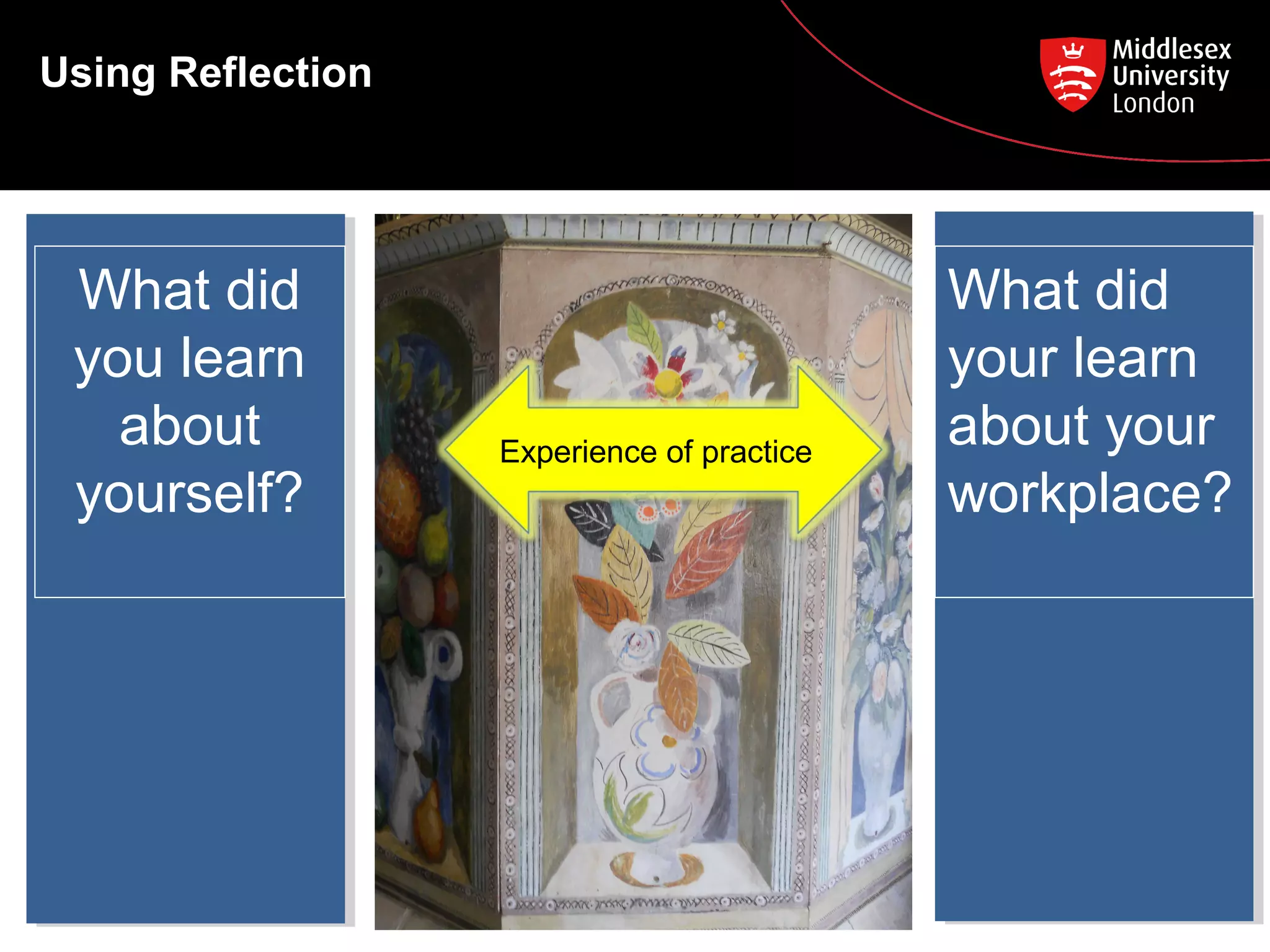
Using Reflection
What did
you learn
about
yourself?
What did
your learn
about your
workplace?
Experience of practice
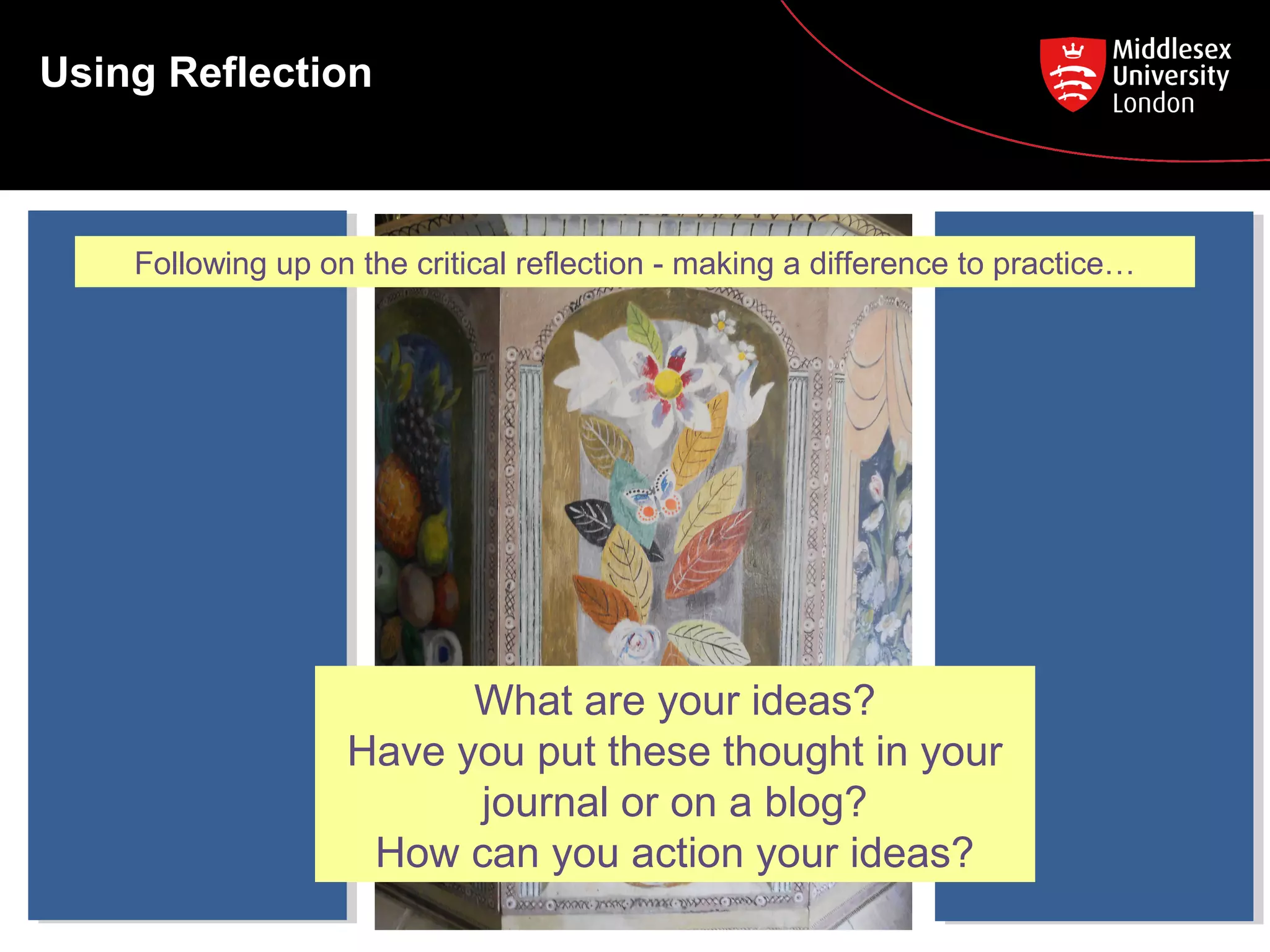
Using Reflection
What are your ideas?
Have you put these thought in your
journal or on a blog?
How can you action your ideas?
Following up on the critical reflection - making a difference to practice…
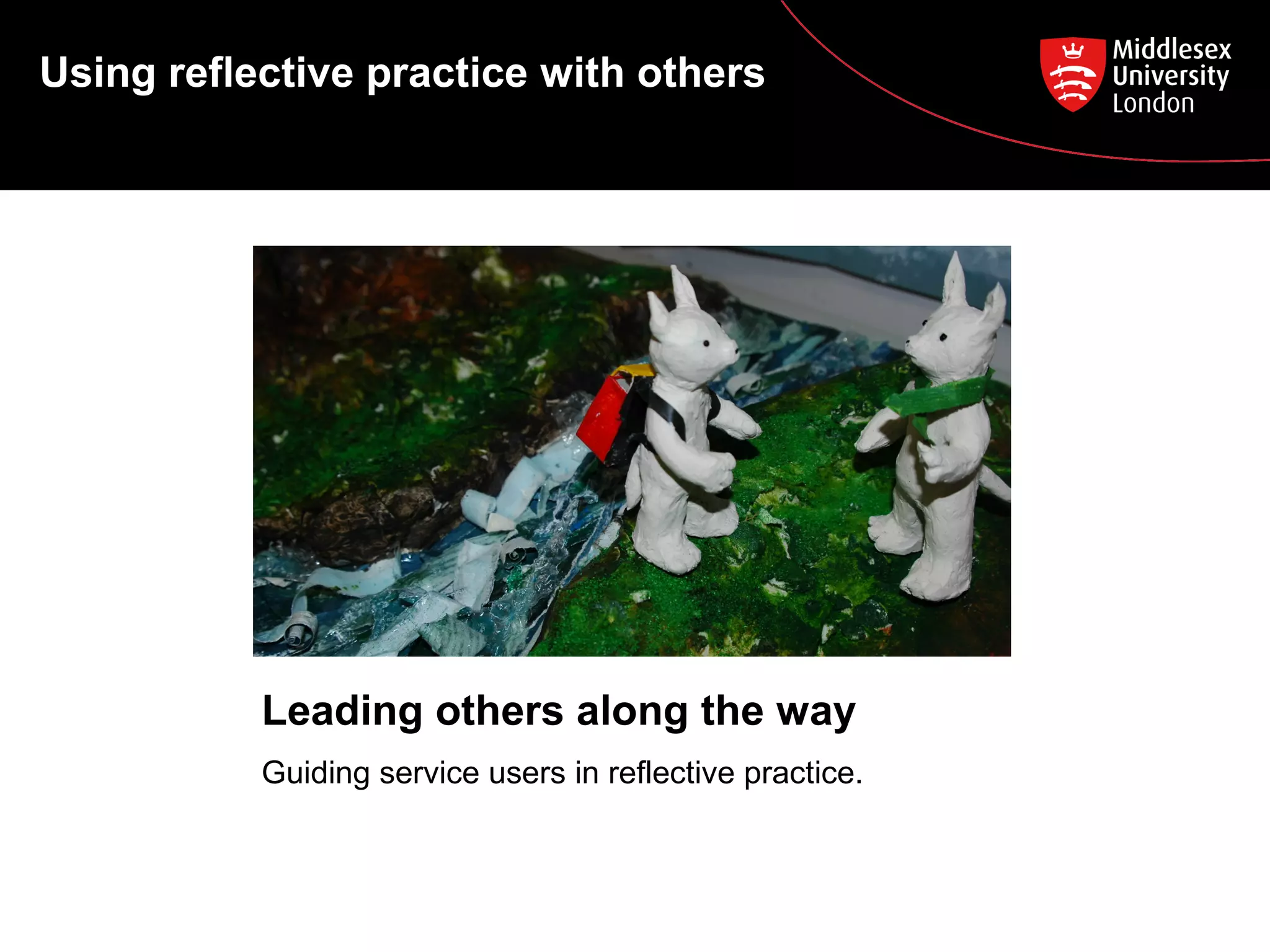
Using reflective practice with others
Leading others along the way
Guiding service users in reflective practice.
Communities of Practice (Wenger)
“Communities of practice are groups of people who share a concern or a
passion for something they do and learn how to do it better as they interact
regularly” (Wenger, 2011, online).
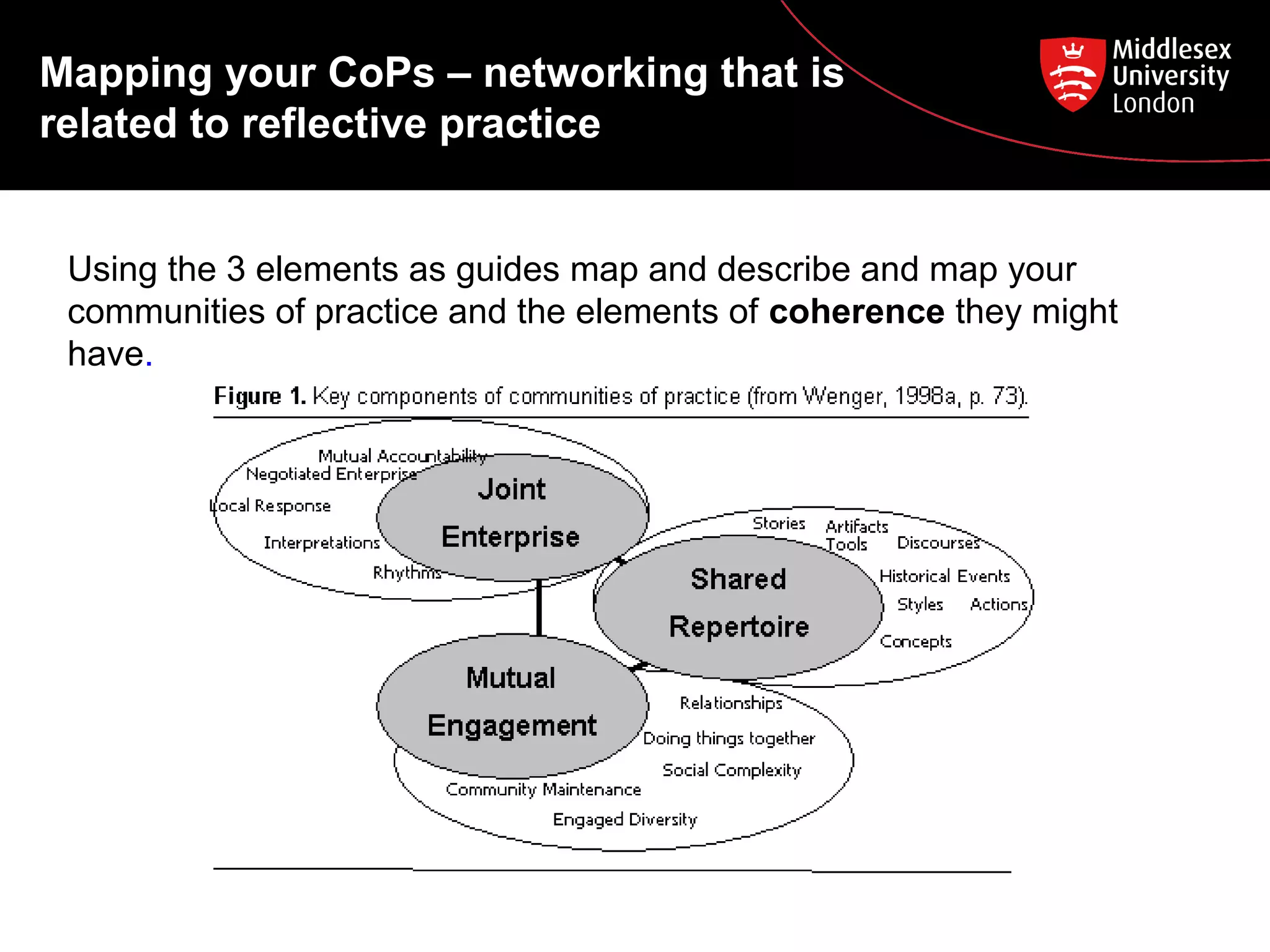
Mapping your CoPs – networking that is
related to reflective practice
Using the 3 elements as guides map and describe and map your
communities of practice and the elements of coherence they might
have.
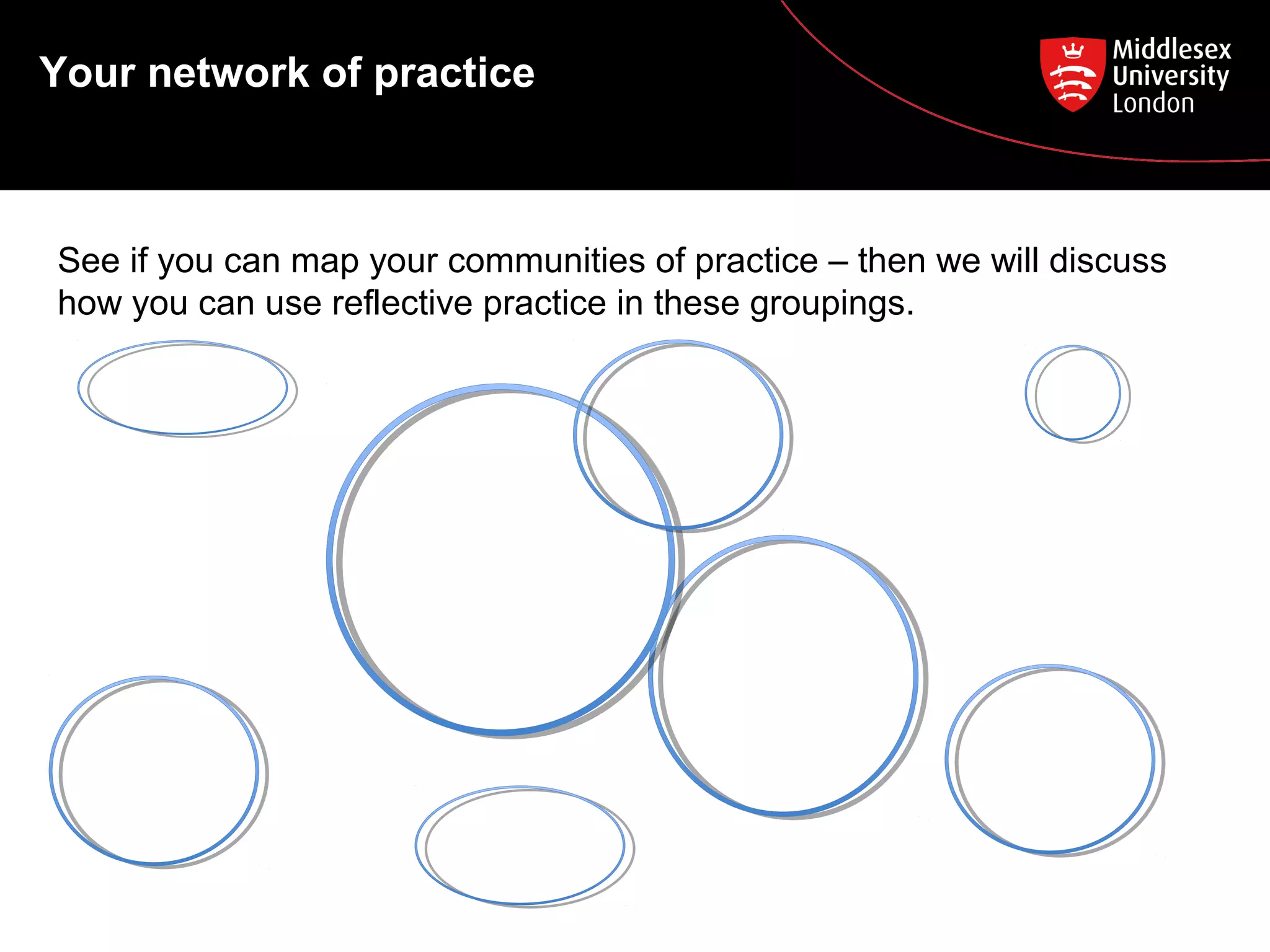
Your network of practice
See if you can map your communities of practice – then we will discuss
how you can use reflective practice in these groupings.
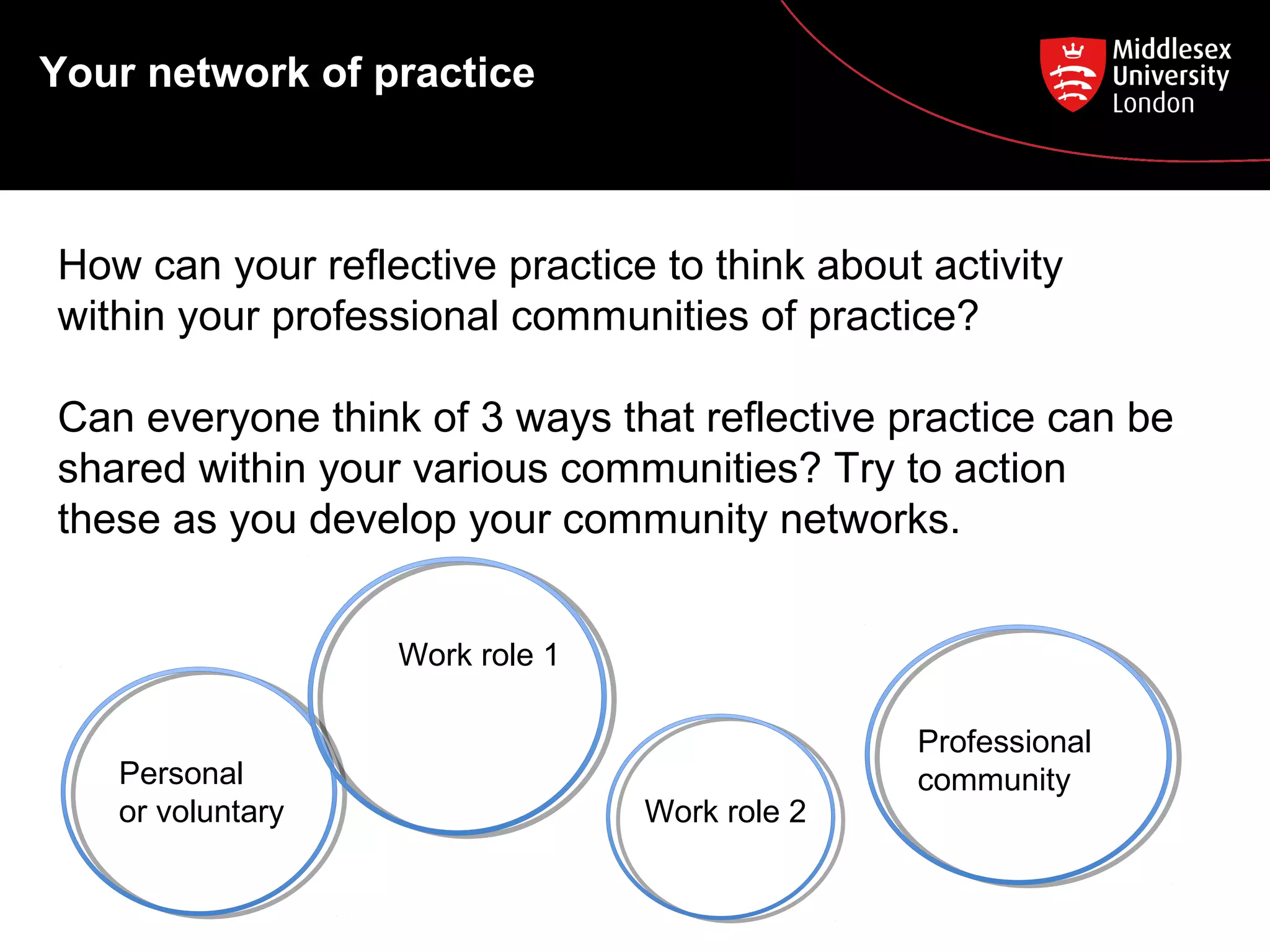
Your network of practice
How can your reflective practice to think about activity
within your professional communities of practice?
Can everyone think of 3 ways that reflective practice can be
shared within your various communities? Try to action
these as you develop your community networks.
Work role 1
Professional
communityPersonal
or voluntary Work role 2
Adding to or making a start
Use today’s exercises to develop a sense of where
you need to apply critical reflection in your practice.
Add to your portfolio
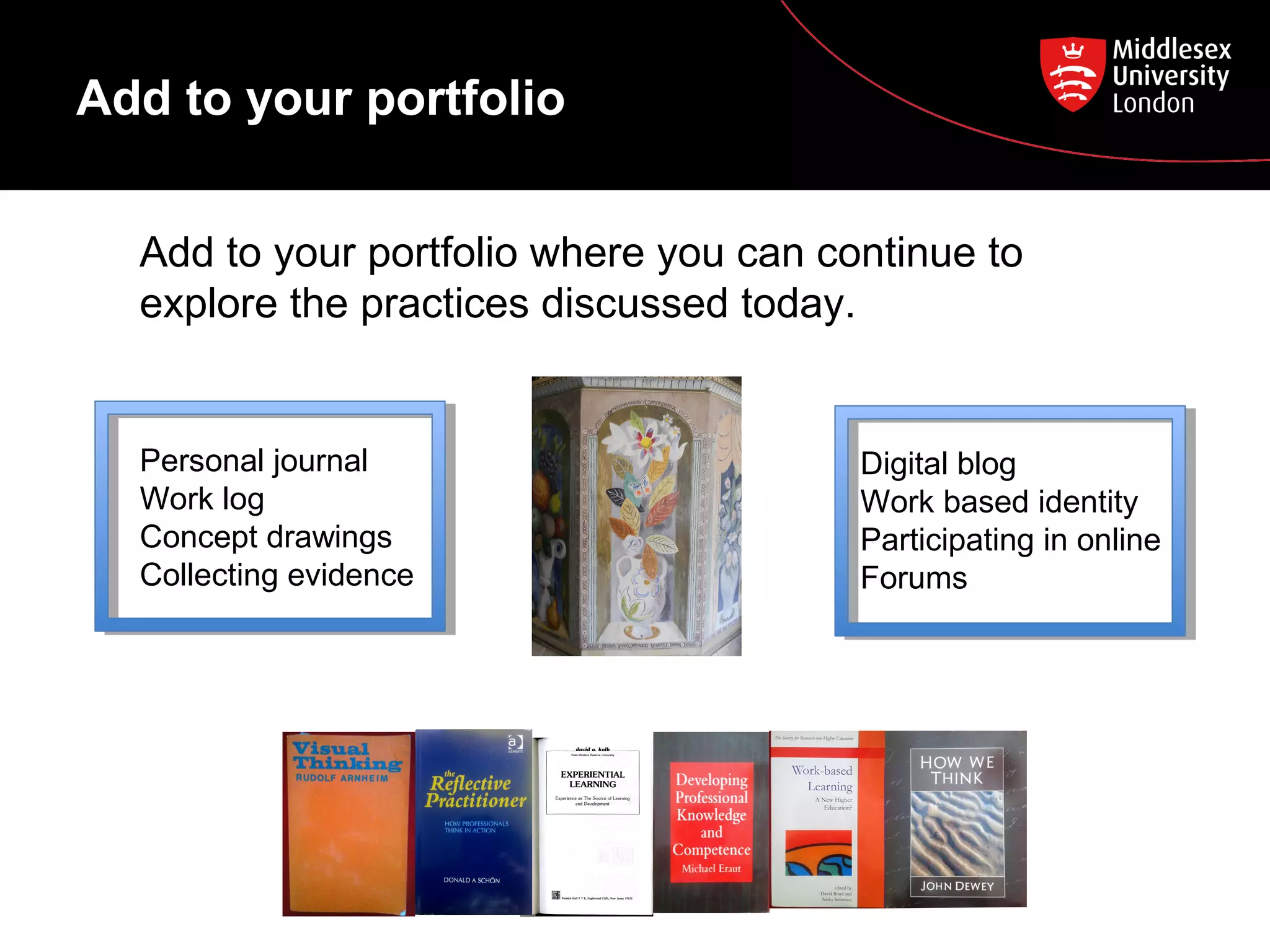
Add to your portfolio where you can continue to
explore the practices discussed today.
Personal journal
Work log
Concept drawings
Collecting evidence
Digital blog
Work based identity
Participating in online
Forums
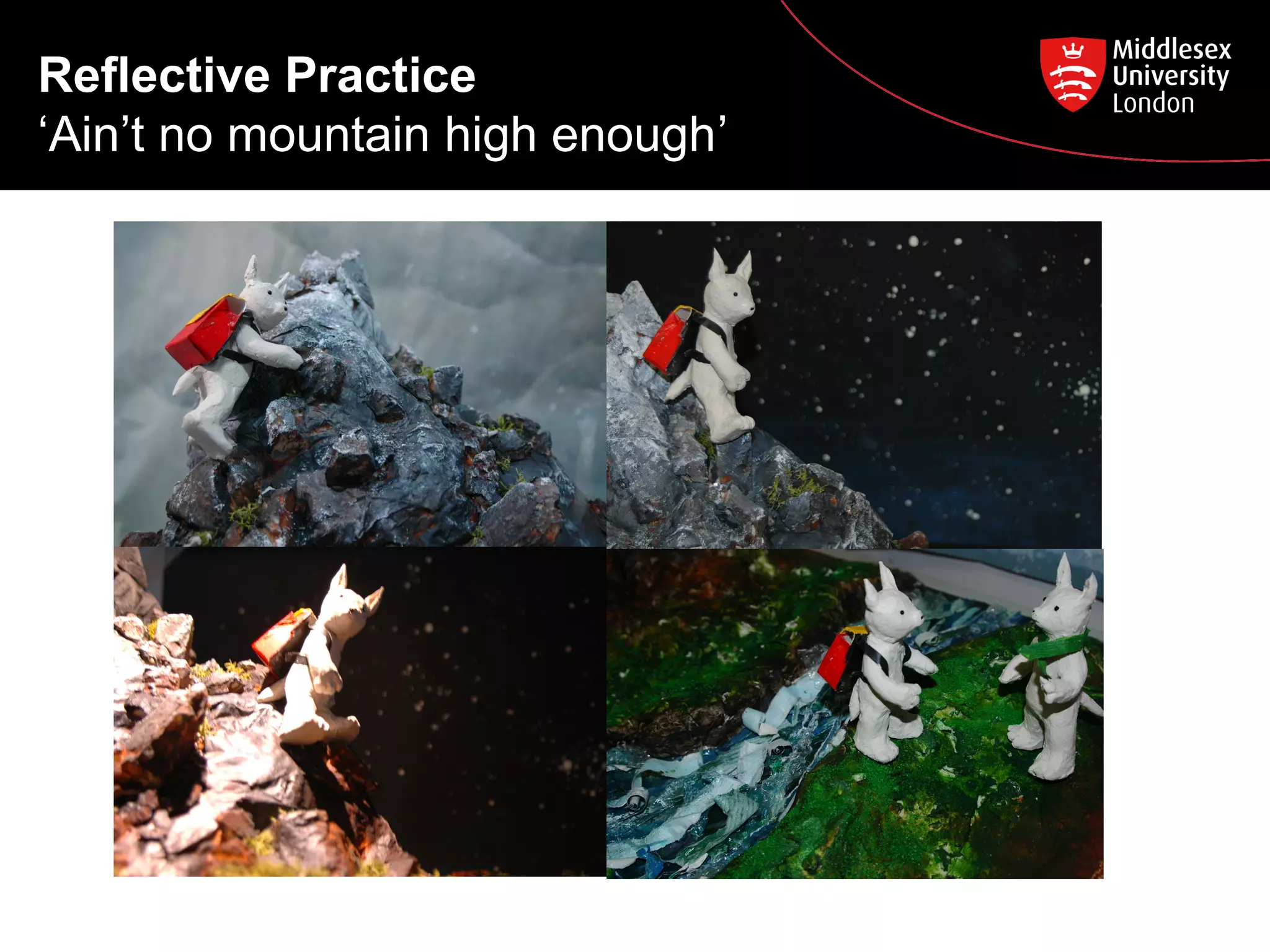
Reflective Practice
‘Ain’t no mountain high enough’
Indicative Bibliography
Bolton, Gillie (2010) (3rd
Ed.) Reflective Practice Writing a& Professional
Development, London: Sage Publications Ltd.
Boud, David and Solomon, Nicky (2001) Work-based Learning A New Higher
Education A New Higher Education, SRHE, Buckingham: Taylor and Francis Inc.
Infed (2013) reflection Infed (2013) (online) reflectionhttp://infed.org/mobi/reflection-
learning-and-education/; ‘david a. kolb on experiential learning’, Available
fromhttp://www.infed.org/biblio/b-explrn.htm; ‘Schon’, Available at:
http://www.infed.org/thinkers/et-schon.htm
International Review of Open and Distance Learning (2011) (illustration of CoP)
(online) Available from: http://www.irrodl.org/index.php/irrodl/article/view/204/286
Kolb, David A. (1984) Experiential Learning: Experience As The Source Of Learning
And Development, Englewood Cliffs, New Jersey: Prentice-Hall.
Kolb’s Learning Styles (2011) (illustration and text) Available from
http://www.businessballs.com/kolblearningstyles.htm
Murillo, E. (2011) "Communities of practice in the business and organization studies
literature" Information Research, 16(1) paper 464. [Available at
http://InformationR.net/ir/16-1/paper464.html] (Illustration)
Indicative Bibliography
Nottingham, Patience (2013) Illustrations ‘Ain’t no mountain high enough’ © used
with permission of artist
Saddington, T. (2011) (online) Available from: http://www.icel.org.uk/pdf/el.pdf
Schön, D. (1983) The Reflective Practitioner: How Professionals Think In Action,
New York, NY: USA: Basic Books.
Schön, D. (1987) Educating the Reflective Practitioner: Towards a New Design for
Teaching and Learning in the Professions, San Francisco: Jossey-Bass Publishers.
University of Leicester (2011) ‘Honey and Mumford’, Available from:
http://www2.le.ac.uk/offices/careers/pgrd/resources/teaching/theories/honey-
mumford
Wenger, E. (2006) ‘Communities of Practice a Brief Introduction’, available from:
http://www.ewenger.com/theory/communities_of_practice_intro.htm [Accessed
4/12/06]
Wenger, E., White, N. and Smith, J. (2009) Digital Habitas Stewarding Technology
for Communities, Portland, USA: CPSquare.
Wenger, E. (2011) Website (online) Available from
http://www.ewenger.com/theory/index.htm

Updated reflective practice session 2 m1 28.10.16

  • 1.
    Reflective Practice Module1 Session 2 * Paula Nottingham: note some slides repeated from 2013 presentation to CILIP
  • 2.
    Postgraduate Course Feedback ReflectivePractice “Reflective practice can enable practitioners to learn from experience about themselves, their work and the way they relate to home and work, significant others and wider society and culture… It challenges assumptions ideological illusions, damaging social and cultural biases, inequalities, and questions personal behaviours which perhaps silence the choices of others or otherwise marginalise them” (Bolton, 2010, p.3).
  • 3.
    Reflecting upon practice Makingthe time to start the journey.
  • 4.
    Reflective practice inprofessional life Ideas for the arts, culture, society, subjects like dance, performance, musical theatre, fine arts Reflection on what you know Experience of practice
  • 5.
  • 6.
    The journey Allowing criticalreflection to guide present and future action. Stargazing
  • 7.
    Schön – reflectingon practice Reflection-in-action practice is when practitioners think about practice while they are doing it. Reflection-on-action can happen after the encounter. It is about using tacit knowledge and treating experience as ‘unique’ versus solely using technical rationality. “It is the entire process of reflection-in-action which is central to the ‘art’ by which some practitioners deal well with situations of uncertainty, instability uniqueness, and value conflict” (Schön, 1983, p. 50).
  • 8.
    Honey and Mumford– how you learn – one example We learn in different ways – Activist - learning by doing – Reflectors - learning by observing – Theorist - learning by thinking through in a logical manner – Pragmatist - learning through putting ideas into practice and testing them out “Honey and Alan Mumford developed their learning styles system as a variation on the Kolb model…” (Infed, 2013, online).
  • 9.
    Experiential models forreflection Kolb and others developed models of experiential learning practice that include developing learning from doing. Learning from experience is a variation of this practice.
  • 10.
    Gibbs and experientialmodels for reflection http://www.ldu.leeds.ac.uk/ldu/sddu_multimedia/kolb/kolb_flash.htm https://www.kent.ac.uk/learning/PDP-and-employability/pdp /reflective.html
  • 11.
    What is ReflectivePractice? Boud in ‘Creating a Work-based Curriculum’, Work-based Learning A New Higher Education (Boud and Solomon, 2001) p. 55. “Critical reflection is important… because it is only through deeper critique that work situations can be improved, workplaces transformed and productivity significantly enhanced. It is about noticing and questioning the taken-for-granted assumptions that one holds and that are held by others. While it can be discomforting process, it is necessary in all situations that do not involve perpetuating the status quo.”
  • 12.
    Dewey John Dewey introduceda practical way of thinking saying that experience was key to understanding. “Reflective thinking is always more or less troublesome because it involves overcoming the inertia that inclines one to take things at face value ; it involves willingness to endure a condition of mental unrest and disturbance (1910, p.13). “Unconsciousness gives spontaneity and freshness ; consciousness conviction and control” (2010, p. 217).
  • 13.
    The journey Seeing therealities of practice. Allowing the process to clarify and articulate needs.
  • 14.
    Using Reflection Personal goals thatcan be played out at work and home to develop a work/life balance and utilise informal learning Where do you think the process of reflection might help you improve or develop more useful practice? Job description What is your role What do you do?
  • 15.
    Twyla Thwarp suggestsin The Creative Habit (2003) reflected using her dance practice (see Reader 2) Mihaly Csikszenrmihalyi talks about ‘flow’ and suggests that emersing yourself in a ‘domain’ that you truly love will allow the “foundations for creativity” to be in place”. (2006) https://www.ted.com/talks/mihaly_csikszentmihalyi_on_flow?language =en Pronounced Chick – sent – me - high http://www.twylatharp.org Thinking within the arts – related to reflection…. http://www.neondance.org/news/2016/2 /7/choreographers-and-composers-lab- reflection-on-a-2-week-intensive Think about reflecting on your experiences – including all aspects of what you do.
  • 16.
    Thinking within thearts – related to reflection…. http://momngaxxx1.blogspot.co.uk/2013/11/how-does-state-of-flow-effect-in.html
  • 17.
    Reviewing an incidentusing Kolb Take an larger significant incident from you own professional working environment and apply the thinking form the Kolb cycle. Discuss this with others. Doing… Reviewing… Concluding… Planning/trying out… What did you do? How did it go? What ideas would you keep or do differently? When we you try out the new version after reflecting on the outcomes?
  • 18.
    Learning Log exercise Whatwas the task for the learning? What have I learned about the focus/task? How can I be more effective? What needs to be done and why? e.g. acquiring knowledge, feedback/discussion with peers? What have I discovered about myself? e.g. strengths, points of view, values… Fill out the sample learning log using a small and focused experience from your workplace. This could be done in your reflective journal. Date
  • 19.
    Using Reflection What did youlearn about yourself? What did your learn about your workplace? Experience of practice
  • 20.
    Using Reflection What areyour ideas? Have you put these thought in your journal or on a blog? How can you action your ideas? Following up on the critical reflection - making a difference to practice…
  • 21.
    Using reflective practicewith others Leading others along the way Guiding service users in reflective practice.
  • 22.
    Communities of Practice(Wenger) “Communities of practice are groups of people who share a concern or a passion for something they do and learn how to do it better as they interact regularly” (Wenger, 2011, online).
  • 23.
    Mapping your CoPs– networking that is related to reflective practice Using the 3 elements as guides map and describe and map your communities of practice and the elements of coherence they might have.
  • 24.
    Your network ofpractice See if you can map your communities of practice – then we will discuss how you can use reflective practice in these groupings.
  • 25.
    Your network ofpractice How can your reflective practice to think about activity within your professional communities of practice? Can everyone think of 3 ways that reflective practice can be shared within your various communities? Try to action these as you develop your community networks. Work role 1 Professional communityPersonal or voluntary Work role 2
  • 26.
    Adding to ormaking a start Use today’s exercises to develop a sense of where you need to apply critical reflection in your practice.
  • 27.
    Add to yourportfolio Add to your portfolio where you can continue to explore the practices discussed today. Personal journal Work log Concept drawings Collecting evidence Digital blog Work based identity Participating in online Forums
  • 28.
    Reflective Practice ‘Ain’t nomountain high enough’
  • 29.
    Indicative Bibliography Bolton, Gillie(2010) (3rd Ed.) Reflective Practice Writing a& Professional Development, London: Sage Publications Ltd. Boud, David and Solomon, Nicky (2001) Work-based Learning A New Higher Education A New Higher Education, SRHE, Buckingham: Taylor and Francis Inc. Infed (2013) reflection Infed (2013) (online) reflectionhttp://infed.org/mobi/reflection- learning-and-education/; ‘david a. kolb on experiential learning’, Available fromhttp://www.infed.org/biblio/b-explrn.htm; ‘Schon’, Available at: http://www.infed.org/thinkers/et-schon.htm International Review of Open and Distance Learning (2011) (illustration of CoP) (online) Available from: http://www.irrodl.org/index.php/irrodl/article/view/204/286 Kolb, David A. (1984) Experiential Learning: Experience As The Source Of Learning And Development, Englewood Cliffs, New Jersey: Prentice-Hall. Kolb’s Learning Styles (2011) (illustration and text) Available from http://www.businessballs.com/kolblearningstyles.htm Murillo, E. (2011) "Communities of practice in the business and organization studies literature" Information Research, 16(1) paper 464. [Available at http://InformationR.net/ir/16-1/paper464.html] (Illustration)
  • 30.
    Indicative Bibliography Nottingham, Patience(2013) Illustrations ‘Ain’t no mountain high enough’ © used with permission of artist Saddington, T. (2011) (online) Available from: http://www.icel.org.uk/pdf/el.pdf Schön, D. (1983) The Reflective Practitioner: How Professionals Think In Action, New York, NY: USA: Basic Books. Schön, D. (1987) Educating the Reflective Practitioner: Towards a New Design for Teaching and Learning in the Professions, San Francisco: Jossey-Bass Publishers. University of Leicester (2011) ‘Honey and Mumford’, Available from: http://www2.le.ac.uk/offices/careers/pgrd/resources/teaching/theories/honey- mumford Wenger, E. (2006) ‘Communities of Practice a Brief Introduction’, available from: http://www.ewenger.com/theory/communities_of_practice_intro.htm [Accessed 4/12/06] Wenger, E., White, N. and Smith, J. (2009) Digital Habitas Stewarding Technology for Communities, Portland, USA: CPSquare. Wenger, E. (2011) Website (online) Available from http://www.ewenger.com/theory/index.htm