Testing the preparedness of our universities for digital mobility   Findings & challenges emerging from feasibility tests of the Coimbra Group VICTORIOUS Project Steven VERJANS, K.U.Leuven
Quality of information about the host university Making courses more ‘visiting student friendly’ Interconnections between virtual learning environments Making course choice from remote universities easier Sharing digital identities between universities Remote access to the full digital services of the home university  Pilot studies
Objective To enable all Erasmus/visiting students to be able to access in English (and optionally other languages) ICT & digital Library infrastructure, support, and e-learning provision, before selecting university to visit or before visit begins.   The outcome   may only be a demonstrator or prototype and not the final ‘service’ version, but will be complete in contents . Pilot 1 – Quality of e-information
Pilot 1 - Method Contact I.O. / search website Availability / completeness / accessibility of information about digital mobility Suggest translations / completions Make available / accessible through I.O. Ask student feedback about Usefulness / sufficiency Suggest model website


In many cases information is either non-existent, badly organised or difficult to understand. Websites are only in local languages or, when in English, not always updated. Universities offer a lot of services that are unknown by most of the students because  of difficulty in finding it. International Offices should include this ICT information on their web pages. Or link easily to where the information is in the computing service or in the general site of the university. Pilot 1: Conclusions
Pilot 1: Suggestions A model website  for other universities to follow  (to be hosted at the international web site or linked from there)   Some improvements on practical information on ICT (summaries, links to the computing service pages, etc.) in the International Students web sites.


Quality of information about the host university Making courses more ‘visiting student friendly’ Interconnections between virtual learning environments Making course choice from remote universities easier Sharing digital identities between universities Remote access to the full digital services of the home university  Pilot studies
Pilot 2 – Culture shock when moving from A to B? Changing between extreme levels of e-services Objectives of pilot 2: a) attempts to reconstruct  both  students’ pathways from one university to another  and  the degrees of satisfaction encountered.  b) does this in a visual form and in terms of a final checklist that can be used as a yardstick.  c) is thus concerned with creating an analytical tool rather than with providing definitive results.
Pilot 2 - Method Step 1:  Classifying cultural shock Step 2:  Identifying and researching typical “ shocks” (Scale 1) Step 3:  “Shock absorbers”: taking universities’    special correctives  into account (Scale 2) Step 4:  Pilot application and data analysis  Step 5:  Conclusions and further research
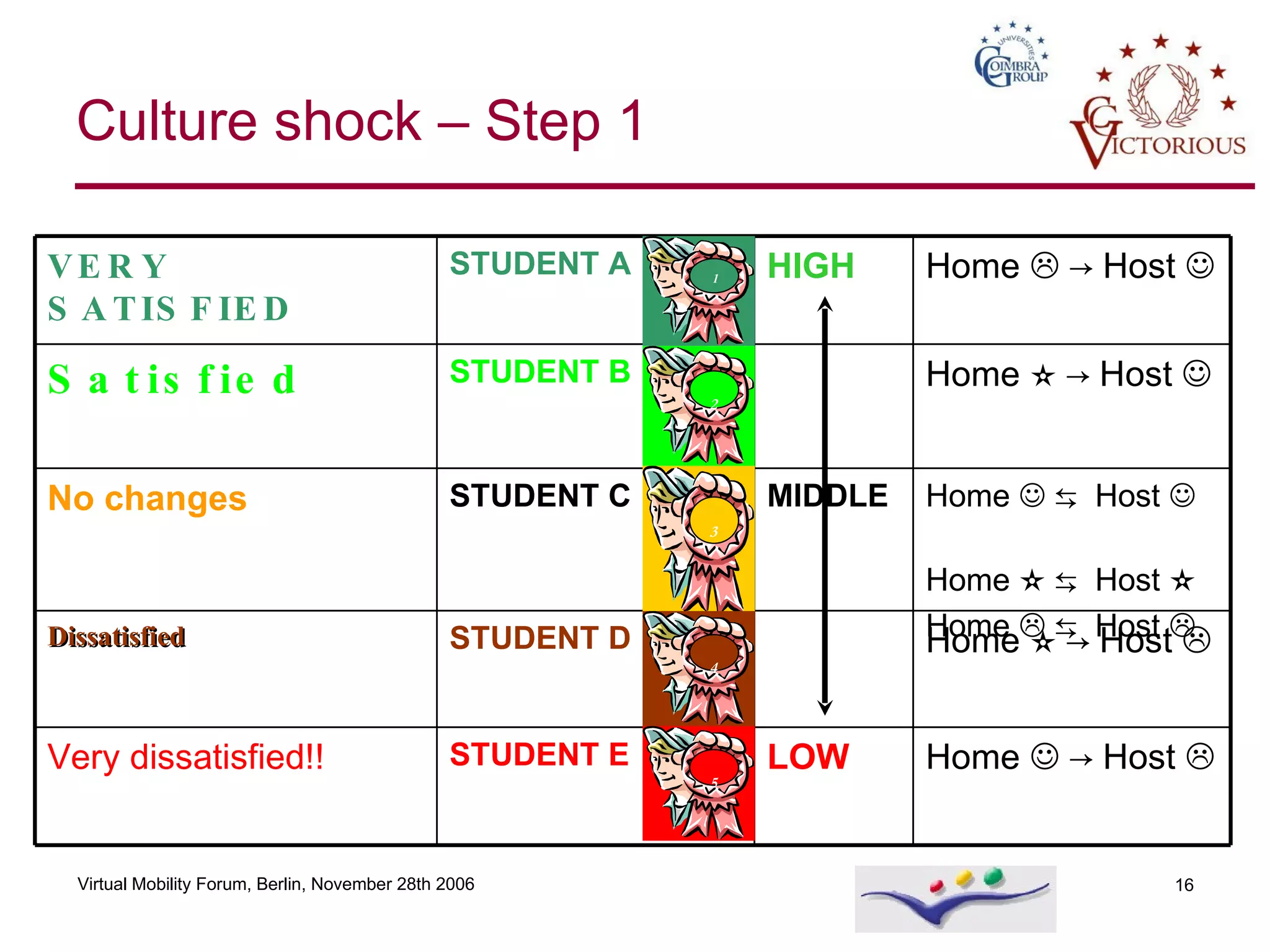
Culture shock – Step 1 Home     ->   Host   STUDENT D Dissatisfied Home     ->   Host   LOW STUDENT E Very dissatisfied!! Home     ⇆   Host     Home     ⇆   Host   Home     ⇆   Host   MIDDLE STUDENT C No changes Home     ->   Host   STUDENT B Satisfied Home     ->   Host   HIGH STUDENT A VERY SATISFIED 1 2 3 4 5
Step 2 – Typical shocks? Which trajectories and satisfaction levels are most typical? Are there regional differences in Europe? Are the extreme culture shocks more prevalent – or rather the more moderate ones? What’s the importance of such shocks in overall exchange experience?
Step 3 – Shock absorbers? Scale 2 – What do our universities provide by way of specific (targeted) support for visiting students? Can this alleviate some of the shock? Can we classify these service levels? Level A: Interaction with students as members of specific groups Level B: Interaction with students as members of student population  Level C: Interactions with all members of specific communities Level D: Interactions with all members of student population Level E: No specific targeting, because service does not exist
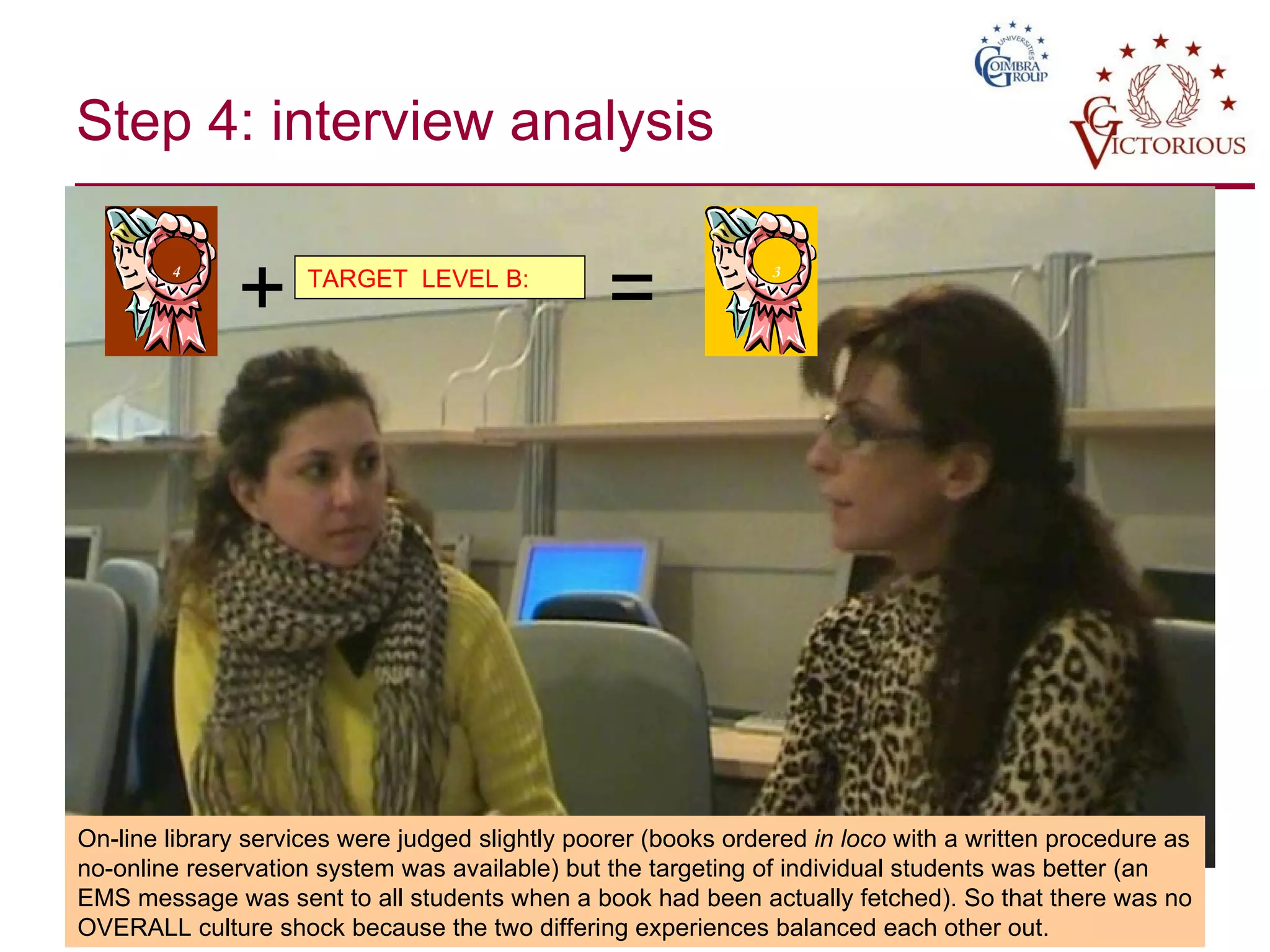
Step 4: interview analysis TARGET  LEVEL B: On-line library services were judged slightly poorer (books ordered  in loco  with a written procedure as no-online reservation system was available) but the targeting of individual students was better (an EMS message was sent to all students when a book had been actually fetched). So that there was no OVERALL culture shock because the two differing experiences balanced each other out. + = 3 4
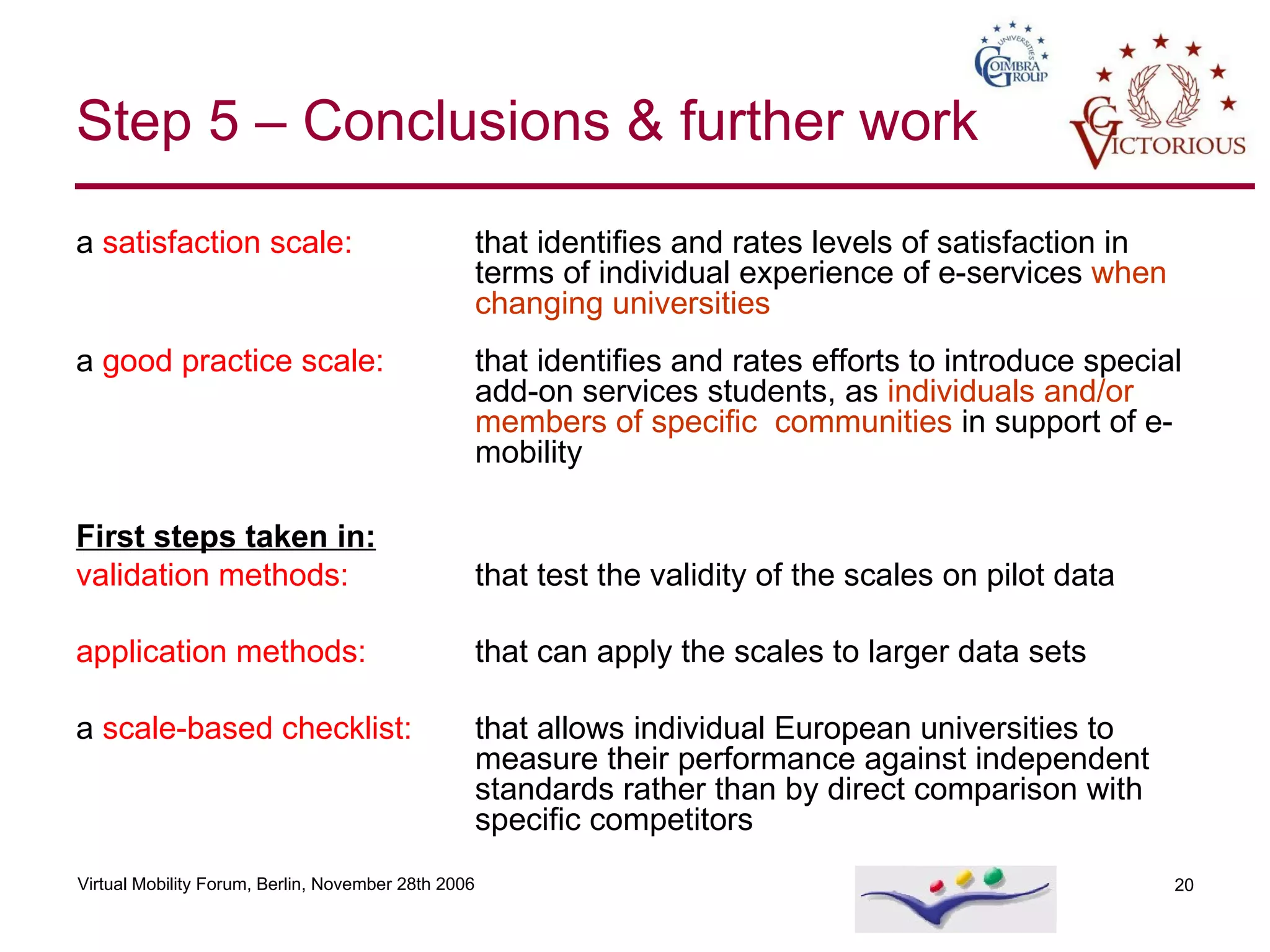
Step 5 – Conclusions & further work a  satisfaction scale: that identifies and rates levels of satisfaction in terms of individual experience of e-services  when changing universities a  good practice scale:   that identifies and rates efforts to introduce special add-on services students, as  individuals and/or members of specific  communities  in support of e-mobility First steps taken in: validation methods: that test the validity of the scales on pilot data application methods:   that can apply the scales to larger data sets a  scale-based   checklist:  that allows individual European universities to measure their performance against independent  standards rather than by direct comparison with specific competitors
Quality of information about the host university Making courses more ‘visiting student friendly’ Interconnections between virtual learning environments Making course choice from remote universities easier Sharing digital identities between universities Remote access to the full digital services of the home university  Pilot studies
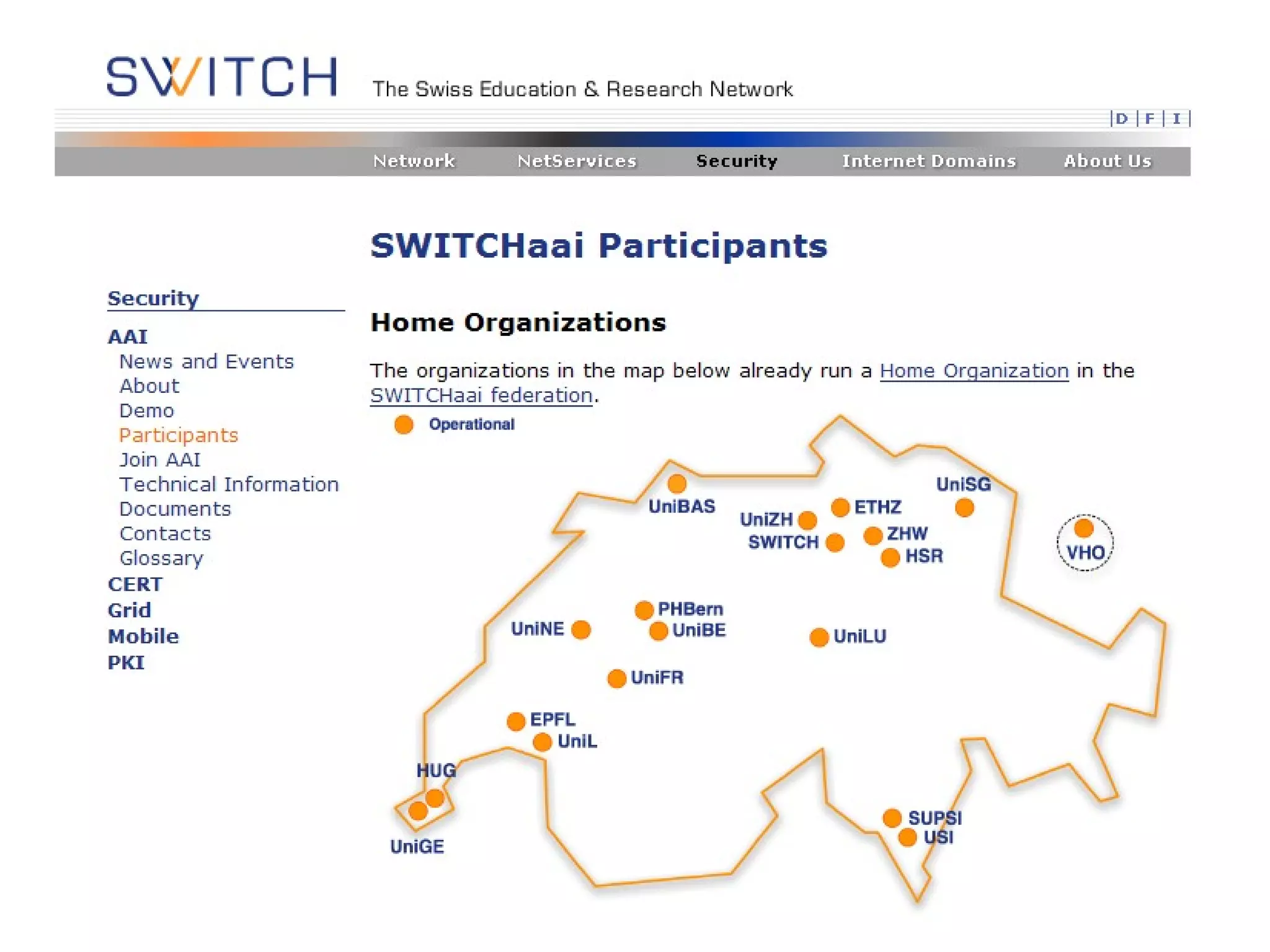
Pilot 5 – Sharing identities Current situation for exchange students / staff Home Host User Webmail Databases VLE Databases VLE Acknowledgement: thanks to SWITCH AAI
Sharing identities Problem: Multiple digital identities Problem managing many credentials Administrative burden Potential partial solution Federated trust framework, e.g. Shibboleth Only one authentication point for web-based services (e.g. VLE, library access, etc.)
Sharing identities Single authentication: @ home institution Home Host User Webmail Databases VLE Databases VLE Acknowledgement: thanks to SWITCH AAI
 
 
Pilot 5 objectives An  online   demonstration  showing a student gaining access to a secure resource at the Host institution by authenticating with their Home institution credentials. A  report  including: An assessment of the feasibility of this approach. Details of the steps and issues that would be associated with widespread adoption. Various possible use cases.
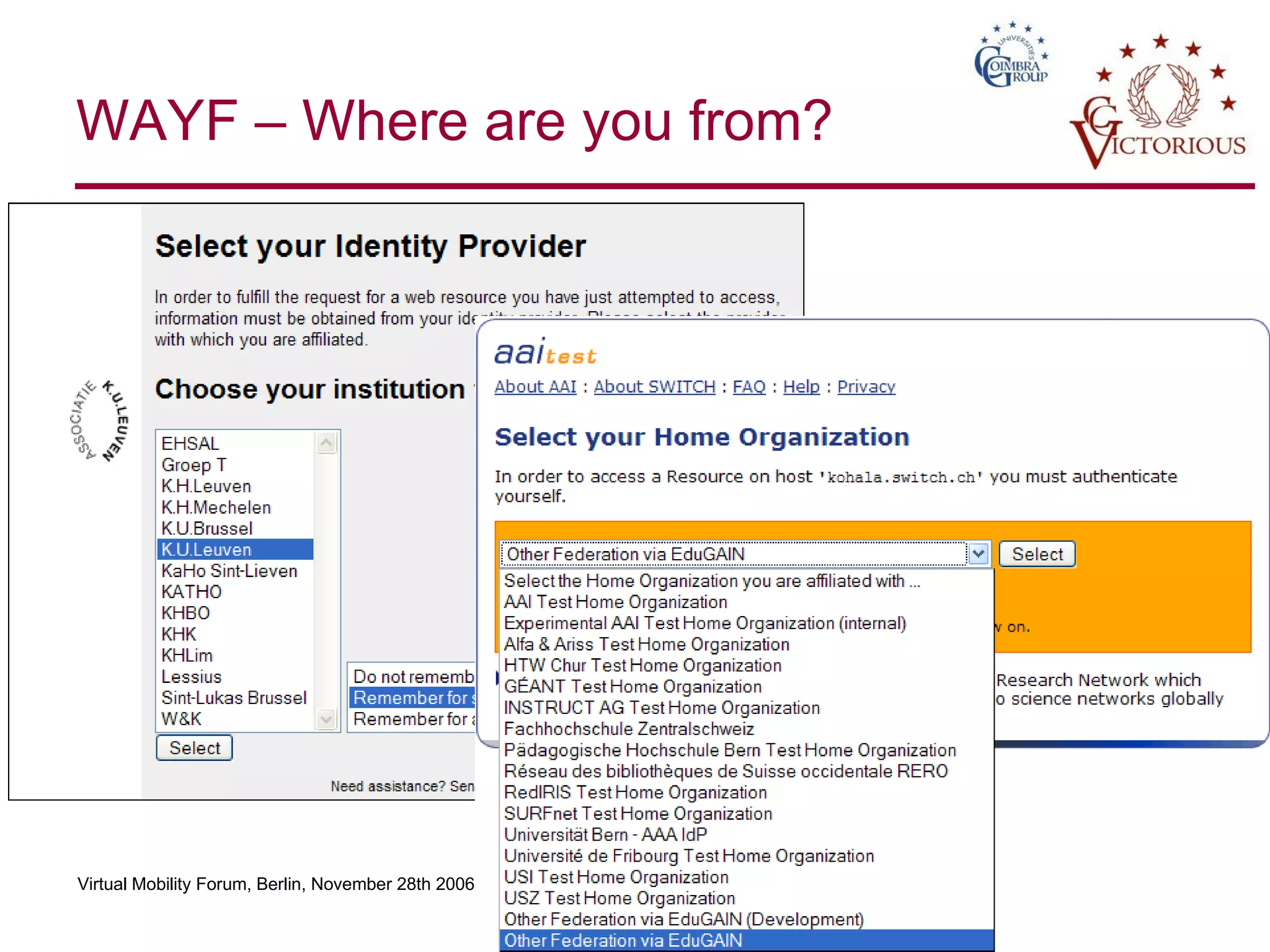
WAYF – Where are you from?
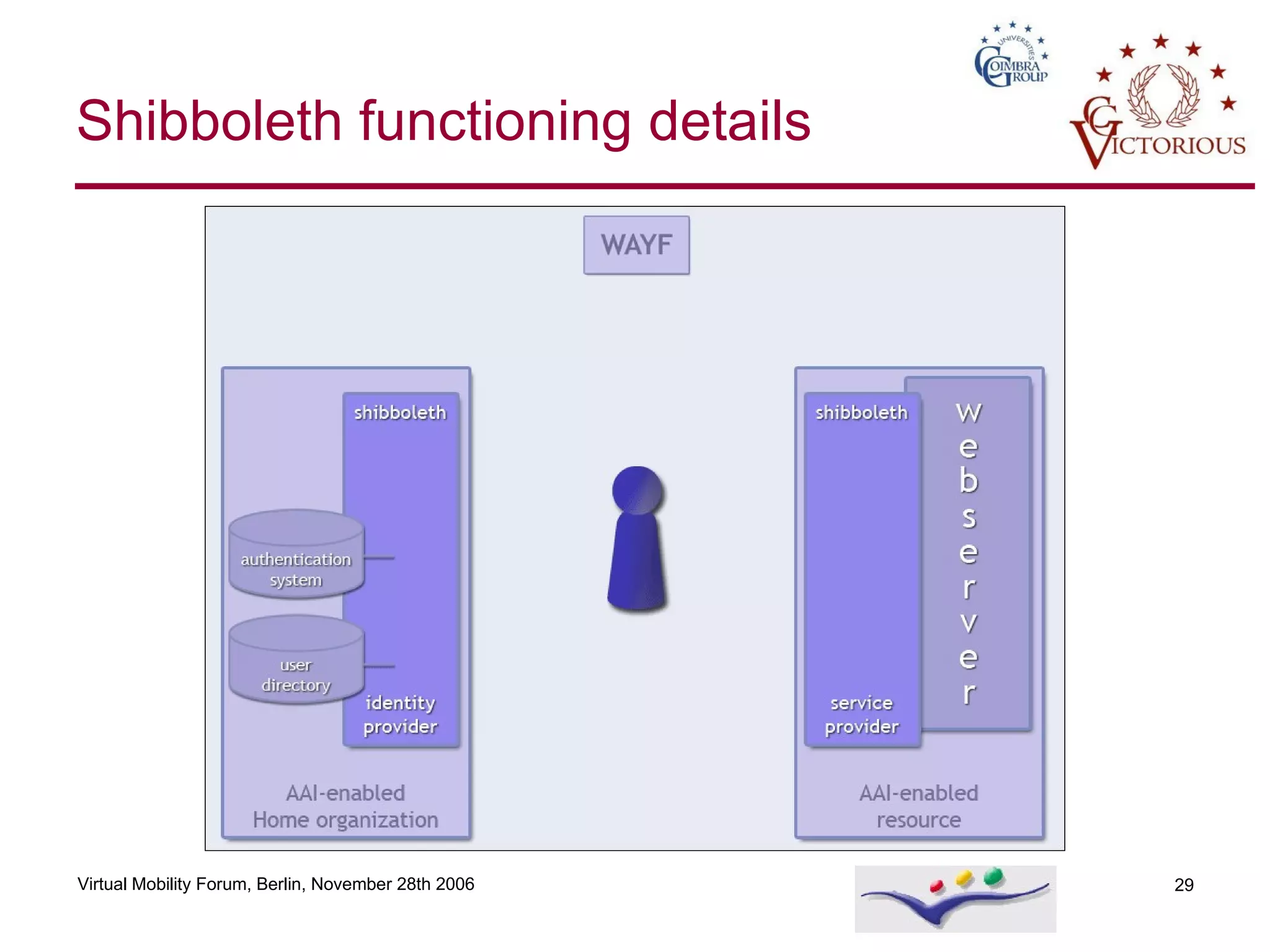
Shibboleth functioning details
Pilot 5 – Preliminary conclusions Federations at national level wanted, because most economic Limited to access to web-based resources Necessary tool for situations with increasing (virtual) mobility BUT: Authorisation  ≠ access Individual access vs. institution-level access e.g. electronic library vs. VLE May shift administrative load, but does it reduce it?
Pilots – summing up Combined with the surveys & interviews, the pilots provided valuable data about digital mobility and the barriers for reaching it. Preliminary conclusions need to be elaborated, as our final aim is to develop checklists for students, universities, national/regional agencies Your input is wanted / needed (round table sessions after lunch)

Victorious feasibility studies

  • 1.
    Testing the preparednessof our universities for digital mobility Findings & challenges emerging from feasibility tests of the Coimbra Group VICTORIOUS Project Steven VERJANS, K.U.Leuven
  • 2.
    Quality of informationabout the host university Making courses more ‘visiting student friendly’ Interconnections between virtual learning environments Making course choice from remote universities easier Sharing digital identities between universities Remote access to the full digital services of the home university Pilot studies
  • 3.
    Objective To enableall Erasmus/visiting students to be able to access in English (and optionally other languages) ICT & digital Library infrastructure, support, and e-learning provision, before selecting university to visit or before visit begins. The outcome may only be a demonstrator or prototype and not the final ‘service’ version, but will be complete in contents . Pilot 1 – Quality of e-information
  • 4.
    Pilot 1 -Method Contact I.O. / search website Availability / completeness / accessibility of information about digital mobility Suggest translations / completions Make available / accessible through I.O. Ask student feedback about Usefulness / sufficiency Suggest model website
  • 5.
  • 6.
  • 7.
  • 8.
    In many casesinformation is either non-existent, badly organised or difficult to understand. Websites are only in local languages or, when in English, not always updated. Universities offer a lot of services that are unknown by most of the students because of difficulty in finding it. International Offices should include this ICT information on their web pages. Or link easily to where the information is in the computing service or in the general site of the university. Pilot 1: Conclusions
  • 9.
    Pilot 1: SuggestionsA model website for other universities to follow (to be hosted at the international web site or linked from there) Some improvements on practical information on ICT (summaries, links to the computing service pages, etc.) in the International Students web sites.
  • 10.
  • 11.
  • 12.
  • 13.
    Quality of informationabout the host university Making courses more ‘visiting student friendly’ Interconnections between virtual learning environments Making course choice from remote universities easier Sharing digital identities between universities Remote access to the full digital services of the home university Pilot studies
  • 14.
    Pilot 2 –Culture shock when moving from A to B? Changing between extreme levels of e-services Objectives of pilot 2: a) attempts to reconstruct both students’ pathways from one university to another and the degrees of satisfaction encountered. b) does this in a visual form and in terms of a final checklist that can be used as a yardstick. c) is thus concerned with creating an analytical tool rather than with providing definitive results.
  • 15.
    Pilot 2 -Method Step 1: Classifying cultural shock Step 2: Identifying and researching typical “ shocks” (Scale 1) Step 3: “Shock absorbers”: taking universities’ special correctives into account (Scale 2) Step 4: Pilot application and data analysis Step 5: Conclusions and further research
  • 16.
    Culture shock –Step 1 Home  -> Host  STUDENT D Dissatisfied Home  -> Host  LOW STUDENT E Very dissatisfied!! Home  ⇆ Host  Home  ⇆ Host  Home  ⇆ Host  MIDDLE STUDENT C No changes Home  -> Host  STUDENT B Satisfied Home  -> Host  HIGH STUDENT A VERY SATISFIED 1 2 3 4 5
  • 17.
    Step 2 –Typical shocks? Which trajectories and satisfaction levels are most typical? Are there regional differences in Europe? Are the extreme culture shocks more prevalent – or rather the more moderate ones? What’s the importance of such shocks in overall exchange experience?
  • 18.
    Step 3 –Shock absorbers? Scale 2 – What do our universities provide by way of specific (targeted) support for visiting students? Can this alleviate some of the shock? Can we classify these service levels? Level A: Interaction with students as members of specific groups Level B: Interaction with students as members of student population Level C: Interactions with all members of specific communities Level D: Interactions with all members of student population Level E: No specific targeting, because service does not exist
  • 19.
    Step 4: interviewanalysis TARGET LEVEL B: On-line library services were judged slightly poorer (books ordered in loco with a written procedure as no-online reservation system was available) but the targeting of individual students was better (an EMS message was sent to all students when a book had been actually fetched). So that there was no OVERALL culture shock because the two differing experiences balanced each other out. + = 3 4
  • 20.
    Step 5 –Conclusions & further work a satisfaction scale: that identifies and rates levels of satisfaction in terms of individual experience of e-services when changing universities a good practice scale: that identifies and rates efforts to introduce special add-on services students, as individuals and/or members of specific communities in support of e-mobility First steps taken in: validation methods: that test the validity of the scales on pilot data application methods: that can apply the scales to larger data sets a scale-based checklist: that allows individual European universities to measure their performance against independent standards rather than by direct comparison with specific competitors
  • 21.
    Quality of informationabout the host university Making courses more ‘visiting student friendly’ Interconnections between virtual learning environments Making course choice from remote universities easier Sharing digital identities between universities Remote access to the full digital services of the home university Pilot studies
  • 22.
    Pilot 5 –Sharing identities Current situation for exchange students / staff Home Host User Webmail Databases VLE Databases VLE Acknowledgement: thanks to SWITCH AAI
  • 23.
    Sharing identities Problem:Multiple digital identities Problem managing many credentials Administrative burden Potential partial solution Federated trust framework, e.g. Shibboleth Only one authentication point for web-based services (e.g. VLE, library access, etc.)
  • 24.
    Sharing identities Singleauthentication: @ home institution Home Host User Webmail Databases VLE Databases VLE Acknowledgement: thanks to SWITCH AAI
  • 25.
  • 26.
  • 27.
    Pilot 5 objectivesAn online demonstration showing a student gaining access to a secure resource at the Host institution by authenticating with their Home institution credentials. A report including: An assessment of the feasibility of this approach. Details of the steps and issues that would be associated with widespread adoption. Various possible use cases.
  • 28.
    WAYF – Whereare you from?
  • 29.
  • 30.
    Pilot 5 –Preliminary conclusions Federations at national level wanted, because most economic Limited to access to web-based resources Necessary tool for situations with increasing (virtual) mobility BUT: Authorisation ≠ access Individual access vs. institution-level access e.g. electronic library vs. VLE May shift administrative load, but does it reduce it?
  • 31.
    Pilots – summingup Combined with the surveys & interviews, the pilots provided valuable data about digital mobility and the barriers for reaching it. Preliminary conclusions need to be elaborated, as our final aim is to develop checklists for students, universities, national/regional agencies Your input is wanted / needed (round table sessions after lunch)