






Web 2.0 in the Classroom Thursday, April 14, 2011 Get your cell phones out for text polling
Andy Petroski Director of Learning Technologies Assistant Professor of Learning Technologies Harrisburg University Harrisburg University LTMS CAE&LT
Don’t forget: You can copy-paste this slide into other presentations, and move or resize the poll.
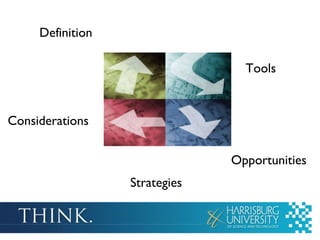
Definition Opportunities Strategies Considerations Tools
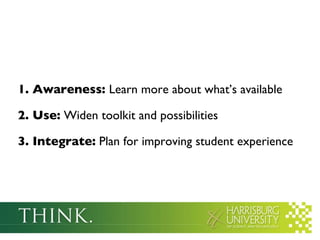
1. Awareness:  Learn more about what’s available 2. Use:  Widen toolkit and possibilities  3. Integrate:  Plan for improving student experience
Definition
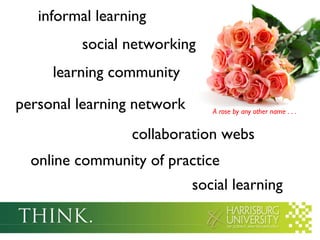
learning community social networking social learning personal learning network informal learning online community of practice collaboration webs A rose by any other name . . .
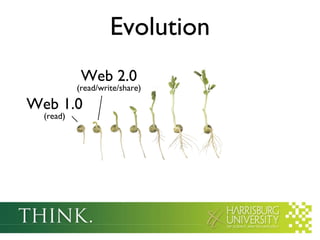
Evolution Web 1.0 (read) Web 2.0 (read/write/share)
 
 
Shift Happens . . .
K-12 Students Today (2007). . .
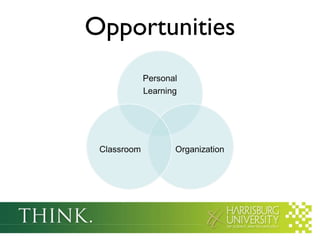
Opportunities
Opportunities
Web 2.0 in the Classroom
 
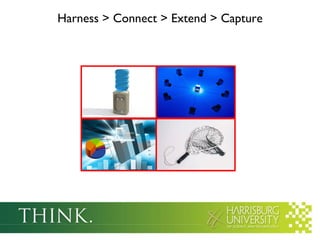
Harness > Connect > Extend > Capture
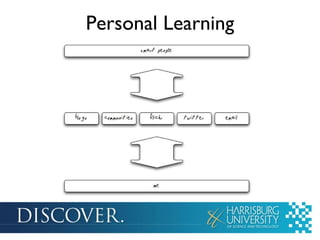
Personal Learning
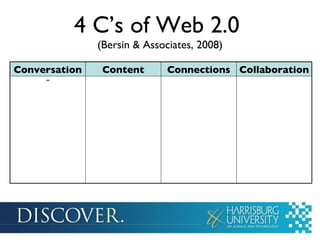
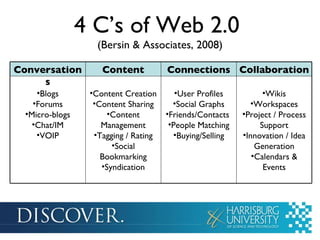
4 C’s of Web 2.0  (Bersin & Associates, 2008) Conversations Content Connections Collaboration Blogs Forums Micro-blogs / Life-streaming Chat/IM VOIP Content Creation Content Sharing Content Management Tagging / Rating Social Bookmarking Syndication User Profiles Social Graphs Friends/Contacts  People Matching Buying/Selling Wikis Workspaces Project / Process Support Innovation / Idea Generation Calendars & Events
4 C’s of Web 2.0  (Bersin & Associates, 2008) Conversations Content Connections Collaboration Blogs Forums Micro-blogs Chat/IM VOIP Content Creation Content Sharing Content Management Tagging / Rating Social Bookmarking Syndication User Profiles Social Graphs Friends/Contacts  People Matching Buying/Selling Wikis Workspaces Project / Process Support Innovation / Idea Generation Calendars & Events
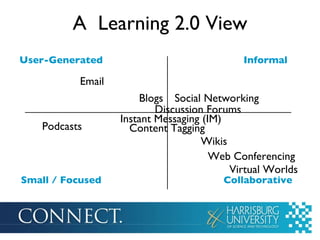
A  Learning 2.0 View Email Instant Messaging (IM) Discussion Forums Blogs Podcasts Wikis Content Tagging Web Conferencing Social Networking Virtual Worlds User-Generated Small / Focused Informal Collaborative
Tools
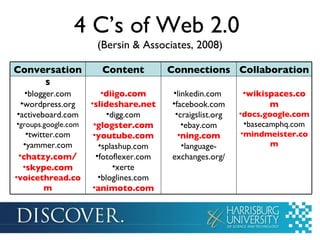
4 C’s of Web 2.0  (Bersin & Associates, 2008) Conversations Content Connections Collaboration blogger.com wordpress.org activeboard.com groups.google.com twitter.com yammer.com chatzy.com / skype.com voicethread.com diigo.com slideshare.net digg.com glogster.com youtube.com splashup.com fotoflexer.com xerte bloglines.com animoto.com linkedin.com  facebook.com craigslist.org ebay.com ning.com language-exchanges.org/ wikispaces.com docs.google.com basecamphq.com mindmeister.com
Social Bookmarking
Wikis
Classroom Use: Skype another classroom Skype an Author Skype with your PLN Skype a parent
Classroom Use: Resource website Students project sites Collaborative projects Parent Portal
Classroom Use: Peer collaboration  Chat around presentations Authentic audience Formative assessment
Classroom Use: Critical analysis of media Verbal communication Collaborative storytelling Student portfolios
Classroom Use: Topical online posters Class web page Interactive online lessons
Blogs
Twitter
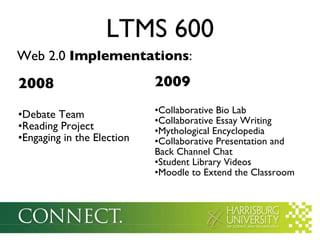
2008 Debate Team Reading Project Engaging in the Election 2009 Collaborative Bio Lab Collaborative Essay Writing Mythological Encyclopedia Collaborative Presentation and Back Channel Chat Student Library Videos Moodle to Extend the Classroom LTMS 600 Web 2.0  Implementations :
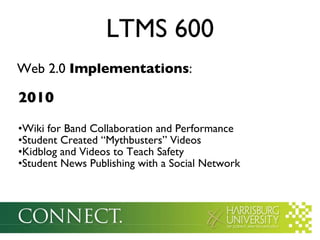
2010 Wiki for Band Collaboration and Performance Student Created “Mythbusters” Videos Kidblog and Videos to Teach Safety Student News Publishing with a Social Network LTMS 600 Web 2.0  Implementations :
Implementation Strategy
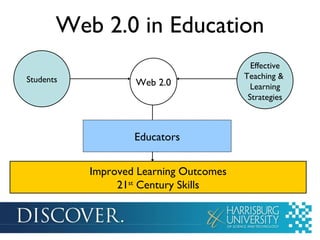
Web 2.0 in Education Students Web 2.0 Effective Teaching &  Learning Strategies Improved Learning Outcomes 21 st  Century Skills Educators
 
 
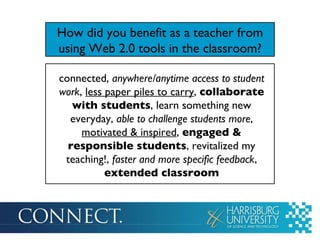
How did you benefit as a teacher from using Web 2.0 tools in the classroom ? connected,  anywhere/anytime access to student work ,  less paper piles to carry ,  collaborate with students , learn something new everyday,  able to challenge students more ,  motivated & inspired ,  engaged & responsible students , revitalized my teaching!,  faster and more specific feedback ,  extended classroom
 
 
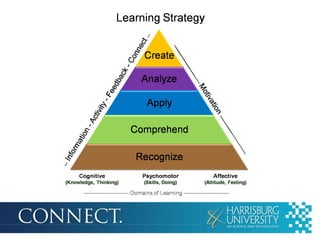
Learning objectives  (Bloom’s level)? Information, activity, feedback, connect Tool(s)? Obstacles and how you’ll overcome them? What will you do?
Across the Employment Lifecycle Recruiting Onboarding Employee Performance Management Learning and Development
 
Considerations
Training Culture Learners Learning Objectives Technology Infrastructure Policies Ownership Evaluation Work-Life Resources
 
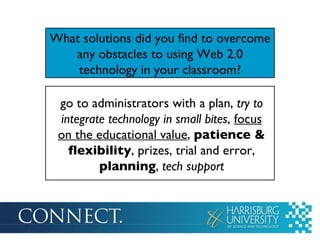
What solutions did you find to overcome any obstacles to using Web 2.0 technology in your classroom? go to administrators with a plan,  try to integrate technology in small bites ,  focus on the educational value ,  patience & flexibility , prizes, trial and error,  planning ,  tech support
 opportunities strategies tools definition considerations
Graduate Courses in Learning Technologies Integrate technology to ENGAGE your students! Classes offered at 6 locations!!! www.HarrisburgU.edu/IULTCohorts www.edtechclinics.net
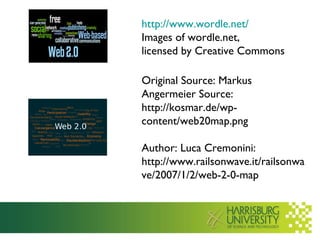
http://www.wordle.net/   Images of wordle.net,  licensed by Creative Commons Original Source: Markus Angermeier Source: http://kosmar.de/wp-content/web20map.png Author: Luca Cremonini: http://www.railsonwave.it/railsonwave/2007/1/2/web-2-0-map
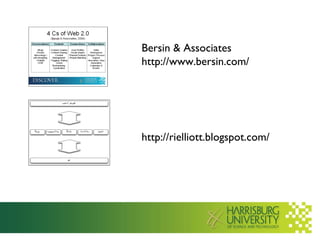
Bersin & Associates http://www.bersin.com/ http://rielliott.blogspot.com/
Andy Petroski Director of Learning Technologies Assistant Professor of Learning Technologies Harrisburg University [email_address] http://www.linkedin.com/pub/andy-petroski/0/176/315 http://www.ning.com/andypetroski http://learnev.blogspot.com/ apetroski http://bit.ly/dWdmZF
Web 2.0 in the Classroom Thursday, April 14, 2011

Web 2.0 in the classroom 04-14-11

  • 1.
    Web 2.0 inthe Classroom Thursday, April 14, 2011 Get your cell phones out for text polling
  • 2.
    Andy Petroski Directorof Learning Technologies Assistant Professor of Learning Technologies Harrisburg University Harrisburg University LTMS CAE&LT
  • 3.
    Don’t forget: Youcan copy-paste this slide into other presentations, and move or resize the poll.
  • 4.
    Don’t forget: Youcan copy-paste this slide into other presentations, and move or resize the poll.
  • 5.
  • 6.
    1. Awareness: Learn more about what’s available 2. Use: Widen toolkit and possibilities 3. Integrate: Plan for improving student experience
  • 7.
  • 8.
    learning community socialnetworking social learning personal learning network informal learning online community of practice collaboration webs A rose by any other name . . .
  • 9.
    Evolution Web 1.0(read) Web 2.0 (read/write/share)
  • 10.
  • 11.
  • 12.
  • 13.
  • 14.
  • 15.
  • 16.
    Web 2.0 inthe Classroom
  • 17.
  • 18.
    Harness > Connect> Extend > Capture
  • 19.
  • 20.
    4 C’s ofWeb 2.0 (Bersin & Associates, 2008) Conversations Content Connections Collaboration Blogs Forums Micro-blogs / Life-streaming Chat/IM VOIP Content Creation Content Sharing Content Management Tagging / Rating Social Bookmarking Syndication User Profiles Social Graphs Friends/Contacts People Matching Buying/Selling Wikis Workspaces Project / Process Support Innovation / Idea Generation Calendars & Events
  • 21.
    4 C’s ofWeb 2.0 (Bersin & Associates, 2008) Conversations Content Connections Collaboration Blogs Forums Micro-blogs Chat/IM VOIP Content Creation Content Sharing Content Management Tagging / Rating Social Bookmarking Syndication User Profiles Social Graphs Friends/Contacts People Matching Buying/Selling Wikis Workspaces Project / Process Support Innovation / Idea Generation Calendars & Events
  • 22.
    A Learning2.0 View Email Instant Messaging (IM) Discussion Forums Blogs Podcasts Wikis Content Tagging Web Conferencing Social Networking Virtual Worlds User-Generated Small / Focused Informal Collaborative
  • 23.
  • 24.
    4 C’s ofWeb 2.0 (Bersin & Associates, 2008) Conversations Content Connections Collaboration blogger.com wordpress.org activeboard.com groups.google.com twitter.com yammer.com chatzy.com / skype.com voicethread.com diigo.com slideshare.net digg.com glogster.com youtube.com splashup.com fotoflexer.com xerte bloglines.com animoto.com linkedin.com facebook.com craigslist.org ebay.com ning.com language-exchanges.org/ wikispaces.com docs.google.com basecamphq.com mindmeister.com
  • 25.
  • 26.
  • 27.
    Classroom Use: Skypeanother classroom Skype an Author Skype with your PLN Skype a parent
  • 28.
    Classroom Use: Resourcewebsite Students project sites Collaborative projects Parent Portal
  • 29.
    Classroom Use: Peercollaboration Chat around presentations Authentic audience Formative assessment
  • 30.
    Classroom Use: Criticalanalysis of media Verbal communication Collaborative storytelling Student portfolios
  • 31.
    Classroom Use: Topicalonline posters Class web page Interactive online lessons
  • 32.
  • 33.
  • 34.
    2008 Debate TeamReading Project Engaging in the Election 2009 Collaborative Bio Lab Collaborative Essay Writing Mythological Encyclopedia Collaborative Presentation and Back Channel Chat Student Library Videos Moodle to Extend the Classroom LTMS 600 Web 2.0 Implementations :
  • 35.
    2010 Wiki forBand Collaboration and Performance Student Created “Mythbusters” Videos Kidblog and Videos to Teach Safety Student News Publishing with a Social Network LTMS 600 Web 2.0 Implementations :
  • 36.
  • 37.
    Web 2.0 inEducation Students Web 2.0 Effective Teaching & Learning Strategies Improved Learning Outcomes 21 st Century Skills Educators
  • 38.
  • 39.
  • 40.
    How did youbenefit as a teacher from using Web 2.0 tools in the classroom ? connected, anywhere/anytime access to student work , less paper piles to carry , collaborate with students , learn something new everyday, able to challenge students more , motivated & inspired , engaged & responsible students , revitalized my teaching!, faster and more specific feedback , extended classroom
  • 41.
  • 42.
  • 43.
    Learning objectives (Bloom’s level)? Information, activity, feedback, connect Tool(s)? Obstacles and how you’ll overcome them? What will you do?
  • 44.
    Across the EmploymentLifecycle Recruiting Onboarding Employee Performance Management Learning and Development
  • 45.
  • 46.
  • 47.
    Training Culture LearnersLearning Objectives Technology Infrastructure Policies Ownership Evaluation Work-Life Resources
  • 48.
  • 49.
    What solutions didyou find to overcome any obstacles to using Web 2.0 technology in your classroom? go to administrators with a plan, try to integrate technology in small bites , focus on the educational value , patience & flexibility , prizes, trial and error, planning , tech support
  • 50.
     opportunities strategiestools definition considerations
  • 51.
    Graduate Courses inLearning Technologies Integrate technology to ENGAGE your students! Classes offered at 6 locations!!! www.HarrisburgU.edu/IULTCohorts www.edtechclinics.net
  • 52.
    http://www.wordle.net/ Images of wordle.net, licensed by Creative Commons Original Source: Markus Angermeier Source: http://kosmar.de/wp-content/web20map.png Author: Luca Cremonini: http://www.railsonwave.it/railsonwave/2007/1/2/web-2-0-map
  • 53.
    Bersin & Associateshttp://www.bersin.com/ http://rielliott.blogspot.com/
  • 54.
    Andy Petroski Directorof Learning Technologies Assistant Professor of Learning Technologies Harrisburg University [email_address] http://www.linkedin.com/pub/andy-petroski/0/176/315 http://www.ning.com/andypetroski http://learnev.blogspot.com/ apetroski http://bit.ly/dWdmZF
  • 55.
    Web 2.0 inthe Classroom Thursday, April 14, 2011

Editor's Notes

  • #3 My Role Also show wiki
  • #4 Press F5 or enter presentation mode to view the poll If you like, you can use this slide as a template for your own voting slides. You might use a slide like this if you feel your audience would benefit from the picture showing a text message on a phone. In an emergency during your presentation, if the poll isn't showing, navigate to this link in your web browser: http://www.polleverywhere.com/multiple_choice_polls/LTE1NDM3MjM3NzU
  • #5 Press F5 or enter presentation mode to view the poll If you like, you can use this slide as a template for your own voting slides. You might use a slide like this if you feel your audience would benefit from the picture showing a text message on a phone. In an emergency during your presentation, if the poll isn't showing, navigate to this link in your web browser: http://www.polleverywhere.com/multiple_choice_polls/LTE1OTQ2MjUzMA
  • #6 The objectives for tonight are to: Define web 2.0 so you can establish a strategy for implementation Describe the opportunities for using web 2.0 as a learning and communication tool Consider strategies for implementing web 2.0 Explore some web 2.0 tools Discuss design, development and implementation considerations What is of most value to you? Where are you? Discovery – Definition, Tools Analysis – Tools, Opportunities Pilot or Implementation – Strategies and Considerations
  • #7 We’ll be exploring some new tools and approaches today. When doing so there’s a tendency for us to become overwhelmed. Don’t feel that you need to remember everything that’s talked about today or begin using everything you see. Our goal for today is primarily Awareness. As you become aware of some new tools and techniques, you might find a few you want to use for yourself and test out. Then you might integrate 1 or 2 of those into your teaching. And the cycle will continue. Our goal is not to investigate all of the options that are out there for you and have you being integrating everything tomorrow.
  • #9 Aliases Has anyone heard of any of the terms on the screen? They are other terms by which web 2.0 is known. Learning 2.0 is essentially web 2.0 tools used for learning. Web 1.0 vs. Web 2.0 Learning 1.0 vs. Learning 2.0 A Learning 2.0 view
  • #10 Aliases Web 1.0 vs. Web 2.0 1 = Read web 2 = Read/write/share web Really a marketing gimmick coined by Tim O’Reilly to describe the web after the dot com bust in fall of 2001. Learning 1.0 vs. Learning 2.0 A Learning 2.0 view http://oreilly.com/web2/archive/what-is-web-20.html
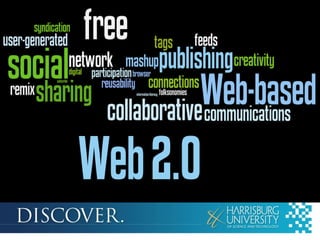
  • #11 I’m not going to take time to give a dictionary description of Web 2.0. If you want that you can look it up on wikipedia (or a dictionary). Let’s dive a little deeper. This is a Web 2.0 word cloud indicating some terms that can be used to describe Web 2.0. Take a minute to review the word cloud. Are there any words that you want to discuss? Are there any words that you’d like more explanation about or any words that you didn’t think would be included with an explanation of Web 2.0? Word cloud from wordle.net – go out and show wordle.net as an example of Web 2.0 if it’s an experienced group that’s looking for tools Basic description of Web 2.0 - Interconnected and interactive web-delivered content . . . versus web 1.0 which was often static, one-way web content. Web 2.0 is often referred to as the social web. Learning activities with Web 2.0 tools is referred to as Social Learning. Describe Mashup – if don’t get any responses Programming mashups Data / presentation mashups Combine data from multiple sources to create a new output
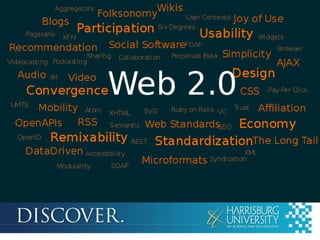
  • #12 Here’s another Web 2.0 word cloud. This one is more detailed than the other – more technical. The other was more of a “user” word cloud. This one is more of an “implementer” word cloud. How about this one? What words do you want to talk about with this one? As you can see from this word cloud and even the one before, there are a lot of concepts, techniques, strategies and technologies that make up web 2.0. Describe folksonomy – if don’t get any responses collaboratively creating and managing tags to annotate and categorize
  • #19 Activity So why are organizations beginning to use learning 2.0 tools? Harness informal learning 70% 30% Connect people to expertise / each other Increase productivity Increase the visibility and impact of leaders Innovate faster Identify future leaders Collaboration Extend the value/impact of learning initiatives Connect peers for learning and knowledge exchange (dispersed workforce) Do more with less (budgets down – demands are up) Provide learning at the point of need Provide learning at the pace of change Capture information/attitudes Capture knowledge Identify the best formal content Aberdeen Group HR Executives Guide to Web 2.0, survey of more than 500 employees Top ways in which web 2.0 tools are used Collaboration/Teamwork – 69% Generating ideas – 60% Establishing communities of practice – 60% Providing an interactive learning experience – 40% eLearning Guild – fall 2008 1,160 Guild Members 40% of respondents indicate they are making some use of e-Learning 2.0 approaches. Over the next 12 months, 70.1% of survey respondents plan to apply more e-Learning 2.0 approaches to their learning endeavors. (Use elsewhere) 66% of survey respondents believe that younger workers will demand e-Learning 2.0 approaches to performance support. Among members who have made significant use of e-Learning 2.0 approaches, 60.6% reporting improved learner / user performance. (Use this elsewhere) Only 28.1% of members report that their organizations are preparing workers on using Web 2.0 approaches for learning and work. (Use this elsewhere) Among members working in organizations with 10,000 or more workers, 10.8% cannot access LinkedIn, 26.2% cannot access Gmail, 35.0% cannot access YouTube, and 39.2% cannot access either Facebook or MySpace.   Aberdeen Group survey of over 500 organizations that use web 2.0 for talent management Average 34% improvement in time to productivity Average 31% improvement employee/retention turnover On average, 78% of employees indicated they were highly engaged   Masie Center 1,069 Learning Trends Readers – March 2009 (Use Elsewhere) Technologies Used Value Rating Some Value 41% High Value 21% (Use Elsewhere) Barriers Length of use? 1-3 years 49% Less than a year 24% Currently have a social learning project? No-65% Yes-35% (Use elsewhere) What % of learning in social learning format?   ASTD Summer 2009 The study included a survey of 743 respondents, most of whom are learning or HR professionals. (Use elsewhere) Just 9% of respondents to the i4cp study said that Web 2.0 technologies play a major role in the learning function in their company, and 32% said they play a minor role. About 87% of respondents predicted that, in the next three years, their organizations were more likely to use Web 2.0 technologies in the learning function than they currently do. Meanwhile, a minuscule 2% predicted that their firms would use these technologies to a lesser degree.
  • #21 Andy Ask audience what types of tools might be in each of the categories Reveal as each one is discussed (Or just reveal if the majority of the group is familiar with web 2.0) Let’s simplify things a little bit. Bersin & Associates is an enterprise learning and talent management research and advisory company. They’ve tried to summarize Web 2.0 by creating 4 categories – The 4 C’s of Web 2.0. The categories are not exclusive. Tools can go cross-category, but for the most part their main use/purpose can be listed in one category. A lot of tools are “mashups” of all of these functions. Describe Web 2.0 4 Cs of Web 2.0 Conversations Content Connections Collaboration (Bersin & Associates) Does anyone have any questions about the categories or the specific examples in each category?
  • #22 Harness > Connect > Extend > Collaborate   Also – web 2.0 glossary - http://www.socialsignal.com/blog/alexandra-samuel/web-2-0-glossary   To dive a little deeper into what organizations are using web 2.0 for, let’s take a look at what Bersin & Associates dubbed the 4 C’s of Web 2.0   Bersin & Associates is an enterprise learning and talent management research and advisory company. They’ve tried to summarize Web 2.0 by creating 4 categories – The 4 C’s of Web 2.0.   The categories are not exclusive. Tools can go cross-category, but for the most part their main use/purpose can be listed in one category.   A lot of tools are “mashups” of all of these functions.   Describe Web 2.0 4 Cs of Web 2.0 Conversations Content Connections Collaboration (Bersin & Associates)   Does anyone have any questions about the categories or the specific examples in each category
  • #23 Aliases Web 1.0 vs. Web 2.0 Learning 1.0 vs. Learning 2.0 A learning 2.0 View Experience Categories Characteristics Experience Categories Email Instant Messaging Discussion Forum Blogs Podcasts Wikis Content Tagging Virtual Classroom Social Networking Virtual Worlds Characteristics User-Generated Content Small Chunks (Focused) Informal Collaborative
  • #25 Here are some specific tools for each category. Also - http://www.go2web20.net/ Conversations Skype Blogs – show a blog (http://www.articulate.com/rapid-elearning/unleash-your-e-learning-graphics-from-powerpoint-2007/) Blogger.com - hosted Wordpress.org - installed Desktop blogging tools http://www.smashingmagazine.com/2008/08/01/15-desktop-blogging-tools-reviewed/ Blogging tools and seven blogging tools reviewed http://www.techsoup.org/learningcenter/webbuilding/page5516.cfm Forums – show a forum (http://forums.adobe.com/community/dreamweaver/dreamweaver_general) activeboard.com groups.google.com Microblogging – show a micro blog (my page on twitter.com) twitter.com Yammer.com VOIP Skype Content Content Sharing www.diigo.com – highlight, annotate, and share the web (show video from home page) http://www.diigo.com/learn_more?p=1 www.slideshare.net www.youtube.com – can create a channel Digg.com – users vote on the best online content (social bookmarking) Delicious.com – share your bookmarks, view others bookmarks, see most popular sites – explore by keywords (social bookmarking) Content Creation www.splashup.com fotoflexer.com Adobe Premiere Express - http://www.adobe.com/products/premiereexpress/ Xerte - http://www.nottingham.ac.uk/xerte/ Content Aggregator www.bloglines.com www.netvibes.com Connections – Social Networking sites (often include a combination of web 2.0 tools) Linkedin.com Facebook.com (games, event page, etc.) Ning.com – show central PA learning technologies Ning site (http://cplearntech.ning.com/) Collaboration Wikis – general collaboration – content development, content sharing, blogs, etc. Wikis in Plain English - http://www.youtube.com/watch?v=-dnL00TdmLY Google Docs - Document Collaboration Basecamp - Project Management Mindmeister - Brainstorming Glypho.com – collaborative story writing Authoring Tools & Enterprise applications (LMS now include many of these social networking tools) Show uPerform - http://www.rwd.com/solutions/products/rwd-uperform.aspx Show SharePoint
  • #26 http://www.youtube.com/watch?v=-dnL00TdmLY
  • #27 http://www.youtube.com/watch?v=-dnL00TdmLY
  • #30 http://www.google.com/educators/p_docs.html http://www.google.com/educators/index.html Docs.google.com (word processing and forms) 10 minutes
  • #31 http://ed.voicethread.com/
  • #32 http://edu.glogster.com/
  • #33 Access, Analyze, Evaluate and Create Media Understand the role and relationship to media and society http://www.youtube.com/watch?v=6ILQrUrEWe8&feature=player_embedded http://www.youtube.com/watch?v=_A-ZVCjfWf8&feature=fvw
  • #34 Access, Analyze, Evaluate and Create Media Understand the role and relationship to media and society http://www.youtube.com/watch?v=6ILQrUrEWe8&feature=player_embedded http://www.youtube.com/watch?v=_A-ZVCjfWf8&feature=fvw
  • #35 Jim Describe the Outcomes of Student Implementations in Their Classroom Suggested case studies from 2008: Betsy Rider - Debate Team Mary Hall & Lisa Gleason - Reading Project Art Titzel - Engaging in the Election Suggested case studies from 2009: (I posted the student profiles on the Ning site) (These link out to the PDFs in the presentation) Collaborative AP Biology Lab Investigation Collaborative Essay Writing Collaborative Presentation and Back Channel Chat Mythological Encyclopedia on Issue Student Collaboration on Library Research Videos Using Moodle to Extend Classroom Learning
  • #38 Andy BECTA http://partners.becta.org.uk/index.php?section=rh&&catcode=_re_rp_02&rid=15879 Of the 2,600 learners surveyed across 27 schools, 74% have social networking accounts and 78% have uploaded artifacts (mostly photographs or video clips from phones) to the internet. However, nearly all Web 2.0 use is currently outside school, and for social purposes There are effective teaching and learning strategies that can be enhanced and implemented more efficiently with web 2.0 Differential learning Project-based learning Student-centered learning Students are using it, but there not sure how to use them for learning. Not being used as a personal learning tool . . . Nor is it a natural tool for quality self-expression. http://educationpr.org/2007/11/19/book-review-web-20-new-tools-new-schools/ Book: Web 2.0: new tools, new schools Solomon and Schrum observe that, although young people may be ahead of their teachers in using these tools, teachers can help them use the tools in educationally appropriate ways. With Web 2.0, students acquire knowledge from many more sources. As long as teachers vet those sources for accuracy and reliability, students can get a broader range of perspectives and resources. Also, some students don’t know how to subscribe . . . But they need these skills for 21 st century jobs
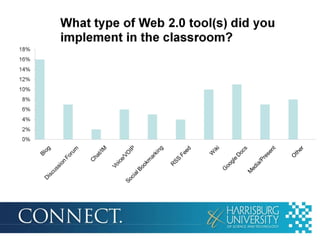
  • #39 Andy 68 Blog 11 - (16%) Discussion Forum 5 - (7%) Chat/IM 2 - (3%) Voice/Video Over IP(skype, oovoo, etc) 6 – (9%) Social Bookmarking 5 (7%) RSS Feed 4 – (6%) Wiki 10 – (15%) Google Docs 11 – (16%) Media and Presentation 7 – (10%) Other, please specify 8 – (12%) Survey of students in the LTMS 600 class What type of Web 2.0 tool(s) did you implement in your classroom? (Select all that apply) Other: podcasting, web-based writing program podcasting Mind mapping Not in a classroom, but using all of these to support classroom teachers and professional development CoveritLive, Google Calendar Backchannel Chat Show Beyond, Audacity, Ning Specific tools from question 1. Moodle for discussion/chat/media/presentation/journaling District domains for blogging using Wordpress, Google docs My Access for writing program Wikispaces Turnitin for accountability del.icio.us for bookmarking Edublog, Blabberize, Crazytalk, Flowgram, Wordles, Wikispaces for Literature, and Google Docs templates Blogs were used for short replies to writing prompts. The emphasis was how to Blog and webettiquette Wikki was were used to make a class wikki and more exploratory than anything. Blogger 2. Skype 3. uStream 4. Jing 5. Flickr 5.Created a Social Bookmarking "group" with my educational consultants using Delicious Created a wiki for the autism support program using wikispaces Created a blog using Blogger.com Set up a google reader account and signed up for several RSS feeds We are creating a moodle to offer a technology integration course. I have used Jing to do screen captures for the Moodle and other training materials. I have the IT department using skype for meetings. I set up Google Apps for the district and have several teachers using both google docs and google spreadsheets. Our science teachers love google spreadsheets for collecting experiment data. I have a few teachers using blogs as a summary tool for their classes. And one teacher about to create blog pages for each student to post their writings. I have set up discussion forums for several groups in our district including our instructional facilitators and high school subject teachers. I have a teacher using a ning with her literature class. Each student has a page on the ning as their character. WordPressMU, Moodle Forum, Google Docs. I pull in a class Delicious tag into Moodle and the Class Blog. Students will begin to use Deliscious in the 2nd half of year. wordpress, diigo, cover it live, GoogleForms (with widgets), & many of the mash-ups for media Created a class blog, use chat via CoverItLive, Skype for interviews, created a Wiki (not student driven), using google.docs for many group activities, Show Beyond as story telling and Audacity (Podbean) for recording a script. Jing, Wordle, Google docs for collaboration, Wikispaces, Blog Moodle: discussion google docs Keystone commons Audacity photostory wall wisher, jamendo, audacity, jing, blaberize
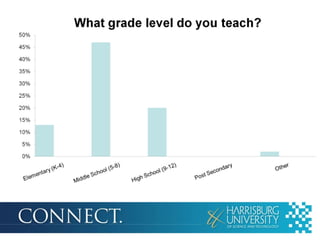
  • #40 Andy Survey of students in the LTMS 600 class What grade level do you teach? Elementary (K-4) 2 – 13% Middle School (5-8) 7 – 47% High School (9-12) 3 – 20% Post Secondary 0 Other, please specify  3 – 20% Other: Special Education K-12 support all teachers technology integration Supervise special education programs
  • #41 Andy Survey of students in the LTMS 600 class How did you benefit as a teacher from using Web 2.0 tools in your classroom Other: I am connected to others I have access to my student work where ever I am I don't have to carry a pile of papers home for grading I collaborate with my students--promoting a community of learning. I love technology and I learn something new every day! Yes. It allowed me to see how much more I could challenge my students and showed them different ways to present, discuss, and create projects and material to be mastered. I had known that web 2.0 applications were out there but did not know exactly what they were and how they could be used in the classroom. I was motivated and inspired to try many of the ideas that I learned at the Web 2.0 class. Hopefully, this also motivates and inspires the students. It provided several forums to connect staff that are located across a three-ounty area I am increasing my own professional development by using my RSS feeds, twitter etc. It has allowed the students to become more engaged in their learning, which has shifted the responsibility for learning more to the students. Before I was more te deliverer of the information. Now I still deliver the info, but ina way that is more flexible for the students. The studenta are also more readily able to collaborate, problem solve, and create new meaning out of the info. I feel that it revitalized my teaching! It really helped the students become more engaged when we were able to use the tools, which does result in better participation and grades. I can provide faster and more specific feedback to students. I am able to keep the students engaged, even after they have left the classroom. There is also an enhanced communication between me, the students, and parents. I became the facilitator instead of the teacher. The students were able to see their own potential and rise to the occasion. When the correct tool is selected, the learning became the responsibility of the student, and I was able to become the guide to the learning. students were more interested students participated more and at a higher level web 2.0 tools provided the most fun lessons.
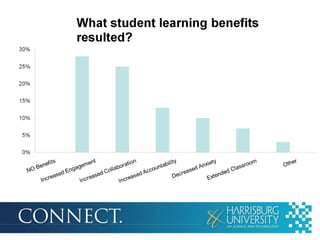
  • #42 Andy Survey of students in the LTMS 600 class What student learning benefits resulted from using Web 2.0 tools in your classroom? (Select all that apply) 40 There were NO benefits (0%) Increased engagement – 11 (28%) Increased student collaboration – 10 (25%) Increased accountability – 5 (13%) Decreased participation anxiety – 4 (10%) Extended activity outside the classroom – 7 (18%) Other, please specify - 3 (8%) Other: Paperless!!!!!!! or at least paper-less increased staff communication Teachers are getting new ideas to use in their programs from colleagues Additional Comments: We are seeing increased excitement from the students in the learning process. As well as increase collaboration among teachers and administrators. It has decreased participation anxiety for shy students. It may have increased anxiety for students who do not like technology, or who have weak computer skills. The biggest change I made this year was the daily class blog. I have six different classes and six different blogs. The blogs get updated daily - frequently by me, but the students also contribute. I always explain exactly what we did, what people need to make up if there were absent, and I embed other resources that will extend the learning (like YouTube videos or study games). Some students log on a couple times a week, just to see the extra activities. The videos are always highly requested. One video half the class sung along to the first time I played it in class because they had all watched it multiple times in class. My 6th graders are presenting on the collaborative work they did on Tuesday afternoon at PETE&C. The students were more engaged and wanted to learn. The collaboration also increased, to see the students talk to each other about what they were learning was cool The biggest change I made this year was the daily class blog. I have six different classes and six different blogs. The blogs get updated daily - frequently by me, but the students also contribute. I always explain exactly what we did, what people need to make up if there were absent, and I embed other resources that will extend the learning (like YouTube videos or study games). Some students log on a couple times a week, just to see the extra activities. The videos are always highly requested. One video half the class sung along to the first time I played it in class because they had all watched it multiple times in class. My 6th graders are presenting on the collaborative work they did on Tuesday afternoon at PETE&C. The students were more engaged and wanted to learn. The collaboration also increased, to see the students talk to each other about what they were learning was cool
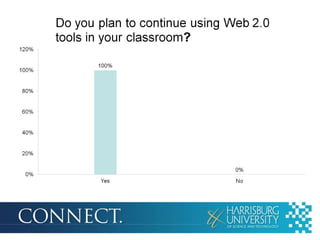
  • #43 Andy Survey of students in the LTMS 600 class Do you plan to continue using Web 2.0 tools in your classroom? 15 Please explain: YES!!!!!!! I plan to expand the use of the tools I have started with various groups of students. I have always enjoyed using technology for myself and my students. I also like to motivate other teachers to try to use these technologies in their classrooms, too. I'm working on developing skill sets regarding 2.0 with the Educational Consultants that work in my program in order to provide teachers with guided practice in the use of the tools I want to expand my use of wikis and podcasting. Rome wasn't built in a day, so I will continue to use the tools even if it is slower than I would wish. I plan to continue to use google docs, blogs and wikis for teacher collaboration and increase the responsibility for teachers to access and utilize. Without the course, I would not have known about so many great tools. Additionally, talking and learning with other educators was very beneficial. This class is a must for all teachers of any age group. Our society is turning more towards technology, we must embrase the technology in order to keep up with the world. The benefits outweigh the challenges.
  • #45 Poll: Which activity are you most engaged with in your job? Recruiting Onboarding Employee performance management Learning and development Aberdeen Group Study – HR Executive’s Guide to Web 2.0 Use of web 2.0 from 2008 to 2009 Recruiting – 105% growth Onboarding – 35% growth Learning and development – 35% growth Employee performance management – 2% growth Succession planning – 1% growth Let’s take a look at how organizations are using web 2.0 to improve performance Recruiting example: Also related to succession planning Enterprise social networking solutions are used by 54% of companies from the Aberdeen survey. Enterprises that used social networking reported a 31% year-over-year improvement of quality of hire, versus a 19% improvement reported by those not using the technology. HR Director from a mid-size US Based hospital network indicated “Each member of the recruiting team has joined a web-based community of individuals who are among our target candidate populations. Several have used the medium to volunteer to mentor newcomers to their field, creating a pipeline of future candidates.” Onboarding example: Company forums and discussions are powerful ways to build connections to ensure that new employees are engaged and assimilated into an organizational culture. Organizations that utilize company forums achieved a 24% year-over-year improvement in time to productivity (a key metric when measuring onboarding). Executive General Manager at Hudson Managed Services indicated “We created a Facebook group for a pool of international recruits so they had a ready-made network upon arrival.” Onboarding activities where web 2.0 tools are most critical: - Getting employees up to speed quickly in terms of skills and/or competencies needed to do the job well - Enabling new employees to find the “go to” people within the organization for answers to their questions - Acclimating new employees into the organization’s culture Learning and Development example: Tools that make content creation easier and more flexible like wikis or social tagging, which allow for individuals to share ideas more broadly and efficiently are showing strong adoption Top activities where web 2.0 tools are critical to success in learning and development - Enabling dispersed workers to collaborate and share ideas - Enabling learning to extend beyond the classroom and on the job - Allowing people to take part in learning without time or geographical boundaries TELUS, a North American telecom company used wikis for learning content creation and was able to add nearly 8,000 new hires while keeping training budgets flat - Extend Formal - Performance Support - Knowledge Management - Informal Learning Performance Management: Plan for how you will measure the success of web 2.0 tools -Participation -Use -Reduction in cost -Improvements in productivity -Hiring metrics
  • #46 Additional opportunities to consider: PSU Outreach http://www.thoughtfarmer.com/blog/2009/02/04/pennstate/ - play vimeo video at the bottom of the page Miller Coors MillerCoors sales faced a potential downturn as they rolled out new sales software. They needed a better, faster result than classroom training. (Employees signing up for the same classes over the years) The MillerCoors University team took a risk by building their software training course in the firm’s existing SharePoint application. This initiative yielded a significant cost savings and speed to software mastery, as well as a collaborative architecture that is being adopted corporate wide. Facebook applications for learning - http://www.astd.org/LC/2009/0709_ellis.htm Webinaria – screen recording and share http://apps.facebook.com/webinaria/?auth_token=6f67abbc8003dfc540c8d427cf3d5362&installed=1 Podclass – course management http://www.facebook.com/apps/application.php?id=2419203860&b&ref=pd_r Apps Directory: http://www.facebook.com/apps/directory.php#/apps/directory.php?app_type=0&category=200
  • #48 Design, Development, Implementation Considerations Culture (corporate and geographical) Training (trainers and learners) Learner profile (skills, time available, work environment) Instructional Technology (firewall, access from home, wireless access, mobile access) Policies/Guidelines Ownership/Stewardship Command & Control vs. Open - http://www.elsua.net/2009/03/09/impact-of-social-software-within-the-enterprise-by-jon-iwata/ Sustainability Social Learning is Personal Evaluating effectiveness Test applications Resources – Online Community Manager is a new role Work-Life Balance Group Work: What considerations would be of most concern for you at your organization? How would you address them? What do you think are some characteristics of successful organizations? Characteristics of successful organizations: Establish metrics and monitor regularly Define a “why” – have a purpose Advanced planning before rolling out Provide training and support for users Allow time for it to take root Avoid a control mentality Identify and connect your experts (get them involved) Enroll senior leaders as web 2.0 champions Connect with other successful programs http://blogs.zdnet.com/Hinchcliffe/?p=581 Sustaining a learning community http://www.elearningnetwork.org/group-content/sustaining-learning-community-top-down-or-bottom SAP Social Media Guidelines http://www.socialmediatoday.com/SMC/108483
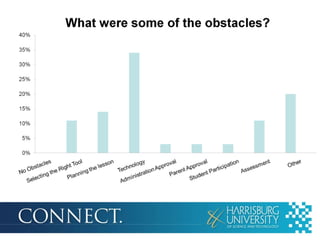
  • #49 Andy Survey of students in the LTMS 600 class What were some obstacles to using Web 2.0 technology in your classroom? (Select all that apply) 35 There were no obstacles – 0 Selecting the right Web 2.0 tool – 4 (11%) Planning the lesson to take advantage of the Web 2.0 technology – 5 (14%) Internet technology (speed, availability, access, etc.) – 12 (34%) Getting approval from the administration – 1 3%) Getting approval from the parents – 1 (3%) Getting students to actively participate using the technology – 1 (3%) Assessing student learning when using Web 2.0 tools in the classroom – 4 (11%) Other: - 7 (20%) Time is the big "obstacle." I am lucky that my district is very open to using Web 2.0 tools, as long as we do it safely and cautiously. time commitment getting staff to actively participate using the techmology access to the sites (not being blocked by filter) and student email for some sites Getting teachers to be willing to learn and use new skills and access the tools Additional comments: I am permitted to do just about anything...so far...as long as I ask and give the technology directors a chance to reflect. Assessment of student work using WEB 2.0 requires a different rubric since there are additional skills involved in doing collaborative work -- assessment is one of my issues--but I have always hated to assign a grade to student work. Some of the Web 2.0 tools--like YouTube--are blocked by our security. As always, time commitment and all the additional demands made on the classroom teacher make it difficult to find the time to do many of the activities you would like. I supervise staff members who lack even the basic skills required to effectively use technology. Getting them on board has been a significant struggle. I have played with the above tools for a few years now. But this class really cemented for me each tools strengthens and weaknesses. So that when a teacher tells me what they want to do. I am able to tell them which tool would best meet their needs. The obstacle is overcoming the fear of opening these tools up for students and navigating safety, fear, common sense, educational value and appropriate use. The only thing that has held me back is the ocassional technological hiccup and the transfer of our blog server from an outside souce to within the District. Some issues with staff being able to create a google account or access the docs from the various districts they are housed in. Student access to technology fit into curriculum Selecting the tool is critical, otherwise technology is not enhancing the learning, it is just entertaining. The biggest issue was having the technology available for the students. Only in half of the rooms I travel to are there sets of 1:1 laptops. When I wanted to use it in the other classes, I had to beg, borrow, and stopped just short of stealing to get the students access to mini-laptops. There are so many different Web 2.0 tools it was hard to decide which one would best assist the students with learning. Planning was another obstacle I had to over come meaning no paper and how to incorporate teaching utilizing Web 2.0 tools, speed and connection time is always as issue. The students were more than happy to actively participate! I can't imagine that being an obstacles.
  • #50 Andy Survey of students in the LTMS 600 class What solutions did you find to overcome any obstacles to using Web 2.0 technology in your classroom Other: I like to go to the administrators with a plan that tells them what and why and how. With that information in hand...they have been very open to permitting me to give it a try. I am not sure if you can ever fully overcome the obstacles of time constraints. The district is always adding more and more to our curriculum. You try to integrate the technology into the curriculum as best as you can. That is always my biggest challenge. The technology should not just be the 40 minutes you spend each week in the computer lab. Currently there are limited solutions - developing the appropriate trainings would be highly beneficial, however, we have very limited professional development time available and there are so many other critical topics we need to address that taking time to train in web 2.0 is almost impossible. Communicating education value of the tool and the techniques being implemented to aid in student safety Patience and flexibility. Prizes to those posting, posting pertinent information, using inservice time to practice together I am flexible when planning. I know to always have at least a plan B or C with technology. For the teachers who let me borrow their laptops, I am incredibly nice, so they will continue to let me borrow their set of laptops. I tried several different techniques which I learned in class to find the one that worked best with learning for the students. It was a trail and error. Planning, tech support plan ahead
  • #51 It’s not about the tools, but you do need to know what’s out there . . . Conclusion (Andy) – 5 minutes Takeaways List of tools (not exhaustive, but good list to begin exploring) Will post to Ning Class survey results Presentation PPT Video case study file
  • #52 Have a duplicate image on the right . . . Just representing a third image . . . Obviously would need to use another image for that third one.
  • #55 http://bit.ly/dWdmZF Information is on my blog LinkedIn Facebook Ning Blog Twitter http://www.ning.com/andypetroski http://learnev.blogspot.com/