Computer Mediated Communication Integrating the Internet into Teaching, Learning &  Research   Blogs and Blogging in Education
Lecture Outline Blogs—Definition Basic Technology Blogs and Blogging in Education Students use of Blogs Teachers use of Blogs Hands-on Creating a Blog Blogs and Blooms
What is a Blog? Simply put, the term blog is a shortened form of weblog or web log  A blog is a website with  entries  on a regular basis Blog entries are normally displayed in reverse chronological order  A blogs is easy to implement, use and manage without knowledge of  html or technical details A Blog differs from a website mainly in terms of content currency (web sites are mostly static, blogs are dynamic)
Some Basic Blog Technology Blogs run on a specialized software  Blogs can be interlinked to  Bloggsphere   RSS stands (Rich Site Summary)  is a software for distributing headlines and article summaries for news systems‚ announcements‚ etc. RSS makes it possible for you to keep up with your favorite web sites in an automated manner RSS are considered to be similar to a mashup web applications—as in Google maps
… ..Basic Blog Technology…Cont..1 Categories or posts to the blog belongs to one or more categories A permalink is a web link (URL) that points straight to a specific post on the blog Each post has its own permalink and they’re useful for bookmaking and referencing specific posts.  Trackbacks are methods of tracking and displaying what other people on other blogs are saying about your blog entries
Blogs in Education Blogs are becoming mainstream CMC tools in education As learning and teaching tools they can; increase student engagement with learning content  provide active learning through personal reflections provide an environment for peer-to-peer learning through collaboration and knowledge sharing enable different individuals to easily create articles‚ and automatically indexes these articles by date and categories  be used a personal diary on a topic of interest or a groups diary for documenting, editing, and sharing group work
……… .Ways Students Use Blogs as personal learning spaces for posting personal experiences, views, perspectives and resources on a particular topic as a collaborative for sharing content or information as  e-Portfolios  to demonstrate mastery of the depth and breadth of knowledge in a particular domain as online notebooks/scrapbooks for aggregating content or knowledge on a particular subject  from other sources What else can you think of………….?
… ..Teachers use Blogs to replace the standard class Web page to link to Internet items that relate to their course through to provide some teaching tips for other teachers  to write about something they learned from other teachers  to organize class discussion and summaries of readings for their students to reflect on teaching experiences and keep a log of what worked for them in the classroom or what didn't work……etc.
Creating a Blog Hands-on Practical on creating a blog
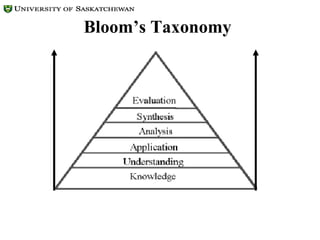
Bloom’s Taxonomy
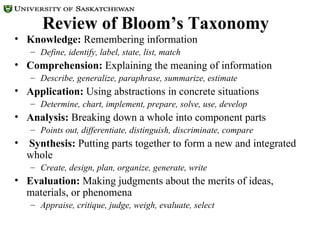
Review of Bloom’s Taxonomy Knowledge:  Remembering information  Define, identify, label, state, list, match   Comprehension:  Explaining the meaning of information  Describe, generalize, paraphrase, summarize, estimate Application:  Using abstractions in concrete situations  Determine, chart, implement, prepare, solve, use, develop Analysis:  Breaking down a whole into component parts  Points out, differentiate, distinguish, discriminate, compare Synthesis:  Putting parts together to form a new and integrated whole Create, design, plan, organize, generate, write  Evaluation:  Making judgments about the merits of ideas, materials, or phenomena Appraise, critique, judge, weigh, evaluate, select
Group Task  Knowledge :  Identify at least three ways in which blogs can be used in education Comprehension :  List three reasons why teachers should integrate blogs into their classrooms Application :  Describe three ways in which you can use Blogs for your own teaching or professional development   Analysis :  Is the use of blogs in education better than the use of static websites? Synthesis : How might blogging change your role as an educator? Evaluation :  List at least potential disadvantages of using blogs in education?  Requirements for this Task You can choose to work as a two or more and not five but you can be a team of one Post your answers to your personal blog and class discussion forum

470blogs

  • 1.
    Computer Mediated CommunicationIntegrating the Internet into Teaching, Learning & Research Blogs and Blogging in Education
  • 2.
    Lecture Outline Blogs—DefinitionBasic Technology Blogs and Blogging in Education Students use of Blogs Teachers use of Blogs Hands-on Creating a Blog Blogs and Blooms
  • 3.
    What is aBlog? Simply put, the term blog is a shortened form of weblog or web log A blog is a website with entries on a regular basis Blog entries are normally displayed in reverse chronological order A blogs is easy to implement, use and manage without knowledge of html or technical details A Blog differs from a website mainly in terms of content currency (web sites are mostly static, blogs are dynamic)
  • 4.
    Some Basic BlogTechnology Blogs run on a specialized software Blogs can be interlinked to Bloggsphere RSS stands (Rich Site Summary) is a software for distributing headlines and article summaries for news systems‚ announcements‚ etc. RSS makes it possible for you to keep up with your favorite web sites in an automated manner RSS are considered to be similar to a mashup web applications—as in Google maps
  • 5.
    … ..Basic BlogTechnology…Cont..1 Categories or posts to the blog belongs to one or more categories A permalink is a web link (URL) that points straight to a specific post on the blog Each post has its own permalink and they’re useful for bookmaking and referencing specific posts. Trackbacks are methods of tracking and displaying what other people on other blogs are saying about your blog entries
  • 6.
    Blogs in EducationBlogs are becoming mainstream CMC tools in education As learning and teaching tools they can; increase student engagement with learning content provide active learning through personal reflections provide an environment for peer-to-peer learning through collaboration and knowledge sharing enable different individuals to easily create articles‚ and automatically indexes these articles by date and categories be used a personal diary on a topic of interest or a groups diary for documenting, editing, and sharing group work
  • 7.
    ……… .Ways StudentsUse Blogs as personal learning spaces for posting personal experiences, views, perspectives and resources on a particular topic as a collaborative for sharing content or information as e-Portfolios to demonstrate mastery of the depth and breadth of knowledge in a particular domain as online notebooks/scrapbooks for aggregating content or knowledge on a particular subject from other sources What else can you think of………….?
  • 8.
    … ..Teachers useBlogs to replace the standard class Web page to link to Internet items that relate to their course through to provide some teaching tips for other teachers to write about something they learned from other teachers to organize class discussion and summaries of readings for their students to reflect on teaching experiences and keep a log of what worked for them in the classroom or what didn't work……etc.
  • 9.
    Creating a BlogHands-on Practical on creating a blog
  • 10.
  • 11.
    Review of Bloom’sTaxonomy Knowledge: Remembering information Define, identify, label, state, list, match Comprehension: Explaining the meaning of information Describe, generalize, paraphrase, summarize, estimate Application: Using abstractions in concrete situations Determine, chart, implement, prepare, solve, use, develop Analysis: Breaking down a whole into component parts Points out, differentiate, distinguish, discriminate, compare Synthesis: Putting parts together to form a new and integrated whole Create, design, plan, organize, generate, write Evaluation: Making judgments about the merits of ideas, materials, or phenomena Appraise, critique, judge, weigh, evaluate, select
  • 12.
    Group Task Knowledge : Identify at least three ways in which blogs can be used in education Comprehension : List three reasons why teachers should integrate blogs into their classrooms Application : Describe three ways in which you can use Blogs for your own teaching or professional development Analysis : Is the use of blogs in education better than the use of static websites? Synthesis : How might blogging change your role as an educator? Evaluation : List at least potential disadvantages of using blogs in education? Requirements for this Task You can choose to work as a two or more and not five but you can be a team of one Post your answers to your personal blog and class discussion forum