1
Using GCC
Auto-Vectorizer
Ira Rosen <ira.rosen@linaro.org>
Michael Hope <michael.hope@linaro.org>
r1
bzr branch lp:~michaelh1/+junk/using-the-vectorizer
2
Using GCC Vectorizer
● Vectorization is enabled by the flag -ftree-vectorize and by
default at -O3:
● gcc –O2 –ftree-vectorize myloop.c
● or gcc –O3 myloop.c
● To enable NEON:
-mfpu=neon -mfloat-abi=softfp or -mfloat-abi=hard
● Information on which loops got vectorized, and which
didn’t and why:
● -fdump-tree-vect(-details)
– dumps information into myloop.c.##t.vect
● -ftree-vectorizer-verbose=[X]
– dumps to stderr
● More information:
http://gcc.gnu.org/projects/tree-ssa/vectorization.html
3
Other useful flags
● -ffast-math - if operating on floats in a reduction
computation (to allow the vectorizer to change the
order of the computation)
● -funsafe-loop-optimizations - if using "unsigned int"
loop counters (can be assumed not to overflow)
● -ftree-loop-if-convert-stores - more aggressive
if-conversion
● --param min-vect-loop-bound=[X] - if have loops with a
short trip-count
● -fno-vect-loop-version- if worried about code size
4
What's vectorizable
● Innermost loops
● countable
● no control flow
● independent data accesses
● continuous data accesses
for (k = 0; k < m; k ++)
for (j = 0; j < m; j ++)
for (i = 0; i < n; i ++)
a[k][j][i] = b[k][j][i] * c[k][j][i];
Example of not vectorizable loop:
while (a[i] != 8)
{
if (a[i] != 0)
a[i] = a[i-1];
b[i+stride] = 0;
}
uncountable
control flow
loop carried dependence
access with unknown stride
5
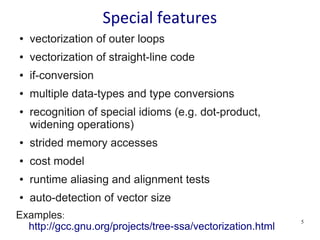
Special features
● vectorization of outer loops
● vectorization of straight-line code
● if-conversion
● multiple data-types and type conversions
● recognition of special idioms (e.g. dot-product,
widening operations)
● strided memory accesses
● cost model
● runtime aliasing and alignment tests
● auto-detection of vector size
Examples:
http://gcc.gnu.org/projects/tree-ssa/vectorization.html
6
GCC Versions
● Current Linaro GCC is based on FSF GCC 4.6
● Once FSF GCC 4.7 is released (in about six
months) Linaro GCC will switch to GCC 4.7
● Some of GCC 4.7 vectorizer related features:
● __builtin_assume_aligned – alignment hints
● vectorization of conditions with mixed types
● vectorization of bool
7
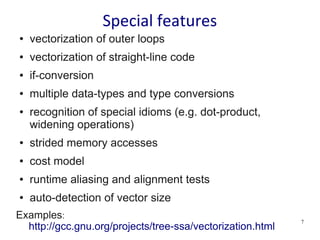
Special features
● vectorization of outer loops
● vectorization of straight-line code
● if-conversion
● multiple data-types and type conversions
● recognition of special idioms (e.g. dot-product,
widening operations)
● strided memory accesses
● cost model
● runtime aliasing and alignment tests
● auto-detection of vector size
Examples:
http://gcc.gnu.org/projects/tree-ssa/vectorization.html
8
Vectorizing for NEON
libswscale/rgb2rgb_template.c:
static inline void rgb24tobgr16_c(
const uint8_t *src, uint8_t *dst,
int src_size) {
const uint8_t *s = src;
const uint8_t *end;
uint16_t *d = (uint16_t *)dst;
end = s + src_size;
while (s < end) {
const int b = *s++;
const int g = *s++;
const int r = *s++;
*d++ = (b>>3) | ((g&0xFC)<<3)
| ((r&0xF8)<<8);
} }
.L12:
mov r1, r4
add r0, r0, #1
vld3.8 {d16, d18, d20}, [r1]!
cmp r0, r6
mov r2, ip
add r4, r4, #48
add ip, ip, #32
vld3.8 {d17, d19, d21}, [r1]
vand q12, q9, q14
vshr.u8 q11, q8, #3
vand q8, q10, q13
vshll.u8 q9, d25, #3
vmovl.u8 q10, d22
vshll.u8 q15, d24, #3
vmovl.u8 q11, d23
vorr q12, q15, q10
vorr q11, q9, q11
vshll.u8 q10, d16, #8
vshll.u8 q9, d17, #8
vorr q8, q12, q10
vorr q11, q11, q9
vst1.16 {q8}, [r2]!
vst1.16 {q11}, [r2]
bcc .L12
scalar: 75000 runs take 216.583ms
vector: 75000 runs take 48.8586ms
speedup: 4.433x
strided access
& and shift right
performed on u8
widening shift
no over-promotion to s32
9
Writing vectorizer-friendly code
● Avoid aliasing problems
– Use __restrict__ qualified pointers
void foo (int *__restrict__ pInput, int *__restrict__ pOutput)
● Don’t unroll loops
– Loop vectorization is more powerful than SLP
for (i=0; i<n; i+=4) {
sum += a[0]; for (i=0; i<n; i++)
sum += a[1]; sum += a[i];
sum += a[2];
sum += a[3];
a += 4;}
10
Writing vectorizer-friendly code (cont.)
● Use countable loops, with no side-effects
– No function-calls in the loop (distribute into a separate
loop)
for (i=0; i<n; i++)
for (i=0; i<n; i++) { if (a[i] == 0) foo();
if (a[i] == 0) foo(); for (i=0; i<n; i++)
b[i] = c[i]; } b[i] = c[i];
– No ‘break’/’continue’
for (i=0; i<n; i++)
for (i=0; i<n; i++) { if (a[i] == 8) {m = i; break;}
if (a[i] == 8) break; for (i=0; i<m; i++)
b[i] = c[i]; } b[i] = c[i];
11
Writing vectorizer-friendly code (cont.)
● Keep the memory access-pattern simple
– Don't use indirect accesses, e.g.:
for (i=0; i<n; i++)
a[b[i]] = x;
– Don't use unknown stride, e.g.:
for (i=0; i<n; i++)
a[i+stride] = x;
● Use "int" iterators rather than "unsigned int" iterators
– The C standard says that the former cannot overflow,
which helps the compiler to determine the trip count.
12
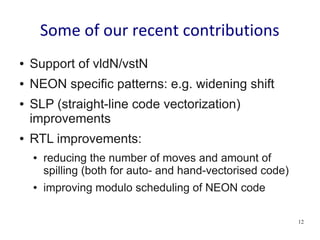
Some of our recent contributions
● Support of vldN/vstN
● NEON specific patterns: e.g. widening shift
● SLP (straight-line code vectorization)
improvements
● RTL improvements:
● reducing the number of moves and amount of
spilling (both for auto- and hand-vectorised code)
● improving modulo scheduling of NEON code
13
People
● Linaro Toolchain WG
● Ira Rosen (IRC: irar)
ira.rosen@linaro.org
– auto-vectorizer
● Richard Sandiford (IRC: rsandifo)
richard.sandiford@linaro.org
– NEON back-end/RTL optimizations
14
Helping us
Send us examples of code that are important to
you to vectorize.
15
Output Example
ex.c:
1 #define N 128
2 int a[N], b[N];
3 void foo (void)
4 {
5 int i;
6
7 for (i = 0; i < N; i++)
8 a[i] = i;
9
10 for (i = 0; i < N; i+=5)
11 b[i] = i;
12 }
● What's got vectorized:
gcc -c -O3 -ftree-vectorizer-verbose=1 ex.c
ex.c:7: note: LOOP VECTORIZED.
ex.c:3: note: vectorized 1 loops in function.
● What's got vectorized and what didn't:
gcc -c -O3 -ftree-vectorizer-verbose=2 ex.c
ex.c:10: note: not vectorized: complicated access
pattern.
ex.c:10: note: not vectorized: complicated access
pattern.
ex.c:7: note: LOOP VECTORIZED.
ex.c:3: note: vectorized 1 loops in function.
...
● All the details:
gcc -c -O3 -ftree-vectorizer-verbose=9 ex.c
or
gcc -c -O3 -fdump-tree-vect-details ex.c

Q4.11: Using GCC Auto-Vectorizer

  • 1.
    1 Using GCC Auto-Vectorizer Ira Rosen<ira.rosen@linaro.org> Michael Hope <michael.hope@linaro.org> r1 bzr branch lp:~michaelh1/+junk/using-the-vectorizer
  • 2.
    2 Using GCC Vectorizer ●Vectorization is enabled by the flag -ftree-vectorize and by default at -O3: ● gcc –O2 –ftree-vectorize myloop.c ● or gcc –O3 myloop.c ● To enable NEON: -mfpu=neon -mfloat-abi=softfp or -mfloat-abi=hard ● Information on which loops got vectorized, and which didn’t and why: ● -fdump-tree-vect(-details) – dumps information into myloop.c.##t.vect ● -ftree-vectorizer-verbose=[X] – dumps to stderr ● More information: http://gcc.gnu.org/projects/tree-ssa/vectorization.html
  • 3.
    3 Other useful flags ●-ffast-math - if operating on floats in a reduction computation (to allow the vectorizer to change the order of the computation) ● -funsafe-loop-optimizations - if using "unsigned int" loop counters (can be assumed not to overflow) ● -ftree-loop-if-convert-stores - more aggressive if-conversion ● --param min-vect-loop-bound=[X] - if have loops with a short trip-count ● -fno-vect-loop-version- if worried about code size
  • 4.
    4 What's vectorizable ● Innermostloops ● countable ● no control flow ● independent data accesses ● continuous data accesses for (k = 0; k < m; k ++) for (j = 0; j < m; j ++) for (i = 0; i < n; i ++) a[k][j][i] = b[k][j][i] * c[k][j][i]; Example of not vectorizable loop: while (a[i] != 8) { if (a[i] != 0) a[i] = a[i-1]; b[i+stride] = 0; } uncountable control flow loop carried dependence access with unknown stride
  • 5.
    5 Special features ● vectorizationof outer loops ● vectorization of straight-line code ● if-conversion ● multiple data-types and type conversions ● recognition of special idioms (e.g. dot-product, widening operations) ● strided memory accesses ● cost model ● runtime aliasing and alignment tests ● auto-detection of vector size Examples: http://gcc.gnu.org/projects/tree-ssa/vectorization.html
  • 6.
    6 GCC Versions ● CurrentLinaro GCC is based on FSF GCC 4.6 ● Once FSF GCC 4.7 is released (in about six months) Linaro GCC will switch to GCC 4.7 ● Some of GCC 4.7 vectorizer related features: ● __builtin_assume_aligned – alignment hints ● vectorization of conditions with mixed types ● vectorization of bool
  • 7.
    7 Special features ● vectorizationof outer loops ● vectorization of straight-line code ● if-conversion ● multiple data-types and type conversions ● recognition of special idioms (e.g. dot-product, widening operations) ● strided memory accesses ● cost model ● runtime aliasing and alignment tests ● auto-detection of vector size Examples: http://gcc.gnu.org/projects/tree-ssa/vectorization.html
  • 8.
    8 Vectorizing for NEON libswscale/rgb2rgb_template.c: staticinline void rgb24tobgr16_c( const uint8_t *src, uint8_t *dst, int src_size) { const uint8_t *s = src; const uint8_t *end; uint16_t *d = (uint16_t *)dst; end = s + src_size; while (s < end) { const int b = *s++; const int g = *s++; const int r = *s++; *d++ = (b>>3) | ((g&0xFC)<<3) | ((r&0xF8)<<8); } } .L12: mov r1, r4 add r0, r0, #1 vld3.8 {d16, d18, d20}, [r1]! cmp r0, r6 mov r2, ip add r4, r4, #48 add ip, ip, #32 vld3.8 {d17, d19, d21}, [r1] vand q12, q9, q14 vshr.u8 q11, q8, #3 vand q8, q10, q13 vshll.u8 q9, d25, #3 vmovl.u8 q10, d22 vshll.u8 q15, d24, #3 vmovl.u8 q11, d23 vorr q12, q15, q10 vorr q11, q9, q11 vshll.u8 q10, d16, #8 vshll.u8 q9, d17, #8 vorr q8, q12, q10 vorr q11, q11, q9 vst1.16 {q8}, [r2]! vst1.16 {q11}, [r2] bcc .L12 scalar: 75000 runs take 216.583ms vector: 75000 runs take 48.8586ms speedup: 4.433x strided access & and shift right performed on u8 widening shift no over-promotion to s32
  • 9.
    9 Writing vectorizer-friendly code ●Avoid aliasing problems – Use __restrict__ qualified pointers void foo (int *__restrict__ pInput, int *__restrict__ pOutput) ● Don’t unroll loops – Loop vectorization is more powerful than SLP for (i=0; i<n; i+=4) { sum += a[0]; for (i=0; i<n; i++) sum += a[1]; sum += a[i]; sum += a[2]; sum += a[3]; a += 4;}
  • 10.
    10 Writing vectorizer-friendly code(cont.) ● Use countable loops, with no side-effects – No function-calls in the loop (distribute into a separate loop) for (i=0; i<n; i++) for (i=0; i<n; i++) { if (a[i] == 0) foo(); if (a[i] == 0) foo(); for (i=0; i<n; i++) b[i] = c[i]; } b[i] = c[i]; – No ‘break’/’continue’ for (i=0; i<n; i++) for (i=0; i<n; i++) { if (a[i] == 8) {m = i; break;} if (a[i] == 8) break; for (i=0; i<m; i++) b[i] = c[i]; } b[i] = c[i];
  • 11.
    11 Writing vectorizer-friendly code(cont.) ● Keep the memory access-pattern simple – Don't use indirect accesses, e.g.: for (i=0; i<n; i++) a[b[i]] = x; – Don't use unknown stride, e.g.: for (i=0; i<n; i++) a[i+stride] = x; ● Use "int" iterators rather than "unsigned int" iterators – The C standard says that the former cannot overflow, which helps the compiler to determine the trip count.
  • 12.
    12 Some of ourrecent contributions ● Support of vldN/vstN ● NEON specific patterns: e.g. widening shift ● SLP (straight-line code vectorization) improvements ● RTL improvements: ● reducing the number of moves and amount of spilling (both for auto- and hand-vectorised code) ● improving modulo scheduling of NEON code
  • 13.
    13 People ● Linaro ToolchainWG ● Ira Rosen (IRC: irar) ira.rosen@linaro.org – auto-vectorizer ● Richard Sandiford (IRC: rsandifo) richard.sandiford@linaro.org – NEON back-end/RTL optimizations
  • 14.
    14 Helping us Send usexamples of code that are important to you to vectorize.
  • 15.
    15 Output Example ex.c: 1 #defineN 128 2 int a[N], b[N]; 3 void foo (void) 4 { 5 int i; 6 7 for (i = 0; i < N; i++) 8 a[i] = i; 9 10 for (i = 0; i < N; i+=5) 11 b[i] = i; 12 } ● What's got vectorized: gcc -c -O3 -ftree-vectorizer-verbose=1 ex.c ex.c:7: note: LOOP VECTORIZED. ex.c:3: note: vectorized 1 loops in function. ● What's got vectorized and what didn't: gcc -c -O3 -ftree-vectorizer-verbose=2 ex.c ex.c:10: note: not vectorized: complicated access pattern. ex.c:10: note: not vectorized: complicated access pattern. ex.c:7: note: LOOP VECTORIZED. ex.c:3: note: vectorized 1 loops in function. ... ● All the details: gcc -c -O3 -ftree-vectorizer-verbose=9 ex.c or gcc -c -O3 -fdump-tree-vect-details ex.c