Introduction to git


Lukas Fittl    29th June 2010
Part 1: Theory
git is really intelligent, and
            beautiful.

But it takes some time to fully grasp the way it works.

  Just ask if you need help with your understanding.
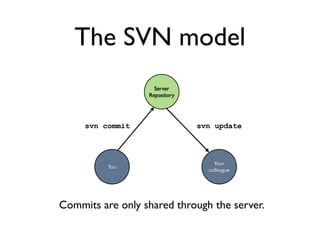
The SVN model
                    Server
                  Repository


     svn commit                svn update


                                   Your
          You
                                 colleague


Commits are only shared through the server.
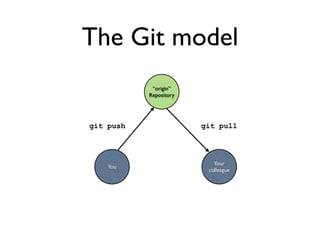
The Git model
            “origin”
           Repository


git push                git pull


                           Your
    You
                         colleague
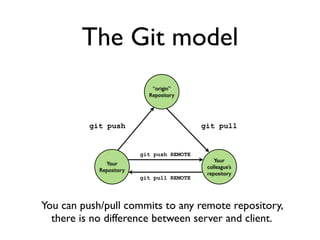
The Git model
                            “origin”
                           Repository


          git push                         git pull


                         git push REMOTE
                                               Your
              Your
                                            colleague’s
            Repository
                                            repository
                         git pull REMOTE


You can push/pull commits to any remote repository,
  there is no difference between server and client.
So how does that
     work?
First of all, definitions:
•   Working tree
    A directory in your filesystem that is associated with a
    repository, containing files & sub-directories.

•   Repository
    A collection of commits & branches, saved in the .git
    directory.

•   Commit
    A snapshot of your working tree at a certain point in
    time, identified by a revision number.

•   HEAD
    The name for the commit thats currently checked out in
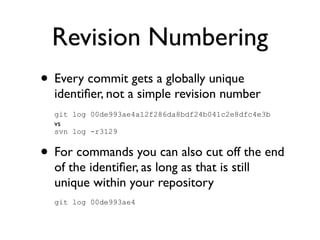
Revision Numbering
• Every commit gets a globally unique
  identifier, not a simple revision number
  git log 00de993ae4a12f286da8bdf24b041c2e8dfc4e3b
  vs
  svn log -r3129


• For commands you can also cut off the end
  of the identifier, as long as that is still
  unique within your repository
  git log 00de993ae4
git clone

   is your starting point for working with
                 existing code

It creates a local repository for you, copying
    & tracking the master branch from the
               specified location.
git clone git@github.com:lfittl/browscap.git ruby-browscap
Remotes
• By default you’ll only have the “origin”
  remote repository, which is the repository
  you did git clone from.

• List existing remotes using git   remote

• Showremote with NAME
  git
         details
                 show

• Add new remotes using
  git remote add NAME       URL
Commits = local
•   git commit only affects your repository,
    not the origin or any other remote
    repository
•   git push in order to share your commits

• Commits are cheap & fast
• Commit as often as possible!
The index
• When you edit/add/remove files, only your
    working tree changes
• To commit changes, you first save them in
    the index with git add or git rm
•   git status shows the current index

•   git commit commits only the changes
    saved in the index, and clears the index
    afterwards
But there’s also git commit -a to commit
all unsaved working tree changes without
         adding them to the index.


   * You still have to use git   rm   for removing files
And don’t forget to

   git push
Also there is

          git log
         git diff
       git annotate


And they do what you expect.

     man git-annotate
            ...


     is also your friend.
Branching
    &
 Merging
Branches are cheap.
Merging just works.
Branch
     =
Named commit
Per default you always work on the
          master branch.
git branch

 shows you the branch you are currently on
(marked with *) & lists the available branches
A branch is local to your repository,
create as many or as little as you like.
Create a new one:
   git branch BRANCH


Checkout an existing one:
  git checkout BRANCH
You can also push all commits of your
 current branch to a remote branch:

      git push REMOTE BRANCH

      git push origin master
             git push
Or checkout someone else’s branch,
 work on it, and then share your
             changes:

         git branch -r
   git checkout REMOTE_BRANCH
       git branch BRANCH
               ...
            git push
git merge BRANCH

Merges the specified branch into your
          current branch.

 You must have a common ancestor.

If the merge fails, use git status to see
    the conflicts, edit the files, git add
        them and then git commit.
You can delete the merged branch
             afterwards:
              git branch -d BRANCH


git will complain if this would result in lost changes (use -D to override).
git push REMOTE :REMOTE_BRANCH

   to delete a remote branch.

                       Careful!
  This won’t check whether the branch is already merged.
Tips & Tricks
git gui

is your friend, especially when
       you’re confused.
git checkout FILENAME

to revert a file changed in the working
          tree back to HEAD
           Only if you didn’t commit yet.
git revert REVISION

    to revert a complete revision.

Creates a new commit that removes the
               changes.
.gitignore
        instead of
svn propset svn:ignore
Single .git directory in the root directory,
    instead of multiple .svn directories
Most relevant configuration is stored in the

                .git/config
         remotes, author name/email, etc.
git stash
git submodule
git cherry-pick
Part 2: Workshop
Further information
•   Git - SVN Crash Course
    http://git.or.cz/course/svn.html


•   The Git Community Book
    http://book.git-scm.com/index.html


•   John Wiegley: Git from the bottom up
    http://ftp.newartisans.com/pub/git.from.bottom.up.pdf


•   Github: a social source-code sharing site
    http://github.com/

Introduction to Git

  • 1.
    Introduction to git LukasFittl 29th June 2010
  • 2.
  • 3.
    git is reallyintelligent, and beautiful. But it takes some time to fully grasp the way it works. Just ask if you need help with your understanding.
  • 4.
    The SVN model Server Repository svn commit svn update Your You colleague Commits are only shared through the server.
  • 5.
    The Git model “origin” Repository git push git pull Your You colleague
  • 6.
    The Git model “origin” Repository git push git pull git push REMOTE Your Your colleague’s Repository repository git pull REMOTE You can push/pull commits to any remote repository, there is no difference between server and client.
  • 7.
    So how doesthat work?
  • 8.
    First of all,definitions: • Working tree A directory in your filesystem that is associated with a repository, containing files & sub-directories. • Repository A collection of commits & branches, saved in the .git directory. • Commit A snapshot of your working tree at a certain point in time, identified by a revision number. • HEAD The name for the commit thats currently checked out in
  • 9.
    Revision Numbering • Everycommit gets a globally unique identifier, not a simple revision number git log 00de993ae4a12f286da8bdf24b041c2e8dfc4e3b vs svn log -r3129 • For commands you can also cut off the end of the identifier, as long as that is still unique within your repository git log 00de993ae4
  • 10.
    git clone is your starting point for working with existing code It creates a local repository for you, copying & tracking the master branch from the specified location. git clone git@github.com:lfittl/browscap.git ruby-browscap
  • 11.
    Remotes • By defaultyou’ll only have the “origin” remote repository, which is the repository you did git clone from. • List existing remotes using git remote • Showremote with NAME git details show • Add new remotes using git remote add NAME URL
  • 12.
    Commits = local • git commit only affects your repository, not the origin or any other remote repository • git push in order to share your commits • Commits are cheap & fast • Commit as often as possible!
  • 13.
    The index • Whenyou edit/add/remove files, only your working tree changes • To commit changes, you first save them in the index with git add or git rm • git status shows the current index • git commit commits only the changes saved in the index, and clears the index afterwards
  • 14.
    But there’s alsogit commit -a to commit all unsaved working tree changes without adding them to the index. * You still have to use git rm for removing files
  • 15.
    And don’t forgetto git push
  • 16.
    Also there is git log git diff git annotate And they do what you expect. man git-annotate ... is also your friend.
  • 17.
    Branching & Merging
  • 18.
  • 19.
  • 20.
    Branch = Named commit
  • 21.
    Per default youalways work on the master branch.
  • 22.
    git branch showsyou the branch you are currently on (marked with *) & lists the available branches
  • 23.
    A branch islocal to your repository, create as many or as little as you like.
  • 24.
    Create a newone: git branch BRANCH Checkout an existing one: git checkout BRANCH
  • 25.
    You can alsopush all commits of your current branch to a remote branch: git push REMOTE BRANCH git push origin master git push
  • 26.
    Or checkout someoneelse’s branch, work on it, and then share your changes: git branch -r git checkout REMOTE_BRANCH git branch BRANCH ... git push
  • 27.
    git merge BRANCH Mergesthe specified branch into your current branch. You must have a common ancestor. If the merge fails, use git status to see the conflicts, edit the files, git add them and then git commit.
  • 28.
    You can deletethe merged branch afterwards: git branch -d BRANCH git will complain if this would result in lost changes (use -D to override).
  • 29.
    git push REMOTE:REMOTE_BRANCH to delete a remote branch. Careful! This won’t check whether the branch is already merged.
  • 30.
  • 31.
    git gui is yourfriend, especially when you’re confused.
  • 32.
    git checkout FILENAME torevert a file changed in the working tree back to HEAD Only if you didn’t commit yet.
  • 33.
    git revert REVISION to revert a complete revision. Creates a new commit that removes the changes.
  • 34.
    .gitignore instead of svn propset svn:ignore
  • 35.
    Single .git directoryin the root directory, instead of multiple .svn directories
  • 36.
    Most relevant configurationis stored in the .git/config remotes, author name/email, etc.
  • 37.
  • 38.
  • 39.
  • 40.
  • 41.
    Further information • Git - SVN Crash Course http://git.or.cz/course/svn.html • The Git Community Book http://book.git-scm.com/index.html • John Wiegley: Git from the bottom up http://ftp.newartisans.com/pub/git.from.bottom.up.pdf • Github: a social source-code sharing site http://github.com/