Vector Codegen in the RISC-V
Backend
Luke Lau
11th October 2023
Agenda
● Overview of RISC-V Vector ISA
● Modelling semantics in LLVM IR
● Vector codegen and lowering
● Middle-end vectorization passes
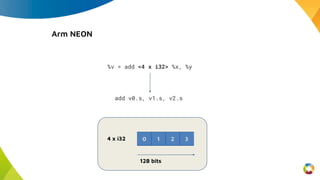
Arm NEON
add v0.s, v1.s, v2.s
%v = add <4 x i32> %x, %y
0 1 2 3
128 bits
4 x i32
● Scalable vector registers
○ 128-1024 bits in size (128-2048 in SVE2)
● Code is vector length agnostic (VLA)
add z0.s, z1.s, z2.s
Arm SVE
0 1 2 3
128 bits
4 x i32
µArch A
0 1 2 3
256 bits
8 x i32
µArch B
4 5 6 7
add z0.s, z1.s, z2.s
Arm SVE
0 1 2 3
Min 128 bits
n x 4 x i32 4 5 6 7 8 9 10 11 12 13
%v = add <???> %x, %y
add z0.s, z1.s, z2.s
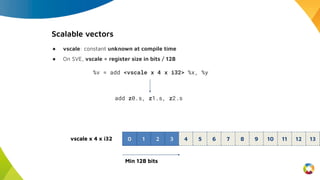
%v = add <vscale x 4 x i32> %x, %y
● vscale: constant unknown at compile time
● On SVE, vscale = register size in bits / 128
Scalable vectors
0 1 2 3
Min 128 bits
vscale x 4 x i32 4 5 6 7 8 9 10 11 12 13
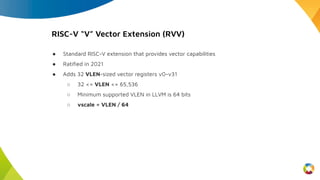
● Standard RISC-V extension that provides vector capabilities
● Ratified in 2021
● Adds 32 VLEN-sized vector registers v0-v31
○ 32 <= VLEN <= 65,536
○ Minimum supported VLEN in LLVM is 64 bits
○ vscale = VLEN / 64
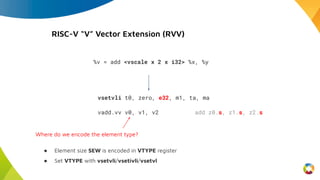
RISC-V “V” Vector Extension (RVV)
vadd.vv v0, v1, v2
%v = add <vscale x 2 x i32> %x, %y
RISC-V “V” Vector Extension (RVV)
add z0.s, z1.s, z2.s
vsetvli t0, zero, e32, m1, ta, ma
● Element size SEW is encoded in VTYPE register
● Set VTYPE with vsetvli/vsetivli/vsetvl
add z0.s, z1.s, z2.s
Where do we encode the element type?
vadd.vv v1, v2, v3
vsetivli t0, 5, e32, m1, ta, ma
● Can control the number of elements to
operate on with the VL register
● Configured with vset[i]vli
Vector length VL
0 1 2 3 4 5 6 7
VL=5
VLEN=256
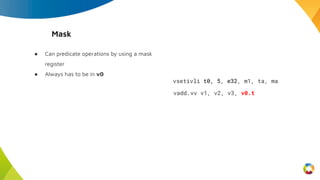
vadd.vv v1, v2, v3, v0.t
vsetivli t0, 5, e32, m1, ta, ma
● Can predicate operations by using a mask
register
● Always has to be in v0
Mask
vadd.vv v1, v2, v3, v0.t
vsetivli t0, 5, e32, m1, ta, ma
● Controlled by length multiplier LMUL, stored
in VTYPE
● At LMUL=1, can operate on VLEN / SEW
elements
Register grouping LMUL
v0 v1 v2 v3
LMUL=1
v4
…
vadd.vv v2, v4, v6, v0.t
vsetivli t0, 5, e32, m2, ta, ma
● Controlled by length multiplier LMUL, stored
in VTYPE
● At LMUL=1, can operate on VLEN / SEW
elements
● At LMUL=2, can operate on VLEN * 2 / SEW
elements
Register grouping LMUL
v0 v2
v0 v1 v2 v3
LMUL=1
LMUL=2
v4
…
v4
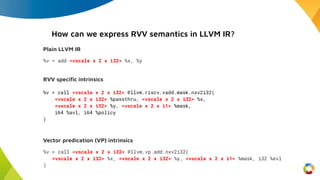
How can we express RVV semantics in LLVM IR?
RVV specific intrinsics
%v = call <vscale x 2 x i32> @llvm.riscv.vadd.mask.nxv2i32(
<vscale x 2 x i32> %passthru, <vscale x 2 x i32> %x,
<vscale x 2 x i32> %y, <vscale x 2 x i1> %mask,
i64 %avl, i64 %policy
)
%v = call <vscale x 2 x i32> @llvm.vp.add.nxv2i32(
<vscale x 2 x i32> %x, <vscale x 2 x i32> %y, <vscale x 2 x i1> %mask, i32 %evl
)
Vector predication (VP) intrinsics
%v = add <vscale x 2 x i32> %x, %y
Plain LLVM IR
How can we express RVV semantics in LLVM IR?
RVV specific intrinsics
%v = call <vscale x 2 x i32> @llvm.riscv.vadd.mask.nxv2i32(
<vscale x 2 x i32> %passthru, <vscale x 2 x i32> %x,
<vscale x 2 x i32> %y, <vscale x 2 x i1> %mask,
i64 %avl, i64 %policy
)
%v = call <vscale x 2 x i32> @llvm.vp.add.nxv2i32(
<vscale x 2 x i32> %x, <vscale x 2 x i32> %y, <vscale x 2 x i1> %mask, i32 %evl
)
Vector predication (VP) intrinsics
%v = add <vscale x 2 x i32> %x, %y
Plain LLVM IR
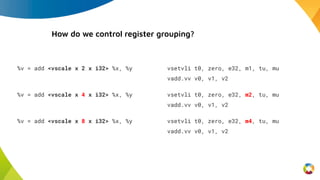
How do we control register grouping?
%v = add <vscale x 2 x i32> %x, %y vsetvli t0, zero, e32, m1, tu, mu
vadd.vv v0, v1, v2
%v = add <vscale x 4 x i32> %x, %y vsetvli t0, zero, e32, m2, tu, mu
vadd.vv v0, v1, v2
%v = add <vscale x 8 x i32> %x, %y vsetvli t0, zero, e32, m4, tu, mu
vadd.vv v0, v1, v2
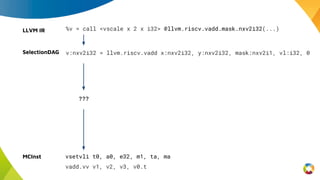
%v = call <vscale x 2 x i32> @llvm.riscv.vadd.mask.nxv2i32(...)
vsetvli t0, a0, e32, m1, ta, ma
vadd.vv v1, v2, v3, v0.t
LLVM IR
MCInst
???
%v = call <vscale x 2 x i32> @llvm.riscv.vadd.mask.nxv2i32(...)
vsetvli t0, a0, e32, m1, ta, ma
vadd.vv v1, v2, v3, v0.t
v:nxv2i32 = llvm.riscv.vadd x:nxv2i32, y:nxv2i32, mask:nxv2i1, vl:i32, 0
LLVM IR
SelectionDAG
MCInst
???
vsetvli t0, a0, e32, m1, ta, ma
vadd.vv v1, v2, v3, v0.t
LLVM IR
SelectionDAG
MCInst
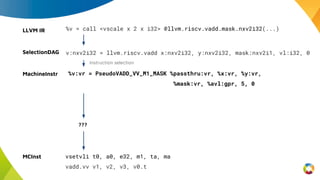
%v:vr = PseudoVADD_VV_M1_MASK %passthru:vr, %x:vr, %y:vr,
%mask:vr, %avl:gpr, 5, 0
MachineInstr
Instruction selection
???
v:nxv2i32 = llvm.riscv.vadd x:nxv2i32, y:nxv2i32, mask:nxv2i1, vl:i32, 0
%v = call <vscale x 2 x i32> @llvm.riscv.vadd.mask.nxv2i32(...)
vsetvli t0, a0, e32, m1, ta, ma
vadd.vv v1, v2, v3, v0.t
LLVM IR
SelectionDAG
MCInst
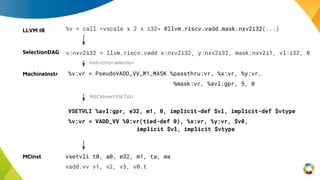
MachineInstr
Instruction selection
VSETVLI %avl:gpr, e32, m1, 0, implicit-def $vl, implicit-def $vtype
%v:vr = VADD_VV %0:vr(tied-def 0), %x:vr, %y:vr, $v0,
implicit $vl, implicit $vtype
RISCVInsertVSETVLI
%v:vr = PseudoVADD_VV_M1_MASK %passthru:vr, %x:vr, %y:vr,
%mask:vr, %avl:gpr, 5, 0
v:nxv2i32 = llvm.riscv.vadd x:nxv2i32, y:nxv2i32, mask:nxv2i1, vl:i32, 0
%v = call <vscale x 2 x i32> @llvm.riscv.vadd.mask.nxv2i32(...)
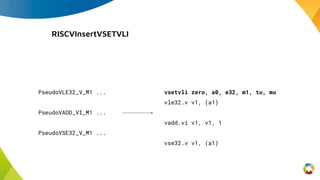
vsetvli zero, a0, e32, m1, tu, mu
vle32.v v1, (a1)
vsetvli zero, a0, e32, m1, tu, mu
vadd.vi v1, v1, 1
vsetvli zero, a0, e32, m1, tu, mu
vse32.v v1, (a1)
RISCVInsertVSETVLI
PseudoVLE32_V_M1 ...
PseudoVADD_VI_M1 ...
PseudoVSE32_V_M1 ...
vsetvli zero, a0, e32, m1, tu, mu
vle32.v v1, (a1)
vadd.vi v1, v1, 1
vse32.v v1, (a1)
RISCVInsertVSETVLI
PseudoVLE32_V_M1 ...
PseudoVADD_VI_M1 ...
PseudoVSE32_V_M1 ...
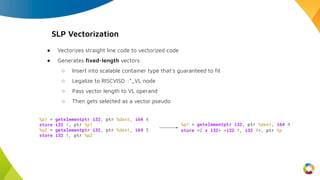
SLP Vectorization
● Vectorizes straight line code to vectorized code
● Generates fixed-length vectors:
○ Insert into scalable container type that’s guaranteed to fit
○ Legalize to RISCVISD::*_VL node
○ Pass vector length to VL operand
○ Then gets selected as a vector pseudo
%p1 = getelementptr i32, ptr %dest, i64 4
store i32 1, ptr %p1
%p2 = getelementptr i32, ptr %dest, i64 5
store i32 1, ptr %p2
%p1 = getelementptr i32, ptr %dest, i64 4
store <2 x i32> <i32 1, i32 1>, ptr %p
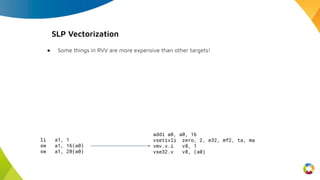
SLP Vectorization
● Some things in RVV are more expensive than other targets!
li a1, 1
sw a1, 16(a0)
sw a1, 20(a0)
addi a0, a0, 16
vsetivli zero, 2, e32, mf2, ta, ma
vmv.v.i v8, 1
vse32.v v8, (a0)
SLP Vectorization
li a1, 1
sw a1, 16(a0)
sw a1, 20(a0)
; SVE
movi v0.2s, #1
str d0, [x0, #16]
● Some things in RVV are more expensive than other targets!
○ No addressing modes in vector load/stores
○ Overhead of vsetvli not costed for
○ Inserts and extracts can be expensive on larger LMULs
○ Which means constant materialization of vectors can be expensive
● Work done to improve cost model
● Recently enabled by default in LLVM 17 now that it’s overall profitable
addi a0, a0, 16
vsetivli zero, 2, e32, mf2, ta, ma
vmv.v.i v8, 1
vse32.v v8, (a0)
Loop Vectorization
f:
blez a1, .exit
li a2, 8
bgeu a1, a2, .vector.preheader
li a2, 0
j .scalar.preheader
.vector.preheader:
andi a2, a1, -8
vsetivli zero, 8, e32, m2, ta, ma
mv a3, a2
mv a4, a0
.vector.body:
vle32.v v8, (a4)
vadd.vi v8, v8, 1
vse32.v v8, (a4)
addi a3, a3, -8
addi a4, a4, 32
bnez a3, .vector.body
beq a2, a1, .exit
.scalar.preheader:
slli a3, a2, 2
add a0, a0, a3
sub a1, a1, a2
.scalar.body:
lw a2, 0(a0)
addi a2, a2, 1
sw a2, 0(a0)
addi a1, a1, -1
addi a0, a0, 4
bnez a1, .scalar.body
.exit:
ret
● Vectorizing with fixed-length vectors is
supported
for (int i = 0; i < n; i++)
x[i]++;
Loop Vectorization
f:
blez a1, .exit
csrr a4, vlenb
srli a3, a4, 1
bgeu a1, a3, .vector.preheader
li a2, 0
j .scalar.preheader
.vector.preheader:
srli a2, a4, 3
slli a5, a2, 2
slli a2, a2, 32
sub a2, a2, a5
and a2, a2, a1
slli a4, a4, 1
vsetvli a5, zero, e32, m2, ta, ma
mv a5, a2
mv a6, a0
.vector.body:
vl2re32.v v8, (a6)
vadd.vi v8, v8, 1
vs2r.v v8, (a6)
sub a5, a5, a3
add a6, a6, a4
bnez a5, .vector.body
beq a2, a1, .exit
.scalar.preheader:
slli a3, a2, 2
add a0, a0, a3
sub a1, a1, a2
.scalar.body:
lw a2, 0(a0)
addiw a2, a2, 1
sw a2, 0(a0)
addi a1, a1, -1
addi a0, a0, 4
bnez a1, .scalar.body
.exit:
ret
for (int i = 0; i < n; i++)
x[i]++;
● Vectorizing with fixed-length vectors is
supported
● Scalable vectorization is enabled by default
Loop Vectorization
f:
blez a1, .exit
csrr a4, vlenb
srli a3, a4, 1
bgeu a1, a3, .vector.preheader
li a2, 0
j .scalar.preheader
.vector.preheader:
srli a2, a4, 3
slli a5, a2, 2
slli a2, a2, 32
sub a2, a2, a5
and a2, a2, a1
slli a4, a4, 1
vsetvli a5, zero, e32, m2, ta, ma
mv a5, a2
mv a6, a0
.vector.body:
vl2re32.v v8, (a6)
vadd.vi v8, v8, 1
vs2r.v v8, (a6)
sub a5, a5, a3
add a6, a6, a4
bnez a5, .vector.body
beq a2, a1, .exit
.scalar.preheader:
slli a3, a2, 2
add a0, a0, a3
sub a1, a1, a2
.scalar.body:
lw a2, 0(a0)
addiw a2, a2, 1
sw a2, 0(a0)
addi a1, a1, -1
addi a0, a0, 4
bnez a1, .scalar.body
.exit:
ret
● Vectorizing with fixed-length vectors is
supported
● Scalable vectorization is enabled by default
● Uses LMUL=2 by default
○ Could be smarter and increase it, but
need to account for register pressure
for (int i = 0; i < n; i++)
x[i]++;
Loop Vectorization
f:
blez a1, .exit
csrr a4, vlenb
srli a3, a4, 1
bgeu a1, a3, .vector.preheader
li a2, 0
j .scalar.preheader
.vector.preheader:
srli a2, a4, 3
slli a5, a2, 2
slli a2, a2, 32
sub a2, a2, a5
and a2, a2, a1
slli a4, a4, 1
vsetvli a5, zero, e32, m2, ta, ma
mv a5, a2
mv a6, a0
.vector.body:
vl2re32.v v8, (a6)
vadd.vi v8, v8, 1
vs2r.v v8, (a6)
sub a5, a5, a3
add a6, a6, a4
bnez a5, .vector.body
beq a2, a1, .exit
.scalar.preheader:
slli a3, a2, 2
add a0, a0, a3
sub a1, a1, a2
.scalar.body:
lw a2, 0(a0)
addiw a2, a2, 1
sw a2, 0(a0)
addi a1, a1, -1
addi a0, a0, 4
bnez a1, .scalar.body
.exit:
ret
● Vectorizing with fixed-length vectors is
supported
● Scalable vectorization is enabled by default
● Uses LMUL=2 by default
○ Could be smarter and increase it, but
need to account for register pressure
● By default scalar epilogue is emitted…
for (int i = 0; i < n; i++)
x[i]++;
Loop Vectorization
f:
blez a1, .exit
li a2, 0
csrr a5, vlenb
srli a3, a5, 1
neg a4, a3
add a6, a3, a1
addi a6, a6, -1
and a4, a6, a4
slli a5, a5, 1
vsetvli a6, zero, e64, m4, ta, ma
vid.v v8
.vector.body:
vsetvli zero, zero, e64, m4, ta, ma
vsaddu.vx v12, v8, a2
vmsltu.vx v0, v12, a1
vle32.v v12, (a0), v0.t
vsetvli zero, zero, e32, m2, ta, ma
vadd.vi v12, v12, 1
vse32.v v12, (a0), v0.t
add a2, a2, a3
add a0, a0, a5
bne a4, a2, .vector.body
.exit:
ret
● Vectorizing with fixed-length vectors is
supported
● Scalable vectorization is enabled by default
● Uses LMUL=2 by default
○ Could be smarter and increase it, but need
to account for register pressure
● By default scalar epilogue is emitted…
○ But predicated tail folding can be enabled
with -prefer-predicate-over-epilogue
for (int i = 0; i < n; i++)
x[i]++;
Loop Vectorization
f:
blez a1, .exit
.vector.body:
vsetvli t0, a1, e32, m2, ta, ma
vle32.v v12, (a0)
vadd.vi v12, v12, 1
vse32.v v12, (a0)
sub a1, a1, t0
add a0, a0, t0
bnez a1, .vector.body
.exit:
ret
for (int i = 0; i < n; i++)
x[i]++;
● Vectorizing with fixed-length vectors is
supported
● Scalable vectorization is enabled by default
● Uses LMUL=2 by default
○ Could be smarter and increase it, but need
to account for register pressure
● By default scalar epilogue is emitted…
○ But predicated tail folding can be enabled
with -prefer-predicate-over-epilogue
○ Work is underway to perform tail folding
via VL (D99750)
■ Via VP intrinsics
What next?
● Teach loop vectorizer to dynamically select an LMUL
● Round out vector predication support
○ Lift InstCombine/DAGCombine to handle VP intrinsics
● Handle scalable interleaved accesses with more than 2 groups
○ Take advantage of segmented loads/stores: vlseg/vsseg
● Data dependent loop exits
○ Take advantage of fault-only-first loads: vle32ff.v
● Use VL to allow SLP to vectorize non-power-of-2 VFs
Vector Codegen in the RISC-V Backend

Vector Codegen in the RISC-V Backend

  • 1.
    Vector Codegen inthe RISC-V Backend Luke Lau 11th October 2023
  • 2.
    Agenda ● Overview ofRISC-V Vector ISA ● Modelling semantics in LLVM IR ● Vector codegen and lowering ● Middle-end vectorization passes
  • 3.
    Arm NEON add v0.s,v1.s, v2.s %v = add <4 x i32> %x, %y 0 1 2 3 128 bits 4 x i32
  • 4.
    ● Scalable vectorregisters ○ 128-1024 bits in size (128-2048 in SVE2) ● Code is vector length agnostic (VLA) add z0.s, z1.s, z2.s Arm SVE 0 1 2 3 128 bits 4 x i32 µArch A 0 1 2 3 256 bits 8 x i32 µArch B 4 5 6 7
  • 5.
    add z0.s, z1.s,z2.s Arm SVE 0 1 2 3 Min 128 bits n x 4 x i32 4 5 6 7 8 9 10 11 12 13 %v = add <???> %x, %y
  • 6.
    add z0.s, z1.s,z2.s %v = add <vscale x 4 x i32> %x, %y ● vscale: constant unknown at compile time ● On SVE, vscale = register size in bits / 128 Scalable vectors 0 1 2 3 Min 128 bits vscale x 4 x i32 4 5 6 7 8 9 10 11 12 13
  • 7.
    ● Standard RISC-Vextension that provides vector capabilities ● Ratified in 2021 ● Adds 32 VLEN-sized vector registers v0-v31 ○ 32 <= VLEN <= 65,536 ○ Minimum supported VLEN in LLVM is 64 bits ○ vscale = VLEN / 64 RISC-V “V” Vector Extension (RVV)
  • 8.
    vadd.vv v0, v1,v2 %v = add <vscale x 2 x i32> %x, %y RISC-V “V” Vector Extension (RVV) add z0.s, z1.s, z2.s vsetvli t0, zero, e32, m1, ta, ma ● Element size SEW is encoded in VTYPE register ● Set VTYPE with vsetvli/vsetivli/vsetvl add z0.s, z1.s, z2.s Where do we encode the element type?
  • 9.
    vadd.vv v1, v2,v3 vsetivli t0, 5, e32, m1, ta, ma ● Can control the number of elements to operate on with the VL register ● Configured with vset[i]vli Vector length VL 0 1 2 3 4 5 6 7 VL=5 VLEN=256
  • 10.
    vadd.vv v1, v2,v3, v0.t vsetivli t0, 5, e32, m1, ta, ma ● Can predicate operations by using a mask register ● Always has to be in v0 Mask
  • 11.
    vadd.vv v1, v2,v3, v0.t vsetivli t0, 5, e32, m1, ta, ma ● Controlled by length multiplier LMUL, stored in VTYPE ● At LMUL=1, can operate on VLEN / SEW elements Register grouping LMUL v0 v1 v2 v3 LMUL=1 v4 …
  • 12.
    vadd.vv v2, v4,v6, v0.t vsetivli t0, 5, e32, m2, ta, ma ● Controlled by length multiplier LMUL, stored in VTYPE ● At LMUL=1, can operate on VLEN / SEW elements ● At LMUL=2, can operate on VLEN * 2 / SEW elements Register grouping LMUL v0 v2 v0 v1 v2 v3 LMUL=1 LMUL=2 v4 … v4
  • 13.
    How can weexpress RVV semantics in LLVM IR? RVV specific intrinsics %v = call <vscale x 2 x i32> @llvm.riscv.vadd.mask.nxv2i32( <vscale x 2 x i32> %passthru, <vscale x 2 x i32> %x, <vscale x 2 x i32> %y, <vscale x 2 x i1> %mask, i64 %avl, i64 %policy ) %v = call <vscale x 2 x i32> @llvm.vp.add.nxv2i32( <vscale x 2 x i32> %x, <vscale x 2 x i32> %y, <vscale x 2 x i1> %mask, i32 %evl ) Vector predication (VP) intrinsics %v = add <vscale x 2 x i32> %x, %y Plain LLVM IR
  • 14.
    How can weexpress RVV semantics in LLVM IR? RVV specific intrinsics %v = call <vscale x 2 x i32> @llvm.riscv.vadd.mask.nxv2i32( <vscale x 2 x i32> %passthru, <vscale x 2 x i32> %x, <vscale x 2 x i32> %y, <vscale x 2 x i1> %mask, i64 %avl, i64 %policy ) %v = call <vscale x 2 x i32> @llvm.vp.add.nxv2i32( <vscale x 2 x i32> %x, <vscale x 2 x i32> %y, <vscale x 2 x i1> %mask, i32 %evl ) Vector predication (VP) intrinsics %v = add <vscale x 2 x i32> %x, %y Plain LLVM IR
  • 15.
    How do wecontrol register grouping? %v = add <vscale x 2 x i32> %x, %y vsetvli t0, zero, e32, m1, tu, mu vadd.vv v0, v1, v2 %v = add <vscale x 4 x i32> %x, %y vsetvli t0, zero, e32, m2, tu, mu vadd.vv v0, v1, v2 %v = add <vscale x 8 x i32> %x, %y vsetvli t0, zero, e32, m4, tu, mu vadd.vv v0, v1, v2
  • 16.
    %v = call<vscale x 2 x i32> @llvm.riscv.vadd.mask.nxv2i32(...) vsetvli t0, a0, e32, m1, ta, ma vadd.vv v1, v2, v3, v0.t LLVM IR MCInst ???
  • 17.
    %v = call<vscale x 2 x i32> @llvm.riscv.vadd.mask.nxv2i32(...) vsetvli t0, a0, e32, m1, ta, ma vadd.vv v1, v2, v3, v0.t v:nxv2i32 = llvm.riscv.vadd x:nxv2i32, y:nxv2i32, mask:nxv2i1, vl:i32, 0 LLVM IR SelectionDAG MCInst ???
  • 18.
    vsetvli t0, a0,e32, m1, ta, ma vadd.vv v1, v2, v3, v0.t LLVM IR SelectionDAG MCInst %v:vr = PseudoVADD_VV_M1_MASK %passthru:vr, %x:vr, %y:vr, %mask:vr, %avl:gpr, 5, 0 MachineInstr Instruction selection ??? v:nxv2i32 = llvm.riscv.vadd x:nxv2i32, y:nxv2i32, mask:nxv2i1, vl:i32, 0 %v = call <vscale x 2 x i32> @llvm.riscv.vadd.mask.nxv2i32(...)
  • 19.
    vsetvli t0, a0,e32, m1, ta, ma vadd.vv v1, v2, v3, v0.t LLVM IR SelectionDAG MCInst MachineInstr Instruction selection VSETVLI %avl:gpr, e32, m1, 0, implicit-def $vl, implicit-def $vtype %v:vr = VADD_VV %0:vr(tied-def 0), %x:vr, %y:vr, $v0, implicit $vl, implicit $vtype RISCVInsertVSETVLI %v:vr = PseudoVADD_VV_M1_MASK %passthru:vr, %x:vr, %y:vr, %mask:vr, %avl:gpr, 5, 0 v:nxv2i32 = llvm.riscv.vadd x:nxv2i32, y:nxv2i32, mask:nxv2i1, vl:i32, 0 %v = call <vscale x 2 x i32> @llvm.riscv.vadd.mask.nxv2i32(...)
  • 20.
    vsetvli zero, a0,e32, m1, tu, mu vle32.v v1, (a1) vsetvli zero, a0, e32, m1, tu, mu vadd.vi v1, v1, 1 vsetvli zero, a0, e32, m1, tu, mu vse32.v v1, (a1) RISCVInsertVSETVLI PseudoVLE32_V_M1 ... PseudoVADD_VI_M1 ... PseudoVSE32_V_M1 ...
  • 21.
    vsetvli zero, a0,e32, m1, tu, mu vle32.v v1, (a1) vadd.vi v1, v1, 1 vse32.v v1, (a1) RISCVInsertVSETVLI PseudoVLE32_V_M1 ... PseudoVADD_VI_M1 ... PseudoVSE32_V_M1 ...
  • 22.
    SLP Vectorization ● Vectorizesstraight line code to vectorized code ● Generates fixed-length vectors: ○ Insert into scalable container type that’s guaranteed to fit ○ Legalize to RISCVISD::*_VL node ○ Pass vector length to VL operand ○ Then gets selected as a vector pseudo %p1 = getelementptr i32, ptr %dest, i64 4 store i32 1, ptr %p1 %p2 = getelementptr i32, ptr %dest, i64 5 store i32 1, ptr %p2 %p1 = getelementptr i32, ptr %dest, i64 4 store <2 x i32> <i32 1, i32 1>, ptr %p
  • 23.
    SLP Vectorization ● Somethings in RVV are more expensive than other targets! li a1, 1 sw a1, 16(a0) sw a1, 20(a0) addi a0, a0, 16 vsetivli zero, 2, e32, mf2, ta, ma vmv.v.i v8, 1 vse32.v v8, (a0)
  • 24.
    SLP Vectorization li a1,1 sw a1, 16(a0) sw a1, 20(a0) ; SVE movi v0.2s, #1 str d0, [x0, #16] ● Some things in RVV are more expensive than other targets! ○ No addressing modes in vector load/stores ○ Overhead of vsetvli not costed for ○ Inserts and extracts can be expensive on larger LMULs ○ Which means constant materialization of vectors can be expensive ● Work done to improve cost model ● Recently enabled by default in LLVM 17 now that it’s overall profitable addi a0, a0, 16 vsetivli zero, 2, e32, mf2, ta, ma vmv.v.i v8, 1 vse32.v v8, (a0)
  • 25.
    Loop Vectorization f: blez a1,.exit li a2, 8 bgeu a1, a2, .vector.preheader li a2, 0 j .scalar.preheader .vector.preheader: andi a2, a1, -8 vsetivli zero, 8, e32, m2, ta, ma mv a3, a2 mv a4, a0 .vector.body: vle32.v v8, (a4) vadd.vi v8, v8, 1 vse32.v v8, (a4) addi a3, a3, -8 addi a4, a4, 32 bnez a3, .vector.body beq a2, a1, .exit .scalar.preheader: slli a3, a2, 2 add a0, a0, a3 sub a1, a1, a2 .scalar.body: lw a2, 0(a0) addi a2, a2, 1 sw a2, 0(a0) addi a1, a1, -1 addi a0, a0, 4 bnez a1, .scalar.body .exit: ret ● Vectorizing with fixed-length vectors is supported for (int i = 0; i < n; i++) x[i]++;
  • 26.
    Loop Vectorization f: blez a1,.exit csrr a4, vlenb srli a3, a4, 1 bgeu a1, a3, .vector.preheader li a2, 0 j .scalar.preheader .vector.preheader: srli a2, a4, 3 slli a5, a2, 2 slli a2, a2, 32 sub a2, a2, a5 and a2, a2, a1 slli a4, a4, 1 vsetvli a5, zero, e32, m2, ta, ma mv a5, a2 mv a6, a0 .vector.body: vl2re32.v v8, (a6) vadd.vi v8, v8, 1 vs2r.v v8, (a6) sub a5, a5, a3 add a6, a6, a4 bnez a5, .vector.body beq a2, a1, .exit .scalar.preheader: slli a3, a2, 2 add a0, a0, a3 sub a1, a1, a2 .scalar.body: lw a2, 0(a0) addiw a2, a2, 1 sw a2, 0(a0) addi a1, a1, -1 addi a0, a0, 4 bnez a1, .scalar.body .exit: ret for (int i = 0; i < n; i++) x[i]++; ● Vectorizing with fixed-length vectors is supported ● Scalable vectorization is enabled by default
  • 27.
    Loop Vectorization f: blez a1,.exit csrr a4, vlenb srli a3, a4, 1 bgeu a1, a3, .vector.preheader li a2, 0 j .scalar.preheader .vector.preheader: srli a2, a4, 3 slli a5, a2, 2 slli a2, a2, 32 sub a2, a2, a5 and a2, a2, a1 slli a4, a4, 1 vsetvli a5, zero, e32, m2, ta, ma mv a5, a2 mv a6, a0 .vector.body: vl2re32.v v8, (a6) vadd.vi v8, v8, 1 vs2r.v v8, (a6) sub a5, a5, a3 add a6, a6, a4 bnez a5, .vector.body beq a2, a1, .exit .scalar.preheader: slli a3, a2, 2 add a0, a0, a3 sub a1, a1, a2 .scalar.body: lw a2, 0(a0) addiw a2, a2, 1 sw a2, 0(a0) addi a1, a1, -1 addi a0, a0, 4 bnez a1, .scalar.body .exit: ret ● Vectorizing with fixed-length vectors is supported ● Scalable vectorization is enabled by default ● Uses LMUL=2 by default ○ Could be smarter and increase it, but need to account for register pressure for (int i = 0; i < n; i++) x[i]++;
  • 28.
    Loop Vectorization f: blez a1,.exit csrr a4, vlenb srli a3, a4, 1 bgeu a1, a3, .vector.preheader li a2, 0 j .scalar.preheader .vector.preheader: srli a2, a4, 3 slli a5, a2, 2 slli a2, a2, 32 sub a2, a2, a5 and a2, a2, a1 slli a4, a4, 1 vsetvli a5, zero, e32, m2, ta, ma mv a5, a2 mv a6, a0 .vector.body: vl2re32.v v8, (a6) vadd.vi v8, v8, 1 vs2r.v v8, (a6) sub a5, a5, a3 add a6, a6, a4 bnez a5, .vector.body beq a2, a1, .exit .scalar.preheader: slli a3, a2, 2 add a0, a0, a3 sub a1, a1, a2 .scalar.body: lw a2, 0(a0) addiw a2, a2, 1 sw a2, 0(a0) addi a1, a1, -1 addi a0, a0, 4 bnez a1, .scalar.body .exit: ret ● Vectorizing with fixed-length vectors is supported ● Scalable vectorization is enabled by default ● Uses LMUL=2 by default ○ Could be smarter and increase it, but need to account for register pressure ● By default scalar epilogue is emitted… for (int i = 0; i < n; i++) x[i]++;
  • 29.
    Loop Vectorization f: blez a1,.exit li a2, 0 csrr a5, vlenb srli a3, a5, 1 neg a4, a3 add a6, a3, a1 addi a6, a6, -1 and a4, a6, a4 slli a5, a5, 1 vsetvli a6, zero, e64, m4, ta, ma vid.v v8 .vector.body: vsetvli zero, zero, e64, m4, ta, ma vsaddu.vx v12, v8, a2 vmsltu.vx v0, v12, a1 vle32.v v12, (a0), v0.t vsetvli zero, zero, e32, m2, ta, ma vadd.vi v12, v12, 1 vse32.v v12, (a0), v0.t add a2, a2, a3 add a0, a0, a5 bne a4, a2, .vector.body .exit: ret ● Vectorizing with fixed-length vectors is supported ● Scalable vectorization is enabled by default ● Uses LMUL=2 by default ○ Could be smarter and increase it, but need to account for register pressure ● By default scalar epilogue is emitted… ○ But predicated tail folding can be enabled with -prefer-predicate-over-epilogue for (int i = 0; i < n; i++) x[i]++;
  • 30.
    Loop Vectorization f: blez a1,.exit .vector.body: vsetvli t0, a1, e32, m2, ta, ma vle32.v v12, (a0) vadd.vi v12, v12, 1 vse32.v v12, (a0) sub a1, a1, t0 add a0, a0, t0 bnez a1, .vector.body .exit: ret for (int i = 0; i < n; i++) x[i]++; ● Vectorizing with fixed-length vectors is supported ● Scalable vectorization is enabled by default ● Uses LMUL=2 by default ○ Could be smarter and increase it, but need to account for register pressure ● By default scalar epilogue is emitted… ○ But predicated tail folding can be enabled with -prefer-predicate-over-epilogue ○ Work is underway to perform tail folding via VL (D99750) ■ Via VP intrinsics
  • 31.
    What next? ● Teachloop vectorizer to dynamically select an LMUL ● Round out vector predication support ○ Lift InstCombine/DAGCombine to handle VP intrinsics ● Handle scalable interleaved accesses with more than 2 groups ○ Take advantage of segmented loads/stores: vlseg/vsseg ● Data dependent loop exits ○ Take advantage of fault-only-first loads: vle32ff.v ● Use VL to allow SLP to vectorize non-power-of-2 VFs