Introduction to
OP-TEE
25 May 2016
May-2016AGL-2.0 OP-TEE Introduction 2
OP-TEE
● OP-TEE
● Open-source Portable Trusted Execution Environment,
● Implements the Global Platform API on top of ARM TrustZone,
● Initiated by ST in 2007, then handled by Linaro (sources on GitHub).
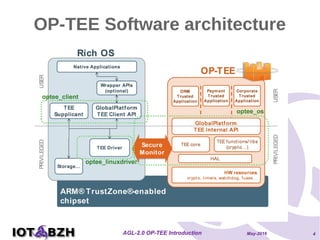
● Architecture
● Security by isolated execution, introducing two contexts:
– Rich Execution Environment (normal world),
– Trusted Execution Environment (secure world).
● A software part handles context switches :
– “secure monitor” (armv7) or “ARM trusted firmware” (armv8).
● Both worlds communicates through:
– Sequences of messages ( ioctl() ),
– Shared memory.
May-2016AGL-2.0 OP-TEE Introduction 3
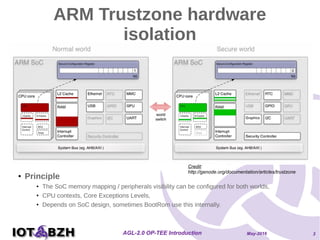
ARM Trustzone hardware
isolation
●
Principle
●
The SoC memory mapping / peripherals visibility can be configured for both worlds,
●
CPU contexts, Core Exceptions Levels,
●
Depends on SoC design, sometimes BootRom use this internally.
Credit:
http://genode.org/documentation/articles/trustzone
May-2016AGL-2.0 OP-TEE Introduction 4
OP-TEE Software architecture
May-2016AGL-2.0 OP-TEE Introduction 5
OP-TEE
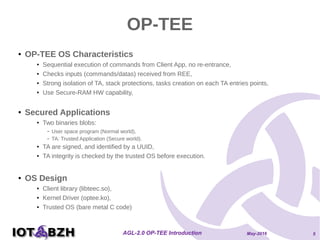
● OP-TEE OS Characteristics
● Sequential execution of commands from Client App, no re-entrance,
● Checks inputs (commands/datas) received from REE,
● Strong isolation of TA, stack protections, tasks creation on each TA entries points,
● Use Secure-RAM HW capability,
● Secured Applications
● Two binaries blobs:
– User space program (Normal world),
– TA: Trusted Application (Secure world).
● TA are signed, and identified by a UUID,
● TA integrity is checked by the trusted OS before execution.
● OS Design
● Client library (libteec.so),
● Kernel Driver (optee.ko),
● Trusted OS (bare metal C code)
May-2016AGL-2.0 OP-TEE Introduction 6
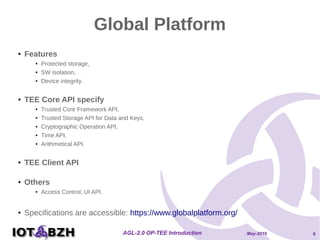
Global Platform
●
Features
● Protected storage,
● SW isolation,
● Device integrity.
● TEE Core API specify
● Trusted Core Framework API,
● Trusted Storage API for Data and Keys,
● Cryptographic Operation API,
● Time API,
● Arithmetical API.
● TEE Client API
● Others
● Access Control, UI API.
● Specifications are accessible: https://www.globalplatform.org/
May-2016AGL-2.0 OP-TEE Introduction 7
Dynamic view
May-2016AGL-2.0 OP-TEE Introduction 8
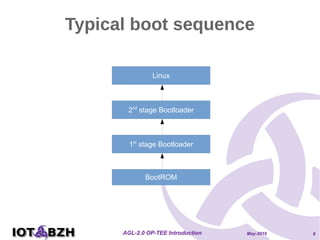
Typical boot sequence
2nd
stage Bootloader
Linux
BootROM
1st
stage Bootloader
May-2016AGL-2.0 OP-TEE Introduction 9
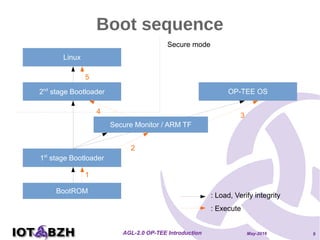
Boot sequence
2nd
stage Bootloader
Linux
BootROM
1st
stage Bootloader
Secure mode
: Load, Verify integrity
OP-TEE OS
Secure Monitor / ARM TF
1
2
3
4
5
: Execute
May-2016AGL-2.0 OP-TEE Introduction 10
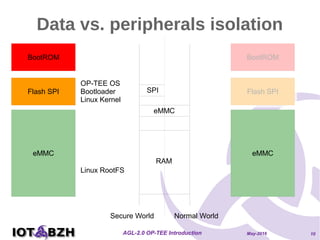
Data vs. peripherals isolation
eMMC
Flash SPI
BootROM
OP-TEE OS
Bootloader
Linux Kernel
Flash SPI
BootROM
eMMC
Linux RootFS
RAM
Secure World Normal World
eMMC
SPI
May-2016AGL-2.0 OP-TEE Introduction 11
Data storage
● Secure storage
● Using Normal world rootfs + cryptography,
● Using eMMC RPMB (Jedec-84 A) partition,
● A Storage usage policy may be defined
● In regards of distro. packages & SW architecture,
● Installation strategy to perform the update
● Single vs. Dual copy updates,
● Recovery mode, rollback, persistence,
● Sw update package format,
● ...
May-2016AGL-2.0 OP-TEE Introduction 12
Status
● Integration in Yocto/AGL
● Layer enabling a QEmu machine with OP-TEE OS +
samples apps:
https://github.com/iotbzh/meta-optee
● Open points
● Security API commonly available in Intel TXT & ARM,
architecture that can enforce SOTA,
● Key management,
● Updates package format, generation from Yocto,
May-2016AGL-2.0 OP-TEE Introduction 13
References
External links:
● http://fr.slideshare.net/linaroorg/hkg15311-optee-for-beginners-and-porting-review
● http://fr.slideshare.net/linaroorg/lcu14-302-how-to-port-optee-to-another-platform
Sources repositories:
● https://github.com/OP-TEE/
● https://github.com/OP-TEE/optee_os/tree/master/documentation
● https://github.com/ARM-software/arm-trusted-firmware

Introduction to Optee (26 may 2016)

  • 1.
  • 2.
    May-2016AGL-2.0 OP-TEE Introduction2 OP-TEE ● OP-TEE ● Open-source Portable Trusted Execution Environment, ● Implements the Global Platform API on top of ARM TrustZone, ● Initiated by ST in 2007, then handled by Linaro (sources on GitHub). ● Architecture ● Security by isolated execution, introducing two contexts: – Rich Execution Environment (normal world), – Trusted Execution Environment (secure world). ● A software part handles context switches : – “secure monitor” (armv7) or “ARM trusted firmware” (armv8). ● Both worlds communicates through: – Sequences of messages ( ioctl() ), – Shared memory.
  • 3.
    May-2016AGL-2.0 OP-TEE Introduction3 ARM Trustzone hardware isolation ● Principle ● The SoC memory mapping / peripherals visibility can be configured for both worlds, ● CPU contexts, Core Exceptions Levels, ● Depends on SoC design, sometimes BootRom use this internally. Credit: http://genode.org/documentation/articles/trustzone
  • 4.
    May-2016AGL-2.0 OP-TEE Introduction4 OP-TEE Software architecture
  • 5.
    May-2016AGL-2.0 OP-TEE Introduction5 OP-TEE ● OP-TEE OS Characteristics ● Sequential execution of commands from Client App, no re-entrance, ● Checks inputs (commands/datas) received from REE, ● Strong isolation of TA, stack protections, tasks creation on each TA entries points, ● Use Secure-RAM HW capability, ● Secured Applications ● Two binaries blobs: – User space program (Normal world), – TA: Trusted Application (Secure world). ● TA are signed, and identified by a UUID, ● TA integrity is checked by the trusted OS before execution. ● OS Design ● Client library (libteec.so), ● Kernel Driver (optee.ko), ● Trusted OS (bare metal C code)
  • 6.
    May-2016AGL-2.0 OP-TEE Introduction6 Global Platform ● Features ● Protected storage, ● SW isolation, ● Device integrity. ● TEE Core API specify ● Trusted Core Framework API, ● Trusted Storage API for Data and Keys, ● Cryptographic Operation API, ● Time API, ● Arithmetical API. ● TEE Client API ● Others ● Access Control, UI API. ● Specifications are accessible: https://www.globalplatform.org/
  • 7.
  • 8.
    May-2016AGL-2.0 OP-TEE Introduction8 Typical boot sequence 2nd stage Bootloader Linux BootROM 1st stage Bootloader
  • 9.
    May-2016AGL-2.0 OP-TEE Introduction9 Boot sequence 2nd stage Bootloader Linux BootROM 1st stage Bootloader Secure mode : Load, Verify integrity OP-TEE OS Secure Monitor / ARM TF 1 2 3 4 5 : Execute
  • 10.
    May-2016AGL-2.0 OP-TEE Introduction10 Data vs. peripherals isolation eMMC Flash SPI BootROM OP-TEE OS Bootloader Linux Kernel Flash SPI BootROM eMMC Linux RootFS RAM Secure World Normal World eMMC SPI
  • 11.
    May-2016AGL-2.0 OP-TEE Introduction11 Data storage ● Secure storage ● Using Normal world rootfs + cryptography, ● Using eMMC RPMB (Jedec-84 A) partition, ● A Storage usage policy may be defined ● In regards of distro. packages & SW architecture, ● Installation strategy to perform the update ● Single vs. Dual copy updates, ● Recovery mode, rollback, persistence, ● Sw update package format, ● ...
  • 12.
    May-2016AGL-2.0 OP-TEE Introduction12 Status ● Integration in Yocto/AGL ● Layer enabling a QEmu machine with OP-TEE OS + samples apps: https://github.com/iotbzh/meta-optee ● Open points ● Security API commonly available in Intel TXT & ARM, architecture that can enforce SOTA, ● Key management, ● Updates package format, generation from Yocto,
  • 13.
    May-2016AGL-2.0 OP-TEE Introduction13 References External links: ● http://fr.slideshare.net/linaroorg/hkg15311-optee-for-beginners-and-porting-review ● http://fr.slideshare.net/linaroorg/lcu14-302-how-to-port-optee-to-another-platform Sources repositories: ● https://github.com/OP-TEE/ ● https://github.com/OP-TEE/optee_os/tree/master/documentation ● https://github.com/ARM-software/arm-trusted-firmware