Boost.Compute
Kyle Lutz
A C++ library for GPU computing
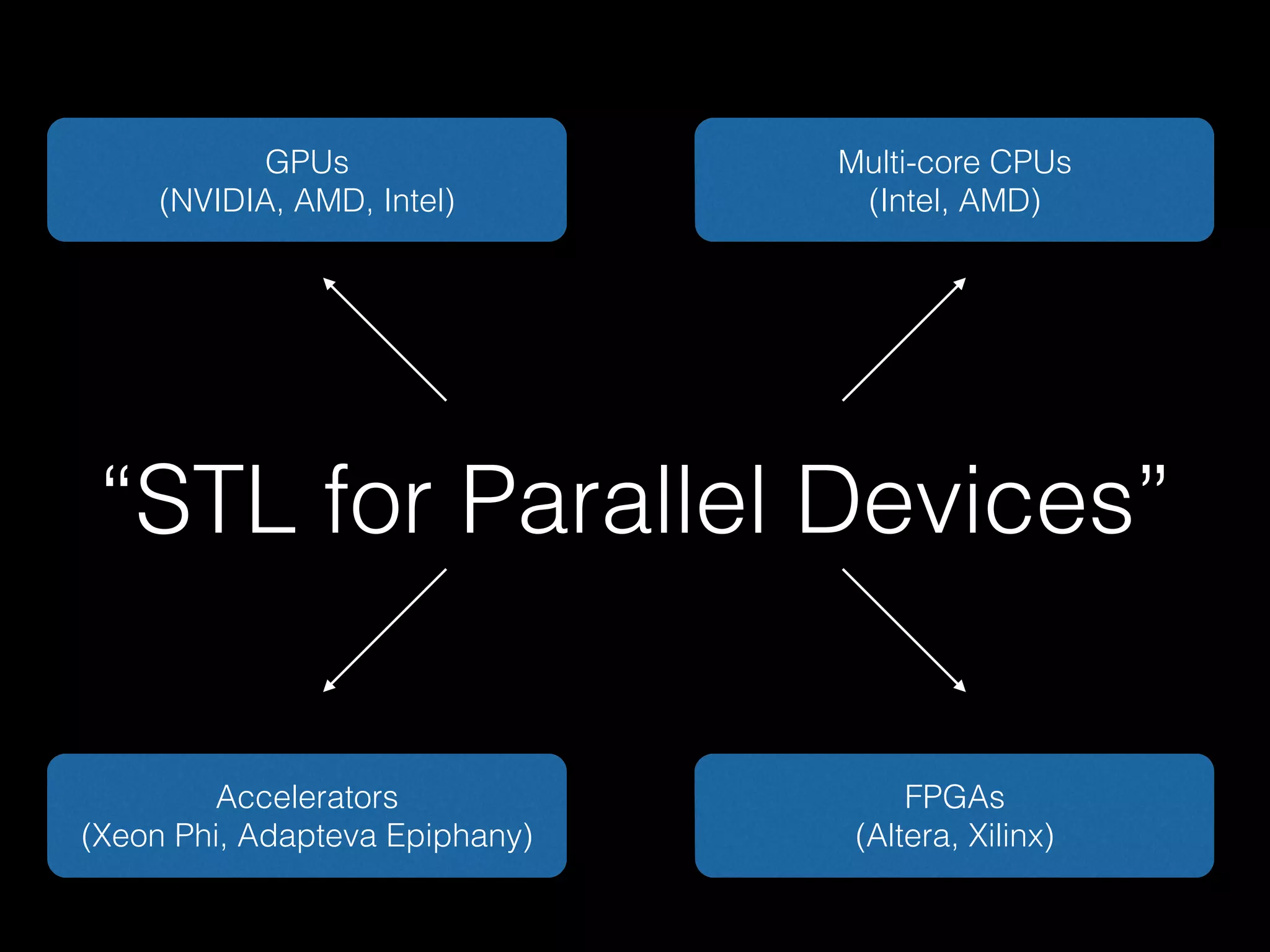
“STL for Parallel Devices”
GPUs
(NVIDIA, AMD, Intel)
Multi-core CPUs
(Intel, AMD)
FPGAs
(Altera, Xilinx)
Accelerators
(Xeon Phi, Adapteva Epiphany)
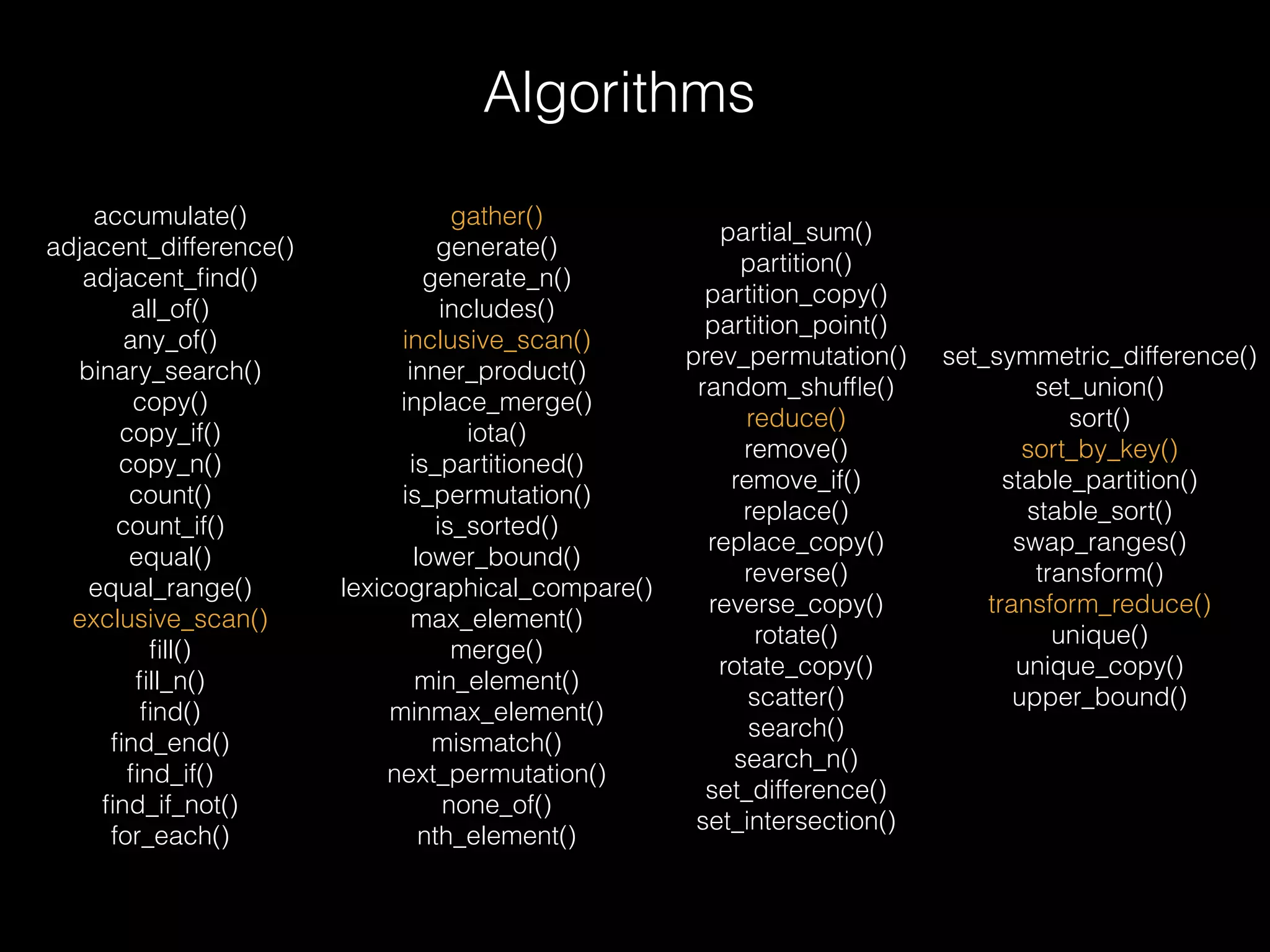
accumulate()
adjacent_difference()
adjacent_find()
all_of()
any_of()
binary_search()
copy()
copy_if()
copy_n()
count()
count_if()
equal()
equal_range()
exclusive_scan()
fill()
fill_n()
find()
find_end()
find_if()
find_if_not()
for_each()
gather()
generate()
generate_n()
includes()
inclusive_scan()
inner_product()
inplace_merge()
iota()
is_partitioned()
is_permutation()
is_sorted()
lower_bound()
lexicographical_compare()
max_element()
merge()
min_element()
minmax_element()
mismatch()
next_permutation()
none_of()
nth_element()
partial_sum()
partition()
partition_copy()
partition_point()
prev_permutation()
random_shuffle()
reduce()
remove()
remove_if()
replace()
replace_copy()
reverse()
reverse_copy()
rotate()
rotate_copy()
scatter()
search()
search_n()
set_difference()
set_intersection()
set_symmetric_difference()
set_union()
sort()
sort_by_key()
stable_partition()
stable_sort()
swap_ranges()
transform()
transform_reduce()
unique()
unique_copy()
upper_bound()
Algorithms
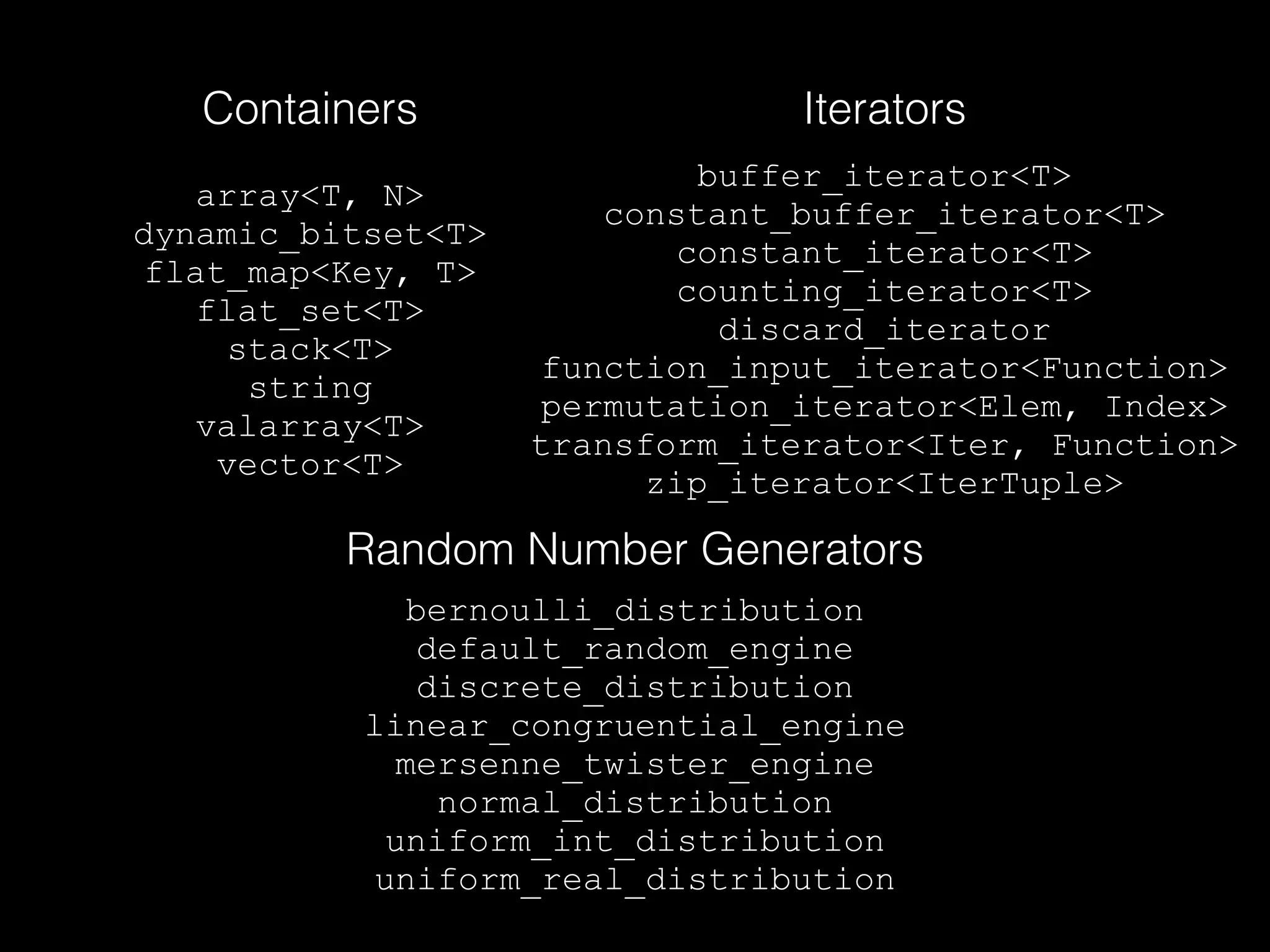
Iterators
buffer_iterator<T>
constant_buffer_iterator<T>
constant_iterator<T>
counting_iterator<T>
discard_iterator
function_input_iterator<Function>
permutation_iterator<Elem, Index>
transform_iterator<Iter, Function>
zip_iterator<IterTuple>
array<T, N>
dynamic_bitset<T>
flat_map<Key, T>
flat_set<T>
stack<T>
string
valarray<T>
vector<T>
Containers
bernoulli_distribution
default_random_engine
discrete_distribution
linear_congruential_engine
mersenne_twister_engine
normal_distribution
uniform_int_distribution
uniform_real_distribution
Random Number Generators
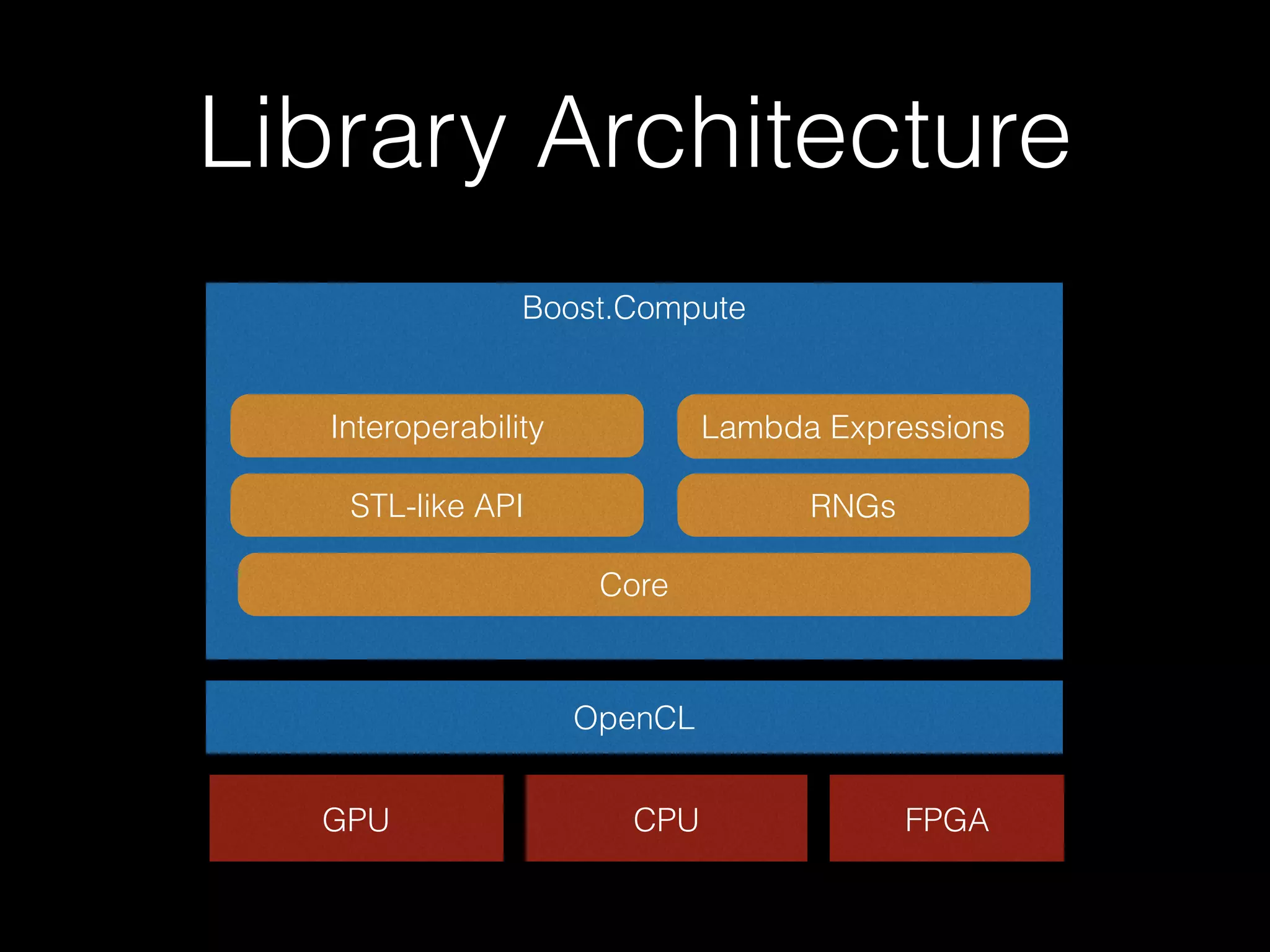
Library Architecture
OpenCL
GPU CPU FPGA
Boost.Compute
Core
STL-like API
Lambda Expressions
RNGs
Interoperability
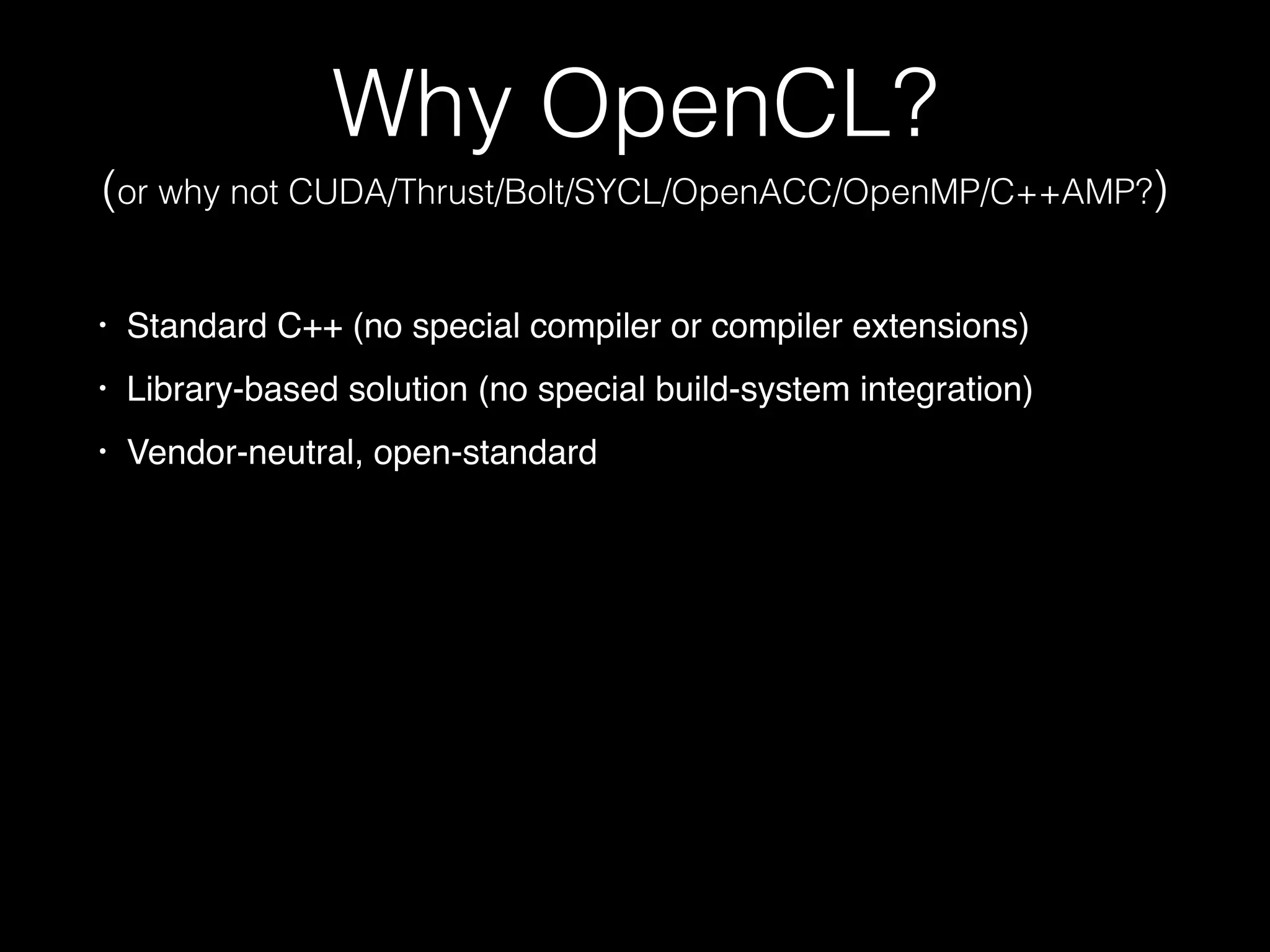
Why OpenCL?
(or why not CUDA/Thrust/Bolt/SYCL/OpenACC/OpenMP/C++AMP?)
• Standard C++ (no special compiler or compiler extensions)
• Library-based solution (no special build-system integration)
• Vendor-neutral, open-standard
Low-level API
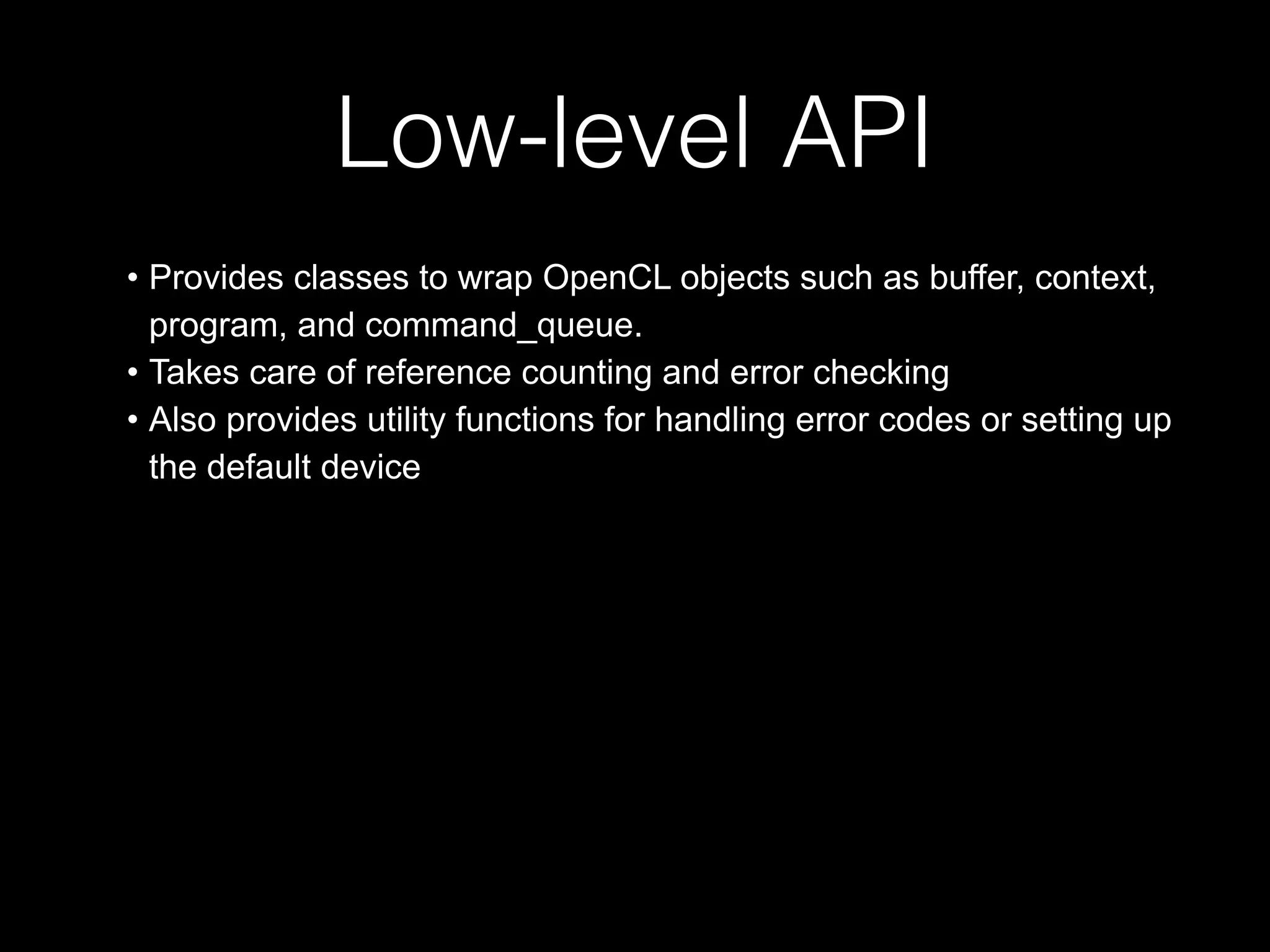
Low-level API
• Provides classes to wrap OpenCL objects such as buffer, context,
program, and command_queue.
• Takes care of reference counting and error checking
• Also provides utility functions for handling error codes or setting up
the default device
Low-level API
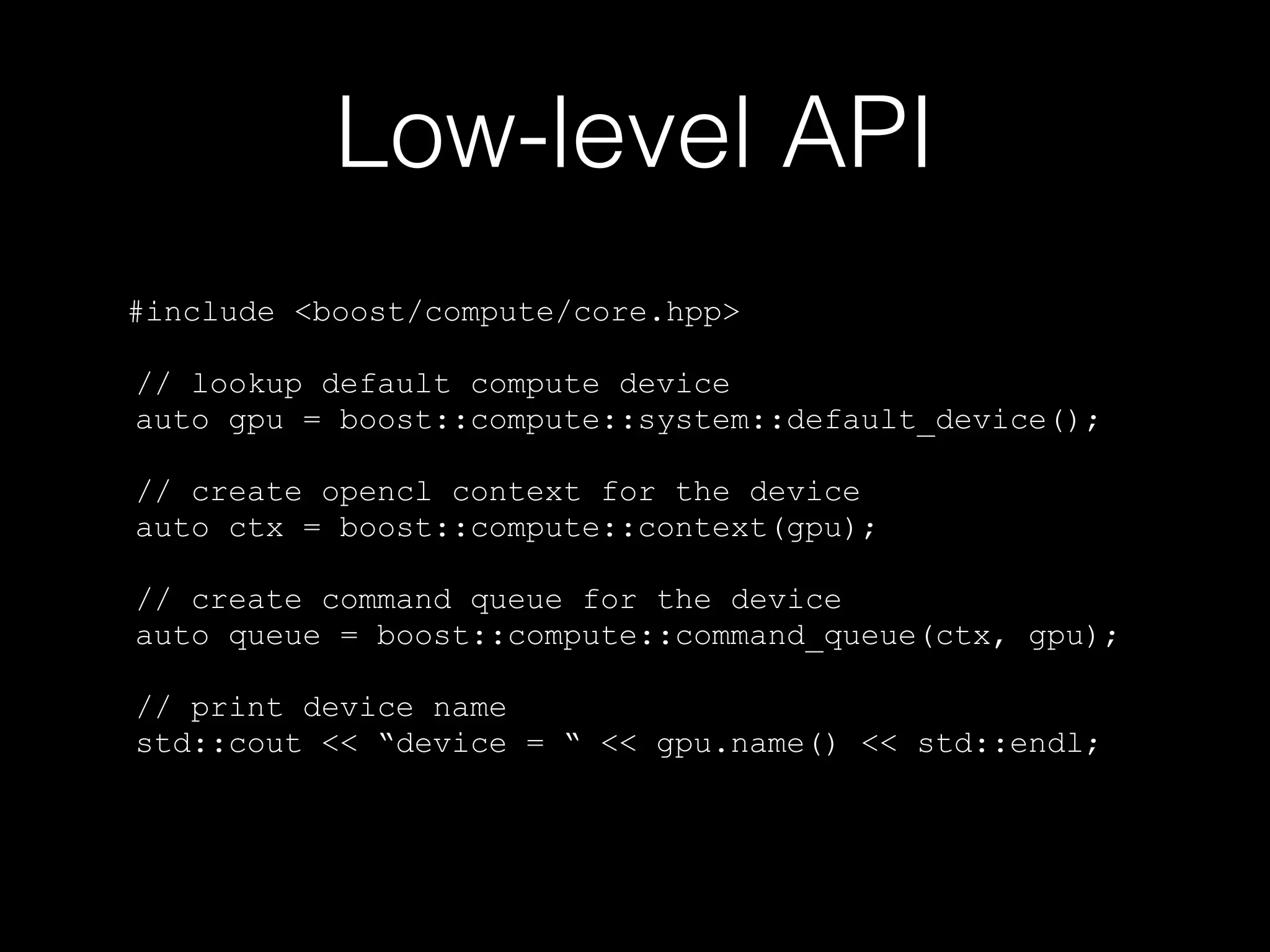
#include <boost/compute/core.hpp>
// lookup default compute device
auto gpu = boost::compute::system::default_device();
// create opencl context for the device
auto ctx = boost::compute::context(gpu);
// create command queue for the device
auto queue = boost::compute::command_queue(ctx, gpu);
// print device name
std::cout << “device = “ << gpu.name() << std::endl;
High-level API
Sort Host Data
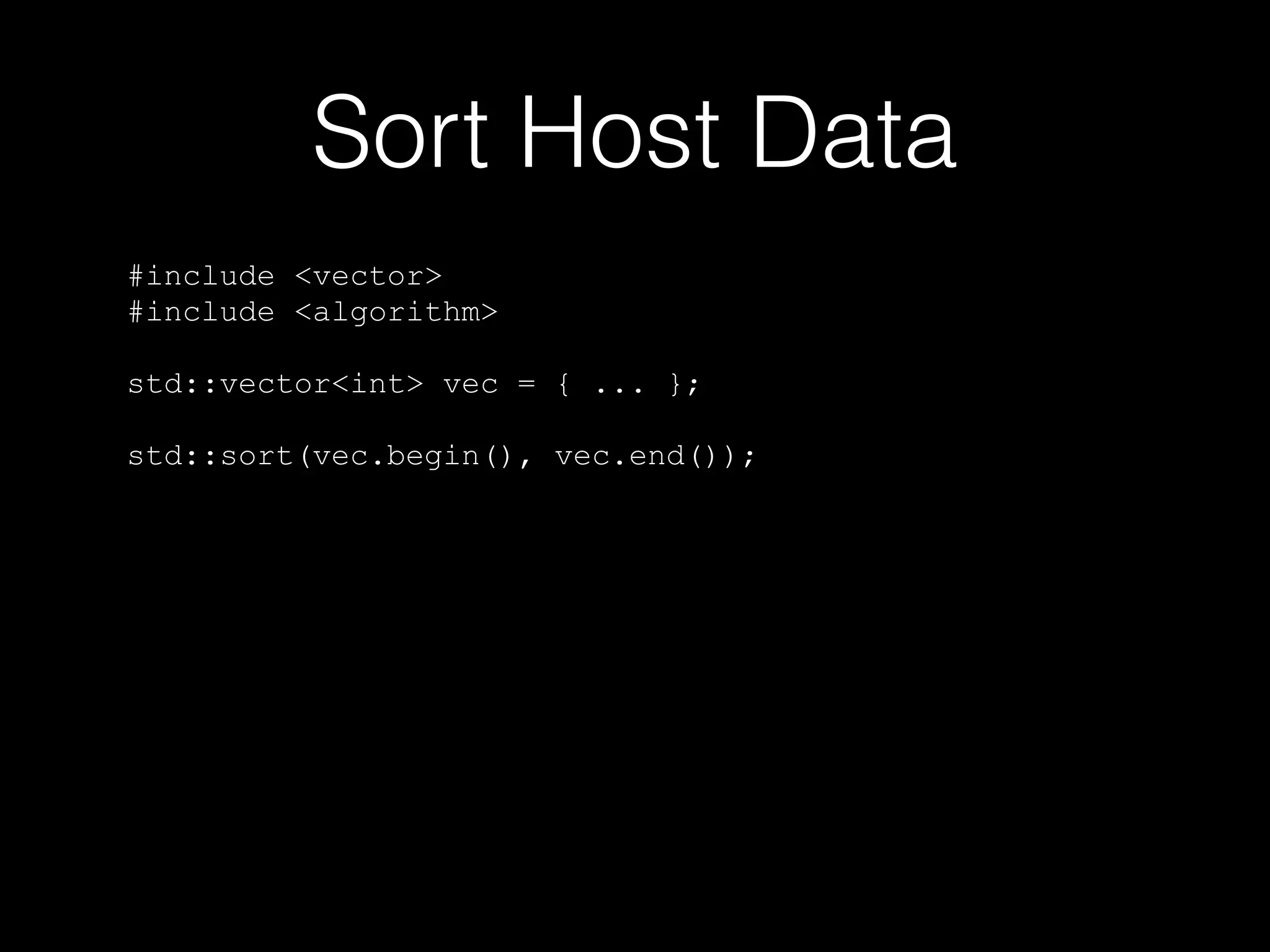
#include <vector>
#include <algorithm>
std::vector<int> vec = { ... };
std::sort(vec.begin(), vec.end());
Sort Host Data
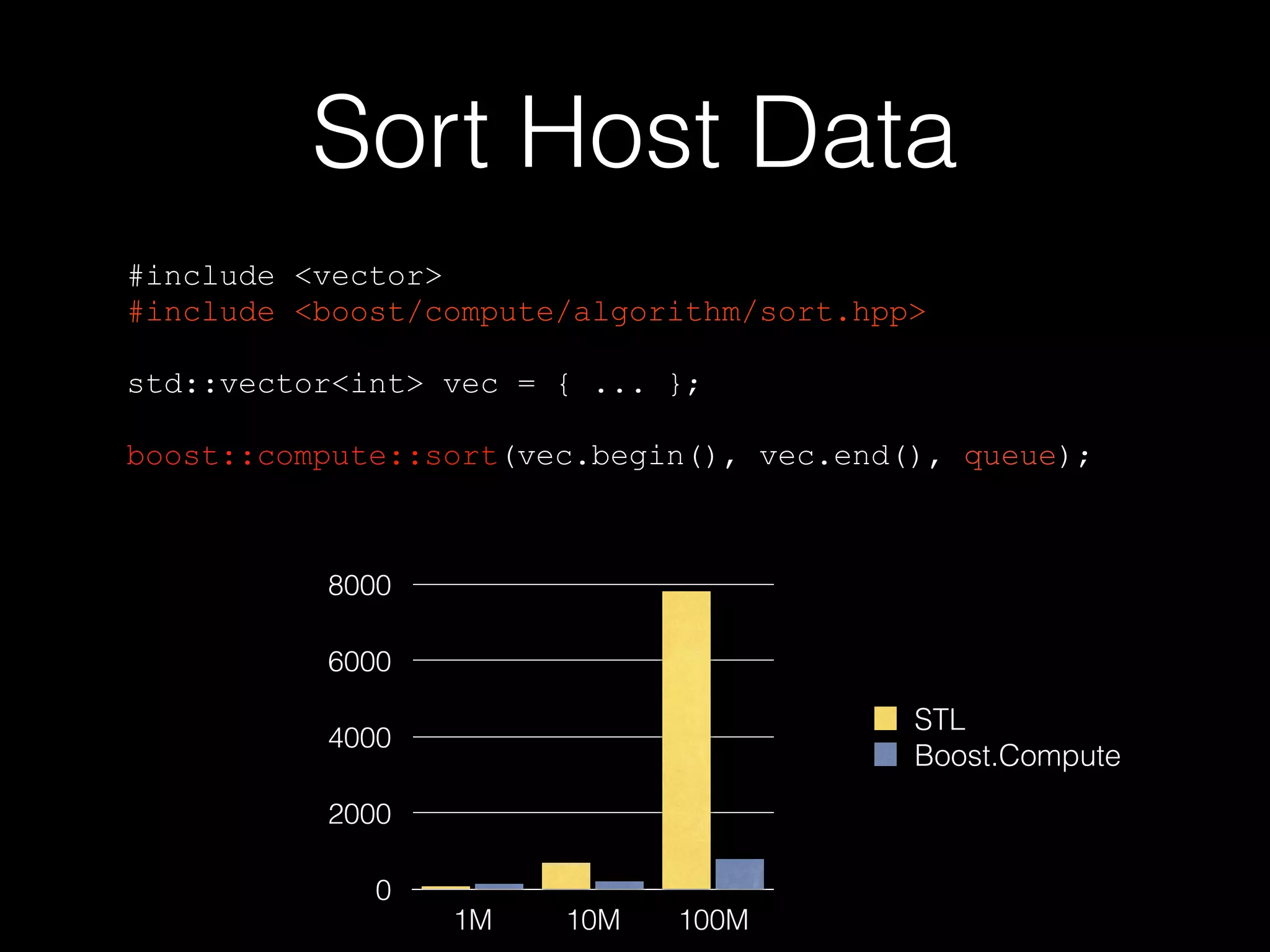
#include <vector>
#include <boost/compute/algorithm/sort.hpp>
std::vector<int> vec = { ... };
boost::compute::sort(vec.begin(), vec.end(), queue);
0
2000
4000
6000
8000
1M 10M 100M
STL
Boost.Compute
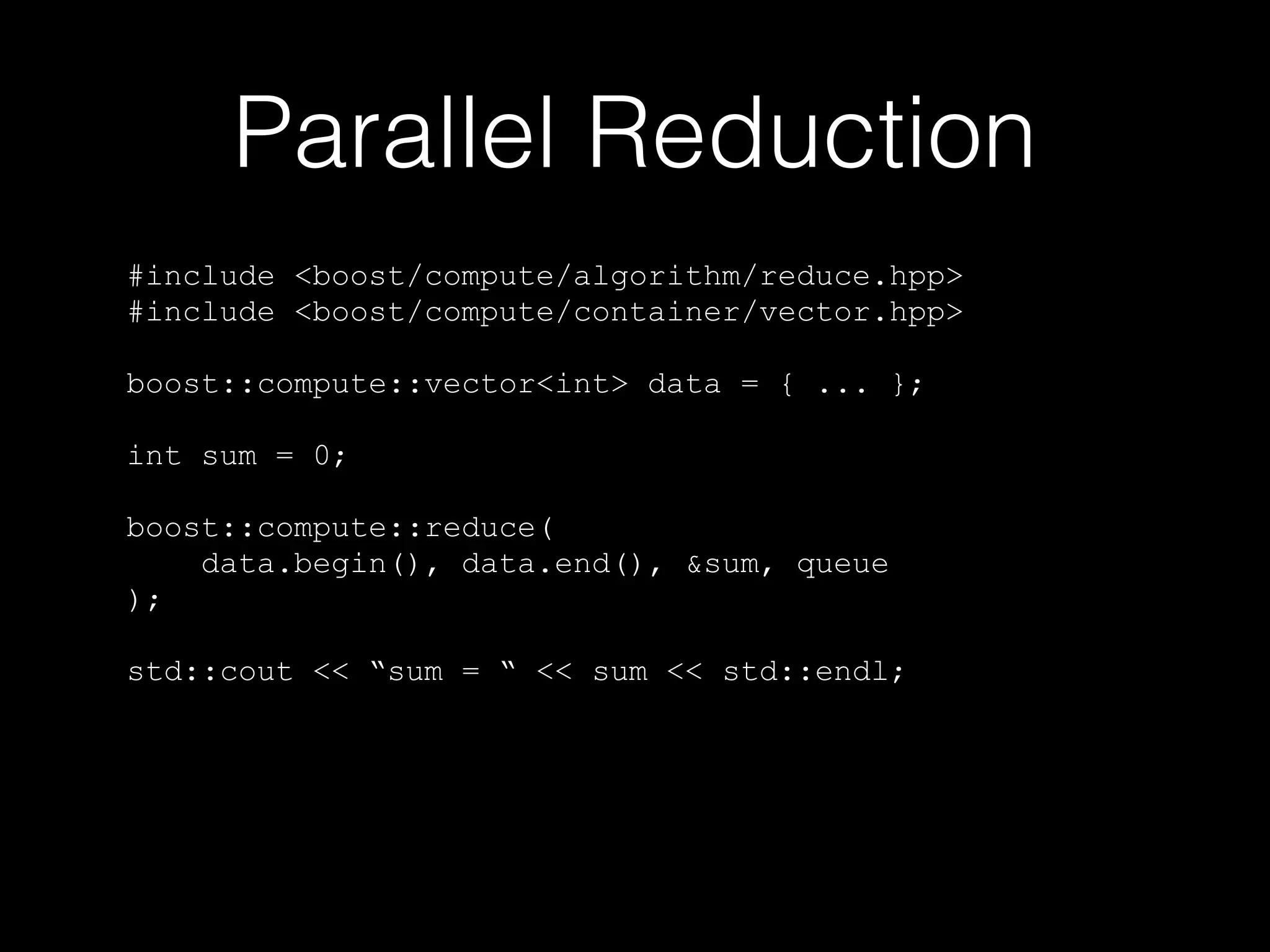
Parallel Reduction
#include <boost/compute/algorithm/reduce.hpp>
#include <boost/compute/container/vector.hpp>
boost::compute::vector<int> data = { ... };
int sum = 0;
boost::compute::reduce(
data.begin(), data.end(), &sum, queue
);
std::cout << “sum = “ << sum << std::endl;
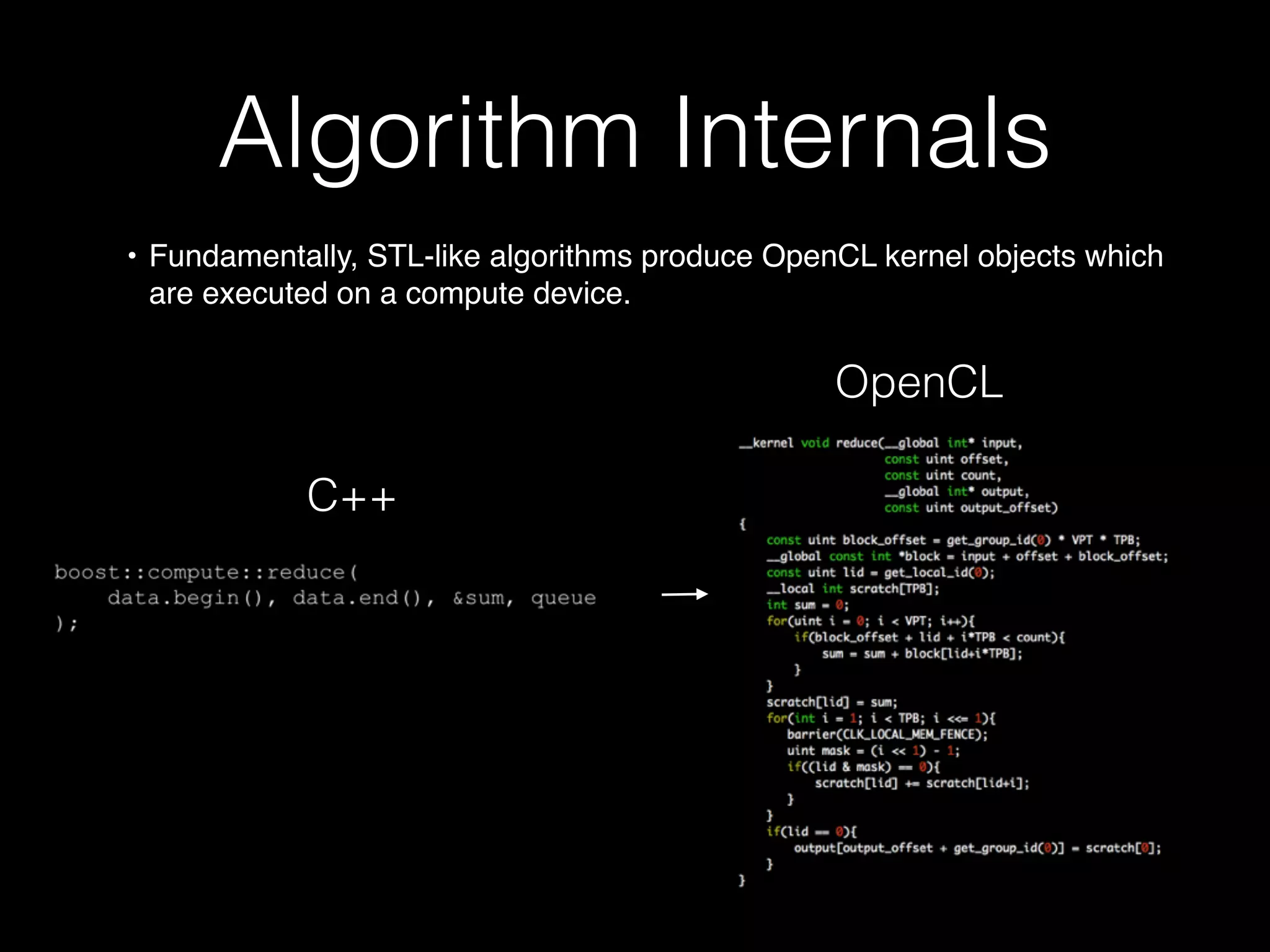
Algorithm Internals
• Fundamentally, STL-like algorithms produce OpenCL kernel objects which
are executed on a compute device.
C++
OpenCL
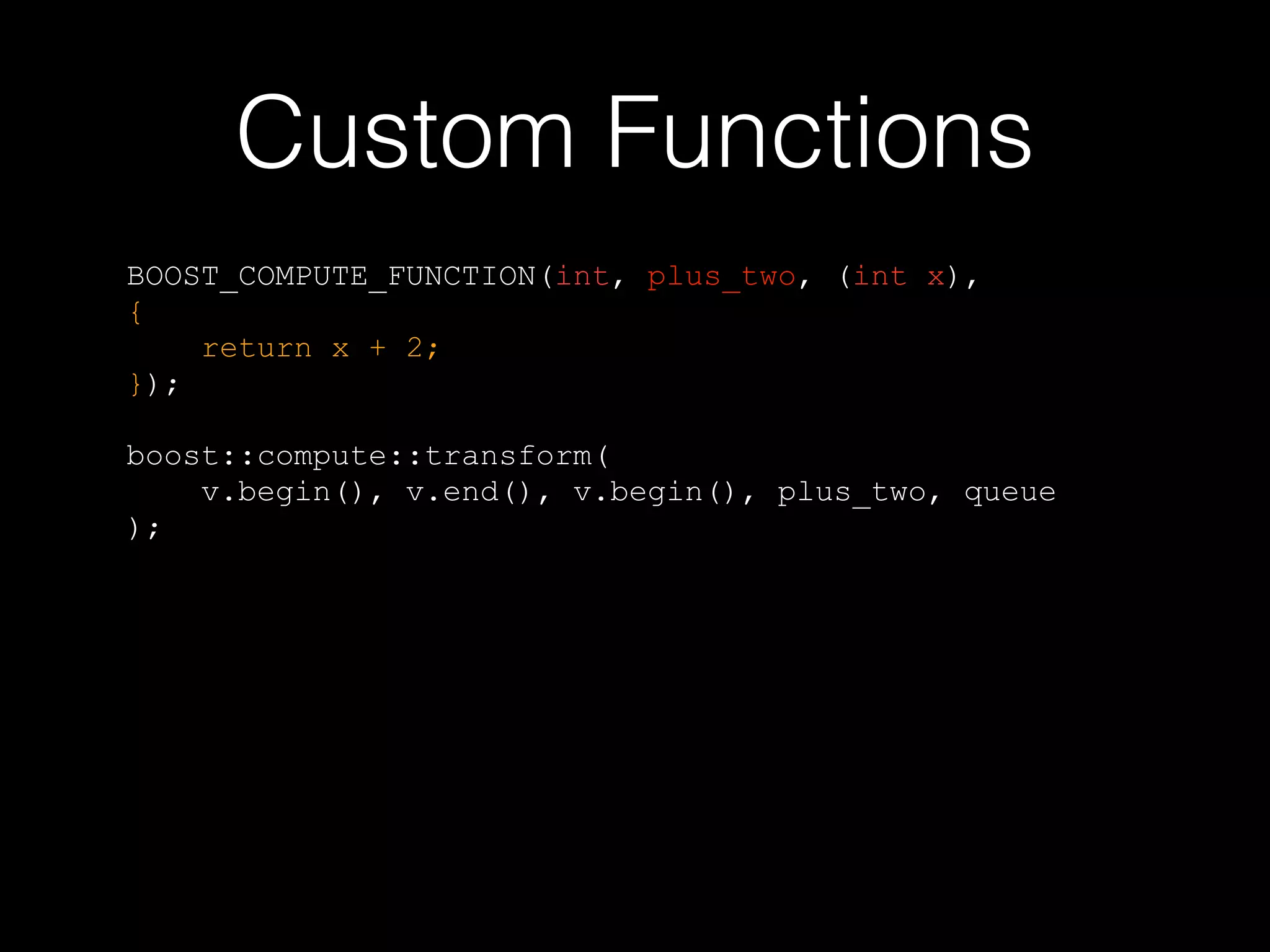
Custom Functions
BOOST_COMPUTE_FUNCTION(int, plus_two, (int x),
{
return x + 2;
});
boost::compute::transform(
v.begin(), v.end(), v.begin(), plus_two, queue
);
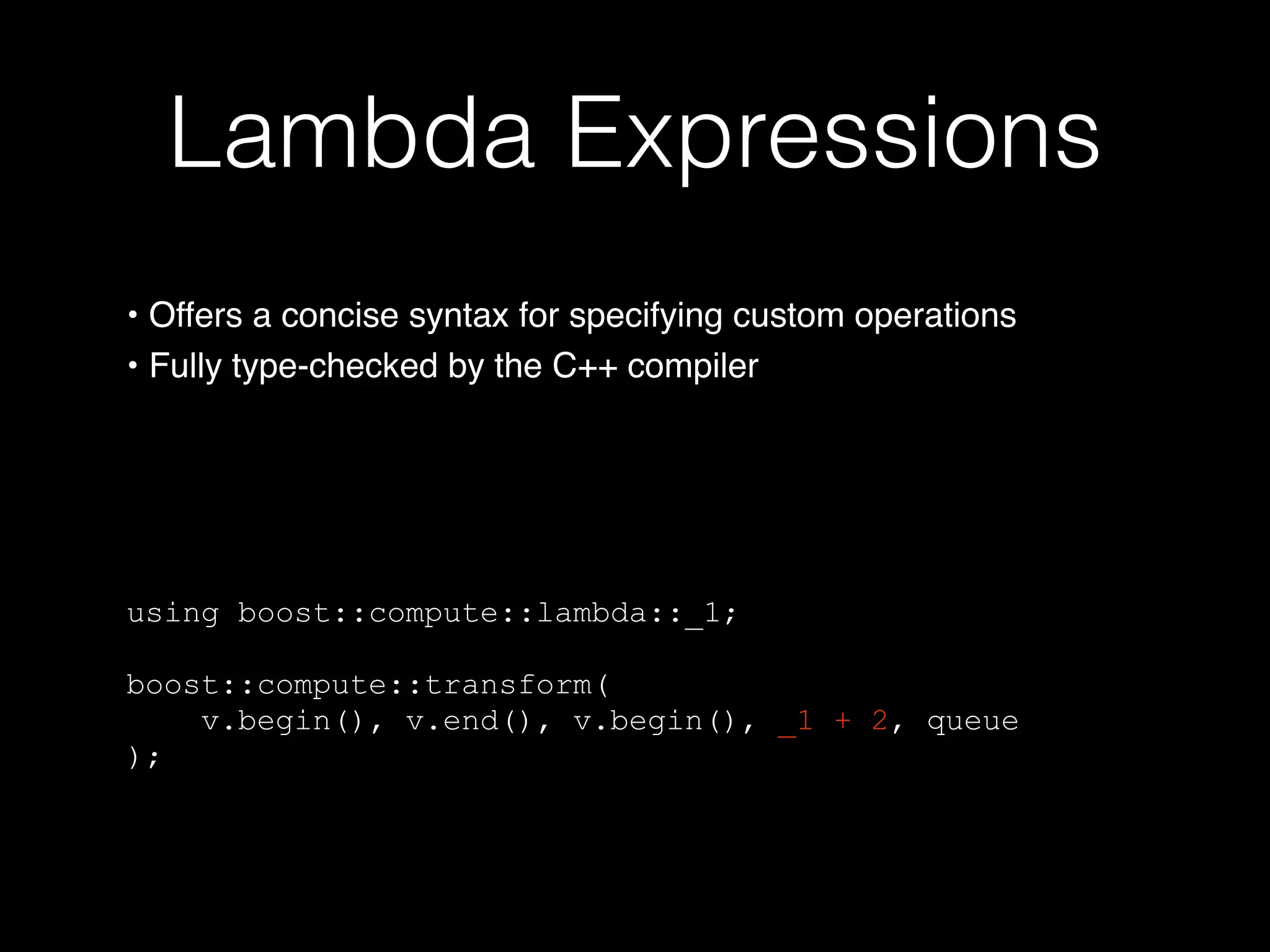
Lambda Expressions
using boost::compute::lambda::_1;
boost::compute::transform(
v.begin(), v.end(), v.begin(), _1 + 2, queue
);
• Offers a concise syntax for specifying custom operations
• Fully type-checked by the C++ compiler
Additional Features
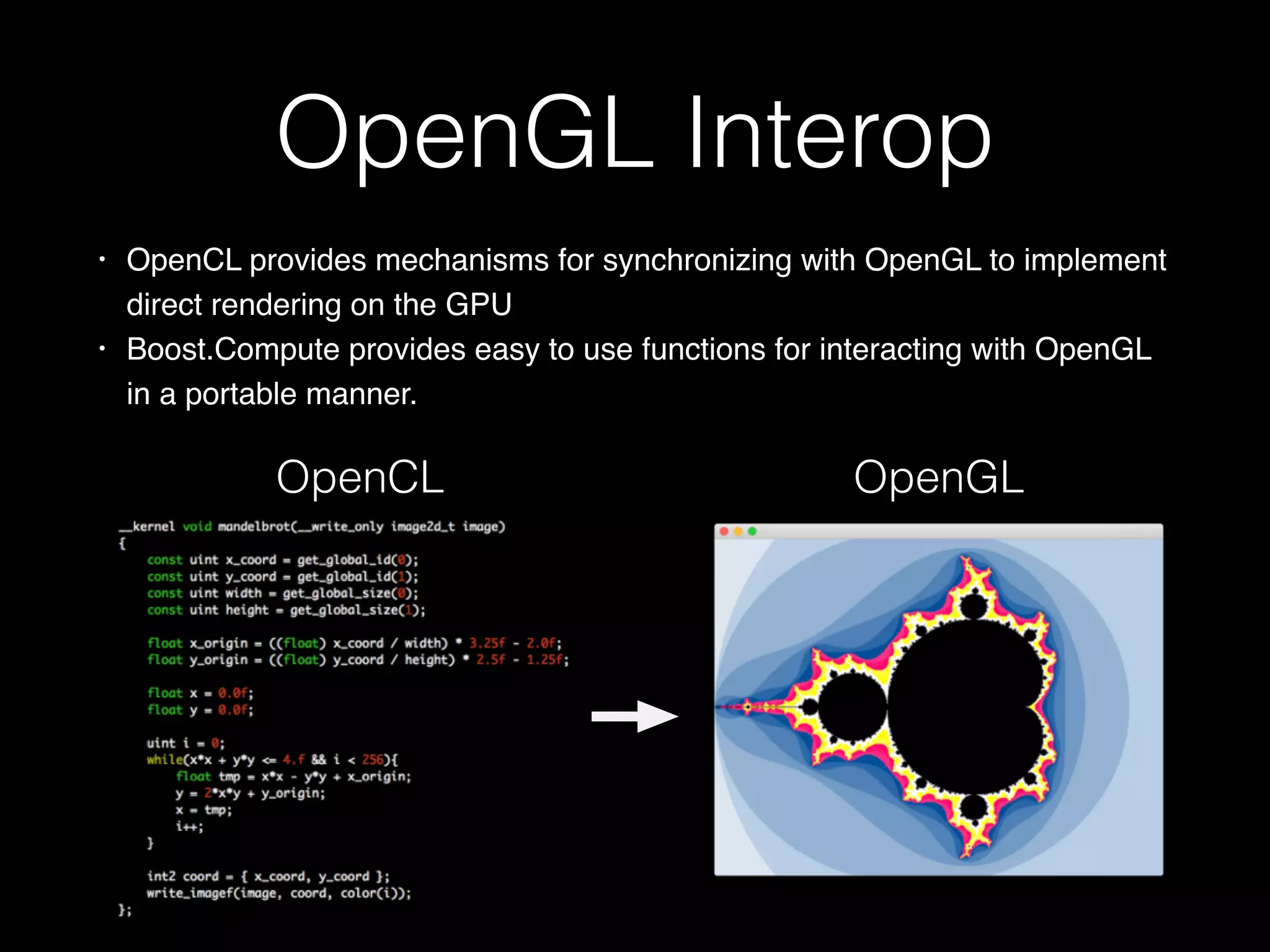
OpenGL Interop
• OpenCL provides mechanisms for synchronizing with OpenGL to implement
direct rendering on the GPU
• Boost.Compute provides easy to use functions for interacting with OpenGL
in a portable manner.
OpenGLOpenCL
Program Caching
• Helps mitigate run-time kernel compilation costs
• Frequently-used kernels are stored and retrieved from the global cache
• Offline cache reduces this to one compilation per system
Auto-tuning
• OpenCL supports a wide variety of hardware with diverse execution
characteristics
• Algorithms support different execution parameters such as work-group size,
amount of work to execute serially
• These parameters are tunable and their results are measurable
• Boost.Compute includes benchmarks and tuning utilities to find the optimal
parameters for a given device
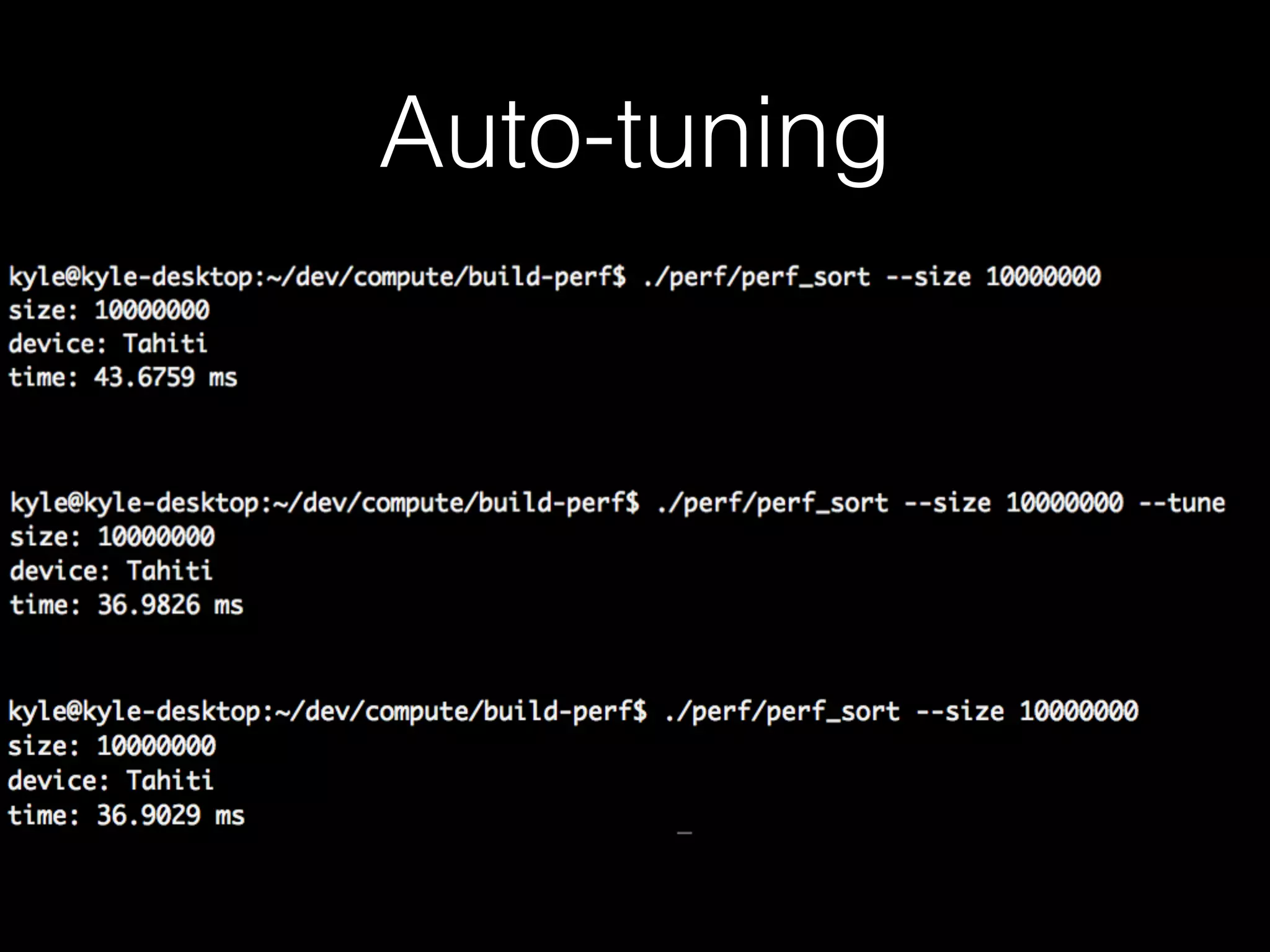
Auto-tuning
Recent News
Coming soon to Boost
• Went through Boost peer-review in December 2014
• Accepted as an official Boost library in January 2015
• Should be packaged in a Boost release this year (1.59)
Boost in GSoC
• Boost is an accepted organization for the Google Summer of Code 2015
• Last year Boost.Compute mentored a student who implemented many new
algorithms and features
• Open to mentoring another student this year
• See: https://svn.boost.org/trac/boost/wiki/SoC2015
Thank You
Source
http://github.com/kylelutz/compute
Documentation
http://kylelutz.github.io/compute

Boost.Compute GTC 2015