
FOLLOW US @leolearning
Using badges for workplace
learning
Mark Aberdour
Platform Solutions Manager
@maberdour
Introduction
Moodle adopted Mozilla Open
Badges standard in 2013
Open Badges gaining momentum
across sectors
Research into open badges in the
workplace for Springer book out
Summer 2016
Web research and phone
interviews with badge
implementers
@leolearning
Original source of publication
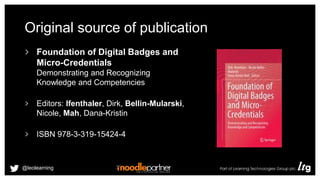
Foundation of Digital Badges and
Micro-Credentials
Demonstrating and Recognizing
Knowledge and Competencies
Editors: Ifenthaler, Dirk, Bellin-Mularski,
Nicole, Mah, Dana-Kristin
ISBN 978-3-319-15424-4
@leolearning
Workplaces using badges
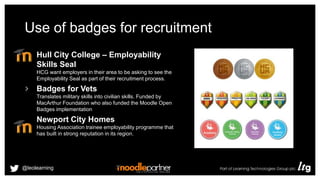
Use of badges for recruitment
Hull City College – Employability
Skills Seal
HCG want employers in their area to be asking to see the
Employability Seal as part of their recruitment process.
Badges for Vets
Translates military skills into civilian skills. Funded by
MacArthur Foundation who also funded the Moodle Open
Badges implementation
Newport City Homes
Housing Association trainee employability programme that
has built in strong reputation in its region.
@leolearning
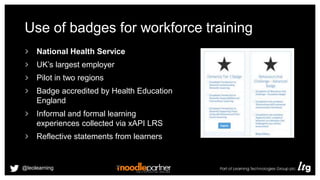
Use of badges for workforce training
National Health Service
UK’s largest employer
Pilot in two regions
Badge accredited by Health Education
England
Informal and formal learning
experiences collected via xAPI LRS
Reflective statements from learners
@leolearning
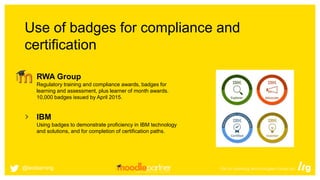
Use of badges for compliance and
certification
RWA Group
Regulatory training and compliance awards, badges for
learning and assessment, plus learner of month awards.
10,000 badges issued by April 2015.
IBM
Using badges to demonstrate proficiency in IBM technology
and solutions, and for completion of certification paths.
@leolearning
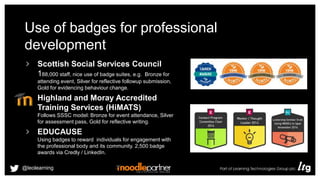
Use of badges for professional
development
Scottish Social Services Council
188,000 staff, nice use of badge suites, e.g. Bronze for
attending event, Silver for reflective followup submission,
Gold for evidencing behaviour change.
Highland and Moray Accredited
Training Services (HiMATS)
Follows SSSC model: Bronze for event attendance, Silver
for assessment pass, Gold for reflective writing.
EDUCAUSE
Using badges to reward individuals for engagement with
the professional body and its community. 2,500 badge
awards via Credly / LinkedIn.
@leolearning
What went well in implementations
Audiences seem very receptive to using badges
and see the value in them.
Badge programmes have help build strong
reputations for organisational training
programmes within sectors or regions.
Badges are an effective enabler for evidencing
behaviour change
@leolearning
What didn’t go well in implementations
Uptake of sharing badges into backbacks, web
pages or social media is often very low, users need
support here.
Badge sharing sites may be blocked by employers’
social media bans.
Marketing and communication effort is often
underestimated.
@leolearning
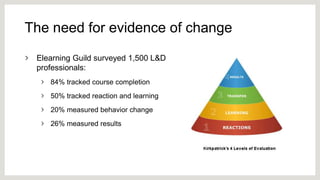
The need for evidence of change
Elearning Guild surveyed 1,500 L&D
professionals:
84% tracked course completion
50% tracked reaction and learning
20% measured behavior change
26% measured results
Key takeaway: badges work as evidence of
change
Badges being used for reflective writing and
evidence of behaviour change
SSSC model: Bronze for completing training, Silver
for reflective statement, Gold for evidencing
behaviour change
Voluntarily submitted by learners, not collected by
management.
Straight to Kirkpatrick Level 3
@leolearning
Top tips
Appoint a badge leader
Don’t skimp on marketing and communications
Do a small scale pilot
Automate badge awards
Build a badge support site (see http://badges.sssc.uk.com)
Measure badge views and shares with analytics tools
@leolearning
Further case study reading
Armstrong, E. (2015). Open Badge: HCUK Employability Skills Seal project– JISC Advance FE and Skills
Programme: Final report. Hull: Hull College Group.
EDUCAUSE Badging Program. (2015, June 10). Retrieved from EDUCAUSE.edu:
http://www.educause.edu/badging
IBM Open Badge Program. (2015, 06 29). Retrieved from IBM Authorized Training - Worldwide:
http://www.ibm.com/services/learning/badges
Price, B. (2015). A simple introduction to Open Badges. Cardiff: Bob Price.
Price, R. (2014, October 15). How One of the Largest Employers in the World is Using Tin Can. Retrieved from
Tin Can API: http://tincanapi.com/2014/10/15/one-largest-employers-world-using-tin-can/
RWA. (2015, 06 26). Badge Rewards. Retrieved from Aviva Development Zone:
http://mydevelopment.zone/features/badge-rewards/
SSSC Open Badges. (2015, 06 29). Retrieved from SSSC Open Badges: http://badges.sssc.uk.com/
@leolearning
leolearning.com
@leolearning

Using Badges for Workplace Learning - Mark Aberdour

  • 1.
    FOLLOW US @leolearning Usingbadges for workplace learning Mark Aberdour Platform Solutions Manager @maberdour
  • 2.
    Introduction Moodle adopted MozillaOpen Badges standard in 2013 Open Badges gaining momentum across sectors Research into open badges in the workplace for Springer book out Summer 2016 Web research and phone interviews with badge implementers @leolearning
  • 3.
    Original source ofpublication Foundation of Digital Badges and Micro-Credentials Demonstrating and Recognizing Knowledge and Competencies Editors: Ifenthaler, Dirk, Bellin-Mularski, Nicole, Mah, Dana-Kristin ISBN 978-3-319-15424-4 @leolearning
  • 4.
  • 5.
    Use of badgesfor recruitment Hull City College – Employability Skills Seal HCG want employers in their area to be asking to see the Employability Seal as part of their recruitment process. Badges for Vets Translates military skills into civilian skills. Funded by MacArthur Foundation who also funded the Moodle Open Badges implementation Newport City Homes Housing Association trainee employability programme that has built in strong reputation in its region. @leolearning
  • 6.
    Use of badgesfor workforce training National Health Service UK’s largest employer Pilot in two regions Badge accredited by Health Education England Informal and formal learning experiences collected via xAPI LRS Reflective statements from learners @leolearning
  • 7.
    Use of badgesfor compliance and certification RWA Group Regulatory training and compliance awards, badges for learning and assessment, plus learner of month awards. 10,000 badges issued by April 2015. IBM Using badges to demonstrate proficiency in IBM technology and solutions, and for completion of certification paths. @leolearning
  • 8.
    Use of badgesfor professional development Scottish Social Services Council 188,000 staff, nice use of badge suites, e.g. Bronze for attending event, Silver for reflective followup submission, Gold for evidencing behaviour change. Highland and Moray Accredited Training Services (HiMATS) Follows SSSC model: Bronze for event attendance, Silver for assessment pass, Gold for reflective writing. EDUCAUSE Using badges to reward individuals for engagement with the professional body and its community. 2,500 badge awards via Credly / LinkedIn. @leolearning
  • 9.
    What went wellin implementations Audiences seem very receptive to using badges and see the value in them. Badge programmes have help build strong reputations for organisational training programmes within sectors or regions. Badges are an effective enabler for evidencing behaviour change @leolearning
  • 10.
    What didn’t gowell in implementations Uptake of sharing badges into backbacks, web pages or social media is often very low, users need support here. Badge sharing sites may be blocked by employers’ social media bans. Marketing and communication effort is often underestimated. @leolearning
  • 11.
    The need forevidence of change Elearning Guild surveyed 1,500 L&D professionals: 84% tracked course completion 50% tracked reaction and learning 20% measured behavior change 26% measured results
  • 12.
    Key takeaway: badgeswork as evidence of change Badges being used for reflective writing and evidence of behaviour change SSSC model: Bronze for completing training, Silver for reflective statement, Gold for evidencing behaviour change Voluntarily submitted by learners, not collected by management. Straight to Kirkpatrick Level 3 @leolearning
  • 13.
    Top tips Appoint abadge leader Don’t skimp on marketing and communications Do a small scale pilot Automate badge awards Build a badge support site (see http://badges.sssc.uk.com) Measure badge views and shares with analytics tools @leolearning
  • 14.
    Further case studyreading Armstrong, E. (2015). Open Badge: HCUK Employability Skills Seal project– JISC Advance FE and Skills Programme: Final report. Hull: Hull College Group. EDUCAUSE Badging Program. (2015, June 10). Retrieved from EDUCAUSE.edu: http://www.educause.edu/badging IBM Open Badge Program. (2015, 06 29). Retrieved from IBM Authorized Training - Worldwide: http://www.ibm.com/services/learning/badges Price, B. (2015). A simple introduction to Open Badges. Cardiff: Bob Price. Price, R. (2014, October 15). How One of the Largest Employers in the World is Using Tin Can. Retrieved from Tin Can API: http://tincanapi.com/2014/10/15/one-largest-employers-world-using-tin-can/ RWA. (2015, 06 26). Badge Rewards. Retrieved from Aviva Development Zone: http://mydevelopment.zone/features/badge-rewards/ SSSC Open Badges. (2015, 06 29). Retrieved from SSSC Open Badges: http://badges.sssc.uk.com/ @leolearning
  • 15.

Editor's Notes

  • #3 https://medium.com/badge-alliance/an-evolution-of-open-badges-9025b7a95cd1#.mxn7067hn https://blog.webmaker.org/mozillas-continued-commitment-to-open-badges
  • #4 https://medium.com/badge-alliance/an-evolution-of-open-badges-9025b7a95cd1#.mxn7067hn https://blog.webmaker.org/mozillas-continued-commitment-to-open-badges
  • #12 Level 1: Reaction, which measures how well the training was received using simple mechanisms such as satisfaction surveys. Level 2: Learning, which measures what the trainee has learned as a result of the training, often performed using simple ‘before and after’ assessments. Level 3: Behaviour, which looks at how trainees applied what they learned and changed their behaviour as a result and is assessed weeks or months later, typically using observations or interviews. Level 4: Results, which looks at bigger picture outcomes such as impact on staff retention, productivity, morale, sales performance, customer satisfaction and other performance-related metrics.