#CLOwebinar
The presentation will begin at the top of the hour.
A dial in number will not be provided.
Listen to today’s webinar using your computer’s
speakers or headphones.
Welcome to the webinar!
#CLOwebinar
	 	
		
Tools You Can Use
Audio Control
–  A dial in number will not be provided.
–  The audio will stream through your
headphones or computer speakers.
–  Also check your computer’s volume for
external speakers or headsets.
#CLOwebinar
Questions	and	Handouts	
You	can	submit	questions	by	clicking	on	
this	icon	here.	


You	can	download	a	PDF	of	the	slide	deck	
by	clicking	here.
#CLOwebinar
	 	
		
1. May I receive a copy of the slides?
YES! Click on the handouts located on the right portion of your
screen.
2. May I review the webinar recording at a later date?
YES! You may log in again using today’s link to review the
presentation on-demand.
3. Is this webinar HRCI or SHRM certified?
YES! The HRCI and SHRM certification codes will be sent in
the follow up email.
Frequently	Asked	Questions
The Agility Shift:
Developing Leaders for a VUCA
World
*Study by BTS
Overview
The Agility Shift is T-Mobile’s
powerful leader development
offering designed to equip
people managers to thrive in
an uncertain, complex, and
ambiguous environment.
Background
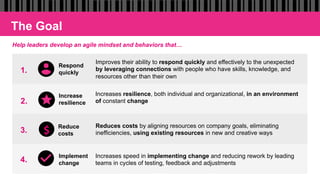
The Goal
Increase
resilience
Implement
change
1.
2.
3.
4.
Improves their ability to respond quickly and effectively to the unexpected
by leveraging connections with people who have skills, knowledge, and
resources other than their own
Increases resilience, both individual and organizational, in an environment
of constant change
Reduces costs by aligning resources on company goals, eliminating
inefficiencies, using existing resources in new and creative ways
Increases speed in implementing change and reducing rework by leading
teams in cycles of testing, feedback and adjustments
Reduce
costs$	
Respond
quickly
Help leaders develop an agile mindset and behaviors that…
A New Partnership
Pamela Meyer, Ph.D., Author
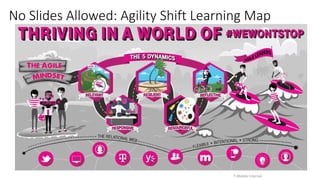
No Slides Allowed: Agility Shift Learning Map
T-Mobile	Internal
13
Participants Comments on Twitter
T-Mobile Internal
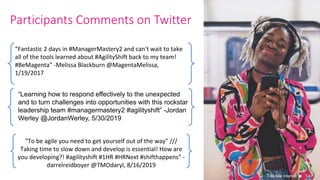
“Fantastic	2	days	in	#ManagerMastery2	and	can't	wait	to	take	
all	of	the	tools	learned	about	#AgilityShift	back	to	my	team!	
#BeMagenta”	-Melissa	Blackburn	@MagentaMelissa,	
1/19/2017
"To	be	agile	you	need	to	get	yourself	out	of	the	way"	///	
Taking	time	to	slow	down	and	develop	is	essential!	How	are	
you	developing?!	#agilityshift	#1HR	#HRNext	#shifthappens”	-
darrelreidboyer	@TMOdaryl,	8/16/2019	
“Learning how to respond effectively to the unexpected
and to turn challenges into opportunities with this rockstar
leadership team #managermastery2 #agilityshift” -Jordan
Werley @JordanWerley, 5/30/2019
But What Is the Impact?
The Success Case Study
Study Purpose
The study sought to answer these questions:
1.  What personal benefit has Agility Shift participation
provided to individuals?
2.  What business impact does Agility Shift participation
generate for T-Mobile?
3.  When Agility Shift delivered impact, why did it work? When
it did not, why not?
4.  What can be done to improve the business impact for
future Agility Shift participants?
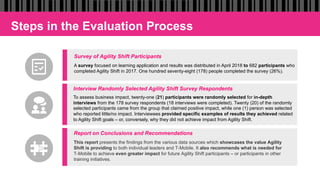
Steps in the Evaluation Process
Survey of Agility Shift Participants
A survey focused on learning application and results was distributed in April 2018 to 682 participants who
completed Agility Shift in 2017. One hundred seventy-eight (178) people completed the survey (26%).
Interview Randomly Selected Agility Shift Survey Respondents
To assess business impact, twenty-one (21) participants were randomly selected for in-depth
interviews from the 178 survey respondents (18 interviews were completed). Twenty (20) of the randomly
selected participants came from the group that claimed positive impact, while one (1) person was selected
who reported little/no impact. Interviewees provided specific examples of results they achieved related
to Agility Shift goals – or, conversely, why they did not achieve impact from Agility Shift.
Report on Conclusions and Recommendations
This report presents the findings from the various data sources which showcases the value Agility
Shift is providing to both individual leaders and T-Mobile. It also recommends what is needed for
T-Mobile to achieve even greater impact for future Agility Shift participants – or participants in other
training initiatives.
Study Conclusions (1 of 5)
Ø  Agility Shift participants valued the experience and have
begun to incorporate the concepts and mindsets in their
day-to-day activities. “This opened my
eyes to things I do
day in and day
out and use a
different
approach rather
than jumping and
reacting to an
issue.”
Study Conclusions (2 of 5)
Ø  Participants reported these factors made Agility Shift a valuable
experience:
•  Highly relevant content
•  Facilitators were “excellent”
•  The relational web helps leaders respond appropriately.
•  “Respond rather than react” to be more strategic, purposeful, and
manage the stress of change
•  Creates a common language for strategies and setting expectations
“It was a great
training that
allowed me to step
back and think
about the big
picture about my
job and my group,
and consider how I
can better lead
our group and
embrace change.”
Study Conclusions (3 of 5)
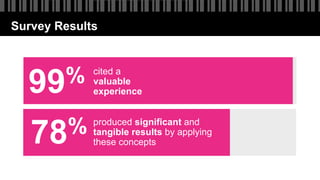
Ø  99% of survey respondents reported that it was a valuable
experience and have begun to apply what they learned
3.  This extremely high rate (99% of respondents) of application is
significantly higher than most programs evaluated.
4.  78% reported that they have produced significant and tangible
results by applying these concepts.
This was a well
needed training for
me. It made me
change my way of
thinking and
showed me that it is
not all about me.
Sometimes you
have to go outside
your comfort zone
to find a resolution.
Being uncomfortable
gets the job done…
Study Conclusions (4 of 5)
Ø  Participants produced business impact:
•  Thinking differently and seeing situations from new perspectives
•  Using the relational web to solve problems and identify new approaches
•  Being less reactive and responding more purposefully
•  Fostering a culture of agility and achieving higher levels of performance
•  Retail Managers: connecting better with employees and helping them develop
•  Account Managers: working more collaboratively and effectively with customers
Study Conclusions (5 of 5)
Ø  Factors which limited the potential impact of that the Agility
Shift could have produced:
Ø  Only 24% began with objectives or expectations for
how they could/should apply the new concepts or skills
back on the job.
Ø  The amount of coaching is inconsistent (some
managers are doing better than others)
“When I feel
overwhelmed, I often
get tunnel vision on one
task, while other needs
of the business are
neglected. After this
development program, I
feel like there are tools
and practices I can
adopt that will help me
better handle multiple
responsibilities in
stressful times.”
Survey Results
Survey Results
99%
78% produced significant and
tangible results by applying
these concepts
cited a
valuable
experience
Which statement below best characterizes your experience
regarding Manager Mastery 2: Agility Shift?
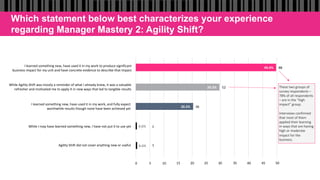
I	learned	something	new,	have	used	it	in	my	work,	and	fully	expect	
worthwhile	results	though	none	have	been	achieved	yet		 36	20.2%	
While	Agility	Shift	was	mostly	a	reminder	of	what	I	already	knew,	it	was	a	valuable	
refresher	and	motivated	me	to	apply	it	in	new	ways	that	led	to	tangible	results		 52	29.2%	
I	learned	something	new,	have	used	it	in	my	work	to	produce	significant	
business	impact	for	my	unit	and	have	concrete	evidence	to	describe	that	impact		
88	49.4%	
0	 5	 10	 15	 20	 25	 30	 35	 40	 45	 50	
1While	I	may	have	learned	something	new,	I	have	not	put	it	to	use	yet		 0.6%	
Agility	Shift	did	not	cover	anything	new	or	useful		 10.6%	
These	two	groups	of		
survey	respondents	–	
78%	of	all	respondents	
–	are	in	the	“high	
impact”	group.			
	
Interviews	confirmed	
that	most	of	them	
applied	their	learning	
in	ways	that	are	having	
high	or	moderate	
impact	for	the	
business.
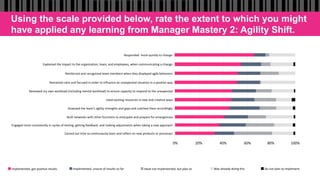
Using the scale provided below, rate the extent to which you might
have applied any learning from Manager Mastery 2: Agility Shift.
0%	 20%	 40%	 60%	 80%	 100%	
Built	networks	with	other	functions	to	anticipate	and	prepare	for	emergencies		
Remained	calm	and	focused	in	order	to	influence	an	unexpected	situation	in	a	positive	way		
Reviewed	my	own	workload	(including	mental	workload)	to	ensure	capacity	to	respond	to	the	unexpected		
Explained	the	impact	to	the	organization,	team,	and	employees,	when	communicating	a	change		
Used	existing	resources	in	new	and	creative	ways		
Carved	out	time	to	continuously	learn	and	reflect	on	new	products	or	processes		
Engaged	more	consistently	in	cycles	of	testing,	getting	feedback,	and	making	adjustments	when	taking	a	new	approach		
Responded		more	quickly	to	change		
Assessed	the	team’s	agility	strengths	and	gaps	and	coached	them	accordingly		
Reinforced	and	recognized	team	members	when	they	displayed	agile	behaviors		
Implemented,	got	positive	results		 Implemented,	unsure	of	results	so	far		 Have	not	implemented,	but	plan	to		 Was	already	doing	this		 Do	not	plan	to	implement
Business Impact
What was learned in
Agility Shift
How it was applied Results Created
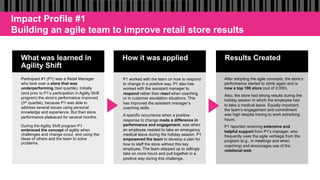
Participant #1 (P1) was a Retail Manager
who took over a store that was
underperforming (last quartile). Initially
(and prior to P1’s participation in Agility Shift
program) the store’s performance improved
(3rd quartile), because P1 was able to
address several issues using personal
knowledge and experience. But then store
performance plateaued for several months.
During the Agility Shift program P1
embraced the concept of agility when
challenges and change occur, and using the
ideas of others and the team to solve
problems.
P1 worked with the team on how to respond
to change in a positive way. P1 also has
worked with the assistant manager to
respond rather than react when coaching
or in customer escalation situations. This
has improved the assistant manager’s
coaching skills.
A specific occurrence when a positive
response to change made a difference in
performance and engagement, was when
an employee needed to take an emergency
medical leave during the holiday season. P1
empowered the team to develop a plan for
how to staff the store without this key
employee. The team stepped up to willingly
take on more hours and pull together in a
positive way during this challenge.
After adopting the agile concepts, the store’s
performance started to climb again and is
now a top 100 store (out of 2,000).
Also, the store had strong results during the
holiday season in which the employee had
to take a medical leave. Equally important,
the team’s engagement and commitment
was high despite having to work extra/long
hours.
P1 reported receiving extensive and
helpful support from P1’s manager, who
frequently uses the agile verbiage from the
program (e.g., in meetings and when
coaching) and encourages use of the
relational web.
Impact Profile #1
Building an agile team to improve retail store results
What was learned in
Agility Shift
How it was applied Results Created
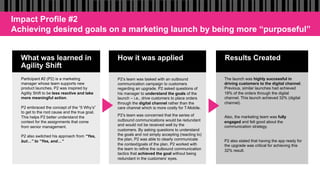
Participant #2 (P2) is a marketing
manager whose team supports new
product launches. P2 was inspired by
Agility Shift to be less reactive and take
more meaningful action.
P2 embraced the concept of the “5 Why’s”
to get to the root cause and the true goal.
This helps P2 better understand the
context for the assignments that come
from senior management.
P2 also switched his approach from “Yes,
but…” to “Yes, and…”
P2’s team was tasked with an outbound
communication campaign to customers
regarding an upgrade. P2 asked questions of
his manager to understand the goals of the
launch – i.e., drive customers to place orders
through the digital channel rather than the
care channel which is more costly for T-Mobile.
P2’s team was concerned that the series of
outbound communications would be redundant
and would not be received well by the
customers. By asking questions to understand
the goals and not simply accepting (reacting to)
the plan, P2 was able to clearly communicate
the context/goals of the plan. P2 worked with
the team to refine the outbound communication
tactics that achieved the goal without being
redundant in the customers’ eyes.
The launch was highly successful in
driving customers to the digital channel.
Previous, similar launches had achieved
18% of the orders through the digital
channel. This launch achieved 32% (digital
channel).
Also, the marketing team was fully
engaged and felt good about the
communication strategy.
P2 also stated that having the app ready for
the upgrade was critical for achieving this
32% result.
Impact Profile #2
Achieving desired goals on a marketing launch by being more “purposeful”
What was learned in
Agility Shift
How it was applied Results Created
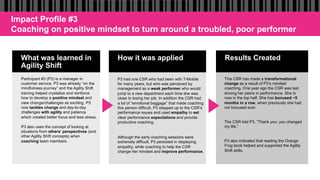
Participant #3 (P3) is a manager in
customer service. P3 was already “on the
mindfulness journey” and the Agility Shift
training helped crystalize and reinforce
how to develop a positive mindset and
view change/challenges as exciting. P3
now tackles change and day-to-day
challenges with agility and patience
which created better focus and less stress.
P3 also uses the concept of looking at
situations from others’ perspectives (and
other Agility Shift concepts) when
coaching team members.
P3 had one CSR who had been with T-Mobile
for many years, but who was perceived by
management as a weak performer who would
jump to a new department each time she was
close to losing her job. In addition the CSR had
a lot of “emotional baggage” that made coaching
this person difficult. P3 stepped up to the CSR’s
performance issues and used empathy to set
clear performance expectations and provide
productive coaching.
Although the early coaching sessions were
extremely difficult, P3 persisted in displaying
empathy, while coaching to help the CSR
change her mindset and improve performance.
This CSR has made a transformational
change as a result of P3’s mindset
coaching. One year ago the CSR was last
among her peers in performance. She is
now in the top half. She has bonused ~5
months in a row, when previously she had
not bonused ever.
The CSR told P3, “Thank you; you changed
my life.”
P3 also indicated that reading the Orange
Frog book helped and supported the Agility
Shift skills.
Impact Profile #3
Coaching on positive mindset to turn around a troubled, poor performer
What was learned in
Agility Shift
How it was applied Results Created
Participant #4 (P4) is a National Accounts
Manager. P4 used the Agility Shift training
to help develop the ability to view
situations from the customer’s
perspective.
P4 has to interact with many people with
very different personalities in his national
accounts. P4 stated that the “schematic on
the wall with pictures” showing different
perspectives and the discussions from
Agility Shift provided new insights into
understanding what customers are
thinking and feeling and how to build
relationships with them.
P4 reported that after Agility Shift he operates
with the mindset that there are multiple
perspectives and the role of the NAM is not to
convince but to work with people to solve
problems.
In one large account P4 deals with a
successful entrepreneur who is very
opinionated. Using the approaches from Agility
Shift, P4 now listens more fully to understand
the other point of view, then responds, “I
appreciate what you’re saying and let me share
another perspective.”
P4 reports having built a better and more
strategic relationship with this account
since attending Agility Shift and adopting
this approach. It is easier now to work
collaboratively with the account on various
issues.
One example of a better working
relationship is that P4 was able to get this
account to agree to accelerated (shorter)
payment terms from 29 days to 24 days.
This increases cash flow for T-Mobile.
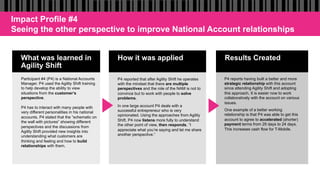
Impact Profile #4
Seeing the other perspective to improve National Account relationships
What was learned in
Agility Shift
How it was applied Results Created
Participant #5 (P5) is a Marketing
Manager for Retail and Direct Channels
for a market. P5 used the Agility Shift
concepts to foster a culture of agility in
this team, getting people to be more
comfortable and effective in handling
change and the ambiguity of waiting to
have a project completely submitted and
finished.
P5’s team develops and executes
marketing plans which frequently change
at the last minute. This caused a lot of
rework (e.g., reprinting ads or mailers),
frustration and extra costs.
P5 used the concepts of having a positive
mindset about change, planning for change
and leveraging the relational web to get his
team more comfortable and effective with
changes.
P5 shared what was learned in the program
and used the Take it to the Team toolkit. P5
worked with the team to develop a process for
creating more effective project plans that
could accommodate last minute changes while
still meeting deadlines. This planning process
identified those elements that are most
vulnerable to change and getting team
members to be comfortable with leaving those
items open longer.
P5 identified several projects that avoided
reprinting costs due to last minute changes,
because the team waited appropriately to
send the artwork for a mailer or ad to the
printer until the last minute. One alone
project saved T-Mobile ~$20-25k in
replacement printing.
However, P5 believes the biggest benefit is
the personal growth P5 saw in the team.
They have embraced the concept of agility
and preparing for change. They see change
as a positive and look outward to other
resources to get answers when things
change.
P5 reported that using the book The Art of
Agile Marketing also helped him work with
the team to make the mindset shift.
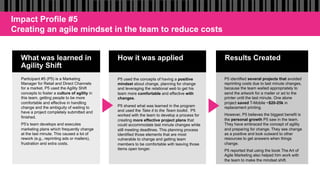
Impact Profile #5
Creating an agile mindset in the team to reduce costs
Recommendations
Recommendations
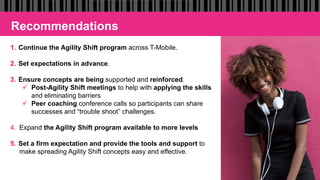
1.  Continue the Agility Shift program across T-Mobile.
2.  Set expectations in advance.
3.  Ensure concepts are being supported and reinforced.
ü  Post-Agility Shift meetings to help with applying the skills
and eliminating barriers
ü  Peer coaching conference calls so participants can share
successes and “trouble shoot” challenges.
4.  Expand the Agility Shift program available to more levels
5.  Set a firm expectation and provide the tools and support to
make spreading Agility Shift concepts easy and effective.
What’s Next for Experiential
Learning?
Appendix: Additional Agility
Shift Survey Data
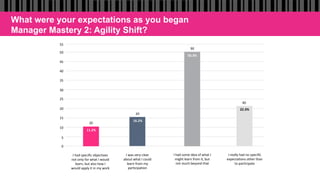
What were your expectations as you began
Manager Mastery 2: Agility Shift?
0	
5	
10	
15	
20	
25	
30	
35	
40	
45	
50	
I	was	very	clear	
about	what	I	could	
learn	from	my	
participation		
29	
16.2%	
I	really	had	no	specific	
expectations	other	than	
to	participate		
40	
22.3%	
I	had	some	idea	of	what	I	
might	learn	from	it,	but	
not	much	beyond	that		
90	
50.3%	
20	
11.2%	
I	had	specific	objectives	
not	only	for	what	I	would	
learn,	but	also	how	I	
would	apply	it	in	my	work		
55
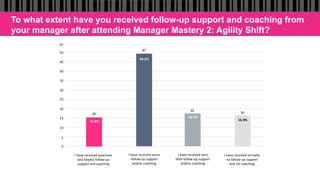
To what extent have you received follow-up support and coaching from
your manager after attending Manager Mastery 2: Agility Shift?
0	
5	
10	
15	
20	
25	
30	
35	
40	
45	
50	
I	have	received	virtually	
no	follow-up	support	
and	/or	coaching		
30	
16.9%	
I	have	received	very		
little	follow-up	support	
and/or	coaching		
32	
18.1%	
I	have	received	some	
follow-up	support		
and/or	coaching		
87	
49.2%	
28	
15.8%	
I	have	received	extensive	
and	helpful	follow-up	
support	and	coaching		
55
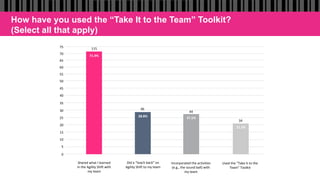
How have you used the “Take It to the Team” Toolkit?
(Select all that apply)
Incorporated	the	activities	
(e.g.,	the	sound	ball)	with	
my	team		
44	
27.5%	
Did	a	“teach	back”	on	
Agility	Shift	to	my	team		
46	
28.8%	
34	
21.3%	
Used	the	“Take	It	to	the	
Team”	Toolkit		
0	
5	
10	
15	
20	
25	
30	
35	
40	
45	
50	
55	
60	
65	
70	
75	
Shared	what	I	learned		
in	the	Agility	Shift	with	
my	team		
115	
71.9%
#CLOwebinar
	 	
		
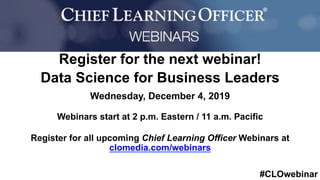
Register for the next webinar!
Data Science for Business Leaders
Wednesday, December 4, 2019
Webinars start at 2 p.m. Eastern / 11 a.m. Pacific
Register for all upcoming Chief Learning Officer Webinars at
clomedia.com/webinars

THE AGILITY SHIFT: T-MOBILE DEVELOPS LEADERS FOR A VUCA WORLD

  • 1.
    #CLOwebinar The presentation willbegin at the top of the hour. A dial in number will not be provided. Listen to today’s webinar using your computer’s speakers or headphones. Welcome to the webinar!
  • 2.
    #CLOwebinar Tools YouCan Use Audio Control –  A dial in number will not be provided. –  The audio will stream through your headphones or computer speakers. –  Also check your computer’s volume for external speakers or headsets.
  • 3.
  • 4.
    #CLOwebinar 1. MayI receive a copy of the slides? YES! Click on the handouts located on the right portion of your screen. 2. May I review the webinar recording at a later date? YES! You may log in again using today’s link to review the presentation on-demand. 3. Is this webinar HRCI or SHRM certified? YES! The HRCI and SHRM certification codes will be sent in the follow up email. Frequently Asked Questions
  • 6.
    The Agility Shift: DevelopingLeaders for a VUCA World *Study by BTS
  • 7.
  • 9.
    The Agility Shiftis T-Mobile’s powerful leader development offering designed to equip people managers to thrive in an uncertain, complex, and ambiguous environment. Background
  • 10.
    The Goal Increase resilience Implement change 1. 2. 3. 4. Improves theirability to respond quickly and effectively to the unexpected by leveraging connections with people who have skills, knowledge, and resources other than their own Increases resilience, both individual and organizational, in an environment of constant change Reduces costs by aligning resources on company goals, eliminating inefficiencies, using existing resources in new and creative ways Increases speed in implementing change and reducing rework by leading teams in cycles of testing, feedback and adjustments Reduce costs$ Respond quickly Help leaders develop an agile mindset and behaviors that…
  • 11.
    A New Partnership PamelaMeyer, Ph.D., Author
  • 12.
    No Slides Allowed:Agility Shift Learning Map T-Mobile Internal
  • 13.
    13 Participants Comments onTwitter T-Mobile Internal “Fantastic 2 days in #ManagerMastery2 and can't wait to take all of the tools learned about #AgilityShift back to my team! #BeMagenta” -Melissa Blackburn @MagentaMelissa, 1/19/2017 "To be agile you need to get yourself out of the way" /// Taking time to slow down and develop is essential! How are you developing?! #agilityshift #1HR #HRNext #shifthappens” - darrelreidboyer @TMOdaryl, 8/16/2019 “Learning how to respond effectively to the unexpected and to turn challenges into opportunities with this rockstar leadership team #managermastery2 #agilityshift” -Jordan Werley @JordanWerley, 5/30/2019
  • 14.
    But What Isthe Impact? The Success Case Study
  • 15.
    Study Purpose The studysought to answer these questions: 1.  What personal benefit has Agility Shift participation provided to individuals? 2.  What business impact does Agility Shift participation generate for T-Mobile? 3.  When Agility Shift delivered impact, why did it work? When it did not, why not? 4.  What can be done to improve the business impact for future Agility Shift participants?
  • 16.
    Steps in theEvaluation Process Survey of Agility Shift Participants A survey focused on learning application and results was distributed in April 2018 to 682 participants who completed Agility Shift in 2017. One hundred seventy-eight (178) people completed the survey (26%). Interview Randomly Selected Agility Shift Survey Respondents To assess business impact, twenty-one (21) participants were randomly selected for in-depth interviews from the 178 survey respondents (18 interviews were completed). Twenty (20) of the randomly selected participants came from the group that claimed positive impact, while one (1) person was selected who reported little/no impact. Interviewees provided specific examples of results they achieved related to Agility Shift goals – or, conversely, why they did not achieve impact from Agility Shift. Report on Conclusions and Recommendations This report presents the findings from the various data sources which showcases the value Agility Shift is providing to both individual leaders and T-Mobile. It also recommends what is needed for T-Mobile to achieve even greater impact for future Agility Shift participants – or participants in other training initiatives.
  • 17.
    Study Conclusions (1of 5) Ø  Agility Shift participants valued the experience and have begun to incorporate the concepts and mindsets in their day-to-day activities. “This opened my eyes to things I do day in and day out and use a different approach rather than jumping and reacting to an issue.”
  • 18.
    Study Conclusions (2of 5) Ø  Participants reported these factors made Agility Shift a valuable experience: •  Highly relevant content •  Facilitators were “excellent” •  The relational web helps leaders respond appropriately. •  “Respond rather than react” to be more strategic, purposeful, and manage the stress of change •  Creates a common language for strategies and setting expectations “It was a great training that allowed me to step back and think about the big picture about my job and my group, and consider how I can better lead our group and embrace change.”
  • 19.
    Study Conclusions (3of 5) Ø  99% of survey respondents reported that it was a valuable experience and have begun to apply what they learned 3.  This extremely high rate (99% of respondents) of application is significantly higher than most programs evaluated. 4.  78% reported that they have produced significant and tangible results by applying these concepts. This was a well needed training for me. It made me change my way of thinking and showed me that it is not all about me. Sometimes you have to go outside your comfort zone to find a resolution. Being uncomfortable gets the job done…
  • 20.
    Study Conclusions (4of 5) Ø  Participants produced business impact: •  Thinking differently and seeing situations from new perspectives •  Using the relational web to solve problems and identify new approaches •  Being less reactive and responding more purposefully •  Fostering a culture of agility and achieving higher levels of performance •  Retail Managers: connecting better with employees and helping them develop •  Account Managers: working more collaboratively and effectively with customers
  • 21.
    Study Conclusions (5of 5) Ø  Factors which limited the potential impact of that the Agility Shift could have produced: Ø  Only 24% began with objectives or expectations for how they could/should apply the new concepts or skills back on the job. Ø  The amount of coaching is inconsistent (some managers are doing better than others) “When I feel overwhelmed, I often get tunnel vision on one task, while other needs of the business are neglected. After this development program, I feel like there are tools and practices I can adopt that will help me better handle multiple responsibilities in stressful times.”
  • 22.
  • 23.
    Survey Results 99% 78% producedsignificant and tangible results by applying these concepts cited a valuable experience
  • 24.
    Which statement belowbest characterizes your experience regarding Manager Mastery 2: Agility Shift? I learned something new, have used it in my work, and fully expect worthwhile results though none have been achieved yet 36 20.2% While Agility Shift was mostly a reminder of what I already knew, it was a valuable refresher and motivated me to apply it in new ways that led to tangible results 52 29.2% I learned something new, have used it in my work to produce significant business impact for my unit and have concrete evidence to describe that impact 88 49.4% 0 5 10 15 20 25 30 35 40 45 50 1While I may have learned something new, I have not put it to use yet 0.6% Agility Shift did not cover anything new or useful 10.6% These two groups of survey respondents – 78% of all respondents – are in the “high impact” group. Interviews confirmed that most of them applied their learning in ways that are having high or moderate impact for the business.
  • 25.
    Using the scaleprovided below, rate the extent to which you might have applied any learning from Manager Mastery 2: Agility Shift. 0% 20% 40% 60% 80% 100% Built networks with other functions to anticipate and prepare for emergencies Remained calm and focused in order to influence an unexpected situation in a positive way Reviewed my own workload (including mental workload) to ensure capacity to respond to the unexpected Explained the impact to the organization, team, and employees, when communicating a change Used existing resources in new and creative ways Carved out time to continuously learn and reflect on new products or processes Engaged more consistently in cycles of testing, getting feedback, and making adjustments when taking a new approach Responded more quickly to change Assessed the team’s agility strengths and gaps and coached them accordingly Reinforced and recognized team members when they displayed agile behaviors Implemented, got positive results Implemented, unsure of results so far Have not implemented, but plan to Was already doing this Do not plan to implement
  • 26.
  • 27.
    What was learnedin Agility Shift How it was applied Results Created Participant #1 (P1) was a Retail Manager who took over a store that was underperforming (last quartile). Initially (and prior to P1’s participation in Agility Shift program) the store’s performance improved (3rd quartile), because P1 was able to address several issues using personal knowledge and experience. But then store performance plateaued for several months. During the Agility Shift program P1 embraced the concept of agility when challenges and change occur, and using the ideas of others and the team to solve problems. P1 worked with the team on how to respond to change in a positive way. P1 also has worked with the assistant manager to respond rather than react when coaching or in customer escalation situations. This has improved the assistant manager’s coaching skills. A specific occurrence when a positive response to change made a difference in performance and engagement, was when an employee needed to take an emergency medical leave during the holiday season. P1 empowered the team to develop a plan for how to staff the store without this key employee. The team stepped up to willingly take on more hours and pull together in a positive way during this challenge. After adopting the agile concepts, the store’s performance started to climb again and is now a top 100 store (out of 2,000). Also, the store had strong results during the holiday season in which the employee had to take a medical leave. Equally important, the team’s engagement and commitment was high despite having to work extra/long hours. P1 reported receiving extensive and helpful support from P1’s manager, who frequently uses the agile verbiage from the program (e.g., in meetings and when coaching) and encourages use of the relational web. Impact Profile #1 Building an agile team to improve retail store results
  • 28.
    What was learnedin Agility Shift How it was applied Results Created Participant #2 (P2) is a marketing manager whose team supports new product launches. P2 was inspired by Agility Shift to be less reactive and take more meaningful action. P2 embraced the concept of the “5 Why’s” to get to the root cause and the true goal. This helps P2 better understand the context for the assignments that come from senior management. P2 also switched his approach from “Yes, but…” to “Yes, and…” P2’s team was tasked with an outbound communication campaign to customers regarding an upgrade. P2 asked questions of his manager to understand the goals of the launch – i.e., drive customers to place orders through the digital channel rather than the care channel which is more costly for T-Mobile. P2’s team was concerned that the series of outbound communications would be redundant and would not be received well by the customers. By asking questions to understand the goals and not simply accepting (reacting to) the plan, P2 was able to clearly communicate the context/goals of the plan. P2 worked with the team to refine the outbound communication tactics that achieved the goal without being redundant in the customers’ eyes. The launch was highly successful in driving customers to the digital channel. Previous, similar launches had achieved 18% of the orders through the digital channel. This launch achieved 32% (digital channel). Also, the marketing team was fully engaged and felt good about the communication strategy. P2 also stated that having the app ready for the upgrade was critical for achieving this 32% result. Impact Profile #2 Achieving desired goals on a marketing launch by being more “purposeful”
  • 29.
    What was learnedin Agility Shift How it was applied Results Created Participant #3 (P3) is a manager in customer service. P3 was already “on the mindfulness journey” and the Agility Shift training helped crystalize and reinforce how to develop a positive mindset and view change/challenges as exciting. P3 now tackles change and day-to-day challenges with agility and patience which created better focus and less stress. P3 also uses the concept of looking at situations from others’ perspectives (and other Agility Shift concepts) when coaching team members. P3 had one CSR who had been with T-Mobile for many years, but who was perceived by management as a weak performer who would jump to a new department each time she was close to losing her job. In addition the CSR had a lot of “emotional baggage” that made coaching this person difficult. P3 stepped up to the CSR’s performance issues and used empathy to set clear performance expectations and provide productive coaching. Although the early coaching sessions were extremely difficult, P3 persisted in displaying empathy, while coaching to help the CSR change her mindset and improve performance. This CSR has made a transformational change as a result of P3’s mindset coaching. One year ago the CSR was last among her peers in performance. She is now in the top half. She has bonused ~5 months in a row, when previously she had not bonused ever. The CSR told P3, “Thank you; you changed my life.” P3 also indicated that reading the Orange Frog book helped and supported the Agility Shift skills. Impact Profile #3 Coaching on positive mindset to turn around a troubled, poor performer
  • 30.
    What was learnedin Agility Shift How it was applied Results Created Participant #4 (P4) is a National Accounts Manager. P4 used the Agility Shift training to help develop the ability to view situations from the customer’s perspective. P4 has to interact with many people with very different personalities in his national accounts. P4 stated that the “schematic on the wall with pictures” showing different perspectives and the discussions from Agility Shift provided new insights into understanding what customers are thinking and feeling and how to build relationships with them. P4 reported that after Agility Shift he operates with the mindset that there are multiple perspectives and the role of the NAM is not to convince but to work with people to solve problems. In one large account P4 deals with a successful entrepreneur who is very opinionated. Using the approaches from Agility Shift, P4 now listens more fully to understand the other point of view, then responds, “I appreciate what you’re saying and let me share another perspective.” P4 reports having built a better and more strategic relationship with this account since attending Agility Shift and adopting this approach. It is easier now to work collaboratively with the account on various issues. One example of a better working relationship is that P4 was able to get this account to agree to accelerated (shorter) payment terms from 29 days to 24 days. This increases cash flow for T-Mobile. Impact Profile #4 Seeing the other perspective to improve National Account relationships
  • 31.
    What was learnedin Agility Shift How it was applied Results Created Participant #5 (P5) is a Marketing Manager for Retail and Direct Channels for a market. P5 used the Agility Shift concepts to foster a culture of agility in this team, getting people to be more comfortable and effective in handling change and the ambiguity of waiting to have a project completely submitted and finished. P5’s team develops and executes marketing plans which frequently change at the last minute. This caused a lot of rework (e.g., reprinting ads or mailers), frustration and extra costs. P5 used the concepts of having a positive mindset about change, planning for change and leveraging the relational web to get his team more comfortable and effective with changes. P5 shared what was learned in the program and used the Take it to the Team toolkit. P5 worked with the team to develop a process for creating more effective project plans that could accommodate last minute changes while still meeting deadlines. This planning process identified those elements that are most vulnerable to change and getting team members to be comfortable with leaving those items open longer. P5 identified several projects that avoided reprinting costs due to last minute changes, because the team waited appropriately to send the artwork for a mailer or ad to the printer until the last minute. One alone project saved T-Mobile ~$20-25k in replacement printing. However, P5 believes the biggest benefit is the personal growth P5 saw in the team. They have embraced the concept of agility and preparing for change. They see change as a positive and look outward to other resources to get answers when things change. P5 reported that using the book The Art of Agile Marketing also helped him work with the team to make the mindset shift. Impact Profile #5 Creating an agile mindset in the team to reduce costs
  • 32.
  • 33.
    Recommendations 1.  Continue theAgility Shift program across T-Mobile. 2.  Set expectations in advance. 3.  Ensure concepts are being supported and reinforced. ü  Post-Agility Shift meetings to help with applying the skills and eliminating barriers ü  Peer coaching conference calls so participants can share successes and “trouble shoot” challenges. 4.  Expand the Agility Shift program available to more levels 5.  Set a firm expectation and provide the tools and support to make spreading Agility Shift concepts easy and effective.
  • 34.
    What’s Next forExperiential Learning?
  • 36.
  • 37.
    What were yourexpectations as you began Manager Mastery 2: Agility Shift? 0 5 10 15 20 25 30 35 40 45 50 I was very clear about what I could learn from my participation 29 16.2% I really had no specific expectations other than to participate 40 22.3% I had some idea of what I might learn from it, but not much beyond that 90 50.3% 20 11.2% I had specific objectives not only for what I would learn, but also how I would apply it in my work 55
  • 38.
    To what extenthave you received follow-up support and coaching from your manager after attending Manager Mastery 2: Agility Shift? 0 5 10 15 20 25 30 35 40 45 50 I have received virtually no follow-up support and /or coaching 30 16.9% I have received very little follow-up support and/or coaching 32 18.1% I have received some follow-up support and/or coaching 87 49.2% 28 15.8% I have received extensive and helpful follow-up support and coaching 55
  • 39.
    How have youused the “Take It to the Team” Toolkit? (Select all that apply) Incorporated the activities (e.g., the sound ball) with my team 44 27.5% Did a “teach back” on Agility Shift to my team 46 28.8% 34 21.3% Used the “Take It to the Team” Toolkit 0 5 10 15 20 25 30 35 40 45 50 55 60 65 70 75 Shared what I learned in the Agility Shift with my team 115 71.9%
  • 40.
    #CLOwebinar Register forthe next webinar! Data Science for Business Leaders Wednesday, December 4, 2019 Webinars start at 2 p.m. Eastern / 11 a.m. Pacific Register for all upcoming Chief Learning Officer Webinars at clomedia.com/webinars