INVESTIGATING PERCEPTIONS AND
POTENTIAL OF OPEN BADGES IN
FORMAL HIGHER EDUCATION
Dr. Ian Glover, Sheffield Hallam University, UK
Farzana Latif, City University London, UK
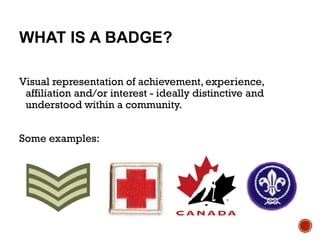
WHAT IS A BADGE?
Visual representation of achievement, experience,
affiliation and/or interest - ideally distinctive and
understood within a community.
Some examples:
“Badges mean nothing in themselves, but they
mark a certain achievement and they are a
link between the rich and the poor.
For when one girl sees a badge on a sister Scout’s
arm, if that girl has won the same badge, it at
once awakens an interest and
sympathy between them.”
- Juliette G. Low,
Founder of Girl Scouts of the USA
WHAT IS AN OPEN BADGE?
o Many apps, websites and organisations issue badges,
but they are all separate
o Open Badges attempt to draw all these into one (free) place
o Include links to criteria and evidence
o Add security and verification
o can check whether a person was actually awarded a specific
badge
o Allow 'clusters' of badges to be shared with others
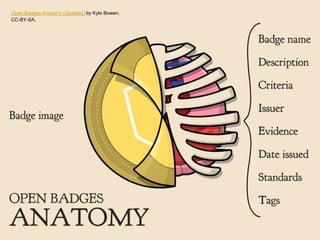
o Basically, an image + related data
Open Badges Anatomy (Updated) by Kyle Bowen.
CC-BY-SA.
WHY IS THERE A BUZZ ABOUT
THEM?
o Growing recognition that learning happens outside
the classroom
o Grade transcripts hide the truth about learning
o Strong links with current trends such as MOOCs,
Gamification, Mobile Learning
o but can be used independently of these
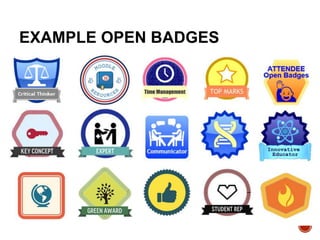
EXAMPLE OPEN BADGES
WHAT DID WE DO IN OUR
PROJECT?
o Semi-structured interviews with staff
o Whole institution
o Focus groups with students
o Health Sciences and Engineering
o None had prior knowledge of badges in HE
o but some were aware of other uses
o Intended to identify perception and value
o recommendation on whether to continue work
WHAT DID WE FIND?
o Students want to use badge to stand out from peers
o Desire to link badges to requirements of professional
accreditation
o Important not to issue too many - each badge must
represent genuine achievement
WHAT ELSE DID WE FIND?
o Badges would act as a motivator
o would push students to go beyond the minimum
o would support both individualistic and competitive goal
structures
o Students would use them when applying for jobs or
further study
o Helped to recall their development and the skills that they
had developed
o staff would use them when writing references
Carpet Badging by Kyle Bowen.
CC-BY-SA
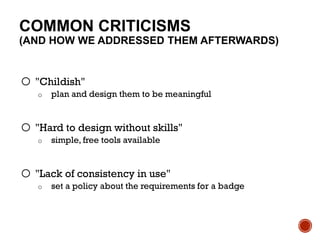
COMMON CRITICISMS
(AND HOW WE ADDRESSED THEM AFTERWARDS)
o "Childish"
o plan and design them to be meaningful
o "Hard to design without skills"
o simple, free tools available
o "Lack of consistency in use"
o set a policy about the requirements for a badge
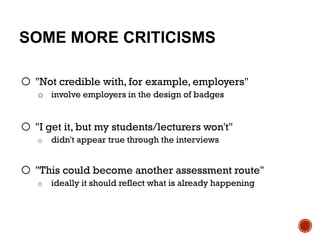
SOME MORE CRITICISMS
o "Not credible with, for example, employers"
o involve employers in the design of badges
o "I get it, but my students/lecturers won't"
o didn't appear true through the interviews
o "This could become another assessment route"
o ideally it should reflect what is already happening
Swiss Army Badge by Kyle Bowen.
CC-BY-SA
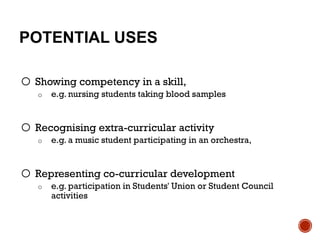
POTENTIAL USES
o Showing competency in a skill,
o e.g. nursing students taking blood samples
o Recognising extra-curricular activity
o e.g. a music student participating in an orchestra,
o Representing co-curricular development
o e.g. participation in Students' Union or Student Council
activities
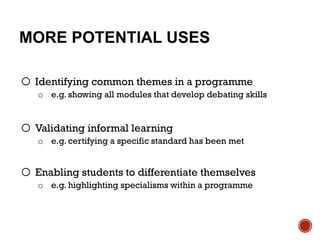
MORE POTENTIAL USES
o Identifying common themes in a programme
o e.g. showing all modules that develop debating skills
o Validating informal learning
o e.g. certifying a specific standard has been met
o Enabling students to differentiate themselves
o e.g. highlighting specialisms within a programme
Indiana Jones and the lost badge by Kyle Bowen.
CC-BY-SA
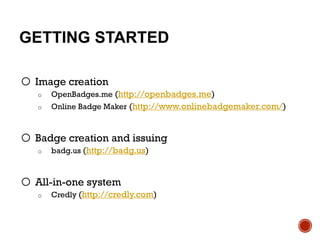
GETTING STARTED
o Image creation
o OpenBadges.me (http://openbadges.me)
o Online Badge Maker (http://www.onlinebadgemaker.com/)
o Badge creation and issuing
o badg.us (http://badg.us)
o All-in-one system
o Credly (http://credly.com)
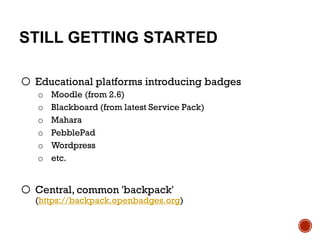
STILL GETTING STARTED
o Educational platforms introducing badges
o Moodle (from 2.6)
o Blackboard (from latest Service Pack)
o Mahara
o PebblePad
o Wordpress
o etc.
o Central, common 'backpack'
(https://backpack.openbadges.org)
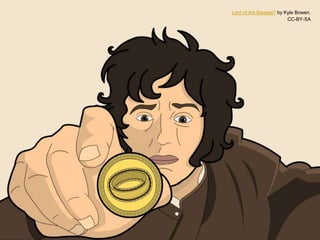
Lord of the Badges? by Kyle Bowen.
CC-BY-SA
CONTACT US
Dr. Ian Glover
email - i.glover@shu.ac.uk
blog - http://blogs.shu.ac.uk/telteam
Farzana Latif
email - f.latif@city.ac.uk
twitter - @farzanalatif

Investigating Perceptions and Potential of Open Badges in Formal Higher Education

  • 1.
    INVESTIGATING PERCEPTIONS AND POTENTIALOF OPEN BADGES IN FORMAL HIGHER EDUCATION Dr. Ian Glover, Sheffield Hallam University, UK Farzana Latif, City University London, UK
  • 2.
    WHAT IS ABADGE? Visual representation of achievement, experience, affiliation and/or interest - ideally distinctive and understood within a community. Some examples:
  • 3.
    “Badges mean nothingin themselves, but they mark a certain achievement and they are a link between the rich and the poor. For when one girl sees a badge on a sister Scout’s arm, if that girl has won the same badge, it at once awakens an interest and sympathy between them.” - Juliette G. Low, Founder of Girl Scouts of the USA
  • 5.
    WHAT IS ANOPEN BADGE? o Many apps, websites and organisations issue badges, but they are all separate o Open Badges attempt to draw all these into one (free) place o Include links to criteria and evidence o Add security and verification o can check whether a person was actually awarded a specific badge o Allow 'clusters' of badges to be shared with others o Basically, an image + related data
  • 6.
    Open Badges Anatomy(Updated) by Kyle Bowen. CC-BY-SA.
  • 7.
    WHY IS THEREA BUZZ ABOUT THEM? o Growing recognition that learning happens outside the classroom o Grade transcripts hide the truth about learning o Strong links with current trends such as MOOCs, Gamification, Mobile Learning o but can be used independently of these
  • 8.
  • 9.
    WHAT DID WEDO IN OUR PROJECT? o Semi-structured interviews with staff o Whole institution o Focus groups with students o Health Sciences and Engineering o None had prior knowledge of badges in HE o but some were aware of other uses o Intended to identify perception and value o recommendation on whether to continue work
  • 10.
    WHAT DID WEFIND? o Students want to use badge to stand out from peers o Desire to link badges to requirements of professional accreditation o Important not to issue too many - each badge must represent genuine achievement
  • 11.
    WHAT ELSE DIDWE FIND? o Badges would act as a motivator o would push students to go beyond the minimum o would support both individualistic and competitive goal structures o Students would use them when applying for jobs or further study o Helped to recall their development and the skills that they had developed o staff would use them when writing references
  • 12.
    Carpet Badging byKyle Bowen. CC-BY-SA
  • 13.
    COMMON CRITICISMS (AND HOWWE ADDRESSED THEM AFTERWARDS) o "Childish" o plan and design them to be meaningful o "Hard to design without skills" o simple, free tools available o "Lack of consistency in use" o set a policy about the requirements for a badge
  • 14.
    SOME MORE CRITICISMS o"Not credible with, for example, employers" o involve employers in the design of badges o "I get it, but my students/lecturers won't" o didn't appear true through the interviews o "This could become another assessment route" o ideally it should reflect what is already happening
  • 15.
    Swiss Army Badgeby Kyle Bowen. CC-BY-SA
  • 16.
    POTENTIAL USES o Showingcompetency in a skill, o e.g. nursing students taking blood samples o Recognising extra-curricular activity o e.g. a music student participating in an orchestra, o Representing co-curricular development o e.g. participation in Students' Union or Student Council activities
  • 17.
    MORE POTENTIAL USES oIdentifying common themes in a programme o e.g. showing all modules that develop debating skills o Validating informal learning o e.g. certifying a specific standard has been met o Enabling students to differentiate themselves o e.g. highlighting specialisms within a programme
  • 18.
    Indiana Jones andthe lost badge by Kyle Bowen. CC-BY-SA
  • 19.
    GETTING STARTED o Imagecreation o OpenBadges.me (http://openbadges.me) o Online Badge Maker (http://www.onlinebadgemaker.com/) o Badge creation and issuing o badg.us (http://badg.us) o All-in-one system o Credly (http://credly.com)
  • 20.
    STILL GETTING STARTED oEducational platforms introducing badges o Moodle (from 2.6) o Blackboard (from latest Service Pack) o Mahara o PebblePad o Wordpress o etc. o Central, common 'backpack' (https://backpack.openbadges.org)
  • 21.
    Lord of theBadges? by Kyle Bowen. CC-BY-SA
  • 22.
    CONTACT US Dr. IanGlover email - i.glover@shu.ac.uk blog - http://blogs.shu.ac.uk/telteam Farzana Latif email - f.latif@city.ac.uk twitter - @farzanalatif