Learning Cafe Workplace Trends Forum
Aspiring for Learning
Excellence in
Australia
Are we in the race ?
July 4, Thursday, 2013
12 - 1 pm, EST
1
Webinar ID: 601-941-520
Toll: +61 3 8644 7040 Access Code: 912-280-281
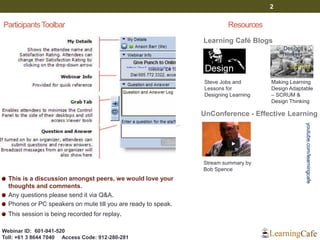
ParticipantsToolbar
This is a discussion amongst peers, we would love your
thoughts and comments.
Any questions please send it via Q&A.
Phones or PC speakers on mute till you are ready to speak.
This session is being recorded for replay.
Resources
2
Making Learning
Design Adaptable
– SCRUM &
Design Thinking
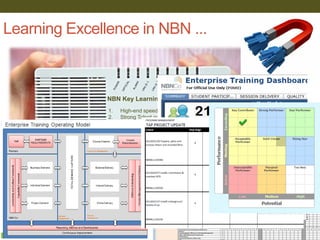
Learning Café Blogs
Steve Jobs and
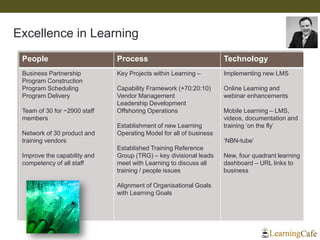
Lessons for
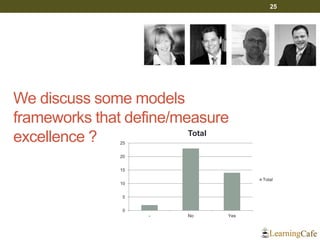
Designing Learning
UnConference - Effective Learning
Stream summary by
Bob Spence
youtube.com/learningcafe
Webinar ID: 601-941-520
Toll: +61 3 8644 7040 Access Code: 912-280-281
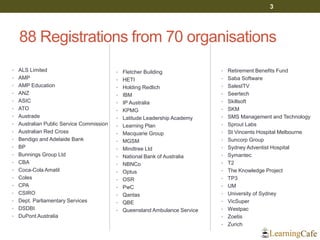
88 Registrations from 70 organisations
• ALS Limited
• AMP
• AMP Education
• ANZ
• ASIC
• ATO
• Austrade
• Australian Public Service Commission
• Australian Red Cross
• Bendigo and Adelaide Bank
• BP
• Bunnings Group Ltd
• CBA
• Coca-Cola Amatil
• Coles
• CPA
• CSIRO
• Dept. Parliamentary Services
• DSDBI
• DuPont Australia
• Fletcher Building
• HETI
• Holding Redlich
• IBM
• IP Australia
• KPMG
• Latitude Leadership Academy
• Learning Plan
• Macquarie Group
• MGSM
• Mindtree Ltd
• National Bank of Australia
• NBNCo
• Optus
• OSR
• PwC
• Qantas
• QBE
• Queensland Ambulance Service
3
• Retirement Benefits Fund
• Saba Software
• SalesITV
• Seertech
• Skillsoft
• SKM
• SMS Management and Technology
• Sprout Labs
• St Vincents Hospital Melbourne
• Suncorp Group
• Sydney Adventist Hospital
• Symantec
• T2
• The Knowledge Project
• TP3
• UM
• University of Sydney
• VicSuper
• Westpac
• Zoetis
• Zurich
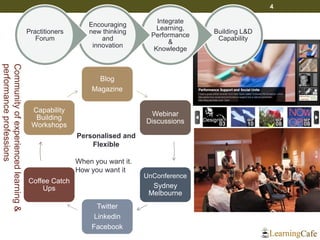
Communityofexperiencedlearning&
performanceprofessions
Building L&D
Capability
Integrate
Learning,
Performance
&
Knowledge
Encouraging
new thinking
and
innovation
Practitioners
Forum
Blog
Magazine
Webinar
Discussions
UnConference
Sydney
Melbourne
Twitter
Linkedin
Facebook
Coffee Catch
Ups
Capability
Building
Workshops
Personalised and
Flexible
When you want it.
How you want it
4
MOOCs in Corporate Training
MOOCs (Massively Open Online
Courses) can be a mainstream
employee learning option. It offers
cost effective solutions for
organisations with the benefits far
outweighing the challenges.
L&D/HR need to be proactive in
exploring and including MOOCs in
learning strategies.
5
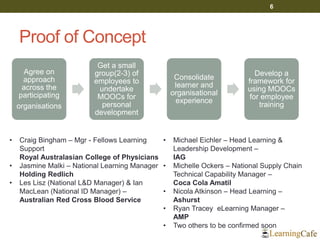
Blending MOOC JLT Group
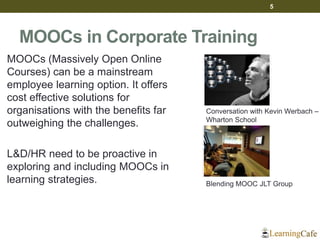
Conversation with Kevin Werbach –
Wharton School
Proof of Concept
Agree on
approach
across the
participating
organisations
Get a small
group(2-3) of
employees to
undertake
MOOCs for
personal
development
Consolidate
learner and
organisational
experience
Develop a
framework for
using MOOCs
for employee
training
6
• Craig Bingham – Mgr - Fellows Learning
Support
Royal Australasian College of Physicians
• Jasmine Malki – National Learning Manager
Holding Redlich
• Les Lisz (National L&D Manager) & Ian
MacLean (National ID Manager) –
Australian Red Cross Blood Service
• Michael Eichler – Head Learning &
Leadership Development –
IAG
• Michelle Ockers – National Supply Chain
Technical Capability Manager –
Coca Cola Amatil
• Nicola Atkinson – Head Learning –
Ashurst
• Ryan Tracey eLearning Manager –
AMP
• Two others to be confirmed soon
Outputs
Date: Thurs August 15, 2013
Time: 12:00 PM - 1:00 PM
AEST
7
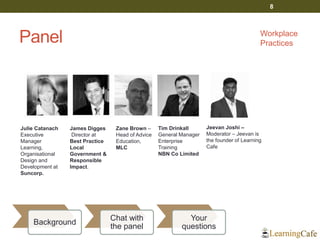
awareness
practitioners collateral
0
2
4
6
8
10
12
14
I have heard
about them
I have registered
and completed
for a MOOC
I have registered
for a MOOC
No idea what
they are
Reckon I spent about 4 hours searching for courses
today. It was a real slog to find relevant courses. If we
are to use MOOCs in a corporate setting there is some
work required up front to find the courses and/or
directories/providers that will be most relevant to your
organisation. - Michelle Ockers, Cola Cola Amatil
Next
Online
Workplace
Forum
Is this similar to F2F courses provided by external
training providers ? Search likely to be learner
led. Information about MOOCs is powered by
social media. Discussion continues…….
http://bit.ly/MOOCs1
Will it work ? If yes
What needs to happen.
Opportunities and challenges
MOOCs Learning Business Model
Better practices
Working Paper
1
2
Panel
Background
Chat with
the panel
Your
questions
8
Julie Catanach
Executive
Manager
Learning,
Organisational
Design and
Development at
Suncorp.
James Digges
Director at
Best Practice
Local
Government &
Responsible
Impact.
Zane Brown –
Head of Advice
Education,
MLC
Tim Drinkall
General Manager
Enterprise
Training
NBN Co Limited
Workplace
Practices
Jeevan Joshi –
Moderator – Jeevan is
the founder of Learning
Cafe
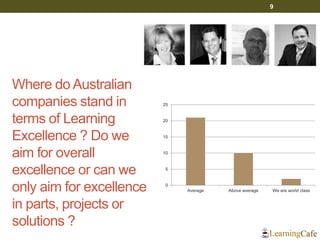
Where do Australian
companies stand in
terms of Learning
Excellence ? Do we
aim for overall
excellence or can we
only aim for excellence
in parts, projects or
solutions ?
9
0
5
10
15
20
25
Average Above average We are world class
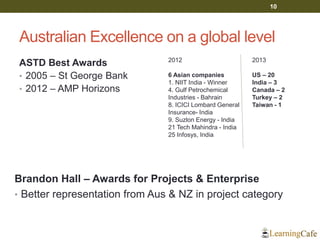
Australian Excellence on a global level
ASTD Best Awards
• 2005 – St George Bank
• 2012 – AMP Horizons
10
2012
6 Asian companies
1. NIIT India - Winner
4. Gulf Petrochemical
Industries - Bahrain
8. ICICI Lombard General
Insurance- India
9. Suzlon Energy - India
21 Tech Mahindra - India
25 Infosys, India
2013
US – 20
India – 3
Canada – 2
Turkey – 2
Taiwan - 1
Brandon Hall – Awards for Projects & Enterprise
• Better representation from Aus & NZ in project category
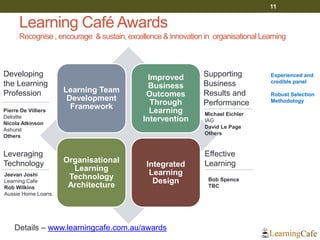
Learning Café Awards
Recognise , encourage & sustain, excellence & innovation in organisational Learning
Learning Team
Development
Framework
Improved
Business
Outcomes
Through
Learning
Intervention
Organisational
Learning
Technology
Architecture
Integrated
Learning
Design
Developing
the Learning
Profession
Pierre De Villiers
Deloitte
Nicola Atkinson
Ashurst
Others
Supporting
Business
Results and
Performance
Effective
Learning
Leveraging
Technology
Details – www.learningcafe.com.au/awards
Michael Eichler
IAG
David Le Page
Others
Jeevan Joshi
Learning Cafe
Rob Wilkins
Aussie Home Loans.
Experienced and
credible panel
Robust Selection
Methodology
Bob Spence
TBC
11
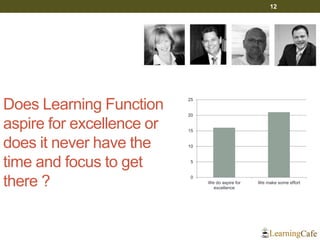
Does Learning Function
aspire for excellence or
does it never have the
time and focus to get
there ?
12
0
5
10
15
20
25
We do aspire for
excellence
We make some effort
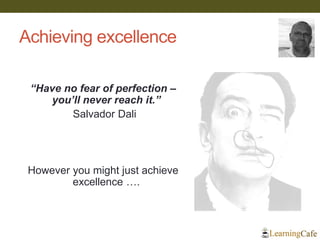
Achieving excellence
“Have no fear of perfection –
you’ll never reach it.”
Salvador Dali
However you might just achieve
excellence ….
Excellence is in the eye of the beholder
• While L&D practitioners aspire to
excellence I question by what criteria is
excellence being judged.
• Each stakeholder will be using their own
criteria for deciding what is excellence.
They will be seeing things through their
own lenses
• So what might those criteria be ….?
The main players …..
Criteria they are looking for can include:
• Boosts in sales/revenue
• Within budget and on time
• Meets Legislative deadlines
• Achieves compliance requirements
• Decreases time to competence for new starters
• Achieves Learning Outcomes
• Achieves changes in behaviours
• Imparts new skills or knowledge
• Interactive and engaging
• High evaluation scores (and/or Net Promoter
Scores)
• Innovative and leading edge (for that company)
Practitioners, stakeholders, Executive and CEOs
(Oh – and don’t forget the students!)
Advice Education’s approach
• Clear identification of the key stakeholders and their lenses
• Clarity on responsibilities (including who gets a voice and who gets a
vote)
• Clear identification of “Who has the D?” and their lens
• Strong adherence to the ID processes and sign offs along the way:
• Work Request
• Project Plan
• Design Brief
• Detailed Design Brief
• Development
• Pilot testing
• Implementation
• PIR
• Owning the L&D space
• Pushing the boundaries and constantly trying new things
So the bottom line is?
But if you can balance the:
• Resourcing
• System constraints
• Budget
• Deadlines
• Competing priorities
• Stakeholder and CEO expectations
• Audience locations and availability
• Etc. etc ….
You might get to excellence. At least in the eyes of those that are
important ….. the students.
Achieving excellence in training is a balancing act and
very few practitioners have the luxury of getting to
perfection.
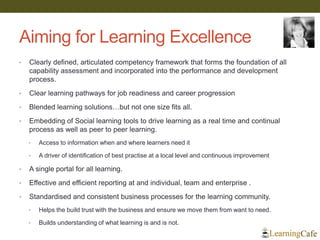
Aiming for Learning Excellence
• Clearly defined, articulated competency framework that forms the foundation of all
capability assessment and incorporated into the performance and development
process.
• Clear learning pathways for job readiness and career progression
• Blended learning solutions…but not one size fits all.
• Embedding of Social learning tools to drive learning as a real time and continual
process as well as peer to peer learning.
• Access to information when and where learners need it
• A driver of identification of best practise at a local level and continuous improvement
• A single portal for all learning.
• Effective and efficient reporting at and individual, team and enterprise .
• Standardised and consistent business processes for the learning community.
• Helps the build trust with the business and ensure we move them from want to need.
• Builds understanding of what learning is and is not.
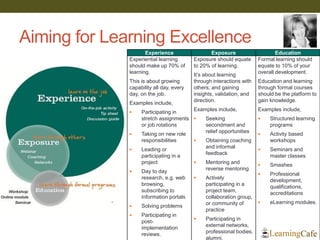
Aiming for Learning Excellence
Experience Exposure Education
Experiential learning
should make up 70% of
learning.
This is about growing
capability all day, every
day, on the job.
Examples include,
 Participating in
stretch assignments
or job rotations
 Taking on new role
responsibilities
 Leading or
participating in a
project
 Day to day
research, e.g. web
browsing,
subscribing to
information portals
 Solving problems
 Participating in
post-
implementation
reviews.
Exposure should equate
to 20% of learning.
It’s about learning
through interactions with
others; and gaining
insights, validation, and
direction.
Examples include,
 Seeking
secondment and
relief opportunities
 Obtaining coaching
and informal
feedback
 Mentoring and
reverse mentoring
 Actively
participating in a
project team,
collaboration group,
or community of
practice
 Participating in
external networks,
professional bodies,
alumni.
Formal learning should
equate to 10% of your
overall development.
Education and learning
through formal courses
should be the platform to
gain knowledge.
Examples include,
 Structured learning
programs
 Activity based
workshops
 Seminars and
master classes
 Smashes
 Professional
development,
qualifications,
accreditations
 eLearning​ modules.
What does excellence of Learning
mean to you at an Personal, Team,
Function and Organisational Level ?
20
Background of NBN ...
• High speed broadband network – 100Mbps
• 100% of Australia covered
• Fixed Fibre Optic Cable – 93%
• Wireless Broadband – 4%
• Satellite Broadband Coverage – 3%
• Australia’s largest infrastructure project
• Government Business Enterprise
Learning Excellence in NBN ...
NBN Key Learning Objectives
1. High-end speed to competency
2. Strong Talent and Succession
3. SWAT team development
4. Industry Accreditation
5. Full disclosure and reporting
a) Dollar Spend
b) Competency
c) Vendors
6. 100% Compliance
People Process Technology
In the last 12 months ....
• 53,000 applications
• 1100 recruited
• ~85% retention
Alignment of values incredibly
strong – complete belief in the
project
Highly technical, deeply
experienced hires in the past 3
years
Structured for growth and
delivery ramp ups for three
years
Delivery Partner model
Planning and Scheduling key
process area
Two full teams documenting and
maintaining process mapping
Quality Assurance and continuous
improvement not just buzz words
Volatility Vision
Uncertainty Understanding
Complexity Clarity
Ambiguity Agility
Moved from a start up business
through to a ‘Factory’ process
CIO and CTO Functions
are state of the art – only a
handful of businesses
have done this before
Fixed, wireless and
satellite technology
100Mbps connectivity
Excellence in NBNCo
People Process Technology
Business Partnership
Program Construction
Program Scheduling
Program Delivery
Team of 30 for ~2900 staff
members
Network of 30 product and
training vendors
Improve the capability and
competency of all staff
Key Projects within Learning –
Capability Framework (+70:20:10)
Vendor Management
Leadership Development
Offshoring Operations
Establishment of new Learning
Operating Model for all of business
Established Training Reference
Group (TRG) – key divisional leads
meet with Learning to discuss all
training / people issues
Alignment of Organisational Goals
with Learning Goals
Implementing new LMS
Online Learning and
webinar enhancements
Mobile Learning – LMS,
videos, documentation and
training ‘on the fly’
‘NBN-tube’
New, four quadrant learning
dashboard – URL links to
business
Excellence in Learning
We discuss some models
frameworks that define/measure
excellence ?
25
0
5
10
15
20
25
- No Yes
Total
Total
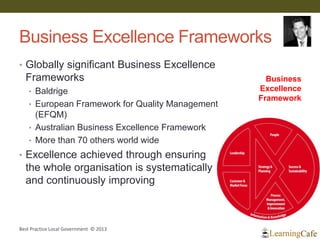
Business Excellence Frameworks
• Globally significant Business Excellence
Frameworks
• Baldrige
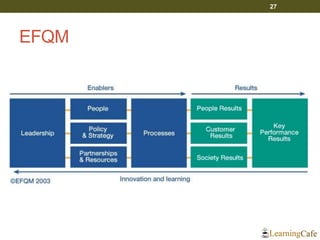
• European Framework for Quality Management
(EFQM)
• Australian Business Excellence Framework
• More than 70 others world wide
• Excellence achieved through ensuring
the whole organisation is systematically
and continuously improving
Best Practice Local Government © 2013
Business
Excellence
Framework
EFQM
27
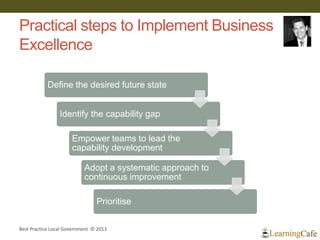
Practical steps to Implement Business
Excellence
Best Practice Local Government © 2013
Define the desired future state
Identify the capability gap
Empower teams to lead the
capability development
Adopt a systematic approach to
continuous improvement
Prioritise
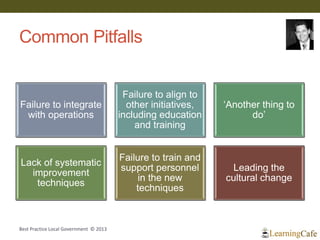
Common Pitfalls
Failure to integrate
with operations
Failure to align to
other initiatives,
including education
and training
‘Another thing to
do’
Lack of systematic
improvement
techniques
Failure to train and
support personnel
in the new
techniques
Leading the
cultural change
Best Practice Local Government © 2013
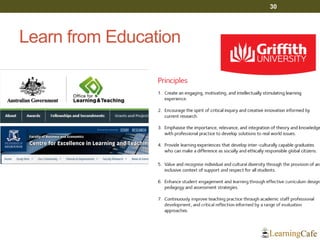
Learn from Education
30
With the nature of Learning
changing e.g. informal and just in
time, will it become challenging to
define and measure excellence in
Learning ?
31
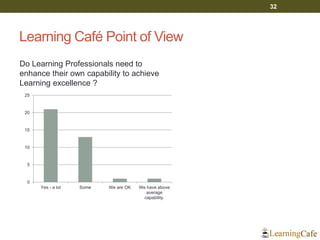
Learning Café Point of View
32
0
5
10
15
20
25
Yes - a lot Some We are OK We have above
average
capability.
Do Learning Professionals need to
enhance their own capability to achieve
Learning excellence ?
Developing Capabilities
33
0
5
10
15
20
25
Business or commercial
acumen
Digital acumen Industry acumen (ie know
the industry better)
Financial acumen
Learning
Community should
Become aware that
reaching excellence in
a process. There are
frameworks available.
Look to the academic
sector for better
practices and lessons
learnt.
Develop capabilities i.e.
business and digital
acumen to help with
journey to excellence.
www.learningcafe.com.au
learningcafemag
http://bit.ly/lcafefb
blogs
learning conversations
free resources
workshops
UnConference 2013
Sydney Melbourne
Webinar recording, ebooks, L&D frameworks
Building Effective Employee Social Networks
34
Open source initiatives

Learning Excellence in Australia - Are we in the race ? Learning Cafe Online Discussion

  • 1.
    Learning Cafe WorkplaceTrends Forum Aspiring for Learning Excellence in Australia Are we in the race ? July 4, Thursday, 2013 12 - 1 pm, EST 1 Webinar ID: 601-941-520 Toll: +61 3 8644 7040 Access Code: 912-280-281
  • 2.
    ParticipantsToolbar This is adiscussion amongst peers, we would love your thoughts and comments. Any questions please send it via Q&A. Phones or PC speakers on mute till you are ready to speak. This session is being recorded for replay. Resources 2 Making Learning Design Adaptable – SCRUM & Design Thinking Learning Café Blogs Steve Jobs and Lessons for Designing Learning UnConference - Effective Learning Stream summary by Bob Spence youtube.com/learningcafe Webinar ID: 601-941-520 Toll: +61 3 8644 7040 Access Code: 912-280-281
  • 3.
    88 Registrations from70 organisations • ALS Limited • AMP • AMP Education • ANZ • ASIC • ATO • Austrade • Australian Public Service Commission • Australian Red Cross • Bendigo and Adelaide Bank • BP • Bunnings Group Ltd • CBA • Coca-Cola Amatil • Coles • CPA • CSIRO • Dept. Parliamentary Services • DSDBI • DuPont Australia • Fletcher Building • HETI • Holding Redlich • IBM • IP Australia • KPMG • Latitude Leadership Academy • Learning Plan • Macquarie Group • MGSM • Mindtree Ltd • National Bank of Australia • NBNCo • Optus • OSR • PwC • Qantas • QBE • Queensland Ambulance Service 3 • Retirement Benefits Fund • Saba Software • SalesITV • Seertech • Skillsoft • SKM • SMS Management and Technology • Sprout Labs • St Vincents Hospital Melbourne • Suncorp Group • Sydney Adventist Hospital • Symantec • T2 • The Knowledge Project • TP3 • UM • University of Sydney • VicSuper • Westpac • Zoetis • Zurich
  • 4.
  • 5.
    MOOCs in CorporateTraining MOOCs (Massively Open Online Courses) can be a mainstream employee learning option. It offers cost effective solutions for organisations with the benefits far outweighing the challenges. L&D/HR need to be proactive in exploring and including MOOCs in learning strategies. 5 Blending MOOC JLT Group Conversation with Kevin Werbach – Wharton School
  • 6.
    Proof of Concept Agreeon approach across the participating organisations Get a small group(2-3) of employees to undertake MOOCs for personal development Consolidate learner and organisational experience Develop a framework for using MOOCs for employee training 6 • Craig Bingham – Mgr - Fellows Learning Support Royal Australasian College of Physicians • Jasmine Malki – National Learning Manager Holding Redlich • Les Lisz (National L&D Manager) & Ian MacLean (National ID Manager) – Australian Red Cross Blood Service • Michael Eichler – Head Learning & Leadership Development – IAG • Michelle Ockers – National Supply Chain Technical Capability Manager – Coca Cola Amatil • Nicola Atkinson – Head Learning – Ashurst • Ryan Tracey eLearning Manager – AMP • Two others to be confirmed soon
  • 7.
    Outputs Date: Thurs August15, 2013 Time: 12:00 PM - 1:00 PM AEST 7 awareness practitioners collateral 0 2 4 6 8 10 12 14 I have heard about them I have registered and completed for a MOOC I have registered for a MOOC No idea what they are Reckon I spent about 4 hours searching for courses today. It was a real slog to find relevant courses. If we are to use MOOCs in a corporate setting there is some work required up front to find the courses and/or directories/providers that will be most relevant to your organisation. - Michelle Ockers, Cola Cola Amatil Next Online Workplace Forum Is this similar to F2F courses provided by external training providers ? Search likely to be learner led. Information about MOOCs is powered by social media. Discussion continues……. http://bit.ly/MOOCs1 Will it work ? If yes What needs to happen. Opportunities and challenges MOOCs Learning Business Model Better practices Working Paper 1 2
  • 8.
    Panel Background Chat with the panel Your questions 8 JulieCatanach Executive Manager Learning, Organisational Design and Development at Suncorp. James Digges Director at Best Practice Local Government & Responsible Impact. Zane Brown – Head of Advice Education, MLC Tim Drinkall General Manager Enterprise Training NBN Co Limited Workplace Practices Jeevan Joshi – Moderator – Jeevan is the founder of Learning Cafe
  • 9.
    Where do Australian companiesstand in terms of Learning Excellence ? Do we aim for overall excellence or can we only aim for excellence in parts, projects or solutions ? 9 0 5 10 15 20 25 Average Above average We are world class
  • 10.
    Australian Excellence ona global level ASTD Best Awards • 2005 – St George Bank • 2012 – AMP Horizons 10 2012 6 Asian companies 1. NIIT India - Winner 4. Gulf Petrochemical Industries - Bahrain 8. ICICI Lombard General Insurance- India 9. Suzlon Energy - India 21 Tech Mahindra - India 25 Infosys, India 2013 US – 20 India – 3 Canada – 2 Turkey – 2 Taiwan - 1 Brandon Hall – Awards for Projects & Enterprise • Better representation from Aus & NZ in project category
  • 11.
    Learning Café Awards Recognise, encourage & sustain, excellence & innovation in organisational Learning Learning Team Development Framework Improved Business Outcomes Through Learning Intervention Organisational Learning Technology Architecture Integrated Learning Design Developing the Learning Profession Pierre De Villiers Deloitte Nicola Atkinson Ashurst Others Supporting Business Results and Performance Effective Learning Leveraging Technology Details – www.learningcafe.com.au/awards Michael Eichler IAG David Le Page Others Jeevan Joshi Learning Cafe Rob Wilkins Aussie Home Loans. Experienced and credible panel Robust Selection Methodology Bob Spence TBC 11
  • 12.
    Does Learning Function aspirefor excellence or does it never have the time and focus to get there ? 12 0 5 10 15 20 25 We do aspire for excellence We make some effort
  • 13.
    Achieving excellence “Have nofear of perfection – you’ll never reach it.” Salvador Dali However you might just achieve excellence ….
  • 14.
    Excellence is inthe eye of the beholder • While L&D practitioners aspire to excellence I question by what criteria is excellence being judged. • Each stakeholder will be using their own criteria for deciding what is excellence. They will be seeing things through their own lenses • So what might those criteria be ….?
  • 15.
    The main players….. Criteria they are looking for can include: • Boosts in sales/revenue • Within budget and on time • Meets Legislative deadlines • Achieves compliance requirements • Decreases time to competence for new starters • Achieves Learning Outcomes • Achieves changes in behaviours • Imparts new skills or knowledge • Interactive and engaging • High evaluation scores (and/or Net Promoter Scores) • Innovative and leading edge (for that company) Practitioners, stakeholders, Executive and CEOs (Oh – and don’t forget the students!)
  • 16.
    Advice Education’s approach •Clear identification of the key stakeholders and their lenses • Clarity on responsibilities (including who gets a voice and who gets a vote) • Clear identification of “Who has the D?” and their lens • Strong adherence to the ID processes and sign offs along the way: • Work Request • Project Plan • Design Brief • Detailed Design Brief • Development • Pilot testing • Implementation • PIR • Owning the L&D space • Pushing the boundaries and constantly trying new things
  • 17.
    So the bottomline is? But if you can balance the: • Resourcing • System constraints • Budget • Deadlines • Competing priorities • Stakeholder and CEO expectations • Audience locations and availability • Etc. etc …. You might get to excellence. At least in the eyes of those that are important ….. the students. Achieving excellence in training is a balancing act and very few practitioners have the luxury of getting to perfection.
  • 18.
    Aiming for LearningExcellence • Clearly defined, articulated competency framework that forms the foundation of all capability assessment and incorporated into the performance and development process. • Clear learning pathways for job readiness and career progression • Blended learning solutions…but not one size fits all. • Embedding of Social learning tools to drive learning as a real time and continual process as well as peer to peer learning. • Access to information when and where learners need it • A driver of identification of best practise at a local level and continuous improvement • A single portal for all learning. • Effective and efficient reporting at and individual, team and enterprise . • Standardised and consistent business processes for the learning community. • Helps the build trust with the business and ensure we move them from want to need. • Builds understanding of what learning is and is not.
  • 19.
    Aiming for LearningExcellence Experience Exposure Education Experiential learning should make up 70% of learning. This is about growing capability all day, every day, on the job. Examples include,  Participating in stretch assignments or job rotations  Taking on new role responsibilities  Leading or participating in a project  Day to day research, e.g. web browsing, subscribing to information portals  Solving problems  Participating in post- implementation reviews. Exposure should equate to 20% of learning. It’s about learning through interactions with others; and gaining insights, validation, and direction. Examples include,  Seeking secondment and relief opportunities  Obtaining coaching and informal feedback  Mentoring and reverse mentoring  Actively participating in a project team, collaboration group, or community of practice  Participating in external networks, professional bodies, alumni. Formal learning should equate to 10% of your overall development. Education and learning through formal courses should be the platform to gain knowledge. Examples include,  Structured learning programs  Activity based workshops  Seminars and master classes  Smashes  Professional development, qualifications, accreditations  eLearning​ modules.
  • 20.
    What does excellenceof Learning mean to you at an Personal, Team, Function and Organisational Level ? 20
  • 21.
    Background of NBN... • High speed broadband network – 100Mbps • 100% of Australia covered • Fixed Fibre Optic Cable – 93% • Wireless Broadband – 4% • Satellite Broadband Coverage – 3% • Australia’s largest infrastructure project • Government Business Enterprise
  • 22.
    Learning Excellence inNBN ... NBN Key Learning Objectives 1. High-end speed to competency 2. Strong Talent and Succession 3. SWAT team development 4. Industry Accreditation 5. Full disclosure and reporting a) Dollar Spend b) Competency c) Vendors 6. 100% Compliance
  • 23.
    People Process Technology Inthe last 12 months .... • 53,000 applications • 1100 recruited • ~85% retention Alignment of values incredibly strong – complete belief in the project Highly technical, deeply experienced hires in the past 3 years Structured for growth and delivery ramp ups for three years Delivery Partner model Planning and Scheduling key process area Two full teams documenting and maintaining process mapping Quality Assurance and continuous improvement not just buzz words Volatility Vision Uncertainty Understanding Complexity Clarity Ambiguity Agility Moved from a start up business through to a ‘Factory’ process CIO and CTO Functions are state of the art – only a handful of businesses have done this before Fixed, wireless and satellite technology 100Mbps connectivity Excellence in NBNCo
  • 24.
    People Process Technology BusinessPartnership Program Construction Program Scheduling Program Delivery Team of 30 for ~2900 staff members Network of 30 product and training vendors Improve the capability and competency of all staff Key Projects within Learning – Capability Framework (+70:20:10) Vendor Management Leadership Development Offshoring Operations Establishment of new Learning Operating Model for all of business Established Training Reference Group (TRG) – key divisional leads meet with Learning to discuss all training / people issues Alignment of Organisational Goals with Learning Goals Implementing new LMS Online Learning and webinar enhancements Mobile Learning – LMS, videos, documentation and training ‘on the fly’ ‘NBN-tube’ New, four quadrant learning dashboard – URL links to business Excellence in Learning
  • 25.
    We discuss somemodels frameworks that define/measure excellence ? 25 0 5 10 15 20 25 - No Yes Total Total
  • 26.
    Business Excellence Frameworks •Globally significant Business Excellence Frameworks • Baldrige • European Framework for Quality Management (EFQM) • Australian Business Excellence Framework • More than 70 others world wide • Excellence achieved through ensuring the whole organisation is systematically and continuously improving Best Practice Local Government © 2013 Business Excellence Framework
  • 27.
  • 28.
    Practical steps toImplement Business Excellence Best Practice Local Government © 2013 Define the desired future state Identify the capability gap Empower teams to lead the capability development Adopt a systematic approach to continuous improvement Prioritise
  • 29.
    Common Pitfalls Failure tointegrate with operations Failure to align to other initiatives, including education and training ‘Another thing to do’ Lack of systematic improvement techniques Failure to train and support personnel in the new techniques Leading the cultural change Best Practice Local Government © 2013
  • 30.
  • 31.
    With the natureof Learning changing e.g. informal and just in time, will it become challenging to define and measure excellence in Learning ? 31
  • 32.
    Learning Café Pointof View 32 0 5 10 15 20 25 Yes - a lot Some We are OK We have above average capability. Do Learning Professionals need to enhance their own capability to achieve Learning excellence ?
  • 33.
    Developing Capabilities 33 0 5 10 15 20 25 Business orcommercial acumen Digital acumen Industry acumen (ie know the industry better) Financial acumen Learning Community should Become aware that reaching excellence in a process. There are frameworks available. Look to the academic sector for better practices and lessons learnt. Develop capabilities i.e. business and digital acumen to help with journey to excellence.
  • 34.
    www.learningcafe.com.au learningcafemag http://bit.ly/lcafefb blogs learning conversations free resources workshops UnConference2013 Sydney Melbourne Webinar recording, ebooks, L&D frameworks Building Effective Employee Social Networks 34 Open source initiatives