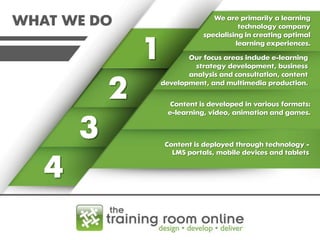

WHAT WE DO

1

2
3

4

We are primarily a learning
technology company
specialising in creating optimal
learning experiences.
Our focus areas include e-learning
strategy development, business
analysis and consultation, content
development, and multimedia production.
Content is developed in various formats:
e-learning, video, animation and games.

Content is deployed through technology LMS portals, mobile devices and tablets
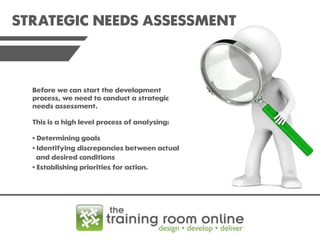
STRATEGIC NEEDS ASSESSMENT

Before we can start the development
process, we need to conduct a strategic
needs assessment.
This is a high level process of analysing:
• Determining goals
• Identifying discrepancies between actual
and desired conditions
• Establishing priorities for action.
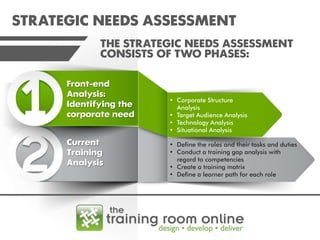
STRATEGIC NEEDS ASSESSMENT
THE STRATEGIC NEEDS ASSESSMENT
CONSISTS OF TWO PHASES:
Front-end
Analysis:
Identifying the
corporate need
Current
Training
Analysis

• Corporate Structure
Analysis
• Target Audience Analysis
• Technology Analysis
• Situational Analysis
• Define the roles and their tasks and duties
• Conduct a training gap analysis with
regard to competencies
• Create a training matrix
• Define a learner path for each role
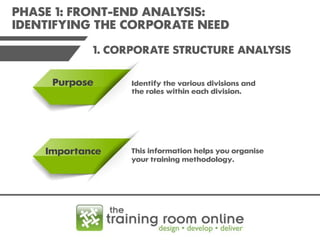
PHASE 1: FRONT-END ANALYSIS:
IDENTIFYING THE CORPORATE NEED
1. CORPORATE STRUCTURE ANALYSIS
Purpose

Importance

Identify the various divisions and
the roles within each division.

This information helps you organise
your training methodology.
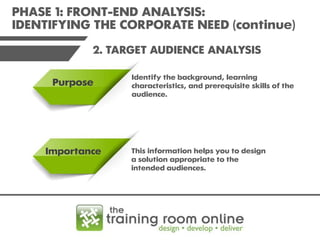
PHASE 1: FRONT-END ANALYSIS:
IDENTIFYING THE CORPORATE NEED (continue)
2. TARGET AUDIENCE ANALYSIS
Purpose

Importance

Identify the background, learning
characteristics, and prerequisite skills of the
audience.

This information helps you to design
a solution appropriate to the
intended audiences.
PHASE 1: FRONT-END ANALYSIS:
IDENTIFYING THE CORPORATE NEED (continue)
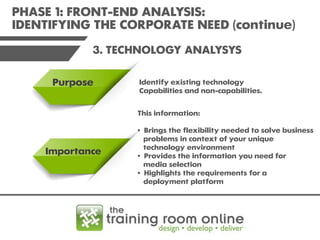
3. TECHNOLOGY ANALYSYS
Purpose

Identify existing technology
Capabilities and non-capabilities.

This information:

Importance

• Brings the flexibility needed to solve business
problems in context of your unique
technology environment
• Provides the information you need for
media selection
• Highlights the requirements for a
deployment platform
PHASE 1: FRONT-END ANALYSIS:
IDENTIFYING THE CORPORATE NEED (continue)
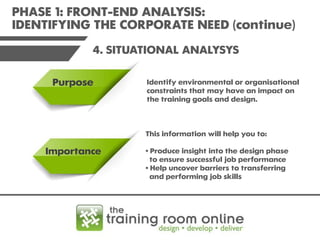
4. SITUATIONAL ANALYSYS
Purpose

Identify environmental or organisational
constraints that may have an impact on
the training goals and design.

This information will help you to:

Importance

• Produce insight into the design phase
to ensure successful job performance
• Help uncover barriers to transferring
and performing job skills
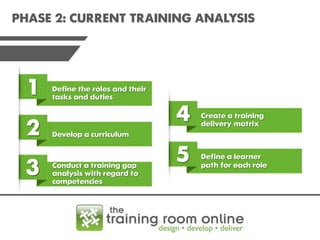
PHASE 2: CURRENT TRAINING ANALYSIS

1
2
3

Define the roles and their
tasks and duties

4

Create a training
delivery matrix

5

Define a learner
path for each role

Develop a curriculum

Conduct a training gap
analysis with regard to
competencies
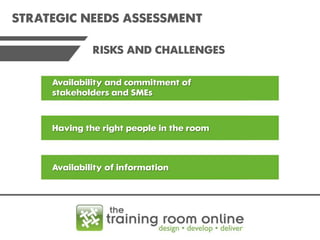
STRATEGIC NEEDS ASSESSMENT
RISKS AND CHALLENGES
Availability and commitment of
stakeholders and SMEs

Having the right people in the room

Availability of information
EXAMPLES
Examples of our business and
e-learning strategy development
and implementation include:
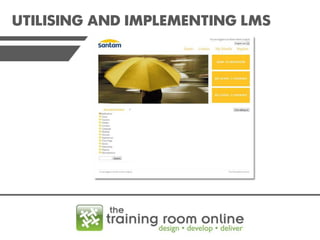
Santam E-learning Roadmap (2013)
Based on Santam’s requirements, the e-learning
Ecosystem broadly took cognisance of the following:
• Individual Learner Profile Management
• Full Learner Management System Capability
• Communication and User Interactivity
• Portfolio of Evidence Creation
• Potential Professional / Social Interactivity
• Creation of Collaboration Groups / Centres of Excellence
EXAMPLES
Examples of our business and
e-learning strategy development
and implementation include:
Telkom Learning and Development Department Restructure (2013)
The Training Room Online assisted Telkom in the
restructuring of their Learning and Development
Department. The nature of the engagements centred on:
• Role Profiling
• Job Analysis
• E-learning Strategy Development
EXAMPLES
Examples of our business and
e-learning strategy development
and implementation include:
E-learning Strategy Development for the Banking Sector (2010 – 2013)
The Training Room Online has focused on the banking
sector for the past three years, assisting banks to develop
their e-learning and technology strategies in the
following areas:
• Technology Strategy
• Learning Strategy
• Compliance and Risk Strategy
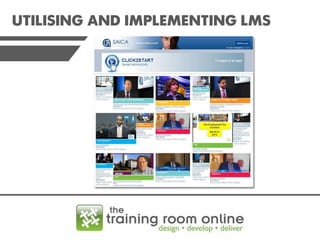
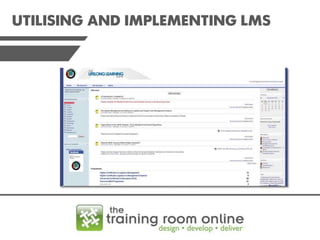
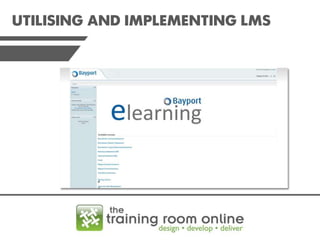
UTILISING AND IMPLEMENTING LMS
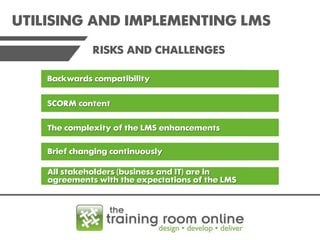
RISKS AND CHALLENGES
Backwards compatibility
SCORM content
The complexity of the LMS enhancements
Brief changing continuously
All stakeholders (business and IT) are in
agreements with the expectations of the LMS
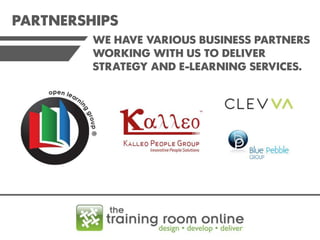
PARTNERSHIPS
WE HAVE VARIOUS BUSINESS PARTNERS
WORKING WITH US TO DELIVER
STRATEGY AND E-LEARNING SERVICES.
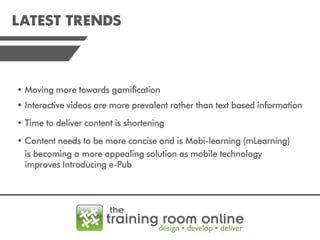
LATEST TRENDS

• Moving more towards gamification
• Interactive videos are more prevalent rather than text based information
• Time to deliver content is shortening
• Content needs to be more concise and is Mobi-learning (mLearning)
is becoming a more appealing solution as mobile technology
improves Introducing e-Pub
QUESTIONS AND ANSWERS

E-Learning Strategy

  • 2.
    WHAT WE DO 1 2 3 4 Weare primarily a learning technology company specialising in creating optimal learning experiences. Our focus areas include e-learning strategy development, business analysis and consultation, content development, and multimedia production. Content is developed in various formats: e-learning, video, animation and games. Content is deployed through technology LMS portals, mobile devices and tablets
  • 4.
  • 5.
    STRATEGIC NEEDS ASSESSMENT Beforewe can start the development process, we need to conduct a strategic needs assessment. This is a high level process of analysing: • Determining goals • Identifying discrepancies between actual and desired conditions • Establishing priorities for action.
  • 6.
    STRATEGIC NEEDS ASSESSMENT THESTRATEGIC NEEDS ASSESSMENT CONSISTS OF TWO PHASES: Front-end Analysis: Identifying the corporate need Current Training Analysis • Corporate Structure Analysis • Target Audience Analysis • Technology Analysis • Situational Analysis • Define the roles and their tasks and duties • Conduct a training gap analysis with regard to competencies • Create a training matrix • Define a learner path for each role
  • 7.
    PHASE 1: FRONT-ENDANALYSIS: IDENTIFYING THE CORPORATE NEED 1. CORPORATE STRUCTURE ANALYSIS Purpose Importance Identify the various divisions and the roles within each division. This information helps you organise your training methodology.
  • 8.
    PHASE 1: FRONT-ENDANALYSIS: IDENTIFYING THE CORPORATE NEED (continue) 2. TARGET AUDIENCE ANALYSIS Purpose Importance Identify the background, learning characteristics, and prerequisite skills of the audience. This information helps you to design a solution appropriate to the intended audiences.
  • 9.
    PHASE 1: FRONT-ENDANALYSIS: IDENTIFYING THE CORPORATE NEED (continue) 3. TECHNOLOGY ANALYSYS Purpose Identify existing technology Capabilities and non-capabilities. This information: Importance • Brings the flexibility needed to solve business problems in context of your unique technology environment • Provides the information you need for media selection • Highlights the requirements for a deployment platform
  • 10.
    PHASE 1: FRONT-ENDANALYSIS: IDENTIFYING THE CORPORATE NEED (continue) 4. SITUATIONAL ANALYSYS Purpose Identify environmental or organisational constraints that may have an impact on the training goals and design. This information will help you to: Importance • Produce insight into the design phase to ensure successful job performance • Help uncover barriers to transferring and performing job skills
  • 11.
    PHASE 2: CURRENTTRAINING ANALYSIS 1 2 3 Define the roles and their tasks and duties 4 Create a training delivery matrix 5 Define a learner path for each role Develop a curriculum Conduct a training gap analysis with regard to competencies
  • 12.
    STRATEGIC NEEDS ASSESSMENT RISKSAND CHALLENGES Availability and commitment of stakeholders and SMEs Having the right people in the room Availability of information
  • 13.
    EXAMPLES Examples of ourbusiness and e-learning strategy development and implementation include: Santam E-learning Roadmap (2013) Based on Santam’s requirements, the e-learning Ecosystem broadly took cognisance of the following: • Individual Learner Profile Management • Full Learner Management System Capability • Communication and User Interactivity • Portfolio of Evidence Creation • Potential Professional / Social Interactivity • Creation of Collaboration Groups / Centres of Excellence
  • 14.
    EXAMPLES Examples of ourbusiness and e-learning strategy development and implementation include: Telkom Learning and Development Department Restructure (2013) The Training Room Online assisted Telkom in the restructuring of their Learning and Development Department. The nature of the engagements centred on: • Role Profiling • Job Analysis • E-learning Strategy Development
  • 15.
    EXAMPLES Examples of ourbusiness and e-learning strategy development and implementation include: E-learning Strategy Development for the Banking Sector (2010 – 2013) The Training Room Online has focused on the banking sector for the past three years, assisting banks to develop their e-learning and technology strategies in the following areas: • Technology Strategy • Learning Strategy • Compliance and Risk Strategy
  • 16.
  • 17.
  • 18.
  • 19.
  • 20.
  • 21.
    UTILISING AND IMPLEMENTINGLMS RISKS AND CHALLENGES Backwards compatibility SCORM content The complexity of the LMS enhancements Brief changing continuously All stakeholders (business and IT) are in agreements with the expectations of the LMS
  • 22.
    PARTNERSHIPS WE HAVE VARIOUSBUSINESS PARTNERS WORKING WITH US TO DELIVER STRATEGY AND E-LEARNING SERVICES.
  • 23.
    LATEST TRENDS • Movingmore towards gamification • Interactive videos are more prevalent rather than text based information • Time to deliver content is shortening • Content needs to be more concise and is Mobi-learning (mLearning) is becoming a more appealing solution as mobile technology improves Introducing e-Pub
  • 24.