A Practical Approach to Gamification
April 7th, 2015
Some Housekeeping Details
The event is
being recorded
Use the Q&A
window
The Polling function
Follow the conversation on Twitter: #GamifiedLearning
@kkapp | @Axonify
The Focus of Today
o Gamification Overview
o A Practical Approach to Get Started
o Aligning your Corporate Goals &
Learning Strategies
o Building your Business Case
o Gamification Requirements Gathering
o Q&A
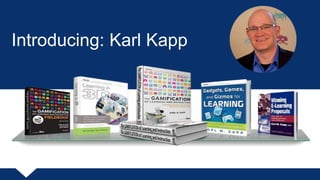
Karl Kapp
AUTHOR & PROFESSOR OF
INSTRUCTIONAL
TECHNOLOGY BLOOMSBURG
UNIVERSITY
Shum Attygalle
DIGITAL MARKETING MANAGER
AXONIFY
Gamification Workbook
You will receive a copy
shortly after the webinar!
Introducing: Karl Kapp
Gamification Recap
E L E V TO R
V
POLL: Where are you currently at
with gamification?
A. People keep saying it but I don’t know what it really means.
B. Trying some things, but haven’t found the sweet spot.
C. Heavily entrenched, trying to gamify as much as we can.
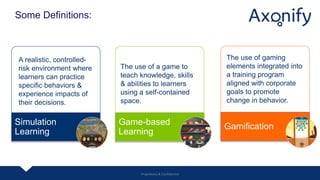
Some Definitions:
GamificationGame-based
Learning
Simulation
Learning
The use of gaming
elements integrated into
a training program
aligned with corporate
goals to promote
change in behavior.
The use of a game to
teach knowledge, skills
& abilities to learners
using a self-contained
space.
A realistic, controlled-
risk environment where
learners can practice
specific behaviors &
experience impacts of
their decisions.
Proprietary & Confidential
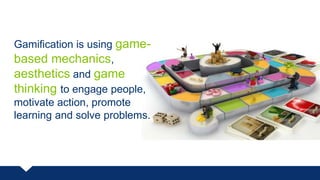
Gamification is using game-
based mechanics,
aesthetics and game
thinking to engage people,
motivate action, promote
learning and solve problems.
Gamification is to
Learning as a
Piece is to
a Puzzle
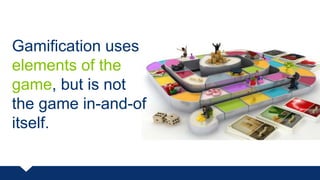
Gamification uses
elements of the
game, but is not
the game in-and-of
itself.
Gamification Getting Started
E L E V TO R
V
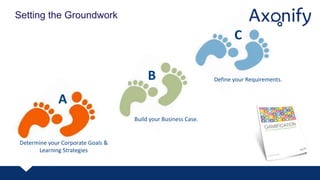
Setting the Groundwork
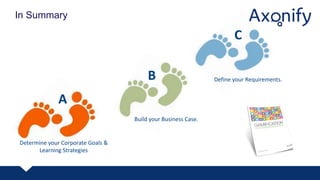
Determine your Corporate Goals &
Learning Strategies
Build your Business Case.
Define your Requirements.
A
B
C
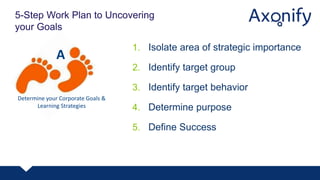
Determine your Corporate Goals &
Learning Strategies
A
1. Isolate area of strategic importance
2. Identify target group
3. Identify target behavior
4. Determine purpose
5. Define Success
5-Step Work Plan to Uncovering
your Goals
ISOLATE AREA OF STRATEGIC IMPORTANCE
1
Successful roll out of their
Omnichannel strategy.
Increase product knowledge to
drive sales.
Reduce safety incidents within
their Logistics organization.
IDENTIFY YOUR TARGET GROUP
2
Retail Associates Sales Reps
Employees in their Logistics
Operation
IDENTIFY TARGET BEHAVIOR
3
To learn, internalize and
consistently apply Omnichannel
principles when dealing with
customers.
To remember and apply product
and procedural knowledge with
their medical clients.
To embrace and apply safe
working practices everyday
on the job.
DETERMINE PURPOSE –
WHY GAMIFICATION?
4
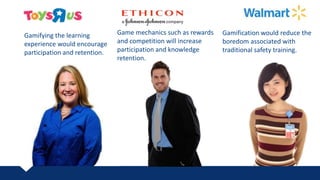
Gamifying the learning
experience would encourage
participation and retention.
Game mechanics such as rewards
and competition will increase
participation and knowledge
retention.
Gamification would reduce the
boredom associated with
traditional safety training.
DEFINE SUCCESS
5
90% Omnichannel knowledge
retention.
80% increase in rep confidence
and revenue growth.
Reduce safety incidents by 50%.
Making a Case for Gamification can
be a Challenge
B
o Determine the current gaps in your learning
strategy where gamification can help
o Combine Steps 1-5 from the previous
section to use as the basis for your Business
Case – i.e. where to focus, problems you’ll
solve, how you will measure success etc.
o Gather and share successes that
organizations similar to yours have
experienced
Build your Business Case
o Now time to determine what you need from
a gamified learning solution
o Know thy audience
o What motivates them? Challenge? Game Play?
o What do they value? Rewards? Recognition?
Gamification Requirements
Gathering Stage
Define your Requirements.
C
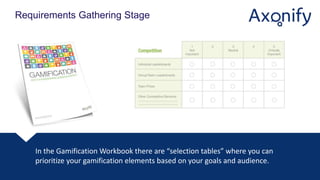
Requirements Gathering Stage
In the Gamification Workbook there are ā€œselection tablesā€ where you can
prioritize your gamification elements based on your goals and audience.
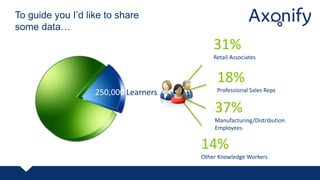
To guide you I’d like to share
some data…
250,000 Learners
31%
Retail Associates
18%
Professional Sales Reps
37%
Manufacturing/Distribution
Employees
14%
Other Knowledge Workers
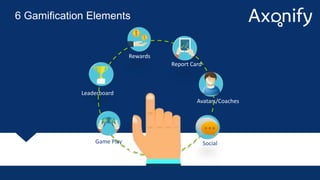
6 Gamification Elements
Game Play
Avatars/Coaches
Rewards
Leaderboard
Report Card
Social
E L E V TO R
V
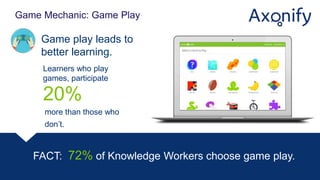
Game Mechanic: Game Play
Game play leads to
better learning.
more than those who
don’t.
20%
FACT: 72% of Knowledge Workers choose game play.
Learners who play
games, participate
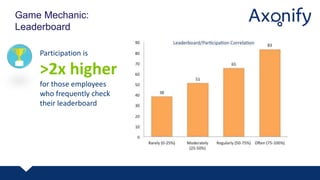
Game Mechanic:
Leaderboard
Participation is
>2x higher
for those employees
who frequently check
their leaderboard
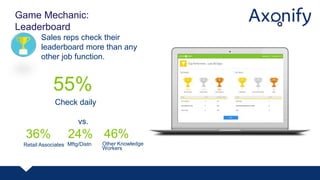
Game Mechanic:
Leaderboard
Sales reps check their
leaderboard more than any
other job function.
Check daily
55%
36%
Retail Associates
24%
Mftg/Distn
46%
Other Knowledge
Workers
vs.
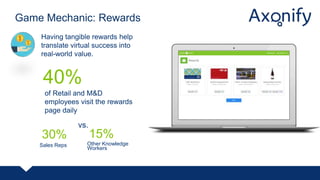
Game Mechanic: Rewards
Having tangible rewards help
translate virtual success into
real-world value.
of Retail and M&D
employees visit the rewards
page daily
40%
30%
Sales Reps
15%
Other Knowledge
Workers
vs.
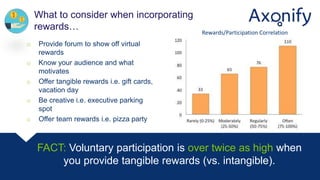
What to consider when incorporating
rewards…
FACT: Voluntary participation is over twice as high when
you provide tangible rewards (vs. intangible).
Rewards/Participation Correlation
o Provide forum to show off virtual
rewards
o Know your audience and what
motivates
o Offer tangible rewards i.e. gift cards,
vacation day
o Be creative i.e. executive parking
spot
o Offer team rewards i.e. pizza party
o Avatar: A reflection of you
o Coach: A learning guide
o In a gamified learning environment,
learners respond better to the term
ā€œCoachā€
Game Mechanic: Avatars vs.
Coaches
Game Mechanic: Coaches
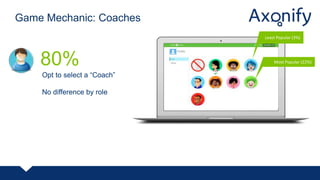
Opt to select a ā€œCoachā€
No difference by role
80%
Least Popular (3%)
Most Popular (22%)
Learning Coaches
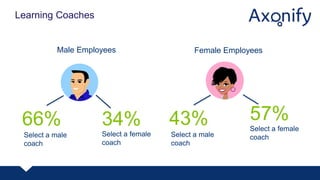
Male Employees Female Employees
Select a male
coach
66% 34%
Select a female
coach
Select a male
coach
43% 57%
Select a female
coach
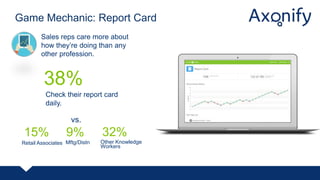
Game Mechanic: Report Card
Sales reps care more about
how they’re doing than any
other profession.
Check their report card
daily.
38%
15%
Retail Associates
9%
Mftg/Distn
32%
Other Knowledge
Workers
vs.
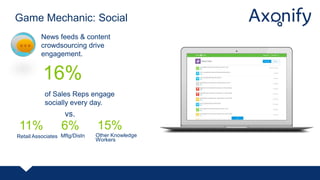
Game Mechanic: Social
News feeds & content
crowdsourcing drive
engagement.
of Sales Reps engage
socially every day.
16%
11%
Retail Associates
6%
Mftg/Distn
15%
Other Knowledge
Workers
vs.
E L E V TO R
V
In Summary
Determine your Corporate Goals &
Learning Strategies
Build your Business Case.
Define your Requirements.
A
B
C
&
To Connect With Karl Kapp
Web: karlkapp.com
To See Axonify in Action
Web: www.axonify.com/contact

Practical Approach to Gamification

  • 1.
    A Practical Approachto Gamification April 7th, 2015
  • 2.
    Some Housekeeping Details Theevent is being recorded Use the Q&A window The Polling function Follow the conversation on Twitter: #GamifiedLearning @kkapp | @Axonify
  • 3.
    The Focus ofToday o Gamification Overview o A Practical Approach to Get Started o Aligning your Corporate Goals & Learning Strategies o Building your Business Case o Gamification Requirements Gathering o Q&A Karl Kapp AUTHOR & PROFESSOR OF INSTRUCTIONAL TECHNOLOGY BLOOMSBURG UNIVERSITY Shum Attygalle DIGITAL MARKETING MANAGER AXONIFY
  • 4.
    Gamification Workbook You willreceive a copy shortly after the webinar!
  • 5.
  • 6.
  • 7.
    E L EV TO R V POLL: Where are you currently at with gamification? A. People keep saying it but I don’t know what it really means. B. Trying some things, but haven’t found the sweet spot. C. Heavily entrenched, trying to gamify as much as we can.
  • 8.
    Some Definitions: GamificationGame-based Learning Simulation Learning The useof gaming elements integrated into a training program aligned with corporate goals to promote change in behavior. The use of a game to teach knowledge, skills & abilities to learners using a self-contained space. A realistic, controlled- risk environment where learners can practice specific behaviors & experience impacts of their decisions. Proprietary & Confidential
  • 9.
    Gamification is usinggame- based mechanics, aesthetics and game thinking to engage people, motivate action, promote learning and solve problems.
  • 10.
    Gamification is to Learningas a Piece is to a Puzzle
  • 11.
    Gamification uses elements ofthe game, but is not the game in-and-of itself.
  • 13.
  • 14.
    E L EV TO R V Setting the Groundwork Determine your Corporate Goals & Learning Strategies Build your Business Case. Define your Requirements. A B C
  • 15.
    Determine your CorporateGoals & Learning Strategies A 1. Isolate area of strategic importance 2. Identify target group 3. Identify target behavior 4. Determine purpose 5. Define Success 5-Step Work Plan to Uncovering your Goals
  • 16.
    ISOLATE AREA OFSTRATEGIC IMPORTANCE 1
  • 17.
    Successful roll outof their Omnichannel strategy. Increase product knowledge to drive sales. Reduce safety incidents within their Logistics organization.
  • 18.
  • 19.
    Retail Associates SalesReps Employees in their Logistics Operation
  • 20.
  • 21.
    To learn, internalizeand consistently apply Omnichannel principles when dealing with customers. To remember and apply product and procedural knowledge with their medical clients. To embrace and apply safe working practices everyday on the job.
  • 22.
  • 23.
    Gamifying the learning experiencewould encourage participation and retention. Game mechanics such as rewards and competition will increase participation and knowledge retention. Gamification would reduce the boredom associated with traditional safety training.
  • 24.
  • 25.
    90% Omnichannel knowledge retention. 80%increase in rep confidence and revenue growth. Reduce safety incidents by 50%.
  • 26.
    Making a Casefor Gamification can be a Challenge B o Determine the current gaps in your learning strategy where gamification can help o Combine Steps 1-5 from the previous section to use as the basis for your Business Case – i.e. where to focus, problems you’ll solve, how you will measure success etc. o Gather and share successes that organizations similar to yours have experienced Build your Business Case
  • 27.
    o Now timeto determine what you need from a gamified learning solution o Know thy audience o What motivates them? Challenge? Game Play? o What do they value? Rewards? Recognition? Gamification Requirements Gathering Stage Define your Requirements. C
  • 28.
    Requirements Gathering Stage Inthe Gamification Workbook there are ā€œselection tablesā€ where you can prioritize your gamification elements based on your goals and audience.
  • 29.
    To guide youI’d like to share some data… 250,000 Learners 31% Retail Associates 18% Professional Sales Reps 37% Manufacturing/Distribution Employees 14% Other Knowledge Workers
  • 30.
    6 Gamification Elements GamePlay Avatars/Coaches Rewards Leaderboard Report Card Social
  • 31.
    E L EV TO R V Game Mechanic: Game Play Game play leads to better learning. more than those who don’t. 20% FACT: 72% of Knowledge Workers choose game play. Learners who play games, participate
  • 32.
    Game Mechanic: Leaderboard Participation is >2xhigher for those employees who frequently check their leaderboard
  • 33.
    Game Mechanic: Leaderboard Sales repscheck their leaderboard more than any other job function. Check daily 55% 36% Retail Associates 24% Mftg/Distn 46% Other Knowledge Workers vs.
  • 34.
    Game Mechanic: Rewards Havingtangible rewards help translate virtual success into real-world value. of Retail and M&D employees visit the rewards page daily 40% 30% Sales Reps 15% Other Knowledge Workers vs.
  • 35.
    What to considerwhen incorporating rewards… FACT: Voluntary participation is over twice as high when you provide tangible rewards (vs. intangible). Rewards/Participation Correlation o Provide forum to show off virtual rewards o Know your audience and what motivates o Offer tangible rewards i.e. gift cards, vacation day o Be creative i.e. executive parking spot o Offer team rewards i.e. pizza party
  • 36.
    o Avatar: Areflection of you o Coach: A learning guide o In a gamified learning environment, learners respond better to the term ā€œCoachā€ Game Mechanic: Avatars vs. Coaches
  • 37.
    Game Mechanic: Coaches Optto select a ā€œCoachā€ No difference by role 80% Least Popular (3%) Most Popular (22%)
  • 38.
    Learning Coaches Male EmployeesFemale Employees Select a male coach 66% 34% Select a female coach Select a male coach 43% 57% Select a female coach
  • 39.
    Game Mechanic: ReportCard Sales reps care more about how they’re doing than any other profession. Check their report card daily. 38% 15% Retail Associates 9% Mftg/Distn 32% Other Knowledge Workers vs.
  • 40.
    Game Mechanic: Social Newsfeeds & content crowdsourcing drive engagement. of Sales Reps engage socially every day. 16% 11% Retail Associates 6% Mftg/Distn 15% Other Knowledge Workers vs.
  • 41.
    E L EV TO R V In Summary Determine your Corporate Goals & Learning Strategies Build your Business Case. Define your Requirements. A B C
  • 42.
    & To Connect WithKarl Kapp Web: karlkapp.com To See Axonify in Action Web: www.axonify.com/contact

Editor's Notes

  • #9Ā GAME-BASED LEARNING An example is the Cheesecake Factory’s game to teach new cooks how to make hamburgers and other types of food. The company’s CLO had an iPhone game built which shows a hamburger bun and different types of food and condiments falling from the top of the screen. The learner has to grab and arrange these ingredients in the right order to assemble the correct hamburger before the items fall to the bottom. Once the learner starts to succeed the game speeds up, and scores are shared among all employees. Those with the highest scores are widely known, and these people are experts in how to assemble and cook various menu items. It’s a simple game, but is fun, engaging and gets the message across. SIMULATION LEARNING A realistic, controlled-risk environment where learners can practice specific behaviours and experience the impact of their decisions. Best for highly complex skills Simulation games don’t need to be entertaining to be educational Build more confidence on the job than classroom instruction – 20% higher GAMIFICATION Gamification is the use of game-based mechanics, aesthetics and game thinking to engage people motivate action, promote learning and solve problems. The game supports the learning, but isn’t the learning Game elements are used as engagement tools to encourage employees to participate in the learning.
  • #17Ā Identify an area of strategic importance to your organization, whether it is a high priority initiative or an issue that is impacting business results.
  • #19Ā Select the most critical or influential group within your organization that will have the greatest impact on the initiative identified in STEP 1.
  • #21Ā AT the end of the day you’d like your gamification strategy to change behavior, so defining what that is upfront is critical. Based on steps 1 and 2, what behaviors do you need to change or actions would you like to influence?
  • #23Ā It’s important to be clear about WHY you would like to add gamification as opposed to other techniques to your learning strategy for this particular group, to solve this particular problem.
  • #25Ā As with any initiative, ā€œresultsā€ will be key in measuring the effectiveness of your program. Define a clear set of business objectives that can be measured against your gamification strategy.
  • #32Ā FACT #1: Science says ā€œGame play improves retention of learningā€ By integrating learning right into game play, we are generating an increased level of arousal in the brain. At some point, we’ve all fought to stay awake during a training session: that’s a distinct lack of arousal. Likewise, we’ve all experienced something so interesting that we sit forward in our chair, and pay attention. That’s arousal, and it’s something you find when people play games they enjoy. Now, here’s the science! The Prefrontal Cortex (PFC) is the region of the brain that directs and sustains attention. To function effectively, researchers including Dr. Amy F.T. Arnsten, Professor of Neurobiology and Psychology at Yale University, have identified that the PFC needs the right amount of arousal to allow it to increase attention on relevant information, and filter out distractions. Emotionally arousing information can lead to better memory encoding, therefore influencing better retention and retrieval of information. Game play increases arousal. So when today’s workers sit down to participate in an eLearning session woven through a game, their Prefrontal Cortex becomes aroused. They’re captivated, and fully engaged. And primed to learn. FACT #2: It gives people the time out they need To learn, we need to focus our attention. But the PreFrontal Cortex can only take so much before it needs a time out. It gets tired. We get distracted. Researchers have recently established that even brief diversions from a task can dramatically improve your ability to focus on that task for prolonged periods. Their research established that switching from a main task to a second task could significantly improve performance in the main task. In Axonify, we integrate learning in bite-sized pieces right into the midst of game play. So while learners focus on the learning module, they complete it and jump back into game play before they get an information overload. This gives them break they need from learning, while focusing on game play that doesn’t require laser focus, and may even allow for a bit of daydreaming. FACT #3: Game play increases learning participation & effectiveness When people equate learning with fun, they’re far more likely to participate. In fact, ā€œgame playā€ is Axonify’s most popular game mechanic and we have a ton of competition when it comes to popular game mechanics like our leaderboard, rewards and avatars! 67% of learners choose to take their learning from within one of the many games that Axonify offers them. In other words, 2/3 of our learners prefer to play a game while learning. And here’s one more staggering statistic for you: data pulled from our community of hundreds of thousands of daily users indicates that Axonify learners who play games participate 20% more than those who don’t. The more they participate, they more they learn. Game play in eLearning isn’t just about fun. It’s about harnessing the power of brain science to deliver more effective learning. It’s about improving knowledge retention. And job performance.