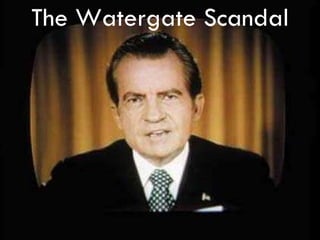
The Watergate Scandal
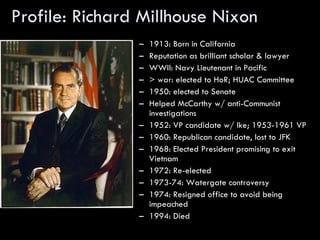
Profile: Richard Millhouse Nixon 1913: Born in California Reputation as brilliant scholar & lawyer WWII: Navy Lieutenant in Pacific > war: elected to HoR; HUAC Committee 1950: elected to Senate Helped McCarthy w/ anti-Communist investigations 1952: VP candidate w/ Ike; 1953-1961 VP 1960: Republican candidate, lost to JFK 1968: Elected President promising to exit Vietnam 1972: Re-elected 1973-74: Watergate controversy 1974: Resigned office to avoid being impeached 1994: Died
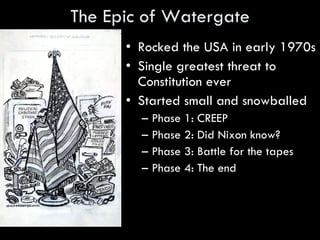
The Epic of Watergate Rocked the USA in early 1970s Single greatest threat to Constitution ever Started small and snowballed Phase 1: CREEP Phase 2: Did Nixon know? Phase 3: Battle for the tapes Phase 4: The end
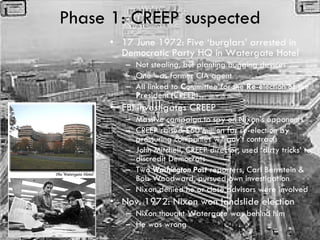
Phase 1: CREEP suspected 17 June 1972: Five ‘burglars’ arrested in Democratic Party HQ in Watergate Hotel Not stealing, but planting bugging devices One was former CIA agent All linked to  C ommittee for the  Re - e lection of the  P resident (CREEP) FBI investigates CREEP Massive campaign to spy on Nixon’s opponents CREEP raised $60 million for re-election by pressuring companies w/ gov’t contracts John Mitchell, CREEP director, used ‘dirty tricks’ to discredit Democrats Two  Washington Post  reporters, Carl Bernstein & Bob Woodward, pursued own investigation Nixon denied he or close advisors were involved Nov. 1972: Nixon won landslide election Nixon thought Watergate was behind him He was wrong
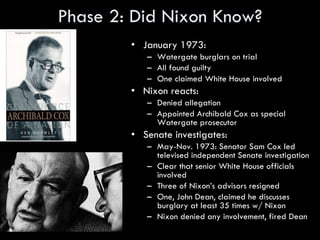
Phase 2: Did Nixon Know? January 1973: Watergate burglars on trial All found guilty One claimed White House involved Nixon reacts: Denied allegation Appointed Archibald Cox as special Watergate prosecutor Senate investigates: May-Nov. 1973: Senator Sam Cox led televised independent Senate investigation Clear that senior White House officials involved Three of Nixon’s advisors resigned One, John Dean, claimed he discusses burglary at least 35 times w/ Nixon Nixon denied any involvement, fired Dean
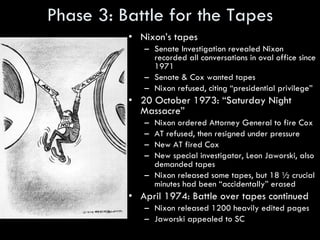
Phase 3: Battle for the Tapes Nixon’s tapes Senate Investigation revealed Nixon recorded all conversations in oval office since 1971 Senate & Cox wanted tapes Nixon refused, citing “presidential privilege” 20 October 1973: “Saturday Night Massacre” Nixon ordered Attorney General to fire Cox AT refused, then resigned under pressure New AT fired Cox New special investigator, Leon Jaworski, also demanded tapes Nixon released some tapes, but 18 ½ crucial minutes had been “accidentally” erased April 1974: Battle over tapes continued Nixon released 1200 heavily edited pages Jaworski appealed to SC
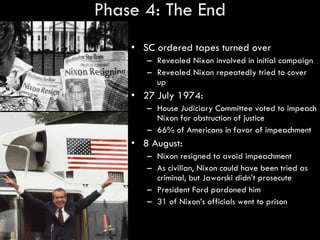
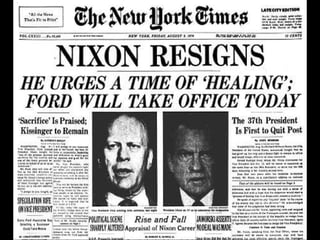
Phase 4: The End SC ordered tapes turned over Revealed Nixon involved in initial campaign Revealed Nixon repeatedly tried to cover up 27 July 1974: House Judiciary Committee voted to impeach Nixon for obstruction of justice 66% of Americans in favor of impeachment 8 August: Nixon resigned to avoid impeachment As civilian, Nixon could have been tried as criminal, but Jaworski didn’t prosecute President Ford pardoned him 31 of Nixon’s officials went to prison
 
The Aftermath Congress passed laws due to scandal Privacy Act (1974): Americans can inspect gov’t files on them Budget Act (1974): President has to account for all $$$ spent (Nixon believed to have spent millions of gov’t money on personal properties & evaded $400,000 of taxes) Election Campaign Act: Limited campaign contributions; eliminated foreign donations Scandal utterly destroyed Nixon’s rep Called “Tricky Dick”, achievements forgotten Watergate’s deeper damage Undermined America’s confidence in gov’t Was Nixon exception or rule of political system? Press turned from hiding info (JFK) to seeking scandal Confidence & idealism of 60s replaced w/ cynicism and doubt
The  Watergate scandal  refers to a political scandal in the United States in the 1970s. Named for the  Watergate  apartment complex, effects of the scandal ultimately led to the resignation of Richard Nixon, President of the United States, on August 9, 1974. It also resulted in the indictment and conviction of several Nixon administration officials.
The scandal began with the arrest of five men for breaking and entering into the Democratic National Committee headquarters at the Watergate Office complex in Washington, D.C. on June 17, 1972. Investigations conducted by the Federal Bureau of Investigation (FBI) and later by the Senate Watergate Committee, House Judiciary Committe and the press revealed that this burglary was one of many illegal activities authorized and carried out by Nixon's staff. They also revealed the immense scope of crimes and abuses, which included campaign fraud, political espionage and sabotage, illegal break-ins, improper tax audits, illegal wiretapping on a massive scale, and a secret slush fund laundered in Mexico to pay those who conducted these operations. This secret fund was also used as hush money to buy the silence of the seven men who were indicted for the June 17 break-in.
Nixon and his staff conspired to cover up the break-in, and especially its connection with the White House, as early as six days after it occurred. After two years of mounting evidence against the President and his staff, which included former staff members testifying against them in a Senate investigation, it was revealed that Nixon had a tape recording system in his offices and that he had recorded many conversations. Recordings from these tapes revealed that he had obstructed justice and attempted to cover up the break-in. This recorded conversation later became known as the Smoking Gun. After a series of court battles, the United States Supreme Court unanimously ruled in  United States v. Nixon  that the President had to hand over the tapes; he ultimately complied.
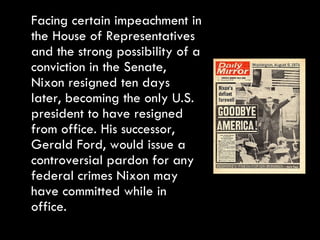
Facing certain impeachment in the House of Representatives and the strong possibility of a conviction in the Senate, Nixon resigned ten days later, becoming the only U.S. president to have resigned from office. His successor, Gerald Ford, would issue a controversial pardon for any federal crimes Nixon may have committed while in office.
 
3.2.1 Three  most interesting things you learned about Watergate Two  reactions you have when learning about this event in American history One  way you can imagine how Watergate changed the way Americans felt about their government
Additional Questions for Discussion Why do you think the American public was so outraged by Watergate? Do you think President Nixon should have resigned? Explain. Do you think President Nixon should have been prosecuted? Explain.

Watergate Scandal

  • 1.
  • 2.
    Profile: Richard MillhouseNixon 1913: Born in California Reputation as brilliant scholar & lawyer WWII: Navy Lieutenant in Pacific > war: elected to HoR; HUAC Committee 1950: elected to Senate Helped McCarthy w/ anti-Communist investigations 1952: VP candidate w/ Ike; 1953-1961 VP 1960: Republican candidate, lost to JFK 1968: Elected President promising to exit Vietnam 1972: Re-elected 1973-74: Watergate controversy 1974: Resigned office to avoid being impeached 1994: Died
  • 3.
    The Epic ofWatergate Rocked the USA in early 1970s Single greatest threat to Constitution ever Started small and snowballed Phase 1: CREEP Phase 2: Did Nixon know? Phase 3: Battle for the tapes Phase 4: The end
  • 4.
    Phase 1: CREEPsuspected 17 June 1972: Five ‘burglars’ arrested in Democratic Party HQ in Watergate Hotel Not stealing, but planting bugging devices One was former CIA agent All linked to C ommittee for the Re - e lection of the P resident (CREEP) FBI investigates CREEP Massive campaign to spy on Nixon’s opponents CREEP raised $60 million for re-election by pressuring companies w/ gov’t contracts John Mitchell, CREEP director, used ‘dirty tricks’ to discredit Democrats Two Washington Post reporters, Carl Bernstein & Bob Woodward, pursued own investigation Nixon denied he or close advisors were involved Nov. 1972: Nixon won landslide election Nixon thought Watergate was behind him He was wrong
  • 5.
    Phase 2: DidNixon Know? January 1973: Watergate burglars on trial All found guilty One claimed White House involved Nixon reacts: Denied allegation Appointed Archibald Cox as special Watergate prosecutor Senate investigates: May-Nov. 1973: Senator Sam Cox led televised independent Senate investigation Clear that senior White House officials involved Three of Nixon’s advisors resigned One, John Dean, claimed he discusses burglary at least 35 times w/ Nixon Nixon denied any involvement, fired Dean
  • 6.
    Phase 3: Battlefor the Tapes Nixon’s tapes Senate Investigation revealed Nixon recorded all conversations in oval office since 1971 Senate & Cox wanted tapes Nixon refused, citing “presidential privilege” 20 October 1973: “Saturday Night Massacre” Nixon ordered Attorney General to fire Cox AT refused, then resigned under pressure New AT fired Cox New special investigator, Leon Jaworski, also demanded tapes Nixon released some tapes, but 18 ½ crucial minutes had been “accidentally” erased April 1974: Battle over tapes continued Nixon released 1200 heavily edited pages Jaworski appealed to SC
  • 7.
    Phase 4: TheEnd SC ordered tapes turned over Revealed Nixon involved in initial campaign Revealed Nixon repeatedly tried to cover up 27 July 1974: House Judiciary Committee voted to impeach Nixon for obstruction of justice 66% of Americans in favor of impeachment 8 August: Nixon resigned to avoid impeachment As civilian, Nixon could have been tried as criminal, but Jaworski didn’t prosecute President Ford pardoned him 31 of Nixon’s officials went to prison
  • 8.
  • 9.
    The Aftermath Congresspassed laws due to scandal Privacy Act (1974): Americans can inspect gov’t files on them Budget Act (1974): President has to account for all $$$ spent (Nixon believed to have spent millions of gov’t money on personal properties & evaded $400,000 of taxes) Election Campaign Act: Limited campaign contributions; eliminated foreign donations Scandal utterly destroyed Nixon’s rep Called “Tricky Dick”, achievements forgotten Watergate’s deeper damage Undermined America’s confidence in gov’t Was Nixon exception or rule of political system? Press turned from hiding info (JFK) to seeking scandal Confidence & idealism of 60s replaced w/ cynicism and doubt
  • 10.
    The Watergatescandal refers to a political scandal in the United States in the 1970s. Named for the Watergate apartment complex, effects of the scandal ultimately led to the resignation of Richard Nixon, President of the United States, on August 9, 1974. It also resulted in the indictment and conviction of several Nixon administration officials.
  • 11.
    The scandal beganwith the arrest of five men for breaking and entering into the Democratic National Committee headquarters at the Watergate Office complex in Washington, D.C. on June 17, 1972. Investigations conducted by the Federal Bureau of Investigation (FBI) and later by the Senate Watergate Committee, House Judiciary Committe and the press revealed that this burglary was one of many illegal activities authorized and carried out by Nixon's staff. They also revealed the immense scope of crimes and abuses, which included campaign fraud, political espionage and sabotage, illegal break-ins, improper tax audits, illegal wiretapping on a massive scale, and a secret slush fund laundered in Mexico to pay those who conducted these operations. This secret fund was also used as hush money to buy the silence of the seven men who were indicted for the June 17 break-in.
  • 12.
    Nixon and hisstaff conspired to cover up the break-in, and especially its connection with the White House, as early as six days after it occurred. After two years of mounting evidence against the President and his staff, which included former staff members testifying against them in a Senate investigation, it was revealed that Nixon had a tape recording system in his offices and that he had recorded many conversations. Recordings from these tapes revealed that he had obstructed justice and attempted to cover up the break-in. This recorded conversation later became known as the Smoking Gun. After a series of court battles, the United States Supreme Court unanimously ruled in United States v. Nixon that the President had to hand over the tapes; he ultimately complied.
  • 13.
    Facing certain impeachmentin the House of Representatives and the strong possibility of a conviction in the Senate, Nixon resigned ten days later, becoming the only U.S. president to have resigned from office. His successor, Gerald Ford, would issue a controversial pardon for any federal crimes Nixon may have committed while in office.
  • 14.
  • 15.
    3.2.1 Three most interesting things you learned about Watergate Two reactions you have when learning about this event in American history One way you can imagine how Watergate changed the way Americans felt about their government
  • 16.
    Additional Questions forDiscussion Why do you think the American public was so outraged by Watergate? Do you think President Nixon should have resigned? Explain. Do you think President Nixon should have been prosecuted? Explain.