Age of Limits Chapter 24 Section 1: The Nixon Administration Section 2: Watergate: Nixon’s Downfall Section 3: The Ford and Carter Years Section 4: Environmental Activism
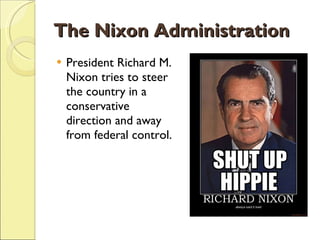
The Nixon Administration President Richard M. Nixon tries to steer the country in a conservative direction and away from federal control.
Nixon’s New Conservatism New Federalism Richard M. Nixon: decrease size and influence of federal government New Federalism—give part of federal power to state, local government Nixon proposes  revenue sharing, which becomes law in 1972: state, local governments now decide how to spend federal money
Nixon’s New Conservatism Welfare Reform Family Assistance Plan gives family of four a base income Senate liberals, conservatives defeat bill
Nixon’s New Conservatism New Federalism Wears Two Faces Nixon backs some social spending increases to win Democratic support Tries to dismantle some programs, impounds funds for others - courts order release of impounded funds
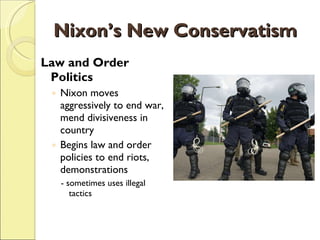
Nixon’s New Conservatism Law and Order Politics Nixon moves aggressively to end war, mend divisiveness in country Begins law and order policies to end riots, demonstrations - sometimes uses illegal tactics
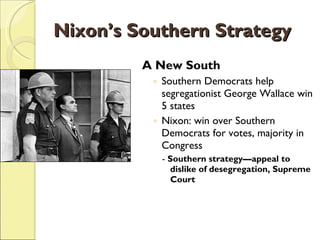
Nixon’s Southern Strategy A New South Southern Democrats help segregationist George Wallace win 5 states Nixon: win over Southern Democrats for votes, majority in Congress -  Southern strategy—appeal to dislike of desegregation, Supreme Court
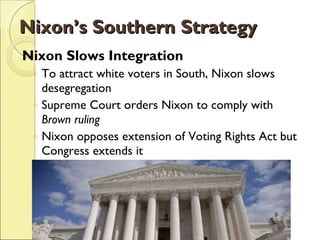
Nixon’s Southern Strategy Nixon Slows Integration To attract white voters in South, Nixon slows desegregation Supreme Court orders Nixon to comply with  Brown ruling Nixon opposes extension of Voting Rights Act but Congress extends it
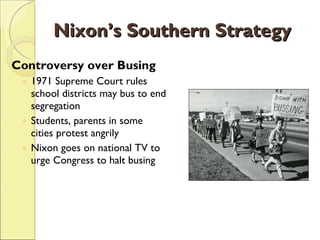
Nixon’s Southern Strategy Controversy over Busing 1971 Supreme Court rules school districts may bus to end segregation Students, parents in some cities protest angrily Nixon goes on national TV to urge Congress to halt busing
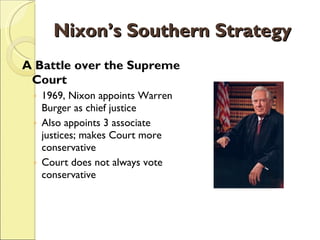
Nixon’s Southern Strategy A Battle over the Supreme Court 1969, Nixon appoints Warren Burger as chief justice Also appoints 3 associate justices; makes Court more conservative Court does not always vote conservative
Confronting a Stagnant Economy The Causes of Stagflation Stagflation—combination of high inflation, high unemployment Inflation result of LBJ’s deficit spending on war, social programs Unemployment from more international trade, new workers
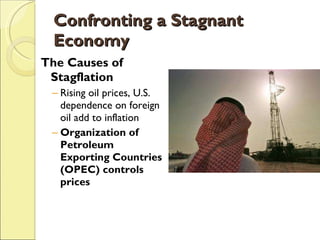
Confronting a Stagnant Economy The Causes of Stagflation Rising oil prices, U.S. dependence on foreign oil add to inflation Organization of Petroleum Exporting Countries (OPEC) controls prices
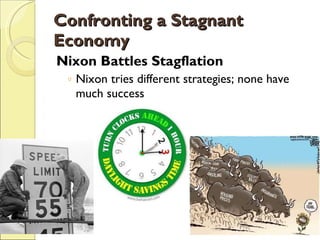
Confronting a Stagnant Economy Nixon Battles Stagflation Nixon tries different strategies; none have much success
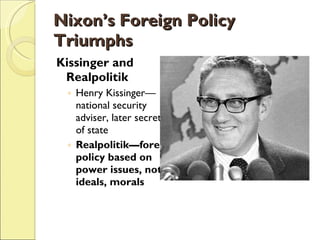
Nixon’s Foreign Policy Triumphs Kissinger and Realpolitik Henry Kissinger—national security adviser, later secretary of state Realpolitik—foreign policy based on power issues, not ideals, morals
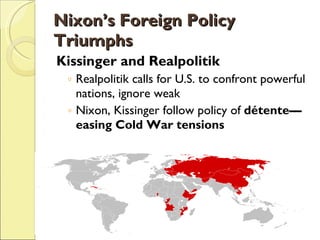
Nixon’s Foreign Policy Triumphs Kissinger and Realpolitik Realpolitik calls for U.S. to confront powerful nations, ignore weak Nixon, Kissinger follow policy of  détente—easing Cold War tensions
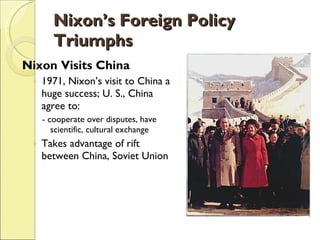
Nixon’s Foreign Policy Triumphs Nixon Visits China 1971, Nixon’s visit to China a huge success; U. S., China agree to: - cooperate over disputes, have scientific, cultural exchange Takes advantage of rift between China, Soviet Union
Nixon’s Foreign Policy Triumphs Nixon Travels to Moscow 1972, Nixon visits Moscow; Nixon and Brezhnev sign  SALT I Treaty: - Strategic Arms Limitation Talks limit missiles to 1972 levels Foreign policy triumphs, expected Vietnam peace help win reelection
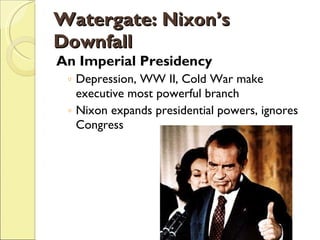
Watergate: Nixon’s Downfall An Imperial Presidency Depression, WW II, Cold War make executive most powerful branch Nixon expands presidential powers, ignores Congress
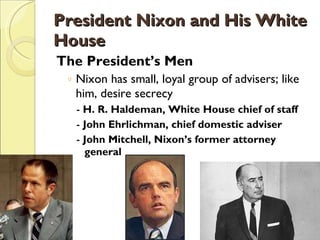
President Nixon and His White House The President’s Men Nixon has small, loyal group of advisers; like him, desire secrecy -  H. R. Haldeman, White House chief of staff -  John Ehrlichman, chief domestic adviser -  John Mitchell, Nixon’s former attorney general
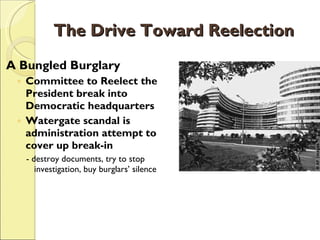
The Drive Toward Reelection A Bungled Burglary Committee to Reelect the President break into Democratic headquarters Watergate scandal is administration attempt to cover up break-in - destroy documents, try to stop investigation, buy burglars’ silence
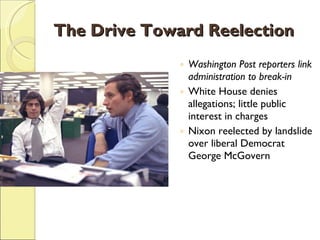
The Drive Toward Reelection Washington Post reporters link administration to break-in White House denies allegations; little public interest in charges Nixon reelected by landslide over liberal Democrat George McGovern
The Cover-Up Unravels The Senate Investigates Watergate Judge  John Sirica presides burglars’ trial, thinks they did not act alone Burglar leader James McCord says lied under oath, advisers involved Nixon dismisses White House counsel John Dean; others resign Senator Samuel J. Ervin heads investigative committee
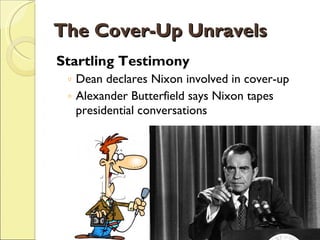
The Cover-Up Unravels Startling Testimony Dean declares Nixon involved in cover-up Alexander Butterfield says Nixon tapes presidential conversations
The Cover-Up Unravels The Saturday Night Massacre Special prosecutor Archibald Cox subpoenas tapes; Nixon refuses Nixon orders Cox fired, attorney general Elliot Richardson refuses Saturday Night Massacre: Richardson resigns; deputy refuses, fired
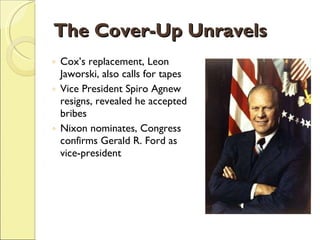
The Cover-Up Unravels Cox’s replacement, Leon Jaworski, also calls for tapes Vice President Spiro Agnew resigns, revealed he accepted bribes Nixon nominates, Congress confirms Gerald R. Ford as vice-president
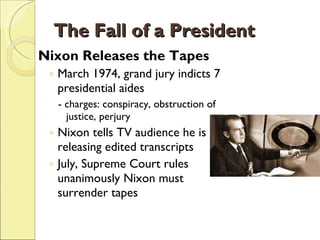
The Fall of a President Nixon Releases the Tapes March 1974, grand jury indicts 7 presidential aides - charges: conspiracy, obstruction of justice, perjury Nixon tells TV audience he is releasing edited transcripts July, Supreme Court rules unanimously Nixon must surrender tapes
The Fall of a President The President Resigns House Judiciary Committee approves 3 articles of  impeachment - formal accusation of wrongdoing while in office - charges: obstruction of justice, abuse of power, contempt of Congress Nixon releases tapes; show knows of administration role, cover up Before full House votes on impeachment, Nixon resigns
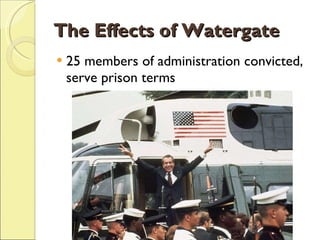
The Effects of Watergate 25 members of administration convicted, serve prison terms

Age of limits

  • 1.
    Age of LimitsChapter 24 Section 1: The Nixon Administration Section 2: Watergate: Nixon’s Downfall Section 3: The Ford and Carter Years Section 4: Environmental Activism
  • 2.
    The Nixon AdministrationPresident Richard M. Nixon tries to steer the country in a conservative direction and away from federal control.
  • 3.
    Nixon’s New ConservatismNew Federalism Richard M. Nixon: decrease size and influence of federal government New Federalism—give part of federal power to state, local government Nixon proposes revenue sharing, which becomes law in 1972: state, local governments now decide how to spend federal money
  • 4.
    Nixon’s New ConservatismWelfare Reform Family Assistance Plan gives family of four a base income Senate liberals, conservatives defeat bill
  • 5.
    Nixon’s New ConservatismNew Federalism Wears Two Faces Nixon backs some social spending increases to win Democratic support Tries to dismantle some programs, impounds funds for others - courts order release of impounded funds
  • 6.
    Nixon’s New ConservatismLaw and Order Politics Nixon moves aggressively to end war, mend divisiveness in country Begins law and order policies to end riots, demonstrations - sometimes uses illegal tactics
  • 7.
    Nixon’s Southern StrategyA New South Southern Democrats help segregationist George Wallace win 5 states Nixon: win over Southern Democrats for votes, majority in Congress - Southern strategy—appeal to dislike of desegregation, Supreme Court
  • 8.
    Nixon’s Southern StrategyNixon Slows Integration To attract white voters in South, Nixon slows desegregation Supreme Court orders Nixon to comply with Brown ruling Nixon opposes extension of Voting Rights Act but Congress extends it
  • 9.
    Nixon’s Southern StrategyControversy over Busing 1971 Supreme Court rules school districts may bus to end segregation Students, parents in some cities protest angrily Nixon goes on national TV to urge Congress to halt busing
  • 10.
    Nixon’s Southern StrategyA Battle over the Supreme Court 1969, Nixon appoints Warren Burger as chief justice Also appoints 3 associate justices; makes Court more conservative Court does not always vote conservative
  • 11.
    Confronting a StagnantEconomy The Causes of Stagflation Stagflation—combination of high inflation, high unemployment Inflation result of LBJ’s deficit spending on war, social programs Unemployment from more international trade, new workers
  • 12.
    Confronting a StagnantEconomy The Causes of Stagflation Rising oil prices, U.S. dependence on foreign oil add to inflation Organization of Petroleum Exporting Countries (OPEC) controls prices
  • 13.
    Confronting a StagnantEconomy Nixon Battles Stagflation Nixon tries different strategies; none have much success
  • 14.
    Nixon’s Foreign PolicyTriumphs Kissinger and Realpolitik Henry Kissinger—national security adviser, later secretary of state Realpolitik—foreign policy based on power issues, not ideals, morals
  • 15.
    Nixon’s Foreign PolicyTriumphs Kissinger and Realpolitik Realpolitik calls for U.S. to confront powerful nations, ignore weak Nixon, Kissinger follow policy of détente—easing Cold War tensions
  • 16.
    Nixon’s Foreign PolicyTriumphs Nixon Visits China 1971, Nixon’s visit to China a huge success; U. S., China agree to: - cooperate over disputes, have scientific, cultural exchange Takes advantage of rift between China, Soviet Union
  • 17.
    Nixon’s Foreign PolicyTriumphs Nixon Travels to Moscow 1972, Nixon visits Moscow; Nixon and Brezhnev sign SALT I Treaty: - Strategic Arms Limitation Talks limit missiles to 1972 levels Foreign policy triumphs, expected Vietnam peace help win reelection
  • 18.
    Watergate: Nixon’s DownfallAn Imperial Presidency Depression, WW II, Cold War make executive most powerful branch Nixon expands presidential powers, ignores Congress
  • 19.
    President Nixon andHis White House The President’s Men Nixon has small, loyal group of advisers; like him, desire secrecy - H. R. Haldeman, White House chief of staff - John Ehrlichman, chief domestic adviser - John Mitchell, Nixon’s former attorney general
  • 20.
    The Drive TowardReelection A Bungled Burglary Committee to Reelect the President break into Democratic headquarters Watergate scandal is administration attempt to cover up break-in - destroy documents, try to stop investigation, buy burglars’ silence
  • 21.
    The Drive TowardReelection Washington Post reporters link administration to break-in White House denies allegations; little public interest in charges Nixon reelected by landslide over liberal Democrat George McGovern
  • 22.
    The Cover-Up UnravelsThe Senate Investigates Watergate Judge John Sirica presides burglars’ trial, thinks they did not act alone Burglar leader James McCord says lied under oath, advisers involved Nixon dismisses White House counsel John Dean; others resign Senator Samuel J. Ervin heads investigative committee
  • 23.
    The Cover-Up UnravelsStartling Testimony Dean declares Nixon involved in cover-up Alexander Butterfield says Nixon tapes presidential conversations
  • 24.
    The Cover-Up UnravelsThe Saturday Night Massacre Special prosecutor Archibald Cox subpoenas tapes; Nixon refuses Nixon orders Cox fired, attorney general Elliot Richardson refuses Saturday Night Massacre: Richardson resigns; deputy refuses, fired
  • 25.
    The Cover-Up UnravelsCox’s replacement, Leon Jaworski, also calls for tapes Vice President Spiro Agnew resigns, revealed he accepted bribes Nixon nominates, Congress confirms Gerald R. Ford as vice-president
  • 26.
    The Fall ofa President Nixon Releases the Tapes March 1974, grand jury indicts 7 presidential aides - charges: conspiracy, obstruction of justice, perjury Nixon tells TV audience he is releasing edited transcripts July, Supreme Court rules unanimously Nixon must surrender tapes
  • 27.
    The Fall ofa President The President Resigns House Judiciary Committee approves 3 articles of impeachment - formal accusation of wrongdoing while in office - charges: obstruction of justice, abuse of power, contempt of Congress Nixon releases tapes; show knows of administration role, cover up Before full House votes on impeachment, Nixon resigns
  • 28.
    The Effects ofWatergate 25 members of administration convicted, serve prison terms