1970’s Political Issues & Scandals
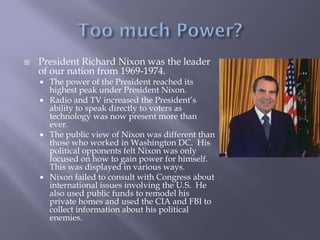
 President Richard Nixon was the leader
of our nation from 1969-1974.
 The power of the President reached its
highest peak under President Nixon.
 Radio and TV increased the President’s
ability to speak directly to voters as
technology was now present more than
ever.
 The public view of Nixon was different than
those who worked in Washington DC. His
political opponents felt Nixon was only
focused on how to gain power for himself.
This was displayed in various ways.
 Nixon failed to consult with Congress about
international issues involving the U.S. He
also used public funds to remodel his
private homes and used the CIA and FBI to
collect information about his political
enemies.
 Since the end of World War II, the U.S. had
refused to establish diplomatic relations with
either country.
 Nixon was a strong anti-Communist, however
he wanted to create a more predictable
situation in Asia compared to events that
almost led to nuclear war. (Korean & Vietnam
Wars, Cuban Missile Crisis)
 Nixon’s most important role was allowing
communication to occur between the leaders of
China, the Soviet Union, and the United States.
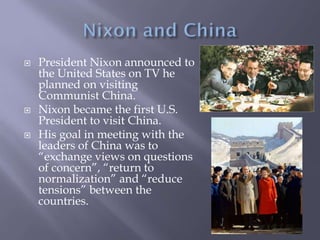
 President Nixon announced to
the United States on TV he
planned on visiting
Communist China.
 Nixon became the first U.S.
President to visit China.
 His goal in meeting with the
leaders of China was to
“exchange views on questions
of concern”, “return to
normalization” and “reduce
tensions” between the
countries.
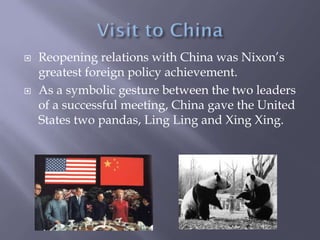
 Reopening relations with China was Nixon’s
greatest foreign policy achievement.
 As a symbolic gesture between the two leaders
of a successful meeting, China gave the United
States two pandas, Ling Ling and Xing Xing.
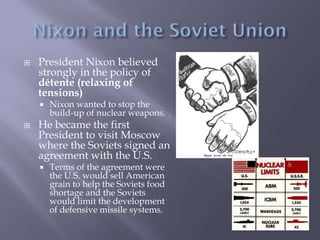
 President Nixon believed
strongly in the policy of
détente (relaxing of
tensions)
 Nixon wanted to stop the
build-up of nuclear weapons.
 He became the first
President to visit Moscow
where the Soviets signed an
agreement with the U.S.
 Terms of the agreement were
the U.S. would sell American
grain to help the Soviets food
shortage and the Soviets
would limit the development
of defensive missile systems.
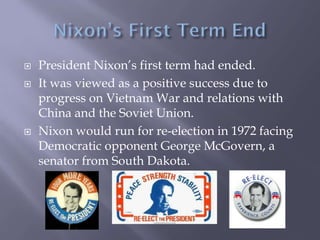
 President Nixon’s first term had ended.
 It was viewed as a positive success due to
progress on Vietnam War and relations with
China and the Soviet Union.
 Nixon would run for re-election in 1972 facing
Democratic opponent George McGovern, a
senator from South Dakota.
 McGovern Presidential Ad (CLICK HERE)
 What was the ad informing the public about
President Nixon?
 How did the ad say the people put an end to it?
 Nixon Presidential Ad (CLICK HERE)
 What are 3 reasons the youth of America
should consider re-electing him?
 Which campaign ad shows a more positive
view? Why?
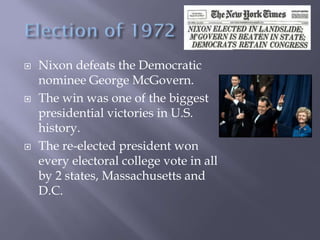
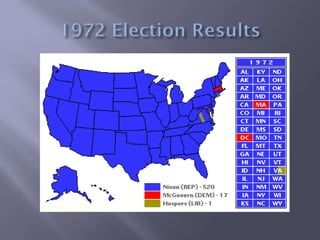
 Nixon defeats the Democratic
nominee George McGovern.
 The win was one of the biggest
presidential victories in U.S.
history.
 The re-elected president won
every electoral college vote in all
by 2 states, Massachusetts and
D.C.
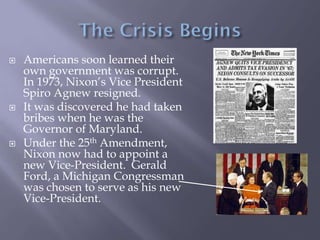
 Americans soon learned their
own government was corrupt.
In 1973, Nixon’s Vice President
Spiro Agnew resigned.
 It was discovered he had taken
bribes when he was the
Governor of Maryland.
 Under the 25th Amendment,
Nixon now had to appoint a
new Vice-President. Gerald
Ford, a Michigan Congressman
was chosen to serve as his new
Vice-President.
 After the resignation of Vice-
President Agnew, an even
greater scandal begin to surface.
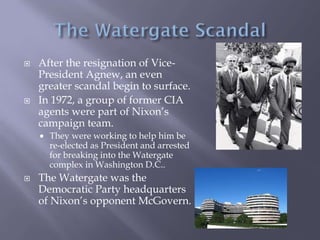
 In 1972, a group of former CIA
agents were part of Nixon’s
campaign team.
 They were working to help him be
re-elected as President and arrested
for breaking into the Watergate
complex in Washington D.C..
 The Watergate was the
Democratic Party headquarters
of Nixon’s opponent McGovern.
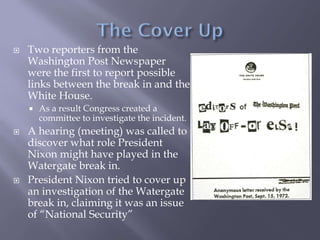
 Two reporters from the
Washington Post Newspaper
were the first to report possible
links between the break in and the
White House.
 As a result Congress created a
committee to investigate the incident.
 A hearing (meeting) was called to
discover what role President
Nixon might have played in the
Watergate break in.
 President Nixon tried to cover up
an investigation of the Watergate
break in, claiming it was an issue
of “National Security”
 In the Senate hearings, a
Presidential assistant
stated that Nixon had
participated in trying to
cover up his role in the
Watergate break in.
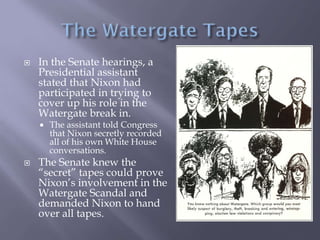
 The assistant told Congress
that Nixon secretly recorded
all of his own White House
conversations.
 The Senate knew the
“secret” tapes could prove
Nixon’s involvement in the
Watergate Scandal and
demanded Nixon to hand
over all tapes.
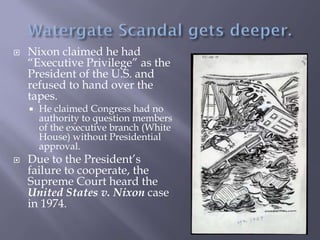
 Nixon claimed he had
“Executive Privilege” as the
President of the U.S. and
refused to hand over the
tapes.
 He claimed Congress had no
authority to question members
of the executive branch (White
House) without Presidential
approval.
 Due to the President’s
failure to cooperate, the
Supreme Court heard the
United States v. Nixon case
in 1974.
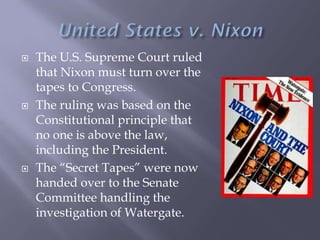
 The U.S. Supreme Court ruled
that Nixon must turn over the
tapes to Congress.
 The ruling was based on the
Constitutional principle that
no one is above the law,
including the President.
 The “Secret Tapes” were now
handed over to the Senate
Committee handling the
investigation of Watergate.
 Nixon Video Clip (CLICK HERE)
 Pay attention to the President’s attitude and
assume the reason for this attitude as you
watch.
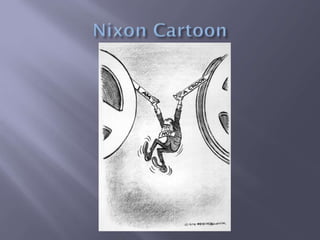
 When President Nixon turned over some of the
secret tapes, some of the conversations were
missing.
 One tape had a gap of 18 minutes and was blamed on
“accidental” erasure by Nixon’s secretary.
 Americans believed the missing conversations
were part of an effort for Nixon to hide evidence.
 As the investigation continued, the tapes proved
Nixon had a desire to punish political opponents
and to slow the Watergate investigation.
 Nixon’s supporters begin to suggest he step down
or face the being impeached (removed) as
President by the Senate
 When the tapes were made public,
they revealed Nixon had lied
when he said he was not involved
in the cover-up.
 The U.S. Congress voted to begin
impeachment trial of President
Nixon.
 Members of the Republican Party
told Nixon removal from office
would occur without a doubt and
a liability they Republicans could
not afford.
 Nixon had to determine if he
wanted to go through with the
impeachment trial or resign from
office.
 Nixon Video Clip (CLICK HERE)
 Start @ 1:20 mark if it doesn’t load there.
 As you watch the clip think:
 Did Nixon tell the truth when he made this
statement?
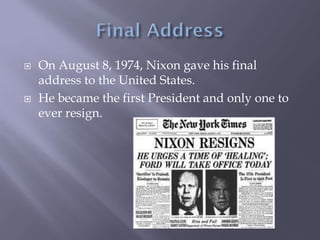
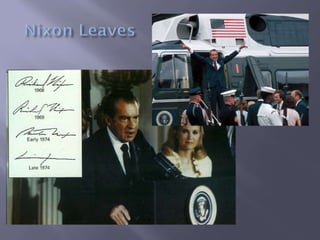
 On August 8, 1974, Nixon gave his final
address to the United States.
 He became the first President and only one to
ever resign.
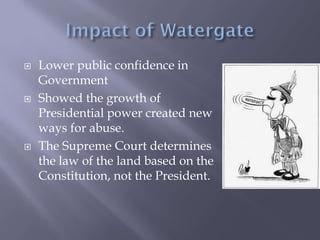
 Lower public confidence in
Government
 Showed the growth of
Presidential power created new
ways for abuse.
 The Supreme Court determines
the law of the land based on the
Constitution, not the President.
 Watergate Scandal (CLICK HERE)
 As you watch the clip, pay attention to the role
journalists from the Washington Post had on
Watergate.
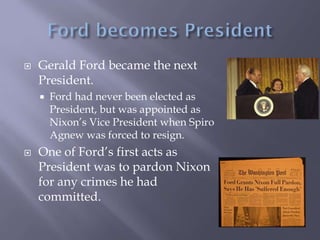
 Gerald Ford became the next
President.
 Ford had never been elected as
President, but was appointed as
Nixon’s Vice President when Spiro
Agnew was forced to resign.
 One of Ford’s first acts as
President was to pardon Nixon
for any crimes he had
committed.
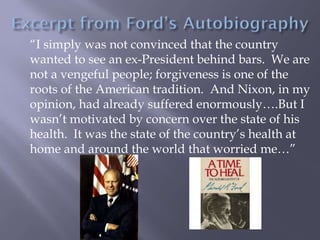
“I simply was not convinced that the country
wanted to see an ex-President behind bars. We are
not a vengeful people; forgiveness is one of the
roots of the American tradition. And Nixon, in my
opinion, had already suffered enormously….But I
wasn’t motivated by concern over the state of his
health. It was the state of the country’s health at
home and around the world that worried me…”
 President Nixon decided to conduct an interview
with reporter David Frost in 1977.
 Nixon was interested in being interviewed and
would be paid $600,00 along with 20% of the
profits made from the interview.
 12 interviews occurred and were cut down to 4 90
minute episodes.
 When the episodes aired, 45 million viewers
watched.
 Last part of Frost / Nixon Interview
(CLICK HERE)

Nixon watergate-ford

  • 1.
  • 2.
     President RichardNixon was the leader of our nation from 1969-1974.  The power of the President reached its highest peak under President Nixon.  Radio and TV increased the President’s ability to speak directly to voters as technology was now present more than ever.  The public view of Nixon was different than those who worked in Washington DC. His political opponents felt Nixon was only focused on how to gain power for himself. This was displayed in various ways.  Nixon failed to consult with Congress about international issues involving the U.S. He also used public funds to remodel his private homes and used the CIA and FBI to collect information about his political enemies.
  • 3.
     Since theend of World War II, the U.S. had refused to establish diplomatic relations with either country.  Nixon was a strong anti-Communist, however he wanted to create a more predictable situation in Asia compared to events that almost led to nuclear war. (Korean & Vietnam Wars, Cuban Missile Crisis)  Nixon’s most important role was allowing communication to occur between the leaders of China, the Soviet Union, and the United States.
  • 4.
     President Nixonannounced to the United States on TV he planned on visiting Communist China.  Nixon became the first U.S. President to visit China.  His goal in meeting with the leaders of China was to “exchange views on questions of concern”, “return to normalization” and “reduce tensions” between the countries.
  • 5.
     Reopening relationswith China was Nixon’s greatest foreign policy achievement.  As a symbolic gesture between the two leaders of a successful meeting, China gave the United States two pandas, Ling Ling and Xing Xing.
  • 6.
     President Nixonbelieved strongly in the policy of détente (relaxing of tensions)  Nixon wanted to stop the build-up of nuclear weapons.  He became the first President to visit Moscow where the Soviets signed an agreement with the U.S.  Terms of the agreement were the U.S. would sell American grain to help the Soviets food shortage and the Soviets would limit the development of defensive missile systems.
  • 7.
     President Nixon’sfirst term had ended.  It was viewed as a positive success due to progress on Vietnam War and relations with China and the Soviet Union.  Nixon would run for re-election in 1972 facing Democratic opponent George McGovern, a senator from South Dakota.
  • 8.
     McGovern PresidentialAd (CLICK HERE)  What was the ad informing the public about President Nixon?  How did the ad say the people put an end to it?
  • 9.
     Nixon PresidentialAd (CLICK HERE)  What are 3 reasons the youth of America should consider re-electing him?  Which campaign ad shows a more positive view? Why?
  • 10.
     Nixon defeatsthe Democratic nominee George McGovern.  The win was one of the biggest presidential victories in U.S. history.  The re-elected president won every electoral college vote in all by 2 states, Massachusetts and D.C.
  • 12.
     Americans soonlearned their own government was corrupt. In 1973, Nixon’s Vice President Spiro Agnew resigned.  It was discovered he had taken bribes when he was the Governor of Maryland.  Under the 25th Amendment, Nixon now had to appoint a new Vice-President. Gerald Ford, a Michigan Congressman was chosen to serve as his new Vice-President.
  • 13.
     After theresignation of Vice- President Agnew, an even greater scandal begin to surface.  In 1972, a group of former CIA agents were part of Nixon’s campaign team.  They were working to help him be re-elected as President and arrested for breaking into the Watergate complex in Washington D.C..  The Watergate was the Democratic Party headquarters of Nixon’s opponent McGovern.
  • 14.
     Two reportersfrom the Washington Post Newspaper were the first to report possible links between the break in and the White House.  As a result Congress created a committee to investigate the incident.  A hearing (meeting) was called to discover what role President Nixon might have played in the Watergate break in.  President Nixon tried to cover up an investigation of the Watergate break in, claiming it was an issue of “National Security”
  • 15.
     In theSenate hearings, a Presidential assistant stated that Nixon had participated in trying to cover up his role in the Watergate break in.  The assistant told Congress that Nixon secretly recorded all of his own White House conversations.  The Senate knew the “secret” tapes could prove Nixon’s involvement in the Watergate Scandal and demanded Nixon to hand over all tapes.
  • 16.
     Nixon claimedhe had “Executive Privilege” as the President of the U.S. and refused to hand over the tapes.  He claimed Congress had no authority to question members of the executive branch (White House) without Presidential approval.  Due to the President’s failure to cooperate, the Supreme Court heard the United States v. Nixon case in 1974.
  • 17.
     The U.S.Supreme Court ruled that Nixon must turn over the tapes to Congress.  The ruling was based on the Constitutional principle that no one is above the law, including the President.  The “Secret Tapes” were now handed over to the Senate Committee handling the investigation of Watergate.
  • 18.
     Nixon VideoClip (CLICK HERE)  Pay attention to the President’s attitude and assume the reason for this attitude as you watch.
  • 19.
     When PresidentNixon turned over some of the secret tapes, some of the conversations were missing.  One tape had a gap of 18 minutes and was blamed on “accidental” erasure by Nixon’s secretary.  Americans believed the missing conversations were part of an effort for Nixon to hide evidence.  As the investigation continued, the tapes proved Nixon had a desire to punish political opponents and to slow the Watergate investigation.  Nixon’s supporters begin to suggest he step down or face the being impeached (removed) as President by the Senate
  • 21.
     When thetapes were made public, they revealed Nixon had lied when he said he was not involved in the cover-up.  The U.S. Congress voted to begin impeachment trial of President Nixon.  Members of the Republican Party told Nixon removal from office would occur without a doubt and a liability they Republicans could not afford.  Nixon had to determine if he wanted to go through with the impeachment trial or resign from office.
  • 22.
     Nixon VideoClip (CLICK HERE)  Start @ 1:20 mark if it doesn’t load there.  As you watch the clip think:  Did Nixon tell the truth when he made this statement?
  • 23.
     On August8, 1974, Nixon gave his final address to the United States.  He became the first President and only one to ever resign.
  • 25.
     Lower publicconfidence in Government  Showed the growth of Presidential power created new ways for abuse.  The Supreme Court determines the law of the land based on the Constitution, not the President.
  • 26.
     Watergate Scandal(CLICK HERE)  As you watch the clip, pay attention to the role journalists from the Washington Post had on Watergate.
  • 27.
     Gerald Fordbecame the next President.  Ford had never been elected as President, but was appointed as Nixon’s Vice President when Spiro Agnew was forced to resign.  One of Ford’s first acts as President was to pardon Nixon for any crimes he had committed.
  • 28.
    “I simply wasnot convinced that the country wanted to see an ex-President behind bars. We are not a vengeful people; forgiveness is one of the roots of the American tradition. And Nixon, in my opinion, had already suffered enormously….But I wasn’t motivated by concern over the state of his health. It was the state of the country’s health at home and around the world that worried me…”
  • 29.
     President Nixondecided to conduct an interview with reporter David Frost in 1977.  Nixon was interested in being interviewed and would be paid $600,00 along with 20% of the profits made from the interview.  12 interviews occurred and were cut down to 4 90 minute episodes.  When the episodes aired, 45 million viewers watched.  Last part of Frost / Nixon Interview (CLICK HERE)