User-defined Functions
CIS-182
UDF Overview
• A user-defined function is an executable database object
that contains SQL statements.
– Also called a UDF or a function
• Functions always return a value.
– A scalar-valued function returns a single value.
– A table-valued function returns an entire table.
• You can call, or invoke, a scalar-valued function from
within any expression.
• You can invoke a table-valued function anywhere you’d
refer to a table or a view.
Function Requirements
• You must specify the name of the schema when
invoking a UDF.
• A function can’t have a permanent effect on the
database.
– Can’t use a function to run an action query against
the database.
Function Organization – 1
• Can be defined with input parameters
– Specify after the function name in the CREATE
FUNCTION statement.
– Each parameter can be assigned an optional default
value.
• Functions don’t use output parameters.
– Specify the data type to return in the RETURNS
clause
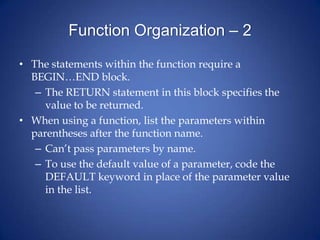
Function Organization – 2
• The statements within the function require a
BEGIN…END block.
– The RETURN statement in this block specifies the
value to be returned.
• When using a function, list the parameters within
parentheses after the function name.
– Can’t pass parameters by name.
– To use the default value of a parameter, code the
DEFAULT keyword in place of the parameter value
in the list.
Scalar Function Syntax
CREATE FUNCTION [schema_name.]function_name
([@parameter_name data_type [= default]] [, ...])
RETURNS data_type
[WITH [ENCRYPTION] [, SCHEMABINDING] [,
EXECUTE_AS_clause]]
[AS]
BEGIN
[sql_statements]
RETURN scalar_expression
END
Table Function Synatx
CREATE FUNCTION [schema_name.]function_name
([@parameter_name data_type [= default]] [, ...])
RETURNS TABLE
[WITH
{ENCRYPTION|SCHEMABINDING|ENCRYPTION,
SCHEMABINDING}]
[AS]
RETURN [(] select_statement [)]

User defined functions

  • 1.
  • 2.
    UDF Overview • Auser-defined function is an executable database object that contains SQL statements. – Also called a UDF or a function • Functions always return a value. – A scalar-valued function returns a single value. – A table-valued function returns an entire table. • You can call, or invoke, a scalar-valued function from within any expression. • You can invoke a table-valued function anywhere you’d refer to a table or a view.
  • 3.
    Function Requirements • Youmust specify the name of the schema when invoking a UDF. • A function can’t have a permanent effect on the database. – Can’t use a function to run an action query against the database.
  • 4.
    Function Organization –1 • Can be defined with input parameters – Specify after the function name in the CREATE FUNCTION statement. – Each parameter can be assigned an optional default value. • Functions don’t use output parameters. – Specify the data type to return in the RETURNS clause
  • 5.
    Function Organization –2 • The statements within the function require a BEGIN…END block. – The RETURN statement in this block specifies the value to be returned. • When using a function, list the parameters within parentheses after the function name. – Can’t pass parameters by name. – To use the default value of a parameter, code the DEFAULT keyword in place of the parameter value in the list.
  • 6.
    Scalar Function Syntax CREATEFUNCTION [schema_name.]function_name ([@parameter_name data_type [= default]] [, ...]) RETURNS data_type [WITH [ENCRYPTION] [, SCHEMABINDING] [, EXECUTE_AS_clause]] [AS] BEGIN [sql_statements] RETURN scalar_expression END
  • 7.
    Table Function Synatx CREATEFUNCTION [schema_name.]function_name ([@parameter_name data_type [= default]] [, ...]) RETURNS TABLE [WITH {ENCRYPTION|SCHEMABINDING|ENCRYPTION, SCHEMABINDING}] [AS] RETURN [(] select_statement [)]